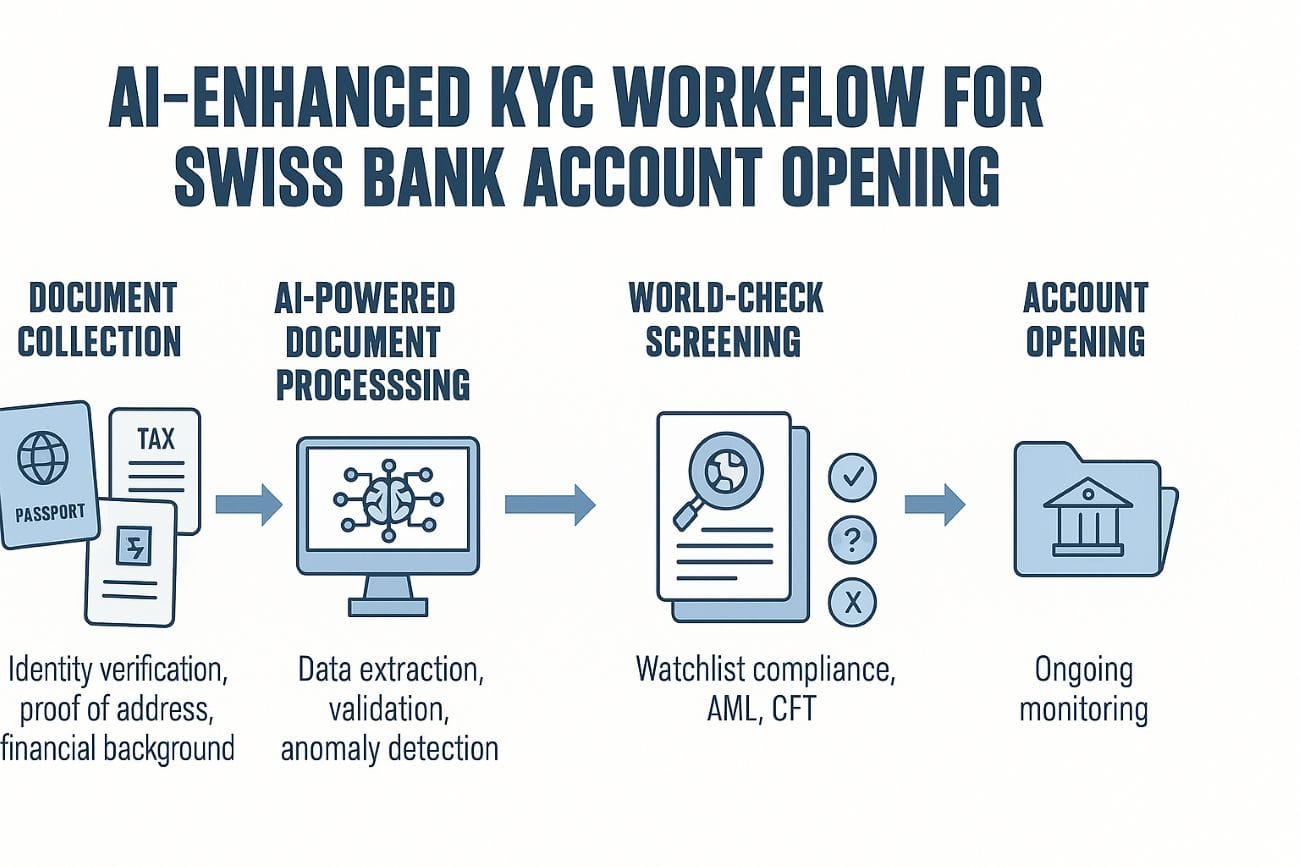
AI for KYC in Swiss banking has changed how serious practitioners prepare account applications — but not in the way most guides describe. The value is not speed. Any scanner digitizes documents quickly. The value is narrative coherence: the thing Swiss compliance officers are actually evaluating, and the thing that most rejected applications lack.
Swiss banks do not reject applications because a document is missing. They reject them because the story the documents tell does not hold together. The name on the passport renders differently than the name on the inheritance papers. The declared source of wealth mentions 15 years of technology investments, but the underlying statements cover only the last three. The employment CV stops abruptly in 2018 with no explanation. A compliance officer reviewing these discrepancies does not ask for clarification — they close the file.
This post is a practitioner’s account of how I use AI to solve that problem: the four pillars Swiss banks assess, the five-step workflow that builds a coherent, verifiable client narrative, what FINMA’s 2026 regulatory reforms mean for applications being prepared right now, and where AI ends and professional compliance judgment begins.

Where Swiss KYC Applications Actually Fail
FINMA enforces Switzerland’s Anti-Money Laundering Act (AMLA) through a risk-based approach. Banks must not only verify who a client is but understand how they accumulated their wealth and why the funds they intend to deposit exist. That understanding must be derivable from the submitted documents — clearly, consistently, and without requiring inference from a compliance officer who is reviewing dozens of files simultaneously.
Three categories of incoherence cause the majority of rejections I see in practice.
Name and date discrepancies. Different transliterations of a name across a passport, a tax certificate, and an inheritance document. A date of birth with one digit transposed between the original and a certified copy. These register as data integrity questions, not clerical errors, in a Swiss compliance review.
Narrative gaps. A source of wealth declaration describing 20 years of business activity, supported by financial documentation covering only the last 3 years. The gap is not inherently suspicious — but it is unexplained, and unexplained is not acceptable under AMLA due diligence standards.
Unsupported claims. “Proceeds from the sale of a family business” with no sale agreement, no prior years of business financials, and no evidence of the business entity in any commercial register. The claim may be entirely accurate. Without evidence, it cannot be verified — and Swiss banks do not approve on trust alone.
AI identifies all three of these problems before submission. Professional judgment is what resolves them.
The Four Pillars of Swiss KYC — and What AI Does at Each Stage
The Swiss KYC framework is consistent across private banks. Four pillars. The first two establish who you are. The second two establish where your money came from. Getting all four right — and making them tell the same story — is what the application is really asking you to do.
Identity Verification. Swiss banks require a certified passport copy, proof of residential address dated within 3 months — a utility bill or recent bank statement with name and address matching the ID exactly — and often a biometric verification step for remote onboarding. OCR extracts names, document numbers, dates, and addresses from every submitted document and builds a master data record. NLP then cross-validates that master record across all documents, flagging every instance where the same field appears differently. A name rendered as “Mohammed” on one document and “Mohamed” on another gets flagged before the bank sees it.
Ultimate Beneficial Ownership (UBO). Every account holder must disclose who ultimately owns and controls the funds being deposited, formalized through Form A, signed and submitted alongside identity documents for each beneficial owner. For corporate accounts or structures involving trusts, foundations, or holding companies, UBO disclosure becomes significantly more complex — every ownership layer must be documented, and opaque structures receive heightened scrutiny. Under Switzerland’s incoming Federal Act on the Transparency of Legal Entities (LETA), expected in force in the second half of 2026, a central non-public beneficial ownership register will be established — raising the documentation standard further. AI tools compare declared UBO names against the World-Check database, screening for Politically Exposed Persons (PEPs), sanctions matches, and adverse media hits before the bank runs the same check.
Source of Funds (SoF). This covers the specific transactional origin of the money being deposited. Quick note on the SoF/SoW distinction — it trips up nearly every first-time applicant. SoF answers: where did this particular deposit come from? SoW answers: how did you build your net worth over your lifetime? They require different documents and entirely different narrative approaches. For SoF: payslips, sale agreements, inheritance receipts, business distribution records — each matched to the bank transfer record showing funds arriving. OCR extracts transaction amounts and dates; NLP maps each declared source to the corresponding transfer. Anything that does not reconcile gets flagged for additional documentation before submission.
Source of Wealth (SoW). This is the most demanding pillar and the one where applications most often fall short. Swiss banks want a documented financial biography: career progression with verifiable income at each stage, business activities with supporting financials across meaningful time periods, asset sales with legal documentation, and investments with account statements showing growth over time. NLP builds a timeline from structured data across all submitted documents, identifies chronological gaps, and stress-tests whether each link in the wealth chain is supported by corresponding evidence. The result is a SoW narrative that can withstand a sceptical reading — which is exactly the reading a Swiss compliance officer will apply.
How AI Changes the Process — The Five Steps I Use
I want to be precise about what AI does here, because the “AI automates compliance” framing overstates it. The accurate version: AI systematizes the preparation and cross-validation process in a way that would take a human analyst several days to perform manually — and it does it without the fatigue-driven errors that manual review introduces on the hundredth document check.
Swiss banks are also now operating under FINMA Guidance 08/2024 on AI governance, which sets standards for how financial institutions implement AI in compliance functions. The framework emphasizes auditability, human oversight, and explainability. The AI-assisted KYC preparation approach aligns with these principles — it augments the compliance adviser’s judgment rather than replacing it, and produces a fully documented, version-controlled submission package that can withstand audit review.
The five steps, in order:
What FINMA’s 2026 AML Reforms Mean for Applications Being Prepared Now
Switzerland’s AML framework is undergoing its most significant revision in a decade — and it is relevant to KYC applications being submitted right now, not just those filed after the reforms take effect.
Parliament adopted the new package in September 2025. Entry into force is expected in the second half of 2026. The key changes that directly affect account opening KYC:
The enhanced due diligence threshold has been reduced from CHF 25,000 to CHF 15,000. Transactions above this level now trigger mandatory enhanced due diligence, which means that applications involving accounts expecting regular higher-value deposits will face a more demanding SoF review from the outset.
LETA — the Federal Act on the Transparency of Legal Entities — introduces a central non-public beneficial ownership register, administered by the Federal Office of Justice. For corporate and structured account applications, UBO documentation will need to align with this register’s requirements once it is operational. Applications prepared now with registration-grade UBO documentation are already ahead of the curve.
Swiss banks are also moving toward perpetual KYC (pKYC) models — ongoing, event-driven monitoring rather than one-time onboarding reviews. The practical implication: a KYC package built for long-term documentation maintenance, with version-controlled files and a clear audit trail, will hold up better under pKYC review than a package assembled purely for the initial application. This is one reason the five-step workflow above emphasizes audit-readiness from Step 1.
Senior management personal liability for compliance failures has also been extended further down the advisory chain. For clients working with advisers on KYC preparation, this reinforces the value of working with a compliance-certified specialist who can demonstrate due diligence in the preparation process. You can review the broader Swiss banking regulatory context in our Swiss banking laws and regulations guide.
The Rejected Application — What Went Wrong and How the Rebuild Worked
A client came to me after a major Swiss private bank rejected his personal account application outright. He had built his net worth over 15 years through three sources: a series of technology company investments in his home country, a property sale in Dubai in 2021, and an inheritance from his father. On paper, the story was clean and plausible. The submission package told four different stories simultaneously.
His passport copy was uncertified — a photocopy submitted without notarization, because no one had told him that Swiss banks require notarized originals or apostille-certified copies for non-resident applicants. His Dubai property sale documentation was missing the stamped sale agreement from the Dubai Land Department; he had submitted only the wire transfer receipt. His inheritance documentation used a Latinized name rendering that differed from the English transliteration on his passport by one letter — enough for an NLP cross-validation pass to flag it as a potential identity discrepancy. And his source of wealth narrative described 15 years of technology investments across two paragraphs, without providing a single underlying investment statement, shareholder register entry, or tax filing showing capital contributions or distributions.
The bank’s compliance team made the correct call. The file, as submitted, did not support the story it claimed.
Rebuilding it took three weeks and 27 source documents. OCR extraction established a master data record across every document — identifying every name variant, date, and amount in the file. NLP cross-validation mapped each inconsistency. The inheritance name discrepancy was resolved with a notarized affidavit confirming the equivalence of both name forms, prepared by a lawyer in the deceased’s country of domicile. The investment history was rebuilt with annual statements from each investment vehicle, ordered chronologically to show consistent participation from initial contribution through to the periods declared in the SoW narrative. The property sale was documented with the original stamped sale agreement sourced from the Dubai Land Department and an apostille-certified copy of the transfer registration. A World-Check screen confirmed no PEP or sanctions exposure. A cover narrative tied every source back to the total net worth declared.
The second application, submitted to a different Swiss private bank, was approved.

KYC Document Requirements — Personal and Corporate Accounts
| Category | Documents Required | Key Notes |
|---|---|---|
| Identity | Certified passport copy | Notarized original or apostille-certified. Must be current and legible throughout |
| Address proof | Utility bill or bank statement (under 3 months) | Full name and address must match ID exactly — spelling, format, and completeness |
| Tax documents | Tax returns (last 2–3 years), TIN, FATCA/CRS declaration | US persons require additional FATCA documentation. FATCA W-9 mandatory |
| Source of Funds | Payslips, invoices, sale agreements, inheritance receipts | Each must be matched to a corresponding bank transfer record showing funds arriving |
| Source of Wealth | Career history CV, investment statements, business financials, inheritance documentation | Chronological, with no gaps. Each source of accumulation supported by third-party evidence |
| World-Check screen | PEP/sanctions pre-screening result | Run before submission. Any PEP status requires enhanced disclosure and explanation |
| Statement of intent | Account purpose, anticipated transaction profile, anticipated balance | Specificity improves credibility. Vague statements draw additional questions |
| Category | Documents Required | Key Notes |
|---|---|---|
| Incorporation | Commercial register extract, articles of association, certificate of incorporation | Certified and translated if not in a Swiss national language or English |
| UBO / Form A | Shareholder register, Form A, certified passports for all UBOs ≥25% control | All ownership layers must be documented. Structures above 2 layers require legal opinion |
| Directors | List of directors, CVs, proof of residence, passports | Background checks apply. Any director with political exposure requires enhanced disclosure |
| Business activity | Detailed business plan, description of operations, client/counterparty types | New or foreign companies require more detail. Banks assess economic substance in jurisdiction |
| Financial statements | Audited accounts (last 2–3 years) or projected revenues for new entities | Support for SoF and economic viability. Audited preferred; management accounts accepted for newer entities |
| Address / presence | Lease agreement, utility bill, registered office certificate | Must align with commercial register filing. Mailbox addresses without substance may disqualify |
| Authorization | Power of attorney for any third-party representative | Notarized. Especially required for offshore structure filings and intermediary-submitted applications |
The Rejection Patterns Most Applicants Don’t See Coming
| Rejection Pattern | Root Cause | Prevention |
|---|---|---|
| Name or date mismatch across documents | Different transliterations, transcription errors, unchecked variants | NLP cross-validation flags every discrepancy across the full document set before submission |
| Uncertified or expired documents | Applicant unaware of Swiss notarization and apostille requirements | Checklist-driven intake flags document format requirements at Step 1; AI flags expiry dates |
| Weak or unsupported SoW narrative | Vague claims without underlying financial evidence for each wealth source | NLP timeline builder identifies every gap in the wealth chain; documentation requests go to client before submission |
| Undisclosed PEP status or sanctions proximity | Applicant unaware of PEP classification, or past political connections not mentioned | World-Check pre-screening at intake; any flag addressed with enhanced disclosure before bank review |
| SoF and SoW conflated in narrative | Applicant and adviser treat the two as equivalent; bank receives one answer where two are needed | Structured narrative template separates SoF and SoW explicitly; each supported by distinct evidence |
| Corporate structure lacking substance evidence | Registered office only; no evidence of economic activity in the jurisdiction | Business plan and counterparty documentation reviewed at intake; substance evidence requested where absent |
KYC is where most applications stall, though it is not where they begin. Our Swiss banking guide covers the decisions that come first: which bank, which account, which minimum.
Where AI Ends and Professional Judgment Begins
AI does some parts of this work better than humans. Name consistency checking across 27 documents? A well-configured NLP tool will catch what a human reviewer scanning quickly under time pressure will miss. PEP screening against a database of millions of records from 240 countries? Not a feasible human task at any meaningful scale. Flagging that a date of birth on page 18 of a tax return contradicts the date on the passport? AI every time.
But AI cannot exercise judgment about context. A Swiss compliance officer reviewing an application is not checking a list of flags — they are constructing a risk profile. Two applications with identical surface characteristics — say, a 10-year employment gap — can require entirely different treatment depending on the country, the industry, the client’s track record with that institution, and what the surrounding documentation suggests. The gap that is completely benign for a family business owner who stepped back to manage an inheritance is a material concern for a former government official with no supporting explanation.
The source of wealth narrative is where this distinction is sharpest. AI can validate that the documents submitted support the claims made. It cannot assess whether the claims themselves are plausible given the bank’s knowledge of the client’s sector, geography, and counterparties — or whether the narrative, while technically consistent, would nonetheless read as implausible to a compliance officer with domain expertise in that market.
This is not a limitation of current AI capability. It is a structural feature of what compliance review actually involves. The value of AI in KYC preparation is that it frees the human compliance adviser to focus on these judgment calls — by eliminating the mechanical error-checking that consumes preparation time and misses more than it should. If you are preparing a Swiss bank account application and want to use the AML risk assessment tool to evaluate your client profile before beginning the KYC process, our free AML risk score calculator is a useful starting point.
If you are ready to begin a Swiss bank account application as a non-resident, or want guidance on structuring a KYC package that will hold up under Swiss compliance review, contact Easy Global Banking to discuss your situation and begin the process correctly. Securing swiss account approval tips can significantly streamline your application process. Understanding the documentation required and familiarizing yourself with local regulations will help you avoid unnecessary delays. Additionally, seeking advice from professionals who specialize in Swiss banking can provide valuable insights tailored to your specific needs.