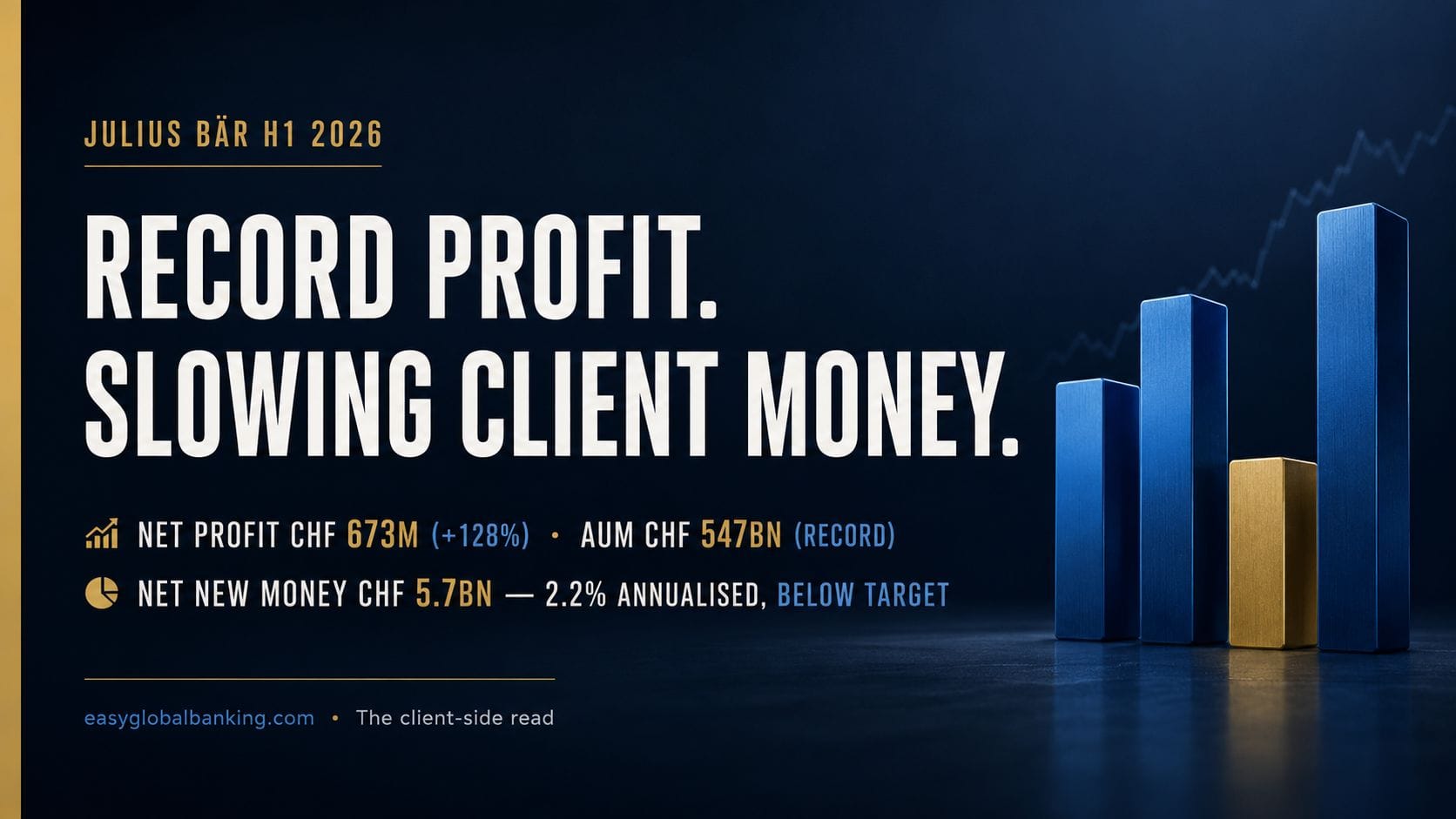
Zurich woke up this morning to the kind of press release bank CEOs dream about. Net profit of CHF 673 million for the half — a record. Assets under management at CHF 547 billion — also a record, the highest in Julius Bär’s 136-year history. The stock opened higher, the analysts typed “beat” into their models, and somewhere on Bahnhofstrasse a communications team exhaled.
Then, a few paragraphs down, the sentence that actually matters if your money is there — or if you want it to be. The de-risking of the client book, the bank confirmed, will continue into 2027.
Those two facts — record profit, ongoing client exits — read like a contradiction. They are not. One is causing the other, and understanding how tells you more about where Swiss private banking is heading than any earnings call this summer will.
A record with a history behind it
You cannot read today’s numbers without remembering how the last three years felt inside this bank. The Signa exposure that turned into public write-downs. A CEO departure. A new risk framework built under regulatory scrutiny, with FINMA looking over every shoulder. When Stefan Bollinger arrived, the mandate was not growth — it was repair.
Today is what repair looks like when it works. Profit up 128 percent against a half-year that provisions had crushed. But notice what did not recover: net new money came in at CHF 5.7 billion for six months, an annualised 2.2 percent. For a wealth manager whose whole story is gathering assets, that is half the pace the bank itself has promised for 2028. Julius Bär, to put it plainly, is collecting money at the tempo of a bank a third its size.
That chart is not an accident of a weak quarter. It is policy. Every exited relationship subtracts from the inflow line, and the bank just told us the subtraction runs for another eighteen months.
Profit by subtraction
Here is the arithmetic the release leaves you to work out on your own. When a bank exits its most complicated clients — the ones whose files demand enhanced monitoring, whose structures eat compliance hours, whose names occasionally surface in the wrong databases — two things happen at once. Inflows suffer, because departing money is negative net new money. And margins improve, because what remains is cheaper to serve and safer to keep. Squeeze risk out of a book and profit concentrates in what is left.
So no, the record and the slowdown are not in tension. They are the same decision viewed from two sides of the ledger. A caveat belongs here, though: part of the AUM record is simply markets and a softer franc doing the lifting. Strip that out and the underlying client engine is running at 2.2 percent — which is why the growth question stays open even on a morning like this.
And that dashed segment is the real story of the next two years. To hit its own 4–5 percent target by 2028, Julius Bär needs to roughly double its intake pace — while still showing clients the door until sometime in 2027. Either the second-half inflows re-accelerate sharply once the heaviest exit wave passes, or that target starts looking like the next CEO’s problem. We would not bet against Bollinger yet. But we notice the market is not pricing the tension at all.
What the exits look like from our side of the desk
We prepare Swiss private banking applications professionally, which means the de-risking programme is not an abstraction to us — it arrives as files. Since spring, the dossiers reaching us from exited relationships have shared three markers, consistently: a residence-nationality-income triangle that no longer tells one story; account structures set up before 2018, when the standards were looser; and source-of-wealth paperwork that was fine by the old rules and is thin by the new ones.
Notice what is not on that list: wealth. Nobody we have seen this year was exited for being too small. They were exited because their files aged badly while the rules moved.
Being de-risked by one bank is not a verdict on you. It is a verdict on your paperwork — and paperwork can be rebuilt.
That distinction matters practically, because exited files do not evaporate. They land at other desks — EFG and UBP grew fastest in 2025 partly by catching what bigger houses shed, a pattern visible in our global private bank comparison. The clients who land well are the ones who re-paper first and apply second. The ones who shop a stale file around Geneva collect rejections that then have to be disclosed on every future application. If that is the situation you are in, start with the non-resident guide to understand today’s bar, or let us rebuild the file before any bank sees it.
Three conversations worth having now
| If you are… | Have this conversation |
|---|---|
| An existing client with a clean profile | About fees. A bank printing record margins has room to move on custody and FX spreads — and knows exactly which clients it cannot afford to lose. Ask at the next review, from strength. |
| An existing client with a complex profile | About your file, before the bank starts it. Exits run into 2027. If your structure predates 2018 or your source-of-wealth evidence is narrative rather than documents, re-paper now — voluntarily, on your timeline. |
| A prospective client | About whether your dossier is genuinely complete. Julius Bär is buying quality, not volume. A file that anticipates the questions gets a banker’s attention; a file that provokes them gets a polite decline. |
The uncomfortable compliment
Here is the reading you will not find in the coverage today: de-risking is the best onboarding signal Swiss private banking has produced in years. A bank that exits clients at the cost of its own growth line is a bank whose yes means something again. For applicants who clear the bar, that is worth more than any welcome bonus — it means your bank is not quietly warehousing the risks that produced the last crisis.
The era of the easy Swiss onboarding is not coming back; today confirmed it has a schedule stretching into 2027. The winners among clients will be the ones who treat documentation as the product. That has been our position for years — the full landscape is in our Swiss private bank ranking and the Swiss banking guide — and mornings like this one are why.
Sources: Julius Bär half-year report 2026; finews.ch and Finanz und Wirtschaft coverage, 21 July 2026. Peer figures from 2025 annual reports as compiled in our AUM ranking. This is analysis, not investment advice.