
Most guides for Brazilian clients with Swiss accounts focus on one law. Law 14.754/2023 — the offshore taxation law — gets the coverage because it was the big structural change: automatic 15% annual tax on controlled foreign entity profits, end of traditional tax deferral, two regime choices with different implications. But Law 14.754/2023 is not the complete picture of what a Brazilian resident with a Swiss account must navigate in 2026. Two other frameworks interact with it directly — and one of them, Law 15.270/2025, took effect on January 1, 2026, and is missing from almost every guide published before mid-2026 including the previous version of this page. This guide covers all three, their interactions, and the calculation traps that turn an apparently straightforward Swiss investment into a surprisingly expensive Brazilian tax liability.
Key figures: 15% annual offshore tax under Law 14.754/2023. 10% new dividend WHT from January 2026. DTA effective January 2022. BRL depreciated ~18% vs CHF in 2024 inflating BRL-calculated tax bills.
The Three Laws at a Glance
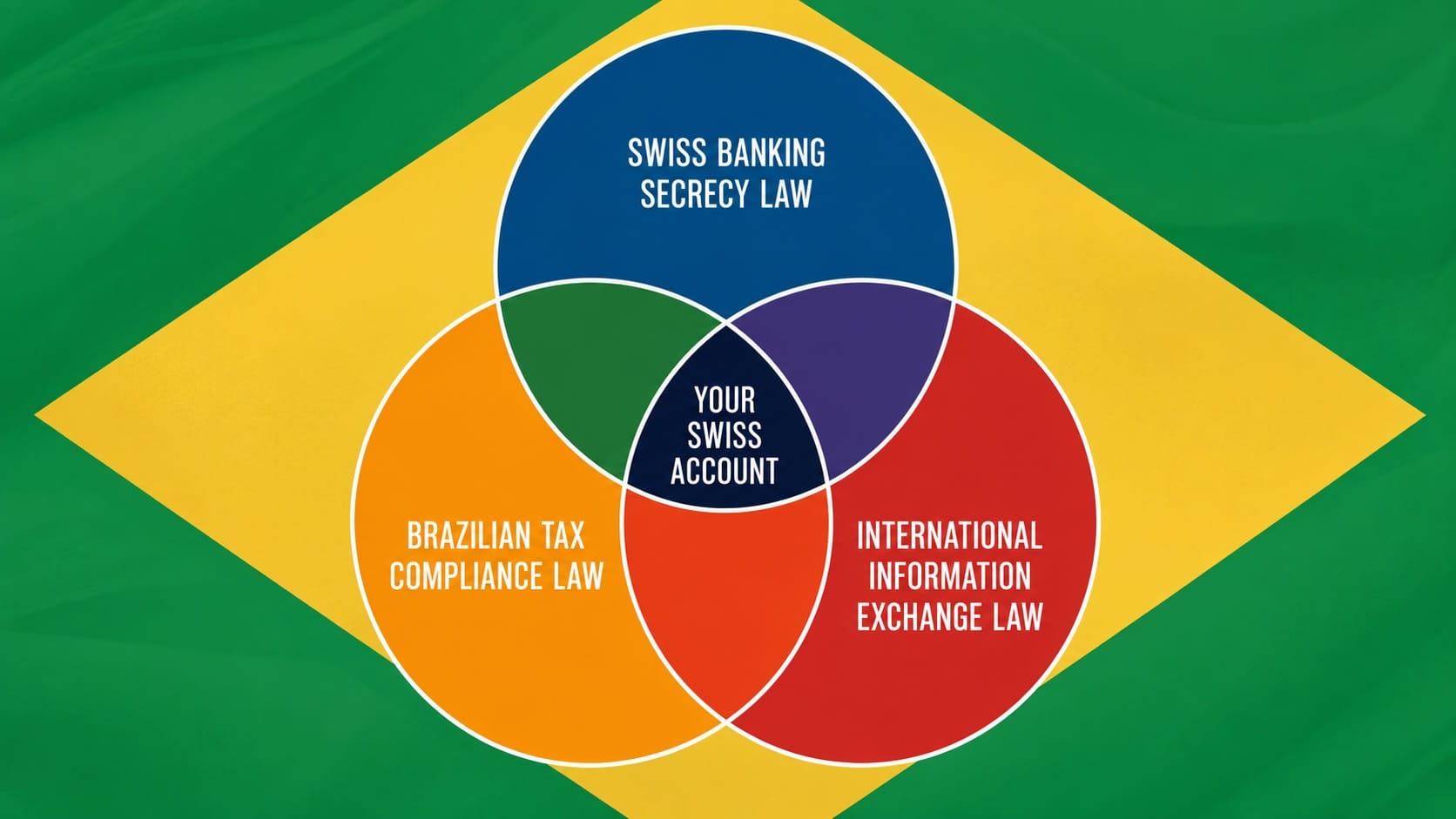
Before working through each framework in detail, it helps to see them together — because understanding how they stack is the key insight most guides miss. The three laws operate on different parts of the same transaction chain. Law 14.754/2023 taxes your Swiss account’s profits annually. Law 15.270/2025 taxes dividends flowing from Brazil to fund or increase that account. The Brazil-Switzerland DTA determines what withholding you can credit against Brazilian tax — and where its protections run out.
- Annual 15% flat tax on controlled foreign entity profits calculated December 31
- Applies whether or not profits are distributed
- Two regime choices: opaque (entity as single asset) or transparent (look-through reporting)
- Transparent regime election is irrevocable per entity — choose carefully
- Losses in one entity cannot be offset against gains in another
- Covers trusts, foundations, and foreign financial investments
- 10% WHT on dividends paid/remitted to non-residents from Brazilian companies
- 10% on dividends >BRL 50,000/month from same company to Brazilian individual residents
- IRPFM: minimum income tax for annual income >BRL 600,000
- Dividends approved and declared by December 31, 2025 remain exempt
- DTA may reduce rate to lower of 10-15% where applicable
- Directly affects funding flows from Brazilian operating companies to Swiss accounts
- Dividends: 10% WHT if >25% shareholding; 15% otherwise
- Interest: 10% (bonds/securities); 15% (other interest)
- Capital gains: taxed in source country on shares deriving value from real estate; otherwise residence country
- No arbitration clause — disputes unresolved by mutual agreement result in potential double taxation
- BEPS anti-abuse clause included — treaty shopping provisions apply
- AEOI under CRS operates separately from DTA — automatic reporting regardless
Law 14.754/2023: What the Offshore Law Actually Requires in 2026
IRPF 2026 is the second full reporting year under Law 14.754/2023 — commonly referred to as the “Offshore Law.” That matters because the first year was characterised by ambiguity, technical questions about calculation methods, and many practitioners working through the regime’s implications for the first time. By 2026, Brazil’s tax authority (Receita Federal do Brasil, RFB) has built its enforcement infrastructure: AEOI data from Swiss banks is being cross-referenced with IRPF declarations systematically, and the discrepancy-detection mechanisms are operational in a way they weren’t in 2024.
The mechanics are worth stating precisely because details matter for planning. The 15% annual tax applies to controlled foreign entities where a Brazilian individual holds a controlling interest — directly or indirectly, more than 50% of capital or actual control regardless of formal shareholding. It is calculated on December 31 balance sheet profits converted to BRL at the Central Bank rate on that date. It applies whether or not any distribution has been made. It applies even if the entity recorded a loss in prior years that hasn’t been recovered. And it applies to each entity separately — there is no aggregation or netting across a portfolio of entities.
| Feature | Opaque regime | Transparent regime |
|---|---|---|
| How entity is treated | Single asset — balance sheet profits taxed annually at 15% regardless of distributions | Look-through — individual assets reported as if held directly; individual tax rates apply to each asset type |
| Loss utilisation | Losses in one entity cannot offset gains in another entity — no cross-compensation | Within same entity: losses on individual assets can offset gains on other assets |
| FX variation treatment | Included in calculation at Central Bank rate December 31 — BRL weakness inflates taxable profit | FX variation between taxation and dividend distribution is exempt on that specific amount |
| Irrevocability | Can switch to transparent in future — but only on a per-entity basis | Irrevocable per entity — once transparent, cannot revert to opaque for that entity |
| Best suited for | Entities with consistent annual profits, minimal FX impact, simple structure | Entities with heterogeneous asset types, significant FX-exempt income, where individual rate optimisation is valuable |
| Applies to Swiss private banking account held through offshore entity? | Yes — the Swiss account-holding entity’s investment gains are subject to 15% on December 31 profits | Yes — but each underlying asset (equity, bonds, cash) reported separately; potentially more granular |
The regime election decision is consequential and permanent. Choosing transparent for an entity holding a diversified Swiss investment portfolio means that each asset type within that portfolio is reported individually, at individual-level rates. This can be advantageous for assets that carry capital gains treatment or produce FX-exempt income. But it is genuinely irrevocable. A client who elects transparent in 2024 for an entity holding a Swiss account cannot switch to opaque in 2027 if the analysis changes. The election follows the entity for its lifetime under the regime. This irreversibility is the single most important planning consideration in Law 14.754/2023, and it deserves more emphasis than it typically receives.
The BRL Calculation Trap: Why Your Tax Bill May Be Higher Than Your Returns Suggest
Here is a specific, numerical consequence of Law 14.754/2023 that no guide on this topic has published explicitly, despite being embedded in the law’s mechanics. All offshore profit calculations are performed in BRL at the Central Bank exchange rate on December 31. In years when the Brazilian real depreciates significantly against the Swiss franc — which describes most years in the past decade — this creates a tax liability on currency movement that the investor has not realised as actual income.
A Brazilian resident holds CHF 1,000,000 in a Swiss investment account through an offshore entity. The portfolio earns a genuine 6% return: CHF 60,000 in investment income during the year. In BRL terms at year-start, CHF 1,000,000 = BRL 5,800,000 (approximate rate: 1 CHF = 5.80 BRL). By December 31, the BRL has depreciated ~18% against the CHF (as it did in 2024). CHF 1,060,000 now equals approximately BRL 7,270,000. The “profit” calculated for Law 14.754/2023 purposes is BRL 7,270,000 minus BRL 5,800,000 = BRL 1,470,000. Tax at 15% = BRL 220,500 — approximately CHF 30,000 at current rates. The actual CHF investment gain was CHF 60,000. The tax bill represents 50% of that gain — not 15% — because the BRL depreciation has inflated the denominator. This isn’t tax evasion; it’s the mathematically predictable outcome of applying a BRL-denominated calculation to a CHF-denominated asset in a year of BRL weakness. Brazilian tax advisers familiar with this regime know it. Most Swiss banking guides don’t mention it.
There is partial relief in the transparent regime for this specific problem. Under the transparent election, the FX variation between the date profits are taxed and the date dividends are actually distributed is exempt from further taxation. This reduces — but does not eliminate — the BRL calculation trap. The underlying December 31 calculation still uses the current exchange rate; it’s only the subsequent FX movement between that date and a future distribution date that receives the exemption. For investors holding CHF-denominated assets through Brazilian-controlled entities, the transparent regime is worth serious analysis precisely because of this partial relief mechanism.
Law 15.270/2025: The Dividend Tax That Took Effect While Most Guides Were Being Published
Brazil did not tax dividends from 1996 to 2025. For 29 years, distributions from Brazilian companies to shareholders — resident or non-resident — were exempt from withholding tax. That ended on January 1, 2026, with Law 15.270/2025, enacted November 27, 2025. The change is material for Brazilian clients who fund Swiss accounts from dividends extracted from Brazilian operating businesses.
The new regime has three distinct components that affect Brazilian clients with Swiss banking relationships in different ways.
The Brazil-Switzerland DTA: What It Helps With and Where It Stops
Brazil and Switzerland signed their first Double Taxation Agreement in May 2018. It took nearly three years to complete parliamentary ratification in both countries and entered into force on January 1, 2022 — the first treaty ever concluded between the two largest trading partners in their respective regions. For Brazilian clients, the DTA is a genuine structural improvement over the pre-2022 environment. It is not, however, the comprehensive protection some advisers present it as.
| Income type | DTA treatment | Practical limitation |
|---|---|---|
| Swiss-source dividends | Swiss withholding tax (normally 35%) reduced to 15% under DTA (or 10% if ≥25% shareholding) | Brazilian resident still pays 15% offshore tax on entity profits under Law 14.754/2023. DTA reduces Swiss WHT but cannot offset the Brazilian offshore tax. |
| Swiss-source interest | 10% WHT on bonds and securities; 15% on other interest | Brazilian offshore tax applies to portfolio income regardless. DTA credit mechanism reduces double-count but doesn’t eliminate total tax burden. |
| Capital gains — Swiss portfolio | In principle, taxed in country of residence (Brazil) for purely financial assets | Under Law 14.754/2023, gains are automatically included in the December 31 BRL calculation. DTA source-country rules create some ambiguity on certain asset types. |
| Brazilian-source dividends to Swiss resident | 10% WHT under DTA (if ≥25% shareholding); 15% otherwise — aligns with Law 15.270/2025 domestic rate | DTA does not improve on domestic 10% rate for controlling shareholders. Non-controlling shareholders face same 10% domestic rate regardless of DTA. |
| Dispute resolution | Mutual agreement procedure available | No arbitration clause. If the mutual agreement procedure fails to resolve a dispute, double taxation can persist indefinitely. Unlike most modern OECD treaties, this DTA has no binding arbitration backstop. |
The Brazil-Switzerland DTA lacks an arbitration clause. The Mutual Agreement Procedure (MAP) allows both tax authorities to try to resolve double-taxation disputes — but if they fail to agree, the taxpayer has no binding recourse. Both jurisdictions may continue to tax the same income. For most straightforward situations, this matters little. For disputes involving complex holding structures, novel income characterisation questions, or large amounts, the absence of arbitration is a real gap. Clients with complex structures should document their tax positions carefully and maintain clear evidence of which law applies to which income — so that the MAP process, if needed, starts from a strong evidential foundation.
The Practical Compliance Architecture — Deadlines, Declarations, Documentation
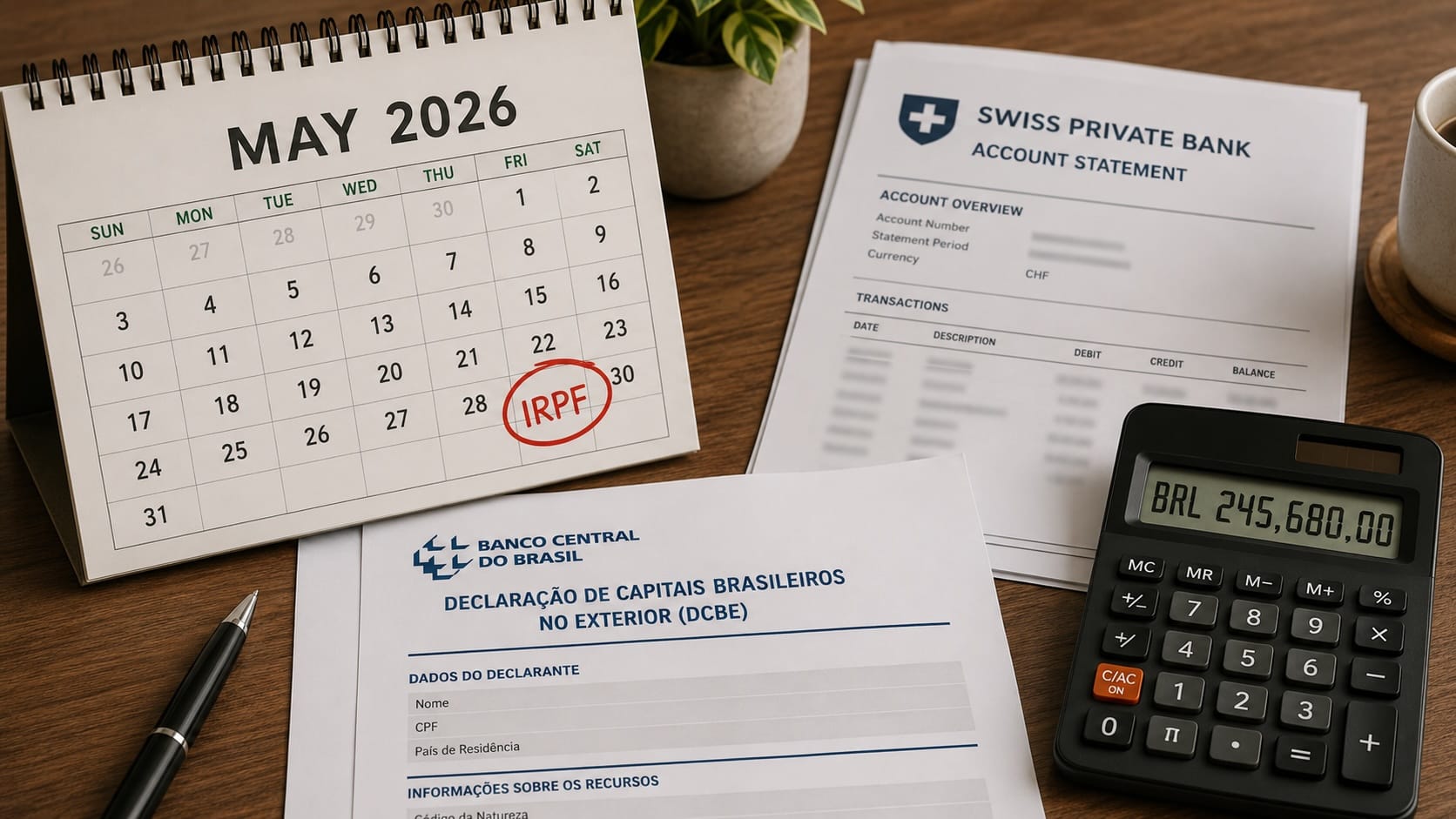
Brazilian clients with Swiss bank accounts face three separate, legally distinct filing obligations that operate on different calendars with different authorities. Missing any one of them triggers independent penalties — the penalties are not merged or waived because another obligation was met. The table below maps the full compliance calendar for a Brazilian resident individual with a Swiss private banking relationship through an offshore entity. Open a Swiss bank account benefits individuals seeking privacy and asset protection. These accounts often provide greater financial security, allowing clients to manage their wealth more effectively. Furthermore, having a Swiss bank account can facilitate international transactions with ease, making it an attractive option for global investors.
| Obligation | Authority | 2026 deadline | Threshold | Penalty for failure |
|---|---|---|---|---|
| IRPF Annual Return (includes offshore income under Law 14.754/2023) | RFB (Receita Federal) | May 30, 2026 | No minimum — all Brazilian tax residents | 1% per month delay (max 20%) + 75% penalty on unpaid tax; criminal prosecution possible for fraud |
| DCBE — Annual Declaration to Central Bank | Banco Central do Brasil | February 15 – April 5, 2026 | Aggregated foreign assets ≥ USD 1,000,000 as of Dec 31 | R$25,000–R$250,000 per violation; additional 50% for aggravating circumstances |
| DCBE — Quarterly Declaration | Banco Central do Brasil | Quarterly (Jun, Sep, Dec 2026 + Mar 2027) | Foreign assets ≥ USD 100,000,000 | Same penalty structure as annual; separate infraction per quarter missed |
| IRPFM election / calculation | RFB | Declared in May 30 IRPF return | Annual income > BRL 600,000 | Integrated with IRPF penalties — underpayment of minimum tax treated as IRPF underpayment |
| Swiss account AEOI reporting (by Swiss bank to RFB via FTA) | Swiss FTA → RFB (automatic) | Annual — Swiss banks report by June 30; RFB receives by September | All accounts held by Brazilian tax residents — no minimum | Non-declaration of reported income on IRPF = automatic discrepancy flag; high audit risk |
Deadlines are for illustrative purposes based on 2026 regulatory calendar. Always verify current deadlines with a qualified Brazilian tax adviser. Penalties are approximate ranges based on current legislation.
One thing worth saying directly about the AEOI intersection: since 2017, Swiss banks have reported all accounts held by Brazilian tax residents to the Swiss Federal Tax Administration, which transmits the information to the RFB. The RFB then cross-references this data against IRPF declarations. By 2026, this cross-referencing process is fully operational and routinely generates audit triggers for discrepancies. A Swiss account that does not appear on an IRPF return, or whose reported balance materially differs from the AEOI data, generates an automatic flag. The consequences of that flag range from administrative corrections at the mild end to criminal prosecution at the severe end. The enforcement environment is not theoretical.
Where Swiss Banking Still Makes Sense for Brazilian Clients
The cumulative tax burden described above does not make Swiss banking economically irrational for Brazilian clients. It makes it expensive to structure incorrectly, and genuinely valuable when structured well. The legitimate value proposition is specific and has nothing to do with opacity — Brazil’s AEOI participation and Law 14.754/2023 together have made opacity impossible for any legally compliant structure. The value lies elsewhere.
Approximate rates based on BRL/USD and USD/CHF historical data. Not investment advice.
BRL/CHF: 2015 = 3.2, 2018 = 4.1, 2020 = 6.0, 2022 = 5.4, 2024 = 6.8, May 2026 ~7.5+.
The chart above explains the fundamental case for Brazilian clients holding CHF-denominated Swiss accounts better than any narrative can. Since 2015, the real has depreciated approximately 130% against the franc. A Brazilian holding CHF 1 million in a Swiss account in 2015 needed BRL 3.2 million to buy that position. The same CHF 1 million in May 2026 represents approximately BRL 7.5 million — a 134% gain in BRL terms, without any investment return. The 15% offshore tax on that nominal gain is real and must be paid, but it still leaves a substantial net positive position relative to holding the same wealth in BRL-denominated Brazilian assets over the same period.
The three specific areas where Swiss banking continues to deliver genuine value for Brazilian HNW clients, correctly structured and fully declared: currency diversification away from BRL exposure (the chart above quantifies why); access to asset classes not available in Brazilian markets — including CHF-denominated bonds, European real estate investment vehicles, and alternative funds not distributed in Brazil; and wealth management continuity across generations in a jurisdiction with institutional stability that Brazil’s political environment cannot replicate. None of these requires secrecy. All of them require compliance. The two are not in conflict. Securing swiss bank approval steps is a crucial part of the compliance process. Following these steps ensures that investments align with international standards, minimizing risks for Brazilian clients. By adhering to these guidelines, clients can enhance their financial portfolios while benefiting from Switzerland’s robust banking framework.
Related reading:
Frequently Asked Questions
Can Brazilian residents legally open a Swiss bank account in 2026? +
What did Law 15.270/2025 change for Brazilians with Swiss accounts? +
Does Law 14.754/2023 apply to Swiss accounts held directly or only through offshore entities? +
Is the transparent regime election under Law 14.754/2023 really irrevocable? +
What does the Brazil-Switzerland DTA actually protect Brazilian clients from? +
What is the minimum deposit for a Swiss bank account as a Brazilian non-resident? +
References
- Trench Rossi Watanabe — Brazil Enacts Law 15,270/2025: Dividend Withholding and IRPF Reforms (opens in new tab)
- Trench Rossi Watanabe — Law 14,754/2023: Offshore Taxation Regime for Brazilian Individuals (opens in new tab)
- KPMG — Brazil-Switzerland DTA: Entering into Force, Key Provisions (January 2022) (opens in new tab)
- Trpuppio Advocacia — IRPF 2026 and International Taxation: Second Year of Offshore Law Obligations (opens in new tab)
- Taxpartner (Switzerland) — Brazil-Switzerland DTA: No Arbitration Clause and Key Limitations (opens in new tab)