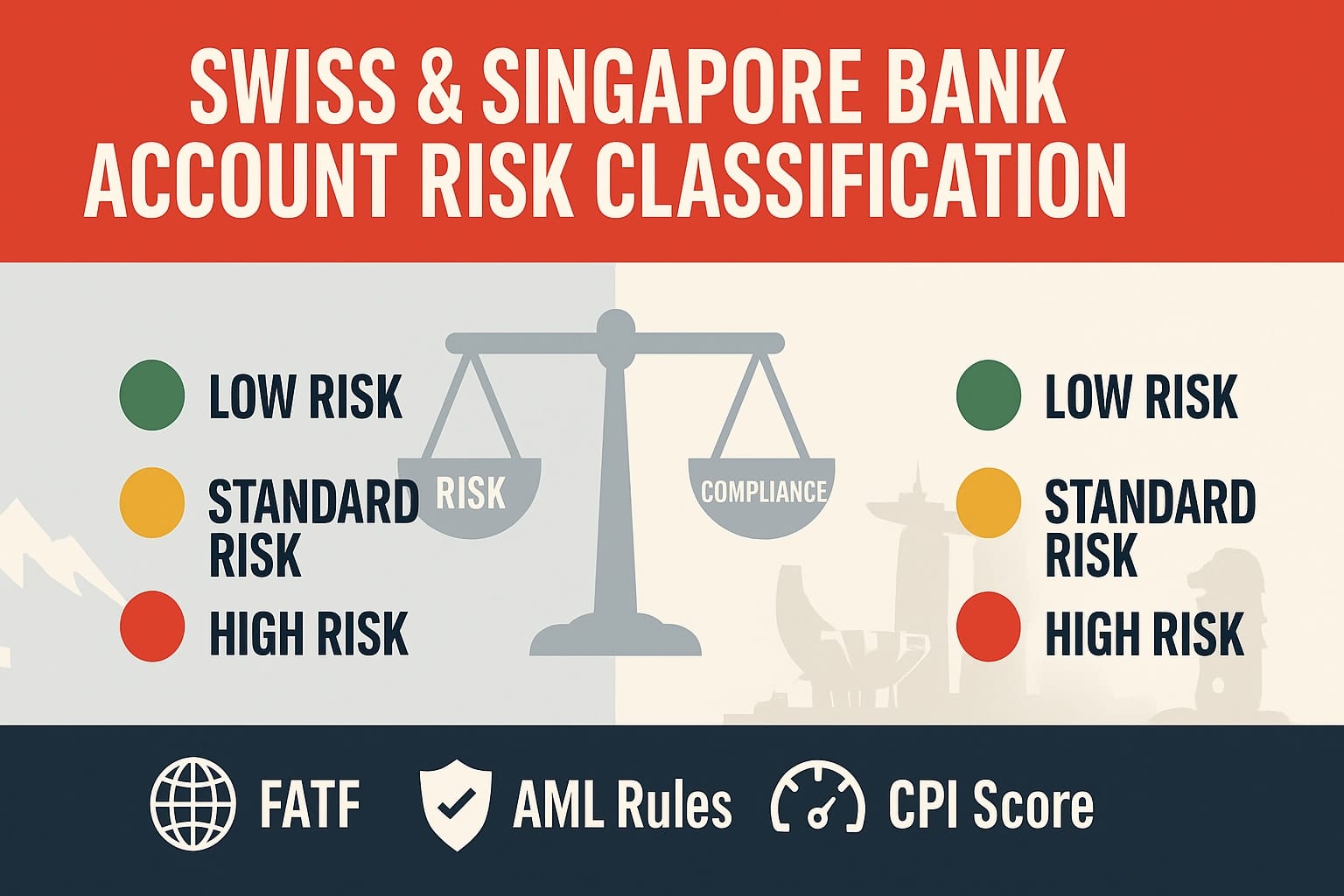
Opening a bank account in Switzerland or Singapore requires passing a risk classification system that most applicants don’t fully understand until something goes wrong. Every client — regardless of wealth, nationality, or account type — is assessed against a structured framework before onboarding begins. That score determines your document burden, your review timeline, and whether the bank will take you on at all. This guide explains exactly how Swiss and Singapore bank account risk classification works, what drives your score, and what you can do to make it work in your favour. Understanding personal bank options in Singapore is crucial for expatriates and locals alike. Choosing the right bank can significantly impact your financial journey and access to services. Additionally, being aware of the specific requirements for each institution can help streamline the account opening process.
Both FINMA in Switzerland and MAS in Singapore follow the Risk-Based Approach (RBA) championed by the Financial Action Task Force (FATF). The frameworks are similar in structure but differ in their regulatory instruments and specific triggers. Understanding both matters if you are considering accounts in either jurisdiction — or both simultaneously.
Why Banks Classify Every Client by Risk
Twenty years ago Swiss privacy was nearly absolute. Today both Switzerland and Singapore operate precision due-diligence systems where scrutiny scales with perceived risk rather than being applied uniformly to everyone. The shift is deliberate: it lets compliance teams concentrate resources on genuinely complex cases while fast-tracking straightforward applicants who would otherwise get caught in the same queue.
The Risk-Based Approach rests on four assessment levers — customer profile, geography, product type, and behaviour. Change any one of them and your risk score can move. A German entrepreneur opening a CHF current account sits at a completely different risk level than a Kazakh property broker requesting a multi-currency corporate account with private banking access. Same jurisdiction, same bank, very different experience.
The payoff for legitimate clients: when you cooperate fully from the start, you shorten onboarding, reduce document-chase cycles, and enter the banking relationship with a compliance file that’s easy to maintain. The banks that matter in both jurisdictions are not looking for reasons to refuse good clients — they’re looking for transparency.
The Legal Framework — Who Writes the Rules
| Jurisdiction | Primary Legislation | Key Regulator | Core Principle |
|---|---|---|---|
| Switzerland | Anti-Money Laundering Act (AMLA); FINMA Anti-Money Laundering Ordinance (AMLO-FINMA); Swiss Bankers Association Code of Conduct (CDB 20) | FINMA | Mandatory risk ladder; zero tolerance for shell banks; periodic data refresh baked into law |
| Singapore | Corruption, Drug Trafficking and Other Serious Crimes Act (CDSA); MAS Notices 626 / 824; Trust Companies Act | MAS | Mirrors FATF principles; tech-enabled KYC; swift suspicious-transaction reporting requirements |
| Global Baseline | FATF 40 Recommendations | FATF | Sets the benchmark; re-rates countries every five years; grey and black list designations carry immediate banking consequences |
Both supervisors also use the Corruption Perception Index (CPI) published annually by Transparency International as a hard input to risk scoring. A CPI score above 50 signals lower perceived corruption — clients from those countries start at a lower risk classification. Scores below 50 push clients toward higher-risk brackets, triggering extra questions or, in extreme cases, outright refusal before an application is even reviewed on its merits.
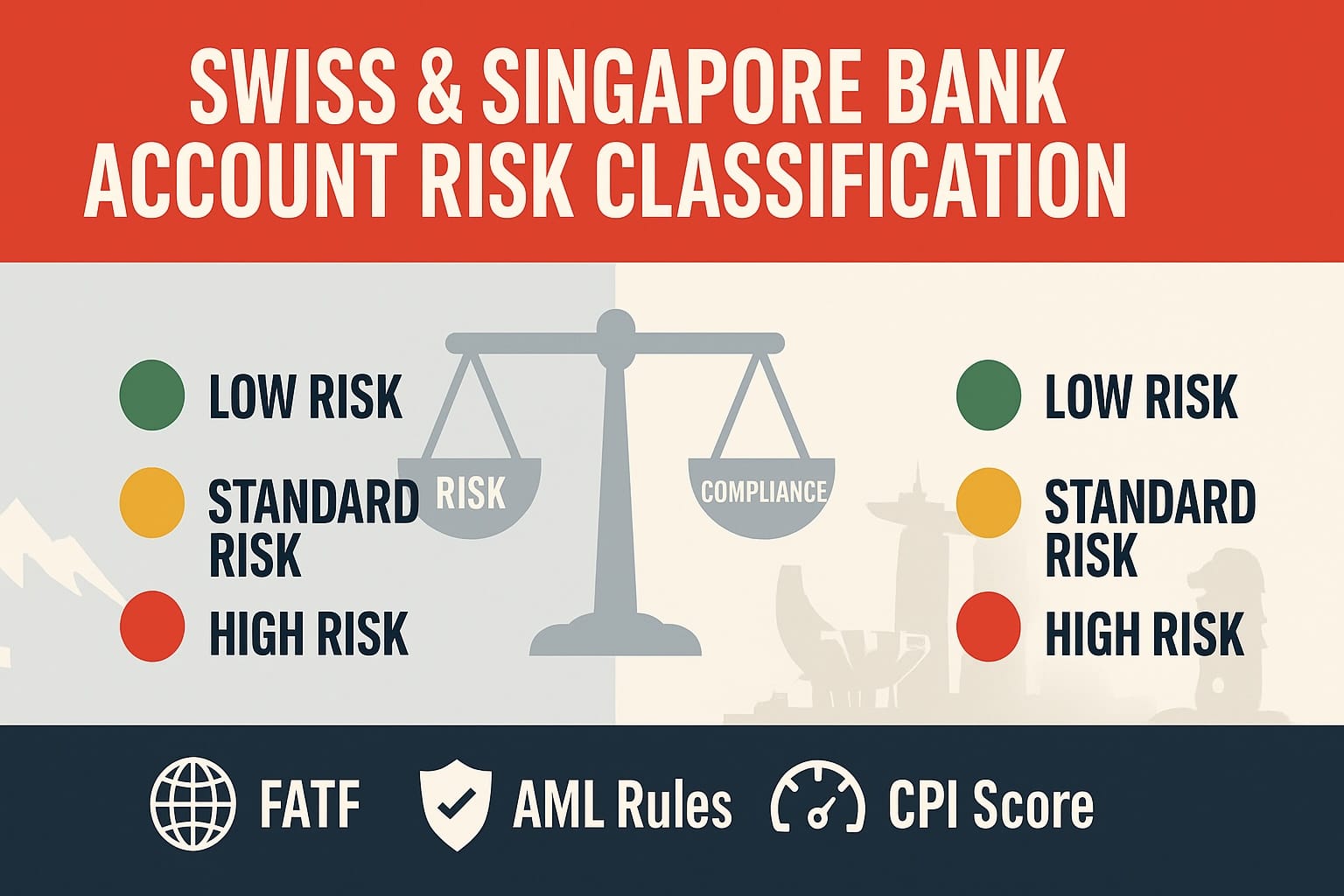
The Five-Level Risk Ladder — Where You Land and What It Means
Both FINMA and MAS use a five-level classification system. The label determines your due-diligence depth, your document burden, and how frequently the bank will review your file once you’re onboarded. Understanding each level before you apply means you can prepare for what’s actually coming rather than being surprised by a document request you weren’t expecting.
The Corruption Perception Index — How Your Country Score Affects Your Application
The CPI is not a perfect instrument — it measures perceived corruption rather than actual incidence — but banks use it as a calibration tool because it’s objective, annually updated, and defensible to regulators. Your CPI score doesn’t determine your outcome alone, but it sets the starting point from which all other factors are assessed.
CPI scores from Transparency International 2024: Denmark 90, Singapore 84, Switzerland 82, Germany 78 — all low risk. UAE 68, Saudi Arabia 53 — standard risk. Kazakhstan 39, Turkey 34 — high risk. Nigeria 25 — high risk requiring enhanced due diligence.
What matters in practice: if you live or operate in a country with a CPI below 50, prepare for EDD as your baseline — not as an exception. Address the CPI context proactively in your application narrative. Banks see dozens of clients from lower-CPI jurisdictions every month; the ones who explain their situation clearly and provide complete documentation move through the process. The ones who ignore the CPI signal and provide the minimum document set stall.
Inside the Due-Diligence Toolkit — SDD, CDD, and EDD Compared
The three active due-diligence levels are not just different quantities of paperwork — they involve different types of verification, different internal bank workflows, and different approval authorities. Understanding what each actually involves helps you prepare rather than react.
| Element | Simplified (SDD) | Customer (CDD) | Enhanced (EDD) |
|---|---|---|---|
| Identity Verification | Passport copy + secondary ID | Certified passport copy + secondary ID | Notarised passport; sometimes embassy certification |
| Address Proof | Utility bill or bank statement ≤3 months | Two separate address documents from different sources | Two documents + cross-reference with public records where available |
| Source of Wealth | Basic narrative note | Tax returns + employment or business verification | Notarised wealth evidence + audited financials covering 10 years |
| UBO / Ownership | Self-declaration sufficient | Form A (Switzerland) or MAS declaration; supporting corporate docs | Full organisational chart + independent verification of each layer |
| Approval Authority | Relationship manager | Compliance team sign-off | Senior management approval required before onboarding can proceed |
| In-Person Meeting | Not required | Recommended but usually not mandatory | Often required — Switzerland especially for private banking EDD clients |
| Review Cycle | Every 15 years | Every 10 years | Every 2 years + event-driven reviews for ownership changes, media alerts, volume spikes |
Banks load your data into automated screening engines regardless of which tier you’re in. If your name, company, or any counterparty pings on sanctions databases, adverse-media monitors, or World-Check, a human compliance officer steps in to review context. This happens before the relationship manager sees your file — so an applicant who appears on a sanctions database even for a technical reason (a name match with a listed entity, for example) needs to be prepared to provide a clear written explanation, often notarised.
Building a Document Package That Passes First Submission
A complete first submission can cut onboarding time in half — even for high-risk files. The difference between a 4-week and a 12-week onboarding is rarely the complexity of the case. It’s usually the state of the document package. Banks that receive a well-organised, complete file move it through compliance faster because there are no pause-and-request loops.
| Document | Why Banks Ask | Common Pitfalls |
|---|---|---|
| Certified Passport + Secondary ID | Confirm identity beyond reasonable doubt; match against sanctions lists | Out-of-date certification; low-resolution scans; secondary ID expired |
| Proof of Address (≤3 months) | Link client to declared residence; verify CPI-relevant jurisdiction | Mobile phone bills widely rejected; PO Box addresses rejected; address must match passport residence |
| Source-of-Wealth File | Evidence lifetime wealth creation — the narrative must be coherent and traceable | Vague “savings” description with no supporting contracts; gaps in timeline that the bank cannot explain |
| Source-of-Funds Trail | Tie the specific deposit to a legal, traceable origin — separate from overall SOW | First payment arriving from a third-party account; unexplained intermediary transfers |
| Corporate and UBO Documentation | Reveal real decision-makers; confirm beneficial ownership to the natural-person level | Nominee layers presented without explanation; outdated company registry extracts |
| CPI Context Note | Banks need an explanation of ties to higher-risk countries — they won’t assume a benign interpretation | Ignoring CPI impact entirely; assuming a strong passport overrides the operational geography |
Life After Approval — Ongoing Monitoring and Maintenance
Risk classification doesn’t end at account opening — it continues for the life of the relationship. Once your account is live, both Swiss and Singapore banks run automated transaction monitoring that flags transfers deviating from your stated profile. A client who declares salaried income and then starts receiving large irregular transfers from multiple jurisdictions will trigger a review regardless of how clean their onboarding file was.
Three types of trigger force a risk re-assessment outside of the scheduled review cycle: new shareholders or changes to beneficial ownership; adverse media alerts — a mention in a news story linked to financial crime, even tangentially; and sudden volume spikes that don’t match the declared transaction profile. Treat each bank query after account opening as a maintenance task, not an interrogation. Silence or delay in responding to monitoring queries can lead the bank to file a Suspicious Activity Report and, in some cases, freeze the account pending further review.
Two Client Profiles — How Risk Classification Plays Out in Practice
Abstract frameworks become concrete when you see them applied to real profiles. The two cases below illustrate how the same bank, reviewing two applicants in the same week, applies entirely different scrutiny levels based on CPI score, business model, and ownership structure. Both clients can succeed — but the investment required is not remotely comparable.
The critical point: Case B is not unworkable. High-risk clients with legitimate wealth open accounts in Switzerland and Singapore regularly. What changes is the preparation required. A Kazakh property broker who arrives with notarised contracts, a clean ownership structure with no unexplained nominee layers, audited financial statements, and a well-written CPI context note moves through EDD in 10 weeks. One who arrives with the same document set as Case A gets stalled for months — not because of who they are, but because of what they submitted.
How to Improve Your Risk Classification Before You Apply
Risk classification is not purely a function of where you’re from or what you do. Several structural factors are within your control before you approach a bank — and addressing them can meaningfully shift your starting risk tier.
Simplify your ownership structure where genuinely possible. A single-layer company is cheaper and faster to explain than a four-layer trust stack. If nominee directors were installed for administrative convenience rather than legal necessity, removing them before the application reduces the UBO complexity that pushes files into EDD. This is not about hiding anything — it’s about making the legitimate reality legible to a compliance officer who has 20 other files on their desk.
Map your money before the bank asks. Prepare a written source-of-wealth narrative covering the past 10 years — not a two-paragraph summary, but a chronological account with supporting documentation for each significant wealth event. Do the same for the specific funds being deposited: trace every transfer from its origin to its current holding account. Gaps in this chain are the single most common reason applications stall at EDD.
Check your CPI exposure before you apply. Run through every country where you operate, hold assets, or receive income. If any are below 50, draft the CPI context note as part of your initial package — don’t wait for the bank to discover the exposure and ask about it. Our free AML risk score calculator lets you model how banks are likely to classify your profile before any formal approach. And for a broader comparison of both jurisdictions, our Singapore non-resident account guide and Swiss banking overview cover the operational specifics of each. Private banking leaders in Singapore offer a range of customized financial services tailored to individual needs. Collaborating with these institutions can enhance wealth management strategies and provide valuable insights into investment opportunities. As you explore your options, consider how their expertise may align with your financial goals.
Related reading:
Frequently Asked Questions
What is the Corruption Perception Index and how does it affect my bank account application?
What is Enhanced Due Diligence and who does it apply to?
Can a high-risk client successfully open a bank account in Switzerland or Singapore?
Is the risk classification system the same in Switzerland and Singapore?
How often does a bank review my account risk classification after opening?
Risk classification is the gate. What sits behind it — account types, minimums, realistic timelines — is covered in our Singapore banking guide.
Understanding your risk classification before you approach a Swiss or Singapore bank saves weeks of reactive document gathering and — more importantly — prevents the failed-application record that complicates future attempts. If you’d like a pre-assessment of your profile using the same screening criteria banks apply, the Easy Global Banking team can review your CPI exposure, ownership structure, and documentation readiness before any formal application is submitted. Contact us for a no-obligation consultation.
References
- Corruption Perception Index 2024 — Transparency International (opens in new tab)
- Anti-Money Laundering — Swiss Financial Market Supervisory Authority (FINMA) (opens in new tab)
- Anti-Money Laundering and CFT — Monetary Authority of Singapore (MAS) (opens in new tab)
- The FATF Recommendations — Financial Action Task Force (opens in new tab)
- FATF Country Risk Classifications — Financial Action Task Force (opens in new tab)