
A Swiss or Singaporean private bank will never open an account for an individual who claims to have no tax residency. Not for CHF 500,000. Not for USD 25 million. Compliance will not negotiate this.
Every week in Zurich, Geneva, Vaduz, and Raffles Place, onboarding committees decline prospective clients who arrived believing that spending under 183 days in every country makes them legally invisible to tax authorities. Across the offshore advisory circuit, this arrangement is marketed as “flag theory” or the “perpetual traveler” structure. Inside a Tier-1 private bank, it carries a different classification: an unbankable CRS circumvention profile. When an applicant attempts to open a foreign bank account with no tax residency, the file rarely survives initial Request for Information (RFI) triage.
The Anatomy of an Immediate Rejection
The refusal is not a matter of commercial risk appetite or institutional conservatism. It is a binding statutory prohibition. Under the Swiss Federal Act on the International Automatic Exchange of Information in Tax Matters (AIA-Gesetz, SR 653.1) and its implementing Ordinance (AIAV), every reporting Swiss financial institution must obtain a valid, reasonable self-certification establishing the account holder’s jurisdiction of tax residence and corresponding Tax Identification Number (TIN) before opening a new account. Under Article 32 AIA-Gesetz, intentional breaches of due diligence, account verification, or reporting duties expose the institution and its responsible executives to criminal fines of up to CHF 250,000—alongside FINMA supervisory enforcement, audit mandates, and reputational sanctions under FINMA Circular 2018/3 and the Swiss Banks’ Code of Conduct with regard to the Exercise of Due Diligence (CDB 20).
Singapore enforces an equally unforgiving statutory perimeter. Under MAS Notice 626 (Prevention of Money Laundering and Countering the Financing of Terrorism for Banks) combined with the Income Tax (International Tax Compliance Agreements) (Common Reporting Standard) Regulations enforced by the Inland Revenue Authority of Singapore (IRAS), serious tax offences constitute predicate money-laundering crimes under Singapore’s Corruption, Drug Trafficking and Other Serious Crimes (Confiscation of Benefits) Act (CDSA). A bank officer in Singapore who onboards a client lacking a verifiable, reportable tax jurisdiction is not merely committing an administrative lapse; the bank is exposing its banking licence to regulatory action for facilitating potential tax evasion.
Inside an onboarding desk, compliance officers quantify this exposure using an internal triage metric—what institutional risk teams effectively treat as a Substance Deficit Score (SDS). Every application starts with a presumption that a human being who generates substantial commercial income or manages liquid wealth must have a fiscal anchor somewhere on earth. When an applicant submits a CRS self certification as a digital nomad declaring “None” or listing a zero-tax territory where they have no residential footprint, the file crosses the Nomad Banking Deadlock Threshold. Automated screening engines flag the submission as an intentional effort to defeat the Common Reporting Standard (CRS). The relationship manager is instructed to terminate discussions immediately, and where forged documents or materially false statements appear, the compliance officer must evaluate filing a suspicious activity report with MROS in Switzerland or STRO in Singapore. As detailed in our analysis of how Swiss and Singapore private banks score client bankability, tax transparency anomalies carry a heavier penalty than almost any other non-sanctions risk factor.
The 2026 Shift: How CRS 2.0 and CARF Closed the Offshore Playbook
Between 2017 and 2024, mobile entrepreneurs exploited three structural gaps in the original 2014 Common Reporting Standard: unregulated e-money institutions, self-custodied or offshore crypto-asset rails, and lightly scrutinized residence-by-investment certificates. The regulatory overhaul enacted in 2026 eliminated all three.
On January 1, 2026, Switzerland brought CRS 2.0—the OECD’s comprehensive amendments to the Common Reporting Standard—into full domestic legal force via the revised AIA-Gesetz and AIAV, with the first expanded reporting cycle due to the Swiss Federal Tax Administration (ESTV) on June 30, 2027. Singapore’s IRAS simultaneously issued aligned CRS 2.0 and digital-asset implementation guidance across financial institutions and corporate service providers. Four concrete operational changes now govern every private banking application:
- Expansion into E-Money, CBDCs, and Tokenized Instruments: CRS 2.0 brings Specified Electronic Money Products, Central Bank Digital Currencies (CBDCs), and indirect crypto-asset investments held through derivatives or custodial vehicles squarely inside financial-account reporting. Parking liquidity in fintech multi-currency wallets no longer sits outside CRS perimeter checks.
- Mandatory Self-Certification Validity Flagging: Financial institutions must now explicitly report to tax authorities whether a valid self-certification was obtained for each account holder and Controlling Person, alongside the exact role played by every Controlling Person (shareholder, settlor, protector, beneficiary, or senior managing official).
- Synchronized CARF Data Collection: While Switzerland established the domestic statutory base for the OECD Crypto-Asset Reporting Framework (CARF) in the revised AIA-Gesetz and deferred bilateral operational exchange activation to January 1, 2027 at the earliest (with first exchanges slated for 2028), Zurich and Singapore compliance teams already apply CARF-aligned self-certification and wallet-provenance KYC in 2026. Applicants whose Source of Wealth derives from digital assets face immediate cross-verification under our CARF 2027 crypto reporting framework and 2026 crypto documentation standards.
- Mandatory Algorithmic TIN Validation: Under CRS 2.0, leaving a TIN field blank when the claimed jurisdiction issues TINs renders the self-certification legally invalid. Onboarding portals run automated syntax and checksum validation on every submitted number before a file can even reach a human compliance officer.
Alongside CRS 2.0, banks enforce the OECD’s Model Mandatory Disclosure Rules (MDR) for CRS Avoidance Arrangements and Opaque Offshore Structures together with the OECD’s high-risk Citizenship by Investment (CBI) and Residence by Investment (RBI) watchlists. Under OECD criteria, any CBI or RBI program that taxes foreign-source personal income below 10 percent and does not require significant physical presence—typically fewer than 90 days per year—triggers a mandatory “Reason to Know” escalation. When an applicant presents a passport or residency card tied to an OECD-flagged scheme, the bank is legally barred from accepting the self-certification at face value. Officers must interrogate where the client actually lived, whether they obtained residency via investment, and whether they hold tax obligations in another state. For a deeper operational examination of second-passport risk, see our review of CBI compliance and second-passport onboarding.
Equally dead is the practice of interposing a corporate shell—such as a British Virgin Islands (BVI) Business Company, Cayman Islands exempted company, or Panama IBC—between a stateless founder and a Swiss or Singaporean custody account. Under CRS Section VIII(D)(8) and Swiss CDB 20 beneficial ownership rules (Form A for natural persons, Form K for operating companies, and Form T for trusts), any entity deriving more than 50 percent of its gross income from passive sources (dividends, interest, royalties, capital gains) or holding more than 50 percent passive assets is classified as a Passive Non-Financial Entity (Passive NFE). The bank must look straight through the corporate veil and document the personal tax residency and TIN of every Controlling Person holding 25 percent or more ownership or effective control. A corporate certificate of incorporation in Road Town or George Town solves nothing when the ultimate beneficial owner behind it claims to reside nowhere.
Why Paper Residencies Fail Automated Compliance Audits
Once location-independent founders realize that declaring “no tax residency” results in immediate rejection, many turn to offshore formation agents and lifestyle influencers who promise an instant, zero-substance paperwork fix. Those arrangements collapse under 2026 bank scrutiny because compliance officers no longer inspect residency cards in isolation. They audit physical reality.
Three promoted paper schemes account for the overwhelming majority of Swiss and Singapore account rejections:
- The Empty UAE Freezone and Flexi-Desk Visa: Promoters routinely claim that registering a Dubai or Ras Al Khaimah freezone entity with a shared flexi-desk, obtaining an Emirates ID, and touching down in Dubai for 24 hours every 180 days establishes zero-tax residency. That claim contradicts both Swiss KYC rules and UAE domestic law. Under UAE Cabinet Decision No. 85 of 2022 (effective March 1, 2023) and Ministerial Decision No. 27 of 2023, a natural person qualifies as a UAE tax resident only by spending 183+ days in the Emirates, spending 90+ days while holding a UAE residence permit and either a permanent place of residence or local employment/business, or proving the UAE is their primary place of residence and center of financial and personal interests. When a client submits a freezone visa with zero residential lease and 3 days spent in Dubai, it is not a mystery why a bank rejected a UAE tax residency certificate or Emirates ID outright.
- The Paper Latin American Residency (Paraguay and Panama): Paraguay’s permanent residency (cédula) and Panama’s Friendly Nations permit are sold heavily as low-cost territorial tax anchors requiring minimal physical presence. Neither document establishes tax residency in the eyes of a Zurich compliance committee if the holder maintains zero residential home, zero utility infrastructure, and zero local economic activity in Asunción or Panama City. Under CRS Reason-to-Know rules, the bank treats the Latin American ID as an immigration permit—not a tax domicile—and demands the TIN of the jurisdiction where the client actually lives or previously filed taxes.
- Non-Substance European Non-Dom and Digital Nomad Permits: Several European states issue remote-worker visas or remittance-based non-dom certificates that look reassuring on paper. Yet when an applicant holds a digital nomad visa in Portugal, Spain, or Greece without registering locally with the municipal tax office, obtaining a domestic fiscal number, and satisfying statutory day counts, the permit creates immigration permission rather than auditable tax residency. Worse, if the applicant spends 110 days in London, 70 days in Milan, and 20 days in the visa-issuing state, the compliance officer identifies active tax exposure in the UK and Italy rather than clean domicile in the nomad-visa country.
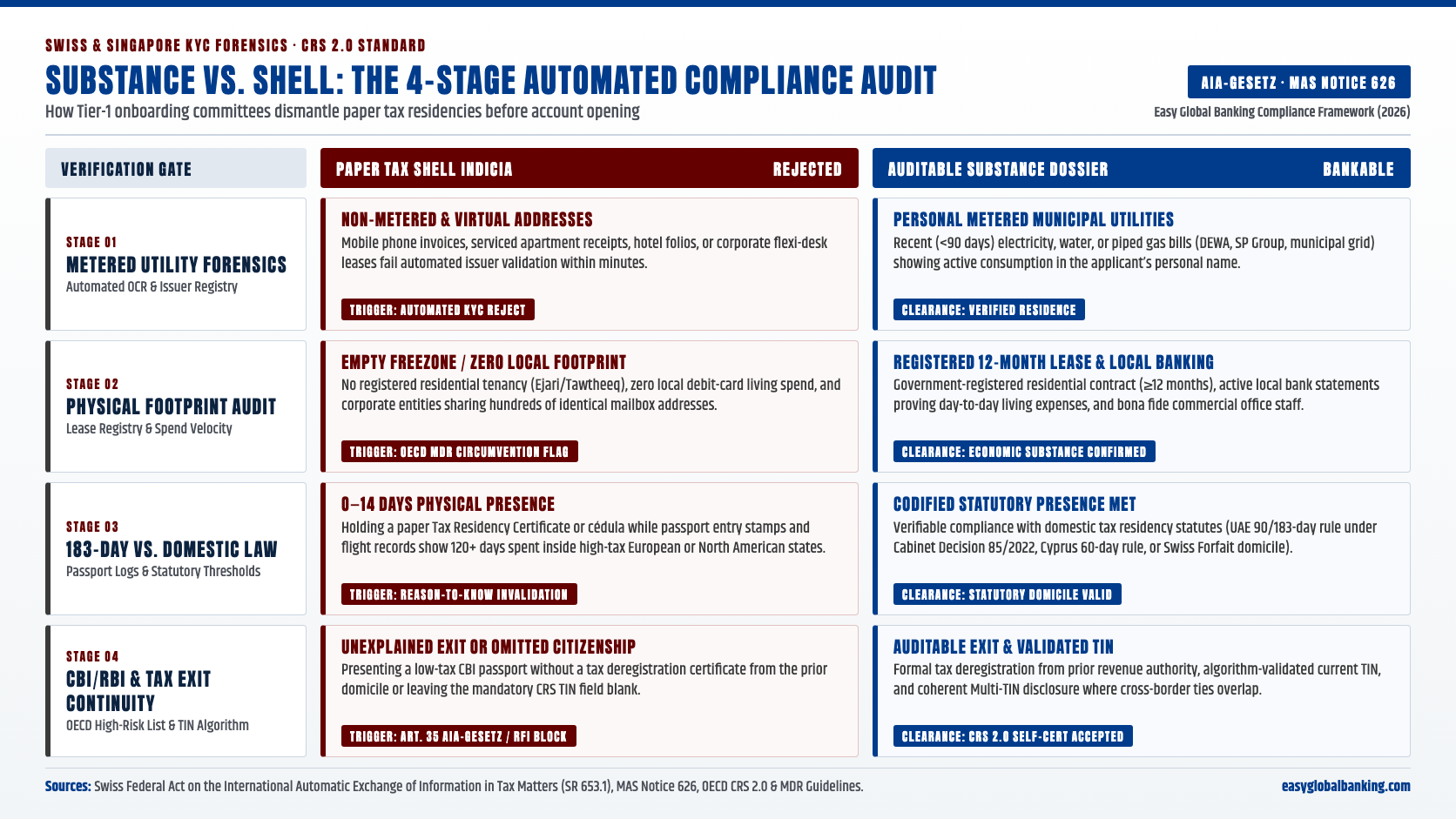
To expose these paper shells systematically, Tier-1 Swiss and Singaporean KYC teams execute a standardized four-stage forensic verification pipeline on every cross-border application:
- Stage 1 — Metered Utility Bill Forensics: Automated document-verification software parses the utility issuer, service address, metering code, and consumption history. If your utility bill is from a serviced apartment, a hotel residence, a mobile telecom carrier, or a lease signed under a commercial corporate vehicle, the onboarder’s automated validation software flags it within 4 minutes. Compliance requires a recent (under 90 days) metered electricity, water, or piped gas invoice—such as DEWA in Dubai or SP Group in Singapore—issued in the applicant’s personal legal name showing normal residential usage.
- Stage 2 — Physical Footprint Verification: Officers cross-check government tenancy registries (such as Dubai’s Ejari or Abu Dhabi’s Tawtheeq), municipal resident registration certificates, and 3 to 6 months of local retail bank statements. A supposed Dubai resident whose bank statements contain zero UAE grocery, fuel, medical, or dining transactions while showing continuous card spend in Paris and Zurich fails Stage 2 immediately. Incoming SWIFT wire messages (
pacs.008) and bank-to-bank compliance inquiries (MT199) are simultaneously checked for geographic consistency. - Stage 3 — The 183-Day vs. Domestic Law Cross-Check: Compliance teams review full passport entry/exit stamps alongside the statutory residency test of both the claimed country and the applicant’s prior home jurisdiction. Holding a paper tax certificate is worthless if the applicant spent 0 days in the issuing territory and 120 days in a high-tax European state whose domestic law triggers tax residence through permanent home availability or habitual abode well below 183 days.
- Stage 4 — Tax Deregistration and 10-Year Domicile Continuity: Every applicant relocating from a high-tax OECD jurisdiction (such as Germany, France, the UK, Canada, or Australia) must produce formal documentary evidence of tax exit—such as a municipal deregistration certificate (Abmeldebestätigung), HMRC P85 / split-year filing confirmation, or a tax clearance letter. Without verifiable exit proof, the compliance officer presumes continuing tax liability in the originating jurisdiction.
The table below summarizes how Tier-1 compliance teams classify and dismantle the four most widely marketed offshore residency shortcuts in 2026.
| Jurisdiction / Scheme Promoted | Marketing Promise (“Flag Theory”) | 2026 Swiss / Singapore Bank Verification Method | Compliance Verdict & Failure Point |
|---|---|---|---|
| UAE Empty Freezone Visa (Zero-Substance Flexi-Desk) | “Zero corporate and personal tax with a 1-day entry requirement every 6 months.” | Inspection of government-registered personal lease (Ejari), metered utility bills (DEWA), and local bank statements proving day-to-day living expenditures. | Rejected / Flagged. Classified as a high-risk circumvention attempt under OECD Mandatory Disclosure Rules. Bank demands home-country TIN. |
| Paraguayan Cédula / Panamanian Friendly Nations (Paper Permanent Residency) | “Acquire permanent residency without physical presence and bank tax-free indefinitely.” | Verification of physical days spent (full passport entry/exit scans) and domestic tax filings under local territorial legislation. | Rejected. Bank treats the individual as a tax resident of their prior domicile under OECD Model Tax Convention Article 4 tie-breaker rules. |
| Caribbean / Vanuatu CBI (Citizenship by Investment) | “New passport with a clean slate; bank reports nowhere under CRS.” | Mandatory disclosure of all historical citizenships, place of birth, and past 10 years of physical tax domiciles on Form A and CRS Self-Certification. | Critical Red Flag. Omission of birth nationality or primary economic nexus constitutes a false self-certification punishable under Art. 35 Swiss AIA-Gesetz (SR 653.1). |
| Pure “Perpetual Traveler” (No Tax Home, Moving Every 60–90 Days) | “Stateless status means no country has jurisdiction to claim taxes or receive CRS data.” | Automated TIN validation algorithms; cross-check against passport issuance country, prior domicile, and center of economic activity. | Immediate Hard Block. Account opening is denied at initial triage. Banks cannot legally onboard a client without at least one reportable tax jurisdiction. |
The OECD Article 4 “Tie-Breaker” Blueprint: How Banks Determine Your True Tax Home
When an applicant insists they live “everywhere and nowhere”—splitting 60 days in Dubai, 60 days in London, 50 days in Switzerland, and 90 days across Southeast Asia—a Tier-1 bank’s legal department does not debate lifestyle philosophy. It applies the exact statutory hierarchy embedded in Article 4(2) of the OECD Model Tax Convention on Income and on Capital. Although Article 4 technically resolves dual residency between two treaty states, Swiss and Singapore compliance manuals adopt its four-tier sequence as the evidentiary blueprint for assessing whether a client’s CRS self-certification passes the “reasonableness” test.
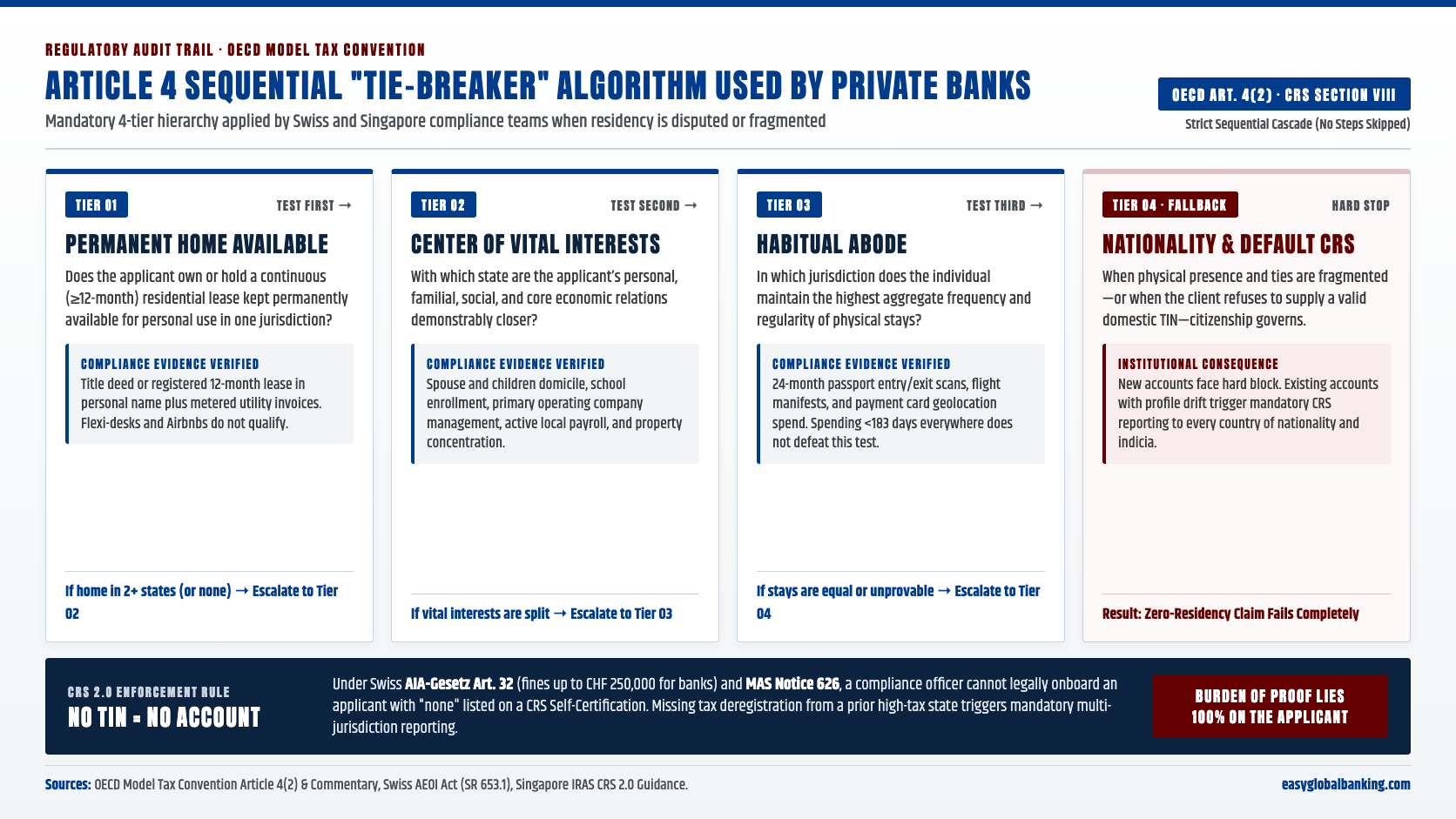
Compliance teams run these four tests strictly in order. An applicant cannot skip Tier 1 to argue Tier 3.
Tier 1: Permanent Home Available
The legal department first asks a binary question: in which jurisdiction does the individual have a permanent residential dwelling continuously available for personal use? Under OECD Commentary on Article 4, permanence does not require property ownership; a continuous 12-month residential lease suffices, provided the dwelling is retained and accessible to the individual at all times rather than leased out to third parties or booked intermittently through short-term platforms. Serviced apartments, co-working flexi-desks, and parent-owned guest rooms fail this threshold. If you own an unlet apartment in Munich while renting Airbnbs in Dubai and Bali, Munich wins Tier 1 instantly—even if you slept in Munich for only 25 nights all year.
Tier 2: Center of Vital Interests
If the individual maintains a permanent home in two or more countries—or genuinely owns or leases no permanent home anywhere—the analysis escalates to the Center of Vital Interests: the state with which the applicant’s personal and economic relations are closer. Compliance officers audit both sides of the ledger. Economic relations include where operating companies are managed, where revenue-generating contracts are executed, where investment real estate is located, and where banking relationships are administered. Personal relations include where a spouse or minor children live, where children attend school, where medical insurance is registered, and where social or civic memberships exist. Under established OECD Commentary and Swiss Federal Supreme Court jurisprudence, when economic interests are geographically dispersed across remote markets, personal and familial ties carry decisive weight.
Tier 3: Habitual Abode
When Tier 2 yields no decisive winner, compliance evaluates the applicant’s Habitual Abode. Perpetual travelers habitually misunderstand this criterion, assuming that staying below 183 days everywhere prevents a habitual abode from forming. That assumption is legally false. Under OECD Commentary, habitual abode measures the frequency, duration, and regularity of physical stays over a representative observation period—typically the preceding 24 months. If an entrepreneur spends 95 days in the United Kingdom, 70 days in Portugal, 55 days in Thailand, and 45 days in the UAE, the UK represents the jurisdiction of greatest recurring physical presence. Banks verify this through full passport page scans, airline booking manifests, and payment-card geolocation logs.
Tier 4: Nationality and the Default CRS Fallback
If an individual possesses no permanent home, fragmented vital interests, and evenly split stays across four or five countries, Article 4(2)(c) resolves residency by nationality. Where an applicant holds dual citizenship or refuses to furnish a domestic TIN, the consequences inside a Swiss or Singapore bank are immediate and severe. For a prospective account, refusal triggers an automatic hard block: the account is never opened. For an existing client whose profile undergoes “profile drift”—for instance, deregistering from France without establishing verifiable substance elsewhere—the bank invokes CRS indicia rules. Under AIA-Gesetz and IRAS CRS regulations, once a client’s self-certification becomes unreliable and remains uncured within the statutory remediation window (typically 90 days), the institution must report the account as an undocumented or indicia-driven reportable account to every jurisdiction linked to the client’s citizenship, country of birth, mailing address, telephone number, or standing payment instructions—and frequently initiates unilateral account exit. Readers facing unexpected compliance termination should examine our operational guide on why banks close accounts without warning and how 2026 debanking rules operate.
| Step | Tie-Breaker Criterion | What the Client Assumes | What the Bank Compliance Officer Verifies | Acceptable Bankable Proof |
|---|---|---|---|---|
| 1 | Permanent Home Available | An address on a rented flexi-desk, virtual office, or rotating Airbnb booking. | A continuous, year-round residential property owned or leased (minimum 12-month lease) available for personal use. | Registered residential lease or title deed, local metered municipal utility bills in client’s legal name, municipal registration certificate. |
| 2 | Center of Vital Interests | Where the offshore shell company is registered or where brokerage accounts are booked. | Where family resides, where core business management occurs, and where personal economic ties are concentrated. | Employment or executive service contracts, active business trading records, children’s school enrollment, local medical and personal footprint. |
| 3 | Habitual Abode | “I spent fewer than 183 days everywhere, so I have no habitual abode.” | The jurisdiction where the individual spends the greatest aggregate number of nights and recurring stays. | Complete passport page scan, flight manifest records, local banking and payment card transaction geolocations over the preceding 24 months. |
| 4 | Nationality / Citizenship | A second passport acquired via investment can bypass home-country inquiries. | State of nationality if habitual abode cannot be determined, triggering direct CRS reporting to all countries of citizenship. | Official national ID, tax clearance certificates, and formal confirmation of tax deregistration from the originating revenue service. |
Interactive Compliance Simulator · Zurich & Singapore Onboarding Triage
The CRS 2.0 Substance Evaluator
Select your actual documentation profile or test a preset scenario to compute your Tax Substance Readiness Score (0–100) and inspect automated KYC failure points.
Forensic Compliance Committee Diagnostic
Scoring reflects 2026 onboarding triage weights applied across Tier-1 Swiss (AIA-Gesetz / FINMA) and Singapore (MAS Notice 626 / IRAS CRS 2.0) compliance committees. Tiers: 0–39 High Rejection (Burgundy), 40–74 Enhanced Due Diligence / RFI Hold (Slate), 75–100 Bankable Clean Profile (Dark Navy).
The Solution: Lawful Structuring for Genuine Cross-Border Citizens
Maintaining a mobile, international life while holding custody accounts in Zurich, Geneva, or Singapore is entirely achievable. What is impossible is achieving it through legal fiction. To clear Tier-1 compliance without friction—and to preserve long-term banking continuity without perpetual RFI freezes—cross-border principals must anchor themselves in one of three legally durable, auditable frameworks.
Pathway A: Genuine Substance Relocation (UAE Real Substance or Singapore Institutional Anchors)
Zero-tax and territorial hubs remain completely bankable in Switzerland and Singapore when backed by verifiable domestic substance. In the United Arab Emirates, that requires abandoning flexi-desk packages and structuring squarely inside Cabinet Decision No. 85 of 2022: executing a personal 12-month residential lease registered through Ejari or Tawtheeq, maintaining metered DEWA or ADDC utilities in your own name, spending at least 90 verified days (ideally 183+ days for treaty protection) physically inside the UAE, operating an active local bank account showing genuine living expenses, and—if operating a business—leasing dedicated commercial office space with verifiable management activity. Once those elements are in place, an official UAE Federal Tax Authority Tax Residency Certificate passes Swiss and Singapore Stage 1–4 audits cleanly.
For ultra-high-net-worth principals seeking an institutional Asian anchor, Singapore's Section 13O and Section 13U Single Family Office (SFO) tax-incentive frameworks provide unimpeachable compliance credibility. Under current MAS and IRAS parameters, Section 13O requires a minimum of S$20 million in Assets Under Management invested in Designated Investments at application and maintained at the end of every basis period, paired with local investment professionals and tiered local business spending (while Section 13U requires S$50 million AUM). Principals evaluating Singapore private banking should review our detailed operational breakdown of the 2026 Singapore private banking account opening process.
Pathway B: European Non-Dom Regimes with Codified Statutory Day Rules
Entrepreneurs whose commercial operations prevent them from spending 183 days in a single state should examine European jurisdictions whose domestic tax statutes explicitly codify sub-183-day residency alongside auditable local ties:
- Cyprus 60-Day Tax Residency + Non-Dom Status: Under Cyprus Income Tax Law, an individual acquires full EU statutory tax residency by spending at least 60 physical days in Cyprus during the calendar year, provided they do not spend more than 183 days in any other single state, maintain a permanent residential home in Cyprus (owned or leased under a 12-month contract), and carry out business, hold employment, or serve as a director of a Cyprus tax-resident company. Individuals without a Cyprus domicile of origin qualify for Non-Dom status for up to 17 years—exempting worldwide dividends and interest from Special Defence Contribution (SDC) while producing an indisputable EU Tax Identification Number and annual tax assessment accepted by every Swiss private bank.
- Malta Global Residence Programme (GRP): Designed for non-EU/EEA/Swiss nationals, the Malta GRP establishes formal EU tax residency taxed at a flat 15 percent on foreign-source income remitted to Malta, subject to a minimum annual tax liability of €15,000, a qualifying local property purchase or lease, comprehensive health insurance, and a statutory cap preventing the holder from spending more than 183 days in any other single jurisdiction. Because the participant receives a Maltese TIN, files annual returns, and pays statutory minimum tax, compliance committees recognize the domicile as genuine rather than a paper shell.
Pathway C: Swiss Lump-Sum Taxation (Forfait Fiscal) and High-Substance Hubs
For financially independent principals who do not engage in gainful employment inside Switzerland, Swiss lump-sum taxation (Pauschalbesteuerung / Forfait fiscal) under Article 14 of the Federal Act on Direct Federal Taxation (DBG) remains the gold standard of bankable European wealth residency. Rather than taxing worldwide income and assets directly, participating cantons (including Vaud, Geneva, Valais, Ticino, Zug, and Schwyz; Zurich and Basel-Stadt abolished the regime) assess tax based on worldwide living expenditure. For the 2026 tax year, the indexed federal minimum taxable expenditure base stands at CHF 435,000—and cannot be lower than seven times the taxpayer's annual Swiss rent or imputed rental value—with individual cantons enforcing their own statutory floors. Because a Forfait taxpayer holds a Swiss B or C residence permit, files Swiss cantonal returns, and maintains a physical Swiss home, onboarding at Zurich or Geneva custodians proceeds without cross-border CRS friction. For non-residents who remain domiciled outside Switzerland but want Swiss custody, see our structural guide on opening a Swiss bank account for non-residents and—for US citizens or green card holders—our specialized guide on offshore wealth management for US persons.
The Multi-TIN Self-Certification Protocol
What if your genuine life genuinely spans two jurisdictions—for example, you operate a substantive UAE company and lease a villa in Dubai for 140 days per year, while maintaining a family residence in the United Kingdom or Switzerland where your spouse and children live? Attempting to conceal the secondary tie is the single fastest route to criminal exposure under Article 35 AIA-Gesetz and permanent account blacklisting.
Institutional advisors resolve overlapping residency through the Multi-TIN Self-Certification Protocol. Rather than forcing an artificial single-country claim onto Swiss Form A and the bank's CRS Self-Certification, the client declares every jurisdiction in which they hold domestic tax residency, supplying each country's valid TIN—or, where a bilateral Double Taxation Agreement resolves residency exclusively in favor of one state under Article 4(2), attaches a formal written legal opinion from qualified tax counsel documenting the treaty tie-breaker outcome alongside proof of tax filing in both states. Under CRS rules, reporting to two jurisdictions is entirely lawful; dual reporting merely ensures both revenue authorities receive identical account data so that treaty relief is applied transparently at the tax-return level rather than hidden at the bank level. A clean Multi-TIN disclosure eliminates compliance suspicion overnight because it proves the applicant has nothing to conceal.
Actionable Implementation: The Pre-Flight Compliance Protocol
Tier-1 Swiss and Singapore private banks share an unwritten institutional memory. Submitting a half-baked application backed by a flexi-desk visa does not merely result in a polite refusal; internal compliance notes document the rejected residency claim, and re-applying six months later with a newly minted address triggers enhanced skepticism. Before a single introductory email is sent to a private banker in Zurich or Singapore, assemble a complete, court-grade compliance dossier.
Your pre-flight binder must align three independent evidentiary pillars: your tax domicile trail, your physical substance trail, and your economic provenance trail. Every principal preparing an onboarding package for a Tier-1 custodian should compile these six verified records in chronological order before approaching any relationship manager:
- Validated Tax Identification Number and Latest Filing: Your active domestic TIN together with your most recent personal tax assessment or statutory Tax Residency Certificate issued under domestic residency law (such as UAE Cabinet Decision No. 85 of 2022 or Cyprus 60-day assessment).
- Formal Tax Exit Proof from Prior Domicile: Municipal deregistration (Abmeldebestätigung), HMRC P85 confirmation, or formal non-residency tax clearance confirming the exact calendar date your prior unlimited tax liability ceased.
- Registered 12-Month Residential Lease or Title Deed: A personal-name residential tenancy registered with the local land or housing authority (e.g., Ejari, Tawtheeq, or cantonal lease)—never a virtual office, co-working desk, or corporate apartment.
- Metered Municipal Utility Invoices (Trailing 90 Days): Recent electricity, water, or piped gas bills issued directly to you at the leased residential address showing active consumption.
- Written Multi-TIN Disclosure or Treaty Tie-Breaker Memo: Where personal or business ties cross borders, a pre-drafted Multi-TIN hierarchy—or a signed tax counsel opinion applying OECD Article 4(2)—so Form A and your CRS Self-Certification are internally consistent from day one.
- Origin-Matched Source of Wealth Chronology: Audited financial statements, equity sale agreements, or tax-filed income records linking how your liquid capital was generated to the tax jurisdictions where you resided during those earning periods. Follow our forensic blueprint on how to write an institutional Source of Wealth declaration.
Verify every item in your pre-flight binder below before submitting Form A or a CRS Self-Certification to a private bank.
Pre-Flight Audit Dossier · Form A & CRS Self-Certification
Pre-Application CRS Self-Certification Checklist
Tax Documentation
Physical Substance
Banking Alignment
Check each verified document in your possession before initiating formal onboarding with a Swiss, Singaporean, or Liechtenstein private bank.
Frequently Asked Questions
Can a digital nomad legally open a Swiss bank account without a local tax residency?
No. You do not need to be a tax resident of Switzerland to open a Swiss private bank account, but you must be a verifiable tax resident of at least one recognized jurisdiction worldwide. Under the Swiss AIA-Gesetz (SR 653.1) and CRS 2.0, Swiss banks are legally prohibited from onboarding an individual who claims "none" or cannot substantiate a reportable tax domicile with a valid TIN.
Why did a Swiss or Singapore bank reject my UAE Tax Residency Certificate and Emirates ID?
Because an Emirates ID is an immigration document and a zero-substance freezone certificate fails the CRS Reason-to-Know test. Unless your UAE profile meets UAE Cabinet Decision No. 85 of 2022—supported by a personal Ejari-registered residential lease, metered DEWA utility bills in your name, verifiable physical days inside the UAE, and formal tax exit from your prior country—banks classify the setup as a paper shell and reject it.
Does forming a BVI, Cayman, or US LLC shield a perpetual traveler from CRS 2.0 reporting?
No. Under CRS Section VIII(D)(8) and Swiss CDB 20 Form A/K rules, investment holding vehicles and remotely managed personal service entities are classified as Passive NFEs. Banks are legally required to look through the entity and verify the personal tax residency and TIN of every Controlling Person holding 25 percent or more ownership or effective control.
What happens if I omit a second citizenship or prior tax residency on a Swiss CRS Self-Certification?
Intentionally providing a false or incomplete self-certification to a reporting Swiss financial institution is a criminal offence under Article 35 of the Swiss AIA-Gesetz (SR 653.1), punishable by a fine of up to CHF 10,000, alongside immediate account freezing or termination, potential document-forgery exposure under Swiss criminal law, and automatic indicia-based CRS reporting.
Primary Statutory & Regulatory References
- Swiss Confederation (Fedlex) — Federal Act on the International Automatic Exchange of Information in Tax Matters (AEOI Act / AIA-Gesetz, SR 653.1, Articles 32 & 35)
- OECD — Crypto-Asset Reporting Framework (CARF), Amended Common Reporting Standard (CRS 2.0), and Model Mandatory Disclosure Rules (MDR)
- OECD — Model Tax Convention on Income and on Capital (Article 4: Resident & Tie-Breaker Commentary)
- Monetary Authority of Singapore (MAS) — Notice 626: Prevention of Money Laundering and Countering the Financing of Terrorism (Banks)
- UAE Federal Tax Authority — Cabinet Decision No. 85 of 2022 & Tax Residency Certificate Statutory Criteria
Operational Rule: Never apply to a Tier-1 Swiss, Singaporean, or Liechtenstein bank until your tax substance dossier is auditable to the level of a tax court defense.
Editorial Disclosure: Easy Global Banking (operated by BMA Business Solutions GmbH, Switzerland) provides independent cross-border banking advisory and compliance readiness analysis. We are not a bank, law firm, or licensed tax authority. Cross-border residency relocations, double-tax treaty claims, and Multi-TIN filings must be verified with qualified tax counsel in each affected jurisdiction.