If you’re a politically exposed person trying to open a private banking relationship — or you’ve just discovered that your spouse or parent’s position makes you one — the standard advice you’ll find online is broadly correct and almost entirely useless. Yes, you need source of wealth documentation. Yes, you’ll face enhanced due diligence. Yes, some banks will reject you. That’s all true. What those guides skip is the part that actually determines success or failure: the bank’s commercial calculation, the specific distinctions that compliance teams use to assess your individual risk level, and the documentary mistakes that cause rejections even when wealth is completely legitimate.
This is a post about how that process actually works. It’s based on working with PEP and PEP-adjacent clients across Swiss and Singapore banking — profiles ranging from former senior civil servants with fully documented government salaries to beneficial owners whose parents held ministerial positions twenty years ago. The situations are rarely identical, but the patterns are consistent. I’ll share what they are.
Who Actually Counts as a PEP — and Where Most Guides Get It Wrong
The FATF definition covers three categories: foreign PEPs (prominent public functions held on behalf of a foreign government), domestic PEPs (the same functions held in the person’s own country), and international organisation PEPs (senior roles at bodies like the UN, IMF, World Bank, or NATO). Family members — spouses, children and their spouses, parents — and close associates with joint beneficial ownership fall under the same regime.
Here’s the distinction most articles miss entirely. Under FATF Recommendations 12 and 22, foreign PEPs are treated as automatically high risk. Domestic PEPs and international organisation PEPs are only subject to enhanced due diligence when the institution identifies higher risk. That’s a meaningful difference in practice. A municipal official in a low-corruption country applying to a local bank is not the same risk profile as a former finance minister from a resource-extraction economy applying to a private bank in Zurich. The FATF framework acknowledges this. Many compliance guides written for general audiences don’t.
The family member question is where I see the most confusion — and the most stress. Banks frequently flag spouses and adult children of active PEPs as requiring EDD. That’s correct. What’s often not communicated clearly is this: once the primary PEP leaves their position, family member PEP status ends at that point, not after any waiting period. The FCA’s finalised guidance (FG25-3) is explicit on this. Family members of former PEPs should be treated as ordinary customers from the date the PEP leaves office, unless other risk factors justify continued EDD. The 12-month minimum watch period applies to the PEP themselves — not to the family.
How Long PEP Status Actually Lasts
This is the question that matters most for former officials and their families, and the answer is genuinely inconsistent across jurisdictions.
EU Anti-Money Laundering Directives require institutions to apply risk-based measures to former PEPs for a minimum of 12 months after leaving office. FATF Recommendation 12 sets no fixed maximum — it requires a risk-based approach with no specified ceiling. In practice, most institutions apply 12–18 months as a standard minimum, then assess whether the risk profile has materially changed.
For senior positions — former heads of state, defence ministers, central bank governors — many banks maintain enhanced monitoring indefinitely, or until there is a demonstrable change in the former official’s influence and network. “Demonstrable” is doing real work in that sentence. A former minister who joins a private sector board in an unrelated industry has a different residual risk profile than one who retains advisory roles to government departments or sits on boards of state-adjacent entities.
Why Most Banks Reject PEPs — and Why the Real Reason Isn’t What You Think
Banks reject PEP applications for two distinct reasons, and they’re not the same thing. Most applicants assume they were rejected because the compliance team found something wrong. Often, the real reason is commercial.
Running an EDD investigation on a PEP client costs a bank real money. A compliance analyst team working a complex cross-border PEP onboarding file — adverse media research, source of wealth verification across multiple jurisdictions, senior management sign-off process — accumulates costs measured in tens of thousands in professional time. A Swiss wealth management firm may advertise a CHF 2 million minimum deposit. But internally, their risk committee may have an unwritten policy that they won’t absorb the EDD cost for a high-risk PEP unless the relationship is expected to generate CHF 15 million or more in AUM. The advertised minimum is the floor for clean-profile clients. The effective threshold for a PEP is significantly higher — and is never published anywhere.
This is the rejection that stings most, because it has nothing to do with the legitimacy of the wealth. A former government official with a perfectly documented public salary, pension, and property portfolio can be turned down commercially because their total assets simply don’t justify the bank’s compliance cost. Understanding this changes how you approach the market — you’re not trying to prove innocence, you’re trying to find an institution where the commercial equation works in your favour.
The Risk Variables Banks Actually Weigh
Not all PEP profiles carry the same weight. Here’s what determines whether a compliance team treats your file as manageable or puts it in the rejection pile before the relationship manager even calls you back.
| Risk variable | Lower risk reading | Higher risk reading |
|---|---|---|
| PEP category | Domestic PEP or international org PEP — EDD required only if elevated risk identified | Foreign PEP — automatic high risk under FATF Rec. 12, mandatory EDD |
| Country Corruption Perception Index (CPI) | Country scores 60+ on Transparency International CPI — lower baseline risk | Country scores below 40 — significantly harder onboarding regardless of personal conduct |
| Position held | Regulatory or administrative role with limited discretionary spending authority | Role with control over procurement, licensing, resource allocation, or significant public funds |
| Time since leaving office | 18+ months with documented clean separation, no continuing government ties | Recently left or maintains advisory, board, or consulting relationships with state entities |
| Asset-to-salary ratio | Net worth consistent with career income — documentable via salary records, inheritance, business | Net worth significantly exceeds plausible career earnings with no clear documented source |
| Proposed AUM | Large enough to justify the bank’s EDD compliance cost — institution-specific threshold | Below the bank’s unwritten internal PEP threshold — commercially rejected regardless of compliance status |
| Ownership structure | Direct personal ownership or simple corporate structure with transparent UBO chain | Multiple layered entities, nominee arrangements, or bearer shares anywhere in the structure |
Table of PEP risk variables: PEP category, country CPI score, position type, time since leaving office, asset-to-salary ratio, proposed AUM, and ownership structure — with lower risk and higher risk readings for each.
A quick note on the CPI point — it sounds arbitrary, but it’s operationally real. Swiss and Singapore banks run country risk scoring that weights the Transparency International Corruption Perception Index heavily. A former senior civil servant from Denmark or New Zealand faces a categorically different onboarding experience than an equivalent official from a country scoring below 35. Neither bank nor applicant chose that country’s governance history, but the compliance framework doesn’t distinguish between personal conduct and jurisdictional risk.
What Your Documentation Package Actually Needs to Do
Most PEP applicants approach the documentation requirement as a compliance exercise — gather the documents on the list, submit them, wait. That framing misses the point. The documentation package is an argument. It needs to answer one central question, preemptively and completely: “Where did this money come from, and why is the amount consistent with what this person could legitimately earn?”
Source of wealth (SoW) and source of funds (SoF) are distinct requirements and banks treat them differently. SoW covers the origin of the total net worth — career income, business ownership, inheritance, property appreciation, investments. SoF covers the specific funds being deposited or invested in this account. A comprehensive SoW narrative matters more than a long document list. Banks want a coherent story they can verify, not a folder of PDFs they have to cross-reference themselves.
For a former government official, a strong SoW package typically includes: certified salary records and pension statements for the period of public service; evidence of any legitimate business income that predates or runs parallel to the public role; property documentation with purchase dates and prices that correspond to income at the time; and a written narrative — prepared or reviewed by a compliance-aware professional — that connects the documented income sources to the total assets being declared.
The narrative matters. I’ve seen files rejected not because the underlying wealth was questionable, but because the documents told a disjointed story and nobody had assembled them into a coherent explanation. A compliance analyst working a PEP file has limited time per case. If your documentation requires significant interpretive work, the file gets pushed to a higher-risk tier or returned. If it reads clearly, the analyst can move through it. Don’t make the bank do detective work to find the innocent explanation. Present it directly.
Jurisdiction Choice: Where This Gets Tactical
Switzerland and Singapore are the two private banking centres where PEP onboarding is realistically achievable for well-documented clients. They work differently.
Two bar charts. Onboarding timelines: Switzerland 3–5 months, Singapore 4–6 months, UK 2.5–4 months. Effective minimum AUM: Swiss top-tier CHF 10–15M+, Swiss mid-tier CHF 3–5M, Singapore USD 5M+.
Switzerland applies a risk-based approach under FINMA supervision and the Swiss Due Diligence Agreement (VSB). The VSB requires banks to identify beneficial owners and verify source of wealth — for PEPs, that process runs through senior management approval. Swiss private banks are experienced with PEP clients from Gulf, Asian, and Eastern European backgrounds. Experience doesn't mean acceptance — it means the process is more structured and the documentation requirements are well-understood on both sides.
Singapore's MAS guidelines align closely with FATF standards. The practical difference from Switzerland is that Singapore's private banking sector has shifted significantly in the post-2023 period. The 2023 Singapore money laundering scandal — which involved approximately SGD 3 billion in assets linked to foreign criminal networks — prompted a wholesale tightening of PEP and high-risk client onboarding across MAS-regulated institutions. Banks that were already cautious became more cautious. Source of wealth verification requirements intensified. If you were working with a Singapore bank in 2022 and found the process manageable, the 2025 experience may feel materially different. If you plan to navigate this changing landscape, it may be necessary to open your personal bank account in Singapore to better manage your finances. Understanding the new regulatory environment will be crucial for compliance and investment purposes. Additionally, engaging with a knowledgeable financial advisor familiar with Singapore's banking system can help you adapt to these new requirements effectively.
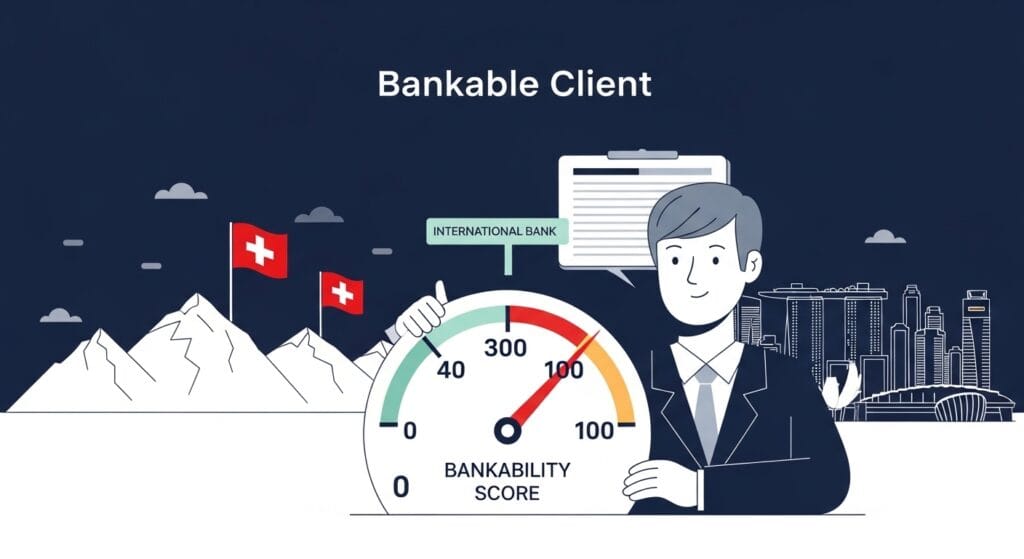
Our deeper analysis of the bankability scoring framework for Swiss and Singapore institutions covers how compliance teams translate these individual risk variables into a composite score — and what realistic improvement looks like for borderline profiles.
The Mistakes That Kill Otherwise Solid Applications
These aren't hypothetical. They're patterns from rejected applications that came back for re-assessment.
Concealing PEP status. Banks run World-Check, Refinitiv, and adverse media screening as standard. If your profile appears on any of these and you failed to disclose it, that inconsistency alone is grounds for immediate rejection — not because of the status itself, but because the failure to disclose signals either negligence or deliberate concealment. Either interpretation is worse than the original risk. Disclose proactively, frame it accurately, and present it with documentation rather than hoping it won't come up.
Corporate structures that weren't designed with banking in mind. A BVI holding company set up for tax or estate planning reasons can create genuine compliance problems at the banking stage if the beneficial ownership chain isn't clean and documentable. Banks cannot onboard clients where the UBO cannot be identified and verified. If your assets sit in structures that made sense commercially but were never reviewed for banking compliance, get that review done before you approach any institution. Presenting a complex structure without a clear explanatory note is a red flag even when everything is legitimate.
Approaching multiple banks simultaneously with the same incomplete file. Banks talk — not directly about specific applications, but through shared databases and adverse media systems. A declined application at one institution can appear in compliance searches at another. If you're not yet ready to present a complete, coherent application, don't present an incomplete one. The cost of a rejection is not just the lost time — it's the mark it leaves on your profile.
Not understanding the difference between a relationship manager's enthusiasm and the compliance committee's decision. Relationship managers are incentivised to bring in assets. They may signal genuine optimism about your application and then come back weeks later with a rejection from compliance. This is not bad faith — it reflects the fact that the RM and the compliance team are answering different questions. The RM is assessing your commercial fit. The compliance committee is assessing your regulatory risk. Both have to say yes. Don't mistake one for the other.
What Happens After You're Onboarded
Approval is not the end of the process. PEP relationships require ongoing enhanced monitoring for as long as the classification applies — and in practice, considerably beyond that for high-profile former officials. Banks will conduct periodic full KYC reviews, typically annually. Transaction patterns are monitored against your declared activity profile. A PEP client whose account activity suddenly diverges from their documented source of funds will trigger a review, not a question — the bank files a Suspicious Activity Report first and asks questions as part of the investigation.
The practical implication: keep your relationship manager informed of material changes. A new business investment, an inheritance, a property sale — anything that changes your source of funds picture should be proactively communicated with documentation, before the transaction, not after. Banks with PEP clients who manage the relationship well and communicate proactively have vastly better ongoing experiences than those who treat the bank as a passive account holder. The monitoring obligation doesn't go away. The quality of that monitoring experience is, in part, something you can influence.
The EU AML Regulation, expected to take effect in 2027, will harmonise PEP definitions across all EU member states and introduce a central AML authority. For PEP clients with EU banking relationships, this will likely result in more standardised documentation requirements — which is both a constraint and, for well-documented clients, a potential simplification compared to current institution-by-institution variation.
Where to Start if You're Approaching This for the First Time
The honest answer is: with a candid self-assessment before you contact any bank. Specifically — map your assets, quantify the total, identify which sources are clearly documented and which require explanation, and assess your position against the risk variables in the table above. That exercise tells you two things: which tier of institution is realistic given your AUM, and where your documentation has gaps that need to be closed before you're ready to apply.
If the self-assessment surfaces complexity — corporate structures that need reviewing, a source of wealth narrative that isn't yet coherent, uncertainty about whether your specific position qualifies as PEP under different jurisdictions' definitions — that work should happen before any bank approach, not during it. For a broader view of how Swiss and Singapore institutions assess profiles like yours, the guide to Swiss bank accounts for non-residents covers the full onboarding landscape including how PEP flags interact with residency and nationality risk scoring.
And if the self-assessment tells you your profile is borderline — the AUM is at the lower end, the jurisdiction of origin carries weight, the time since leaving office is recent — that's useful information too. A borderline profile submitted at the wrong moment to the wrong institution doesn't just get rejected; it creates a record that makes the next approach harder. Timing and institution selection matter as much as documentation quality.
We work with clients navigating exactly this kind of assessment at Easy Global Banking contact page. Not every PEP profile is ready for Switzerland or Singapore right now — and for profiles that aren't, there are intermediate steps that can genuinely improve outcomes over 12–18 months. We'll tell you honestly where you stand, which means sometimes the advice is to wait and prepare rather than apply and fail. That's the advice that actually serves your interests.
Related reading:
- The Bankability Score: A Public Formula to Rate How “Openable” You Are for Swiss & Singapore Banks
- High-Risk Business Banking: 6 Best Proven Jurisdictions 2026
- How to Document Crypto Income for a Bank Application: The 2026 Compliance Guide