
Having your Swiss bank account approved is meaningless if the US correspondent clearing bank seizes your first transfer on day one. Your Zurich onboarding committee can clear your Source of Wealth, sign off on Form A, and issue your Swiss IBAN—and your initial $2,000,000 funding wire can still vanish into an unmonitored New York compliance queue for three weeks.
The operational script repeats across Europe, the Gulf, and Asia every business day. An entrepreneur clears four months of KYC due diligence at a Swiss or Singapore private bank, instructs their regional bank to wire initial capital, and watches the debit leave their sending account within an hour. Four days later, the private bank balance still reads zero. The remitting bank tells the client: “The funds have left our system; contact the receiving bank.” The Swiss or Singapore private banker checks the settlement ledger and responds: “Nothing has settled into our account; ask your sending bank to trace it.”
The Purgatory of the First Deposit
Your money is not lost in cyberspace, and neither bank is necessarily lying. Your capital is sitting inside an automated sanctions or AML exception queue at an intermediary correspondent clearing bank—most commonly in New York for US Dollars or Frankfurt for Euros—that neither you nor your Swiss private banker controls. When an intermediary bank is holding a wire transfer, frontline customer service representatives at retail banks lack terminal access to the SWIFT investigations queue and have no idea where the cash actually sits.
Worse, most wealth holders waste their first ten business days trying to call, email, or hire lawyers to contact the intermediary clearing bank directly. That strategy fails 100 percent of the time because of a rigid principle of international clearing law: locus standi (legal standing). A New York or Frankfurt clearing correspondent holds a bilateral nostro/vostro banking contract solely with its direct correspondent bank—never with the underlying remitter and never with the end beneficiary. The correspondent bank has zero legal customer duty toward you. Under US Bank Secrecy Act and European banking confidentiality frameworks, its compliance desk will neither confirm nor deny holding your wire if you telephone them. The correspondent bank does not care. Only an authenticated interbank SWIFT message originating from its direct correspondent node—the remitting bank’s treasury operations desk—possesses standing to release the queue.
Before blaming your newly appointed private banker, understand the structural plumbing that traps clean capital between two fully compliant institutions—and note that passing initial onboarding clearance (as detailed in our forensic analyses of CRS 2.0 tax residency substance and 180-day post-onboarding de-risking controls) provides zero immunity against third-party clearing-rail holds.
The Cover Payment Decoupling: pacs.008 vs. pacs.009 COV
To understand why a Zurich relationship manager can literally see your incoming $3,000,000 transfer on their terminal screen yet refuse to credit your portfolio, you must examine the two-leg clearing architecture used across cross-border private banking: the Cover Method.
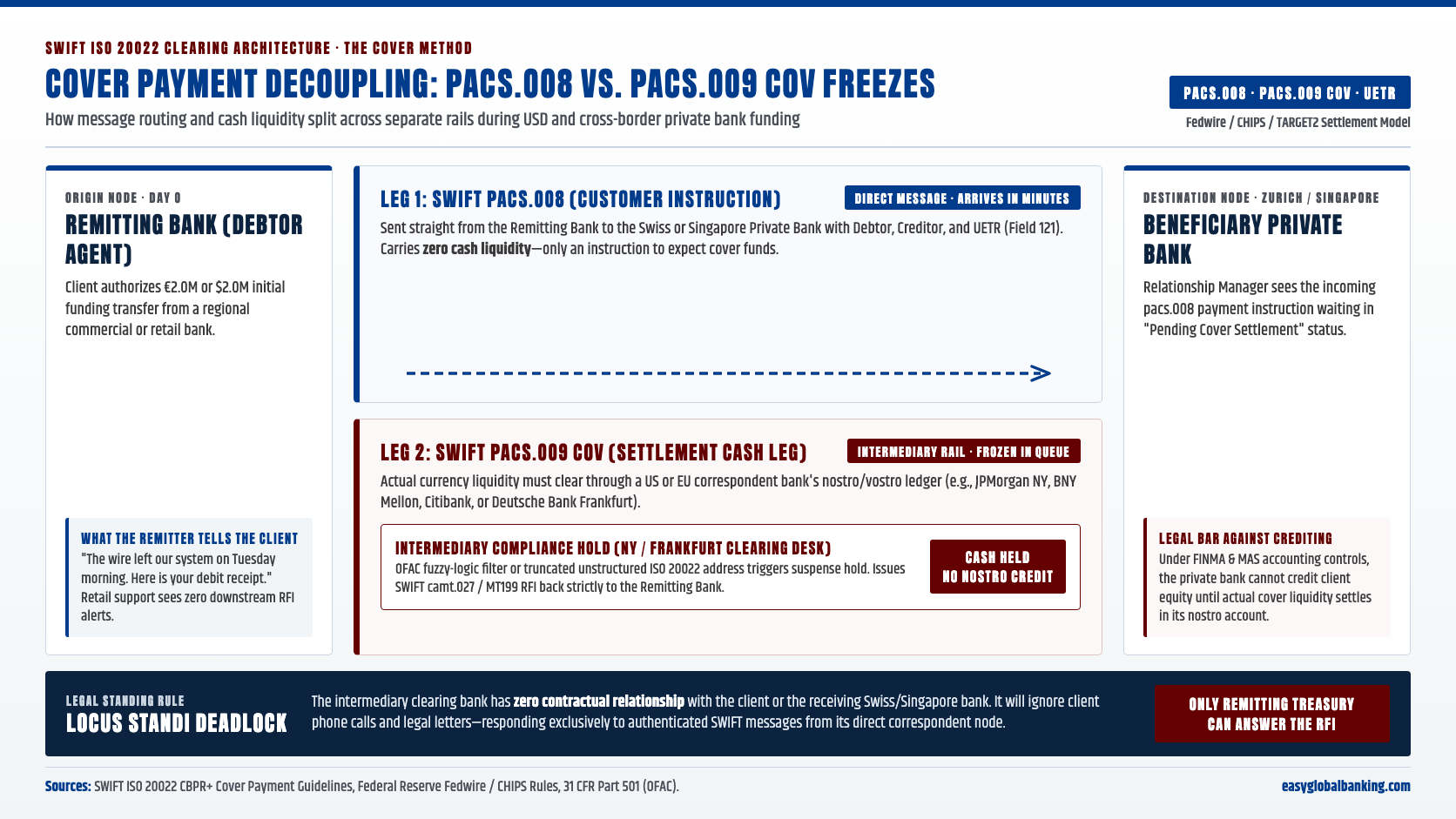
When two banks do not maintain a direct bilateral account relationship in the settlement currency—for example, a commercial bank in Dubai or Warsaw wiring US Dollars to a boutique private bank in Geneva or Zurich—the remitting bank splits the transfer into two separate ISO 20022 XML messages linked by a shared 36-character tracking hash:
- The Direct Information Leg (
pacs.008.001.08— FI-to-FI Customer Credit Transfer): This XML instruction travels directly over SWIFT from the remitting bank to the Swiss or Singapore private bank. It carries your legal name, account IBAN, structured postal address, remittance purpose, and exact dollar figure. It typically lands in Zurich or Singapore within two minutes—carrying zero actual cash. - The Settlement Cash Leg (
pacs.009.001.08 COV— Financial Institution Cover Transfer): Actual US Dollar or Euro central-bank liquidity cannot teleport across borders; it must settle in the central bank money of the issuing currency’s home jurisdiction. The remitting bank transmits a separatepacs.009 COVsettlement order instructing its New York USD clearing bank (such as JPMorgan Chase, BNY Mellon, or Citibank) to debit its nostro account and credit the Swiss bank’s USD nostro correspondent via Fedwire or CHIPS.
This decoupling creates the Private Banker’s Dilemma. Your Relationship Manager sees the pacs.008 instruction sitting in “Pending Cover Settlement” status. The bank wants your assets under management; your banker wants the mandate funded. Yet under FINMA accounting standards and MAS liquidity controls, a private bank is strictly prohibited from crediting client equity until the corresponding pacs.009 COV cash leg reconciles unconditionally inside its nostro ledger. If the New York intermediary freezes the cover leg at 09:14 EST, the Swiss bank is left staring at an unfunded electronic promise.
Every major settlement currency runs through a distinct national clearing engine with its own regulatory jurisdiction and failure profile. The matrix below maps the four dominant currencies used to fund Swiss and Singapore private bank accounts.
| Settlement Currency | Primary Clearing Engine & Location | Intermediary Clearing Node Examples | Governing Regulatory Oversight | Primary Freeze Vulnerability |
|---|---|---|---|---|
| USD (US Dollar) | Fedwire / CHIPS (New York, USA) | JPMorgan Chase, BNY Mellon, Citibank, Bank of America | US OFAC, FinCEN, USA PATRIOT Act (Sec. 311/312) | Automated fuzzy-logic keyword filters on names, common Arabic/Slavic phonetic matches, transit through regional non-FATF corridors. |
| EUR (Euro) | TARGET2 / EURO1 / SECB (Frankfurt / Zurich) | Deutsche Bank AG, BNP Paribas, Swiss Euro Clearing Bank (SECB) | European Central Bank, BaFin, EU Sanctions Regimes | EU Verification of Payee (VoP) mismatch (live since Oct 2025), lack of mandatory structured Remittance Information (<RmtInf>). |
| CHF (Swiss Franc) | SIC (Swiss Interbank Clearing) (Zurich, CH) | Swiss National Bank (SNB) / SIX Interbank Clearing; UBS AG, ZKB | FINMA, Swiss National Bank, Swiss AMLA (GwG) | Lowest international intermediary risk; direct domestic clearing if sent from a bank holding a direct SIC participant account. |
| SGD (Singapore Dollar) | MEPS+ (MAS Electronic Payment System) | DBS Bank, OCBC Bank, UOB | Monetary Authority of Singapore (MAS Notice 626) | High-value AML transaction holds; cross-border remitter beneficial ownership verification. |
Why Intermediary Neural Filters Trap Clean Money
Sophisticated clients frequently protest: “I am not sanctioned, my company is audited, and neither I nor my counterparty has ever set foot in the United States.” That objection misunderstands how modern correspondent screening engines operate. Clearing banks process millions of high-value transfers daily; their compliance filters are engineered for zero regulatory liability, not nuanced commercial interpretation. Three technical triggers trap completely clean deposits:
1. The Extraterritorial US Dollar Jurisdiction Nexus
Whenever a wire is denominated in US Dollars—even a transfer from a Swiss citizen’s corporate account in Dubai to a personal custody account in Zurich—the cash leg must clear across Fedwire or CHIPS in New York. Touching a New York clearing ledger grants the US Treasury’s Office of Foreign Assets Control (OFAC) and FinCEN immediate extraterritorial jurisdiction over the transaction. New York clearing filters deploy aggressive fuzzy-logic phonetic screening against SDN lists, sectoral sanctions directives, and sanctioned geographic keywords. A benign town name, a common Slavic or Arabic surname overlapping 85 percent with a designated entity, or a reference line containing an ambiguous acronym (such as a vessel name or regional trading code) halts the pacs.009 COV cover payment instantly.
2. The ISO 20022 Data Cleansing & Structured Address Failure
Following SWIFT’s global migration from legacy MT messaging to ISO 20022 XML (CBPR+), correspondent banks rebuilt their automated sanctions and AML parsers around structured XML tags—specifically separating Debtor and Creditor details into discrete <PstlAdr> elements (street name, building number, postal code, <TwnNm>, and two-letter ISO <Ctry>) alongside structured <RmtInf> remittance purpose codes. Although SWIFT deferred its originally scheduled November 2026 network-wide hard stop on fully unstructured addresses to accommodate lagging regional banks, Tier-1 US and European clearing correspondents already penalize unstructured free-text payloads inside their compliance engines. When a legacy regional remitting bank truncates your address into unstructured <AdrLine> text or leaves <Ustrd> remittance fields blank (writing simply “Transfer” or “Own Funds”), automated screening engines cannot verify whether the sender resides in a sanctioned territory—automatically routing the wire into manual review. For Euro transfers routed through Frankfurt or the Swiss Euro Clearing Bank (SECB), the EU Instant Payments Regulation’s Verification of Payee (VoP) mandate—enforced across Eurozone payment service providers since October 9, 2025—adds another strict automated gate: even minor spelling discrepancies between legal entity names and IBAN registrations trigger immediate friction.
3. High-Risk Regional Transit Corridors
Intermediary neural models weight payment geography heavily before examining underlying wealth provenance. First-time seven-figure wires originating from or transiting through regional commercial hubs—including the UAE, Turkey, Cyprus, Hong Kong, or offshore island jurisdictions—are routinely routed into enhanced manual triage by New York and Frankfurt correspondents, regardless of how thoroughly the receiving Swiss or Singapore private bank already vetted the client’s Source of Wealth.
Interactive Pre-Wire Route Checker · Correspondent Rail & OFAC Freeze Test
Will an Intermediary Bank Freeze Your Wire?
What this tool does: Before you send a €500,000+ wire to Switzerland or Singapore, test your planned transfer below. It identifies which hidden clearing bank your cash will pass through (New York, Frankfurt, Zurich, or Singapore), scores your freeze probability (0–100), and gives you the exact rerouting fix or RFI documents to prepare before releasing funds.
Step 1: Load a Common Transfer Scenario (or Customize the 4 Inputs Below)
Live Clearing Path: Where Your Money Actually Travels
Step 2: Configure Your Transfer Parameters
What the Intermediary Clearing Desk Will Check & Demand
Score capped at 100. Zones: 0–30 Low Clearing Friction (Brand Navy), 31–65 Intermediary RFI / Manual Triage Risk (Muted Slate), 66–100 High OFAC / Correspondent Freeze Probability (Deep Burgundy).
The Request for Information (RFI) Black Hole
Once an intermediary correspondent's neural filter intercepts the pacs.009 COV cash leg, the transaction enters a strictly timed operational sequence that most retail clients discover only after the clock has nearly expired.
- Suspense Segregation & Interbank RFI Dispatch (Day 0–1): The clearing correspondent removes the wire from straight-through processing, parks the liquidity in an internal non-interest-bearing suspense ledger, and fires an authenticated interbank Request for Information—via SWIFT
MT199or ISO 20022camt.027/ case-management inquiry—strictly back to its direct correspondent, the remitting bank. - The Retail Support Breakdown (Day 2–9): That authenticated SWIFT inquiry lands inside the remitting bank's centralized Payment Investigations or Correspondent Treasury queue—not on the desk of the branch officer or retail relationship manager who assisted the client. When the client calls customer support asking where their €2,000,000 is, the teller checks only the retail debit screen, sees "Completed," and tells the client to wait another 5 business days. Meanwhile, the intermediary's RFI sits unanswered in a back-office queue.
- The 10-to-15 Business Day Statutory Cutoff (Day 10–15): Correspondent banks will not hold unsettled suspense funds indefinitely. If the remitting bank fails to return a complete, authenticated compliance response within the intermediary's operational window (typically 10 to 15 business days), one of two punishing outcomes occurs. For a standard AML or missing-data RFI, the intermediary rejects the cover payment and returns the funds via
pacs.004, deducting double correspondent fees and punitive two-way FX conversion spreads while flagging the sender for repeated screening. Worse, if the hold stemmed from an unresolved US sanctions match, OFAC regulations under 31 CFR Part 501 mandate a hard block rather than a return: the US clearing bank transfers your cash into a segregated, interest-bearing blocked account, reports the seizure to OFAC within 10 business days, and freezes all standard SWIFT recall paths. Liberating blocked capital requires filing a formal legal petition with the US Treasury for an OFAC Specific License—a process routinely lasting 6 to 18 months.
Understanding every ISO 20022 message code in this sequence lets you speak the exact operational language of treasury clearing desks rather than accepting vague assurances from retail support.
| SWIFT Message / Component | Technical Role in Wire Lifecycle | Where It Stalls | Why It Gets Frozen | The Tactical Fix |
|---|---|---|---|---|
pacs.008.001.08(Customer Credit Transfer) | Direct payment instruction sent from Remitting Bank to Swiss/Singapore Beneficiary Bank. | Beneficiary Bank Front Office. | Arrives intact, but stays in "Pending Settlement" status because the underlying cover funds have not arrived. | Relationship Manager confirms receipt of message and monitors the UETR pipeline. |
pacs.009.001.08 COV(Financial Institution Cover) | Settlement message routing the actual liquidity through intermediary correspondent banks. | Intermediary Clearing Desk (e.g., NY / Frankfurt). | Algorithmic Sanctions/PEP alert triggered by unstructured debtor address, counterparty name similarity, or high amount. | Remitting bank treasury must answer the intermediary's authenticated RFI (MT199 / camt.027) with verified KYC proof. |
UETR (RFC 4122)(36-character UUID) | Unique End-to-End Transaction Reference tracking the wire across every intermediary hop. | Visible across the entire SWIFT GPI network. | Frontline retail tellers fail to provide the UETR copy to the client, blocking real-time node visibility. | Client demands the full MT103/pacs.008 transcript showing Field 121 (UETR) to pinpoint the exact holding BIC. |
camt.056 / pacs.004(Recall / Return of Funds) | Cancellation request or return of payment when an intermediary hold cannot be cleared. | Correspondent Bank Operations. | Intermediary hold hits the 10-to-15 business day statutory deadline without a satisfactory RFI reply. | Client must block the sending bank from filing a recall during screening, which escalates evasion flags and incurs heavy FX/fee haircuts. |
The Resolution Protocol: Triangulating with UETR and SWIFT GPI
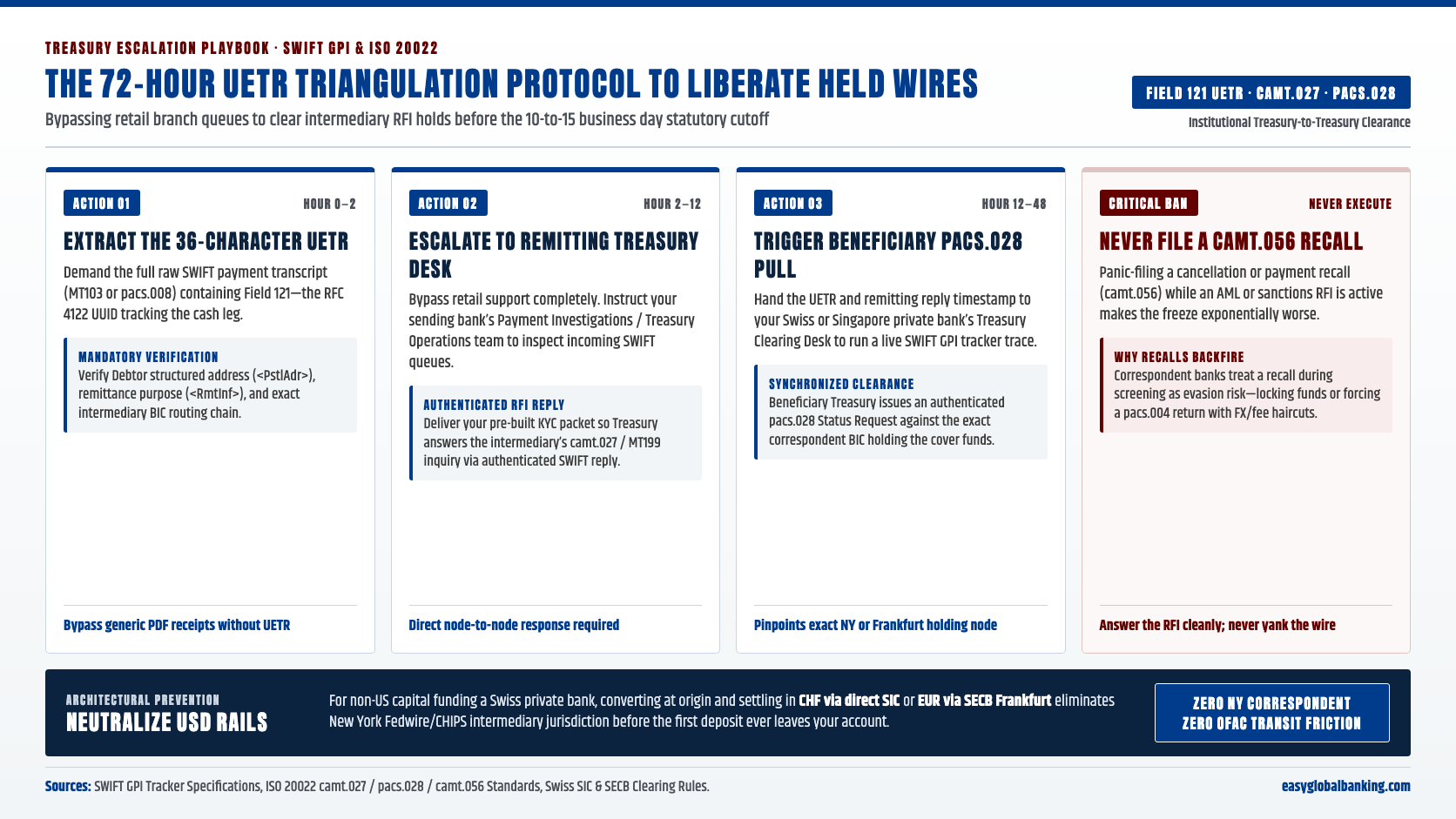
When a high-value initial deposit fails to credit your Swiss or Singapore account by T+2 business days, stop calling retail customer service. Execute the four-action UETR Triangulation Protocol to force direct treasury-to-treasury resolution within 72 hours.
Action 1: Extract the 36-Character Field 121 UETR Transcript
Demand the raw interbank SWIFT payment confirmation (MT103 / pacs.008 transmission copy)—never a branded retail PDF receipt—from your sending bank. Locate Field 121, which contains the 36-character RFC 4122 Unique End-to-End Transaction Reference (UETR) (formatted as xxxxxxxx-xxxx-4xxx-yxxx-xxxxxxxxxxxx). Simultaneously inspect the raw payload for formatting damage: verify whether your sending bank preserved your structured residential address, included your explicit payment purpose, and routed through the exact correspondent BIC supplied by your Swiss or Singapore bank.
Action 2: Force Escalation to the Remitting Bank's Treasury Investigations Desk
Send a formal written instruction bypassing branch support and demanding escalation to the remitting bank's Payment Investigations / Correspondent Treasury Operations Desk. Instruct them specifically to pull all incoming SWIFT MT199, camt.027, and GPI exception messages tied to your exact UETR. Do not wait for them to tell you what documents the intermediary wants—attach your turnkey RFI clearance bundle upfront: certified passport copy, exact date and place of birth, residential utility proof, executed underlying contract (share sale, dividend resolution, or property deed), and a 3-month statement confirming prior source of funds (aligned with our blueprint on drafting an institutional Source of Wealth dossier). This enables Treasury Operations to dispatch a complete, authenticated SWIFT reply in a single message cycle.
Action 3: Synchronize a Beneficiary pacs.028 Pull from Zurich or Singapore
Forward the exact UETR copy and the timestamp of your remitting bank's authenticated RFI reply to your Swiss or Singapore Relationship Manager, requesting immediate handoff to their Treasury Clearing Desk. Using the SWIFT GPI Tracker, the receiving private bank can see precisely which intermediary BIC (for instance, CHASUS33 in New York or DEUTDEFF in Frankfurt) currently holds the liquidity and whether the status changed from ACSP/G002 (Pending Compliance) to Released. Where cover liquidity stalls beyond 48 hours after an authenticated remitting reply, your Swiss or Singapore treasury desk can dispatch an authenticated pacs.028 Payment Status Request directly against the holding correspondent to accelerate nostro reconciliation.
Action 4: Strictly Prohibit a camt.056 Payment Recall During Active Screening
Panicked clients routinely beg their sending bank to "cancel the wire and pull the money back" via a SWIFT camt.056 recall request. Never do this while an intermediary AML or sanctions RFI is active. First, a clearing correspondent is legally barred from honoring a recall while a sanctions or AML review is open. Second, attempting to yank seven-figure funds back the moment compliance asks a question is a textbook evasion red flag—turning a routine phonetic false positive into a formal FinCEN SAR or prolonged review. Answer the RFI cleanly, allow settlement to complete, and keep the audit trail spotless.
Architectural Prevention: How to Structure High-Value First Deposits
The fastest way to beat an intermediary clearing freeze is to engineer the payment rail so your money never enters an adversarial jurisdiction in the first place. While institutional payment rails are slowly evolving toward tokenized 24/7 settlement—as examined in our coverage of JPMorgan and DBS 24/7 tokenized cross-border dollar settlement and Swiss Instant Payments over SIC—private wealth funding in 2026 still settles predominantly across traditional correspondent plumbing.
Apply two architectural controls before authorizing any seven-figure deposit to Switzerland or Singapore:
- Execute Currency Routing Arbitrage Before Wiring: If you are a non-US principal funding a Swiss private bank with capital currently held in US Dollars at a European, UK, or Gulf bank, ask why you are exposing clean funds to New York Fedwire/CHIPS clearing at all. Converting at an institutional FX desk at your originating bank and funding the Swiss custody account in Swiss Francs (CHF) via direct SIC rails—or in Euros (EUR) via SECB Frankfurt—eliminates US correspondent intermediaries and OFAC transit friction entirely. Once settled safely inside Zurich, you can convert back to USD custody securities internally with zero cross-border clearing exposure. Similarly, for Asian custody funding structured under the 2026 Singapore private banking onboarding framework, settling in SGD via MEPS+ or via a directly aligned multi-currency correspondent eliminates unnecessary third-party cover hops.
- Enforce the 5-Day Pre-Flight Clearing Protocol: Five business days before authorizing your first wire, send your Swiss or Singapore Relationship Manager the exact remitting bank BIC, exact transfer currency and amount, executed contract or dividend resolution, and 3-month remitting bank statement—and obtain the beneficiary bank's preferred direct correspondent routing sheet (SSI). Hand that exact SSI sheet to your remitting bank's treasury desk with explicit written instructions to populate structured ISO 20022 address tags and a clear remittance purpose.
Run every seven-figure funding transfer through the Pre-Wire Correspondent Cleansing Checklist below before signing the release.
Pre-Flight Treasury Control · Seven-Figure Initial Funding
The Pre-Wire Correspondent Cleansing Checklist
Routing & Currency
ISO 20022 Formatting
SWIFT Tracking & Evidence
Verify every routing, ISO 20022 schema, and tracking control below before authorizing a seven-figure initial transfer to Zurich, Geneva, or Singapore.
Frequently Asked Questions
Why can my Swiss bank see my incoming wire on screen but refuse to credit my account?
Under the SWIFT Cover Method, the customer payment instruction (pacs.008) travels directly to your Swiss bank within minutes, whereas the actual cash settlement leg (pacs.009 COV) routes separately through an intermediary correspondent bank in New York or Frankfurt. Until actual cover liquidity settles in the Swiss bank's nostro account, FINMA accounting rules legally bar the bank from crediting your balance.
Can I call JPMorgan, Citibank, or BNY Mellon directly to release my held USD wire?
No. Under correspondent banking locus standi rules, an intermediary clearing bank has no contractual relationship with either the sender or the end beneficiary. Its compliance operations desk will communicate strictly via authenticated SWIFT messages with its direct correspondent—your remitting bank's treasury operations department.
What is a UETR and why do I need it to trace a frozen SWIFT wire?
The UETR (Unique End-to-End Transaction Reference) is a 36-character RFC 4122 identifier located in Field 121 of your SWIFT MT103 or pacs.008 confirmation. It allows both your remitting bank's treasury team and your Swiss or Singapore private bank to track the exact intermediary BIC holding the cash in real time over the SWIFT GPI network.
Should I ask my sending bank to recall a wire if an intermediary bank holds it for compliance review?
No. Submitting a SWIFT camt.056 recall while an AML or sanctions RFI is open cannot override an active compliance hold and signals potential evasion to the intermediary's risk desk. Instead, escalate to your remitting bank's Treasury Investigations team to submit a complete authenticated compliance response answering the RFI.
Primary Statutory & Technical Clearing References
- SWIFT — ISO 20022 Cross-Border Payments and Reporting Plus (CBPR+) Messaging Standards (pacs.008, pacs.009 COV, pacs.028, camt.027 & Structured Postal Address Guidance)
- U.S. Electronic Code of Federal Regulations — 31 CFR Part 501 (OFAC Reporting, Procedures and Penalties Regulations & Specific Licensing)
- SIX Interbank Clearing & Swiss National Bank — Swiss Interbank Clearing (SIC) and Swiss Euro Clearing Bank (SECB Frankfurt) Infrastructure
- European Union (EUR-Lex) — Regulation (EU) 2024/886 on Instant Credit Transfers in Euro (Verification of Payee / VoP Mandate Effective October 9, 2025)
- Monetary Authority of Singapore (MAS) — MEPS+ Real-Time Gross Settlement System & MAS Notice 626 Compliance Framework
Cross-Border Payment Governance Rule: Never release a seven-figure initial wire until you have neutralized unnecessary US correspondent rails, verified structured ISO 20022 address tags on the sending voucher, and secured your Field 121 UETR tracking string within two hours of transmission.
Editorial Disclosure: Easy Global Banking (operated by BMA Business Solutions GmbH, Switzerland) provides independent cross-border banking advisory and treasury compliance readiness analysis. We are not a bank, clearing house, or law firm. Parties whose funds have been formally blocked under US OFAC regulations (31 CFR Part 501) must retain licensed US sanctions counsel to petition for a Specific License.