
The most dangerous day of a foreign bank account relationship is not the day you apply, but the 180th day after your first deposit. By month six, onboarding due diligence is history, relationship managers have moved on to fresh mandates, and your live SWIFT wires are being scored relentlessly against the paper assumptions you signed on Day 1.
Every quarter in Zurich, Geneva, Vaduz, and Singapore, legitimate entrepreneurs and family office principals spend three to six months clearing exhaustive onboarding scrutiny—submitting notarized corporate charts, audited tax returns, and multi-year Source of Wealth narratives—only to receive a registered letter six to twelve months later invoking the bank’s General Terms and Conditions (Allgemeine Geschäftsbedingungen, or AGB) and granting exactly 30 days to move their assets out. No reason is given. No compliance hearing is offered. Compliance is under zero obligation to hear your explanation.
The 180-Day Cliff: Why Approval Is Only Provisional
Most international clients make a fatal conceptual error: they treat private bank onboarding as a permanent clearance certificate. Inside a Tier-1 institution regulated by FINMA in Switzerland or the Monetary Authority of Singapore (MAS), onboarding approval is strictly provisional. It represents a single snapshot in time—an agreement by the Onboarding Committee that your theoretical client risk profile falls within institutional tolerances.
That theoretical baseline contains four binding numerical boundaries: your declared annual incoming and outgoing turnover, your declared payment jurisdictions, your named commercial or personal counterparties, and your stated account purpose (for example, long-term wealth preservation versus active operating treasury). The moment your first deposit clears, custody of your risk rating shifts from human onboarding analysts to an automated Transaction Monitoring System (TMS).
Onboarding compliance is static; transaction monitoring is dynamic and mathematical. Over the first 90 to 180 days, the TMS builds a live behavioral ledger of every incoming credit, foreign exchange conversion, and outgoing SWIFT wire. When your actual transactions diverge sharply from the static Client Risk Profile baseline—a phenomenon compliance departments track as Transaction Profile Drift—the monitoring engine does not ask whether your capital is tax-paid or clean. It flags a statistical anomaly and pushes the file onto the De-Risking Guillotine. This explains the recurring shock behind searches for why a Swiss bank closed my account without reason or why a Singapore private bank issued a 30-day closure notice to a client who never broke a law. As outlined in our broader jurisdictional overview of 2026 debanking rules across the UK, US, EU, and Switzerland, sudden exits rarely stem from proven criminality; in private banking, they stem overwhelmingly from unexplained deviation from the original KYC envelope.
The Algorithmic Engine: What “Transaction Profile Drift” Means in Practice
Tier-1 Swiss and Singapore wealth managers do not rely on relationship managers visually scanning monthly statements. Under AMLO-FINMA in Switzerland and MAS Notice 626 (Paragraphs 6.19–6.26) in Singapore, licensed banks are legally required to deploy automated surveillance platforms—predominantly enterprise deployments of NICE Actimize, BAE Systems NetReveal, or Fenergo—tuned to detect complex, unusually large, or structurally inconsistent flows.
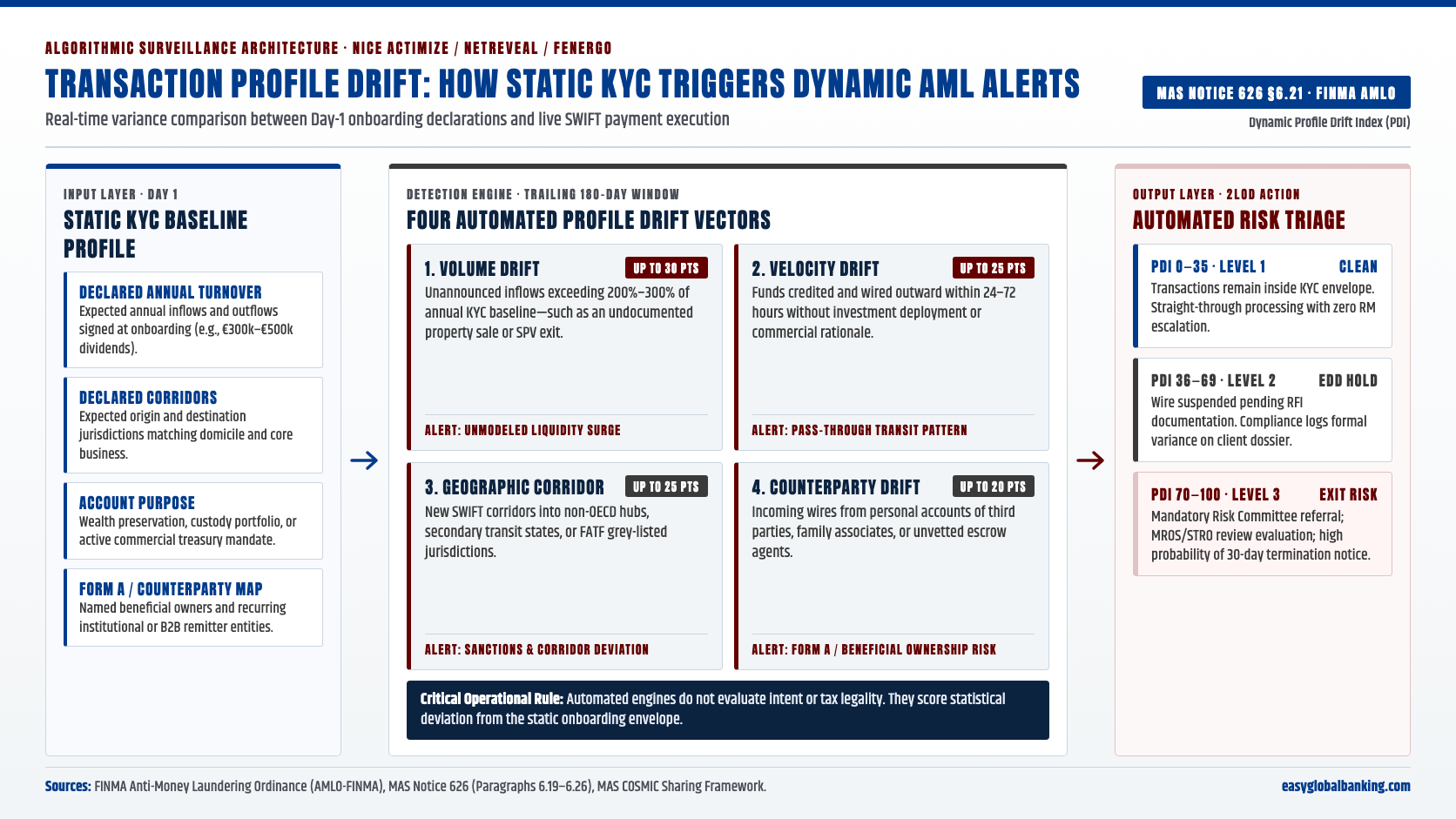
Inside these surveillance engines, every account generates a rolling Dynamic Profile Drift Index (PDI). Rather than evaluating transactions in isolation, the software compares rolling 30-, 90-, and 180-day account activity against the numeric and geographic parameters entered into the core banking system during onboarding. Four specific drift vectors account for nearly all post-onboarding account terminations:
- Volume Drift: An entrepreneur states during onboarding that the account will receive €300,000 annually in corporate dividends from a German GmbH. Seven months later, the client sells an investment property or receives a €1.5 million shareholder loan repayment without warning the bank. Because the incoming credit breaches 300 percent of declared annual turnover in a single value date, the TMS instantly escalates a Level 3 AML anomaly.
- Velocity Drift (Pass-Through Transit Alarm): Private wealth accounts are priced and risk-modeled for capital accumulation and multi-year custody. If €800,000 arrives on Tuesday morning and €780,000 is wired out to two external counterparties on Wednesday afternoon, automated rules classify the account as a pass-through transit account—the textbook behavioral signature of layering.
- Geographic Corridor Drift: At onboarding, the client declared counterparties strictly within Germany, Austria, and Switzerland. Six months later, disbursements begin routing to vendors or escrow agents in Turkey, the UAE, Hong Kong, or FATF grey-listed jurisdictions. Even when the underlying invoice is legitimate, an unmodeled payment corridor triggers an immediate Level 2 Sanctions and Corridor Alert, freezing outgoing SWIFT settlement pending manual clearing review.
- Counterparty and Beneficial Ownership Drift: Under Swiss CDB 20 Form A declarations and MAS Notice 626 beneficial ownership standards, the bank cleared specific commercial entities or the client’s personal accounts at peer OECD banks. Incoming wires arriving from personal accounts of business partners, family associates, or unvetted third-party escrow companies raise immediate pooling and beneficial-ownership-mismatch alarms.
Worse still, in Singapore the surveillance perimeter is no longer isolated inside a single institution. Through MAS’s COSMIC (Collaborative Sharing of Money Laundering/Terrorism Financing Information & Cases) platform, major participating Singapore banks can share structured red-flag intelligence regarding misuse of legal persons, hidden networks, and unexplained transaction flows. An unaddressed profile drift anomaly at one bank can rapidly harden your risk posture across the wider financial hub. Before assuming your account activity looks benign, review how automated engines score real-world deviations in the matrix below.
| Baseline Onboarding Profile Parameter | The Operational Deviation (“Profile Drift”) | Algorithmic Alert Level (TMS Engine) | Internal Compliance Assessment | Relationship Manager (CRM) Dilemma |
|---|---|---|---|---|
| Annual Inflow: €500k from EU holding company dividends. | Sudden Inflow: €2.8M lump-sum wire from an offshore SPV following a secondary asset sale. | Level 3 AML Alert (Critical) | Unannounced liquidity event; unverifiable intermediary chain; unmodeled surge in account velocity. | Faces 14 days to collect notarized contracts or submit file to Risk Committee; prefers offboarding to reduce personal regulatory risk. |
| Payment Geography: Commercial counterparties in Germany, Austria, and Switzerland. | Payment Geography: Third-party vendor disbursements routed to Turkey, UAE, or Hong Kong. | Level 2 Sanctions & Corridor Alert | High-risk transit jurisdiction; nexus to potential FATF grey-list intermediaries or transit hubs. | Bank clearing operations freeze outgoing SWIFT; compliance desk flags file for systemic corridor deviation. |
| Transaction Counterparties: B2B commercial entities with matching corporate websites. | Transaction Counterparties: Incoming wires from personal accounts of corporate shareholders or family associates. | Level 2 Beneficial Ownership Mismatch | Third-party pooling risk; possible pass-through account usage; potential circumvention of Form A declarations. | Operations team requires audited loan agreements and source-of-funds documentation for every individual remitter. |
| Asset Allocation: Wealth preservation; 80% custody in Swiss bonds and equities. | Asset Allocation: Account liquidated to cash; frequent high-velocity FX conversions and outgoing wires. | Level 3 Account Misuse Alert | Commercial trading or treasury pass-through activity in a private wealth management account. | High compliance monitoring overhead with zero recurring wealth management fee margin; account marked for commercial closure. |
Interactive Compliance Simulator · Dynamic Transaction Monitoring Model
The Profile Drift Risk Calculator
Measure how far your planned or recent account activity diverges from your Day-1 onboarding baseline—and calculate your exposure to a 30-day termination notice.
Internal Risk Committee Remediation Output
Lower scores indicate tighter alignment with your Day-1 KYC baseline. Zones: 0–35 Clean Baseline Profile (Dark Navy), 36–69 Enhanced Due Diligence Review (Muted Slate), 70–100 Automated De-Risking Triage / High 30-Day Exit Risk (Deep Burgundy).
The Structural Tension: Why Your Relationship Manager Will Not Save You
When a compliance alert locks an incoming wire or triggers a Request for Information (RFI), most clients assume their dedicated Relationship Manager—the executive who courted them over lunch on Bahnhofstrasse or at Marina Bay Financial Centre—will step in and clear the misunderstanding. That assumption misunderstands the modern architecture of private bank governance.
Every Tier-1 Swiss and Singaporean bank operates under a rigid statutory separation between the First Line of Defense (1LoD)—Client Relationship Managers (CRMs) and Front Office market heads—and the Second Line of Defense (2LoD)—the independent Financial Crime Unit, Legal & Compliance, and the Client Risk Committee. Under FINMA enforcement standards and MAS supervisory inspections, Front Office bankers cannot override a 2LoD hold. They can only submit evidence and plead a case.
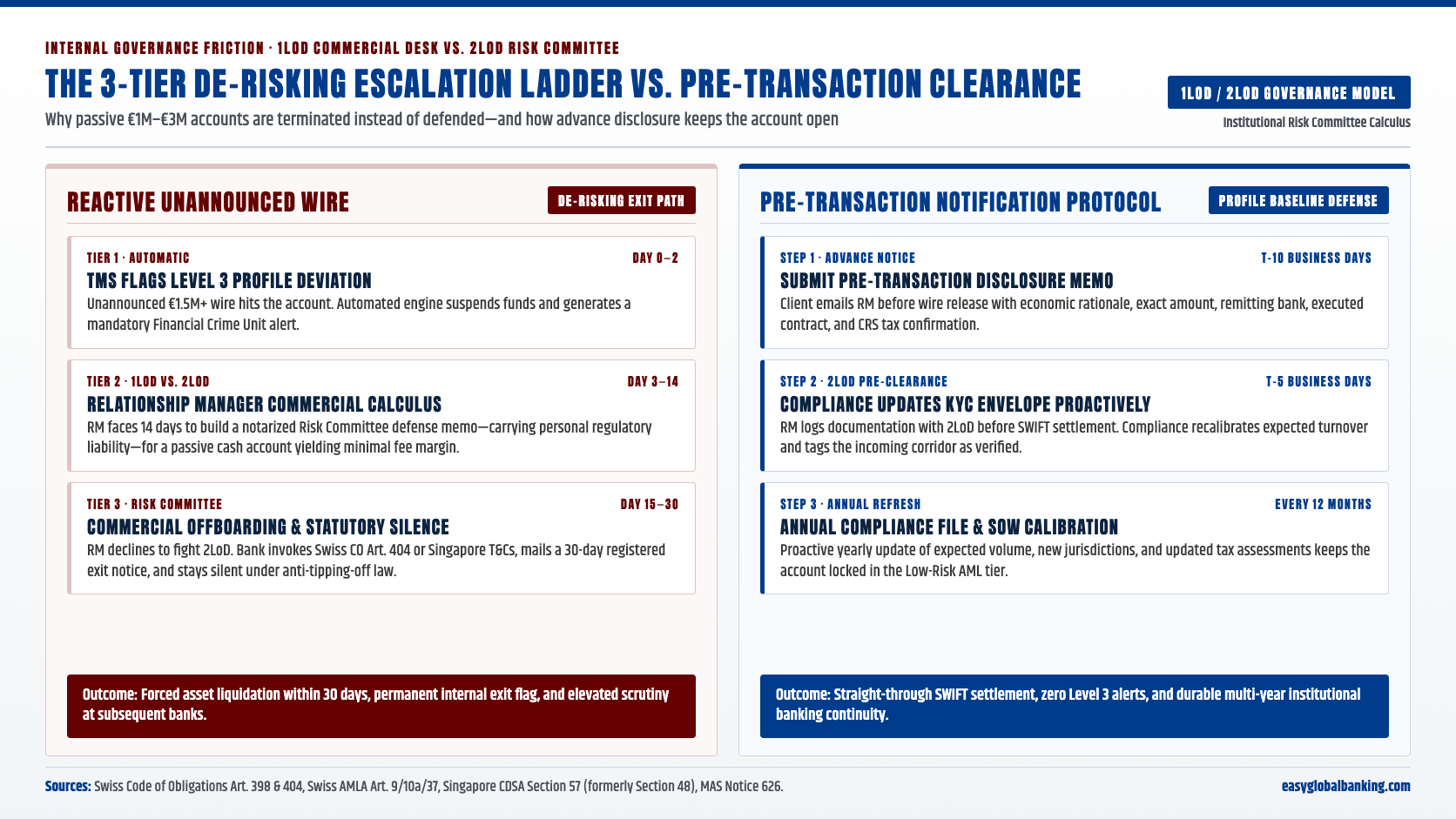
Here is the institutional truth banks never print in marketing brochures: your Relationship Manager bears direct personal regulatory and career liability for defending your file. When a Level 3 AML alert drops onto a CRM's compliance dashboard, the banker is placed on a strict 10- to 14-day remediation clock. To keep your account open, the CRM must assemble an exhaustive defense memorandum for the internal Risk Committee—gathering apostilled contracts, counterparty beneficial ownership structures, independent registry verifications, and updated tax compliance confirmations—and then sign their own name to the risk acceptance form. If an external auditor or FINMA inspector challenges that judgment two years later, the CRM's bonus is clawed back, their internal risk rating is downgraded, and their Swiss banking career can end permanently.
Now apply cold private-banking unit economics to that personal liability. Suppose you hold €1.5 million or €2.5 million at a Swiss private bank, largely parked in cash deposits, money-market funds, or buy-and-hold sovereign bonds generating 30 to 45 basis points in net annual revenue (€6,000 to €11,000 per year before overhead). Defending a single Level 3 Profile Drift alert consumes 15 to 25 hours of senior Front Office, Compliance, and Risk Committee labor—wiping out two full years of net margin on the account while introducing asymmetric career risk for the banker.
The verdict inside the Risk Committee is purely mathematical. Unless the account holds substantial fee-generating discretionary mandate assets (typically CHF 5 million to CHF 10 million+) or anchors a broader multi-entity family office relationship, the Relationship Manager will not burn internal political capital fighting 2LoD. Instead, the CRM quietly concurs with Compliance's recommendation to terminate the mandate on commercial grounds. Understanding this internal margin-versus-risk calculus—which mirrors the institutional scoring mechanics examined in our guide on private bankability scores in Switzerland and Singapore—explains why clients with spotless legal histories are still terminated while far more complex UHNW portfolios with proactive compliance teams remain untouched.
The Wall of Silence: Why the Bank Refuses to Give Reasons
When the Risk Committee votes to offboard an account, the relationship terminates behind an impenetrable legal barrier. The client receives a short, impersonal registered letter stating that the bank has decided to terminate the business relationship effective in 30 days, instructing the holder to supply transfer coordinates for an external account in their exact legal name. Repeated emails and phone calls to the Relationship Manager receive the same scripted reply: "This is a commercial decision taken under our General Terms and Conditions; we are unable to provide further details."
That silence is not rudeness or corporate arrogance. It is legally mandated by two interlocking bodies of law: unilateral private-law termination rights and criminal anti-tipping-off statutes.
Switzerland: Article 404 CO and the AMLA Tipping-Off Iron Curtain
Under Swiss private law, a banking relationship is legally governed by mandate law under the Swiss Code of Obligations (CO, SR 220). While Article 398 CO defines the bank's fiduciary duty of care while the mandate is active, Article 404(1) CO grants either party the absolute statutory right to revoke or terminate the mandate at any time, with immediate effect, without stating reasons. Although Article 404(2) creates narrow damages liability only if termination occurs at an "inopportune time" (zur Unzeit), Swiss bank General Terms and Conditions (AGB) calibrate termination mechanics by granting a 30-day orderly transfer window—insulating the bank from civil challenge.
Layered directly above contract law is the Swiss Anti-Money Laundering Act (AMLA / GwG, SR 955.0). Whenever a Level 3 Profile Drift anomaly creates well-founded suspicion under Article 9 AMLA, the financial intermediary must file a report with the Money Laundering Reporting Office Switzerland (MROS) and manage execution and asset-freezing duties under Article 9a and Article 10 AMLA. Simultaneously, Article 10a AMLA imposes an absolute statutory prohibition on informing the client or any third party that an MROS filing or internal AML inquiry exists. Under Article 37 AMLA, breaching these duties carries criminal fines of up to CHF 500,000 for willful intent and up to CHF 150,000 for negligence. Consequently, even when a bank closes an account purely out of commercial de-risking without filing an MROS report, Swiss compliance policy enforces uniform silence across all exits so that clients cannot infer by contrast which terminations involved an FIU filing.
Singapore: MAS Notice 626 and Section 57 (Formerly Section 48) CDSA
Singapore operates an even stricter criminal deterrent against bank disclosure. Private bank account agreements governed by Singapore common law include explicit unilateral termination clauses enabling closure on 30 days' written notice without cause. Meanwhile, under MAS Notice 626, if ongoing transaction monitoring identifies suspicious patterns, the bank must file a Suspicious Transaction Report (STR) with the Suspicious Transaction Reporting Office (STRO) with zero minimum monetary threshold.
Once an STR or AML investigation is underway or contemplated, Section 57 of Singapore's Corruption, Drug Trafficking and Other Serious Crimes (Confiscation of Benefits) Act (CDSA, 2020 Revised Edition)—widely referenced in legacy compliance manuals under its pre-2020 numbering as Section 48 CDSA—makes "tipping off" a serious criminal offence. Any banker or compliance officer who discloses information likely to prejudice an investigation faces a criminal fine of up to S$250,000, imprisonment for up to 3 years, or both. No Relationship Manager in Raffles Place will risk three years in Changi Prison to tell you why Compliance disliked your last incoming wire.
| Legal / Operational Dimension | Switzerland (FINMA / Swiss Private Banking) | Singapore (MAS / Singapore Wealth Management) |
|---|---|---|
| Primary Statutory Right to Terminate | Art. 404 Swiss Code of Obligations (CO): Either party may revoke or terminate the mandate contract at any time, effective immediately, without stating reasons (paired with 30-day AGB notice). | Common Law Contract Right & Bank T&Cs: Standard contractual termination clause granting the bank absolute discretion to terminate with 30 days' written notice. |
| The Legal Reason for Bank Silence | Art. 10a Swiss AMLA (GwG): Absolute prohibition on informing the client or third parties when an AML inquiry or MROS suspicious activity report is initiated (Art. 37 fines up to CHF 500,000). | Section 57 (formerly Section 48) Singapore CDSA: Criminal offence of "tipping off" punishable by fines up to S$250,000, imprisonment up to 3 years, or both. |
| The 30-Day Liquidation Protocol | Client receives a formal registered letter; e-banking access is downgraded to read-only; bank demands destination IBAN in the client's exact legal name. | Registered mail notification; payment cards canceled immediately; remaining funds transferred via cashier's order or outward wire within 30 days. |
| Failure to Provide Destination Account | Assets are moved to an internal non-interest-bearing segregated escrow account, subjected to judicial consignation (Art. 92 CO), or held under statutory dormancy rules (Art. 37m BankG). | Funds are placed in a suspense account; physical cashier's order drawn and deposited in escrow, freezing capital until third-party clearance. |
The Defense Manual: The Pre-Transaction Notification Protocol (PTNP)
Preventing de-risking is not about hiring aggressive litigators after a termination letter arrives; it is about denying the Transaction Monitoring System a statistical surprise in the first place. Institutional family offices keep Swiss and Singapore accounts open for decades—even while executing €10 million real estate exits, corporate restructurings, and cross-border dividend distributions—by enforcing two disciplined governance routines: the Pre-Transaction Notification Protocol (PTNP) and the Annual Compliance File Refresh.
Step 1: Test Every Upcoming Wire Against the 25% Profile Drift Rule
Before releasing any non-routine incoming or outgoing transfer, audit the transaction against your signed Day-1 onboarding profile. You must trigger the Pre-Transaction Notification Protocol whenever a transfer meets any of four thresholds: (1) the wire pushes rolling 12-month volume more than 25 percent above your declared KYC annual turnover; (2) the funds originate from or route to a country not previously recorded on your client profile; (3) the counterparty is a new legal entity, SPV, trust, or personal third party; or (4) the transfer involves liquidating invested custody assets into cash for rapid outward remittance.
Step 2: Assemble and Deliver the Pre-Transaction Disclosure Memo (T-10 Business Days)
At least 10 business days before instructing the remitting bank to release funds, email a concise, self-contained Pre-Transaction Disclosure Memo to your Relationship Manager. Your goal is to hand the CRM a turnkey compliance packet that takes less than five minutes to forward directly to 2LoD—removing the administrative burden that causes bankers to choose offboarding over advocacy. Every disclosure memo must contain five exact sections:
- Transaction Summary Header: Exact anticipated value date, currency, exact transfer amount, remitting institution name and SWIFT/BIC code, and the exact legal name of the remitter or beneficiary.
- Economic Rationale Statement: A plain-language, three-sentence commercial explanation tying the wire back to your established Source of Wealth (e.g., partial exit of shares in Company X held since 2019, or disposal of residential property in Zurich acquired in 2016).
- Primary Legal Execution Proof: The fully executed, dated, and signed share purchase agreement, notarized property deed, dividend board resolution, or commercial loan contract.
- Source of Funds & Counterparty Verification: A 3- to 6-month remitting bank statement showing the clean accumulation of funds prior to transfer, paired with the counterparty's commercial register extract, Certificate of Incumbency, or ID where applicable.
- CRS & Tax Reporting Confirmation: Explicit written confirmation that the proceeds are declared in your verified jurisdiction of tax residence under CRS 2.0—consistent with the documentation standards detailed in our guide on CRS 2.0 tax residency substance for Swiss and Singapore accounts.
Step 3: Demand Written First-Line Pre-Clearance Before Funds Move
Never release a large non-routine SWIFT wire on a verbal "no problem" from a junior assistant. Wait for a short written email from your Relationship Manager confirming: "Compliance has logged the supporting documentation and pre-cleared the incoming/outgoing transfer." That timestamped email proves your KYC envelope was updated before settlement. When the wire arrives, the TMS alert—if generated at all—closes automatically against the pre-logged compliance ticket in minutes rather than escalating to the Risk Committee.
10-Day Pre-Wire Defense Dossier · Submit Before SWIFT Release
The Pre-Transaction Notification Protocol (PTNP)
Transaction Rationale
Underlying Documentation
Counterparty Transparency
Deliver all six components to your relationship manager at least 10 business days before initiating any high-value or non-routine wire exceeding 25% of baseline volume.
The Annual Compliance Profile Refresh: Locking In Low-Risk AML Status
Even if no single wire triggers a crisis, legitimate businesses evolve over 12 months. Revenue grows, holding structures expand into new jurisdictions, and wealth holders relocate tax domiciles. Waiting for the bank's periodic 3-year KYC review guarantees that your paper file falls dangerously behind operational reality—creating slow-burn profile drift.
Every twelve months—ideally 30 days after filing your annual personal or corporate tax return—proactively send your Relationship Manager a one-page Annual Compliance Profile Refresh containing four updated records: (1) your revised expected annual turnover band for the next 12 months, (2) any newly added operating jurisdictions or recurring counterparties, (3) your most recent filed tax assessment and updated Source of Wealth summary, and (4) confirmation of your current custody allocation strategy. Clients who proactively refresh their compliance file every year remain anchored in the bank's Low-Risk AML tier—cutting manual RFI delays to near zero and transforming their Relationship Manager into a long-term institutional advocate. For principals currently structuring new Asian custody relationships, align this annual calendar from Day 1 with the 2026 Singapore private banking account opening process.
Crisis Management: What to Do If You Receive a 30-Day Termination Notice
If a registered termination letter has already landed on your desk, recognize one uncompromising operational rule immediately: do not panic, do not argue with your Relationship Manager, and do not threaten litigation. The moment a client threatens a lawsuit or files an angry accusation of discrimination, the front-office file is stripped from the Relationship Manager and transferred permanently to the bank's General Counsel. Legal departments do not grant operational flexibility, do not assist with orderly securities transfers, and communicate exclusively via formal letters.
Execute a disciplined, calm four-step exit protocol within the first 72 hours of receiving notice:
- Acknowledge Receipt Professionally and Request a Structured Extension If Needed: Reply in writing acknowledging the bank's notice calmly. If you hold illiquid structured products, fixed-term deposits, or multi-line securities portfolios that cannot settle within 30 calendar days, request a formal 30-day administrative extension specifically to complete an orderly Free-of-Payment (FOP) custody transfer rather than a forced market liquidation. Review our tactical guide on how to transfer an investment portfolio between Swiss custodians cleanly.
- Route Capital Strictly to an Account in Your Exact Legal Name: Never attempt to wire closing balances to third parties, newly incorporated offshore shells, or high-risk e-money wallets. Outgoing exit transfers must settle directly into an established Tier-1 account held in the exact identical personal or corporate legal name matching your Form A declaration.
- Download Your Complete Historical Archive Before Portal Downgrade: Immediately export every monthly statement, SWIFT
MT103/pacs.008settlement confirmation, annual tax report, and fee schedule covering the entire lifespan of the relationship. Once the 30-day window closes, e-banking access is terminated permanently and retrieving historical records carries heavy archival fees and weeks of delay. - Secure Formal Reference and Closure Documentation: While the relationship remains cooperative, request an official banking confirmation letter (Bankauskunft) verifying the opening date, satisfactory conduct prior to closure, and—where possible—a formal closing statement confirming zero outstanding liabilities. Your next Swiss or Singapore bank will demand full provenance showing how the incoming capital exited your prior custodian cleanly.
Frequently Asked Questions
Can a Swiss bank legally close my account without giving any reason?
Yes. Under Article 404(1) of the Swiss Code of Obligations (CO), either party may revoke a banking mandate at any time without stating reasons, subject to contractual notice periods in the bank's General Terms and Conditions (typically 30 days). Where internal AML inquiries or MROS filings exist, Article 10a of the Swiss AMLA legally prohibits the bank from explaining the closure.
Why did my Singapore private bank terminate my account after 6 months when onboarding took months?
Onboarding approves a static paper narrative, whereas post-onboarding transaction monitoring under MAS Notice 626 (Paragraph 6.21) audits actual account velocity, volume, and geographic corridors dynamically. When real transactions diverge sharply from your initial KYC baseline without prior disclosure, automated systems trigger Level 3 alerts that often lead to commercial offboarding.
Can I appeal a private bank account freeze or 30-day termination notice?
In Switzerland and Singapore, private banks have no legal duty to maintain a commercial client relationship, so formal appeals rarely reverse a Risk Committee offboarding vote unless the exit stemmed from an indisputable factual or clerical error. Your highest-leverage move is executing an orderly transfer of assets to a peer institution while preserving clean audit documentation.
How much advance notice should I give my private banker before a large non-routine wire?
Submit a complete Pre-Transaction Disclosure Memo at least 10 business days before instructing the remitting bank to release funds. Allowing 5 to 10 business days gives your Relationship Manager sufficient time to log executed contracts and Source of Funds evidence with Second Line Compliance and confirm written pre-clearance.
Primary Statutory & Regulatory References
- Swiss Confederation (Fedlex) — Federal Act on the Amendment of the Swiss Civil Code (Code of Obligations, SR 220, Articles 92, 398 & 404)
- Swiss Confederation (Fedlex) — Federal Act on Combating Money Laundering and Terrorist Financing (AMLA / GwG, SR 955.0, Articles 9, 9a, 10a & 37)
- Monetary Authority of Singapore (MAS) — Notice 626: Prevention of Money Laundering and Countering the Financing of Terrorism (Ongoing Monitoring & STR Duties)
- Singapore Statutes Online (AGC) — Corruption, Drug Trafficking and Other Serious Crimes (Confiscation of Benefits) Act 1992 (Section 57 / formerly Section 48 Tipping-Off Offence)
- Monetary Authority of Singapore (MAS) — COSMIC (Collaborative Sharing of Money Laundering/Terrorism Financing Information & Cases)
Contractual Governance Rule: A Tier-1 private bank account is never a passive vault; it is a continuously audited compliance contract. Keep your written KYC baseline ahead of your live SWIFT ledger—or automated de-risking will terminate the mandate on 30 days' notice without asking your permission.
Editorial Disclosure: Easy Global Banking (operated by BMA Business Solutions GmbH, Switzerland) provides independent cross-border banking advisory and compliance readiness analysis. We are not a bank, law firm, or licensed dispute authority. Account holders facing an active asset freeze or formal legal dispute should retain qualified banking counsel in Switzerland or Singapore.