Earlier this year a client showed us a custody agreement he was ready to sign. Respected Swiss crypto bank, familiar logo, Zurich address in the footer. One detail had escaped him: the entity named on page one was not the Swiss bank at all. It was a European subsidiary, regulated in another country, under another legal regime. He wanted Swiss custody. He was about to get something else, with the same brand on the letterhead.
Keep that story in mind, because the licences that just landed will multiply it.
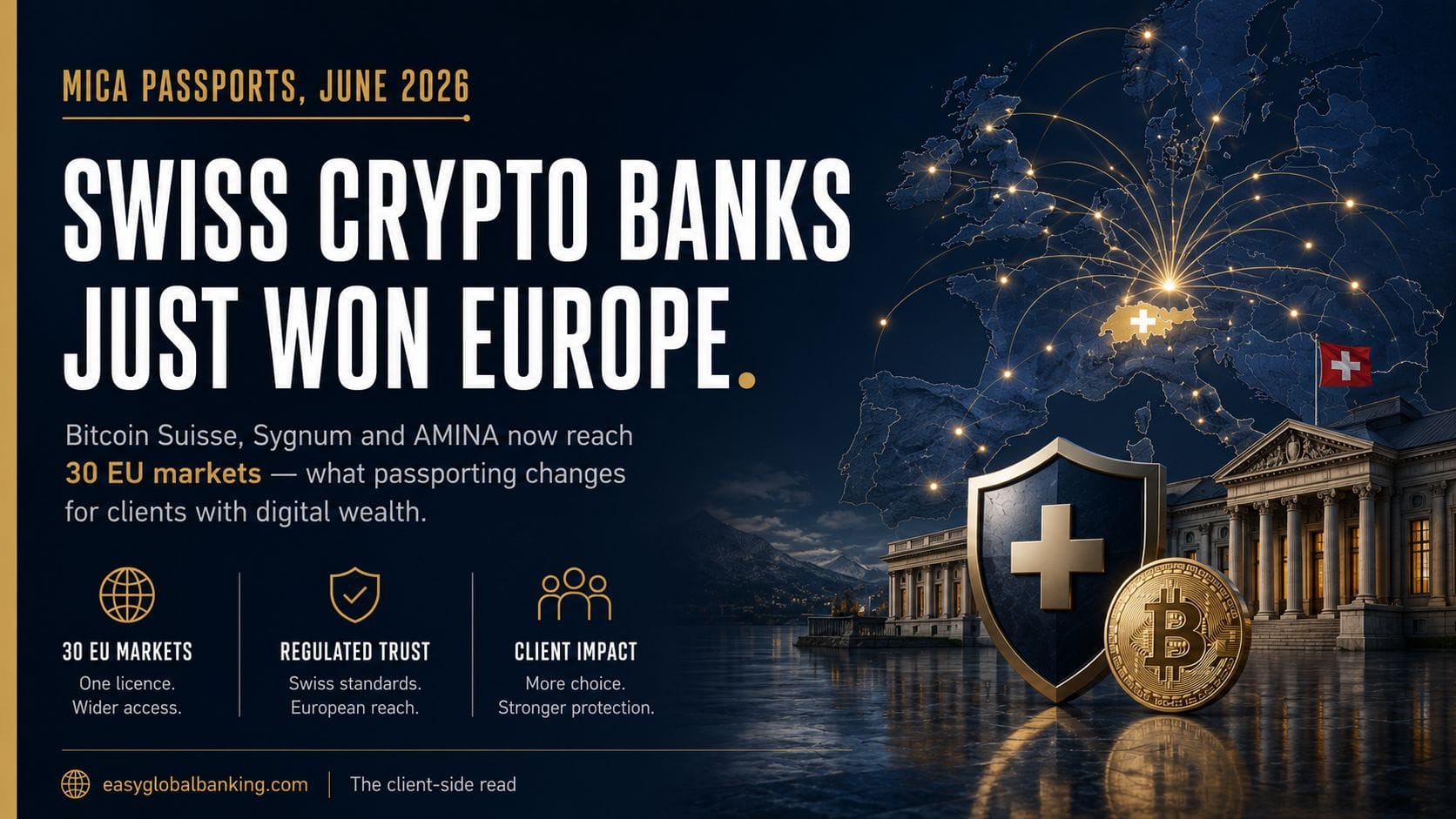
In the last week of June, Liechtenstein’s financial regulator granted MiCA authorisations to Bitcoin Suisse and Sygnum — four days apart. AMINA had already collected its passport through Austria in late 2025. In one quarter, the regulated Swiss crypto banks went from serving one market to serving thirty-one. It is the biggest expansion of Swiss digital-asset banking since the first licences of 2019, and it is genuinely good news. It also comes with a catch that no press release mentions, which is the part we are qualified to explain.
Four days in June
| Date | Event | Why it matters |
|---|---|---|
| Q4 2025 | AMINA Bank secures a MiCA licence via Austria’s FMA | First Swiss-rooted crypto bank with EU passporting — up to 30 markets |
| 23 June 2026 | Bitcoin Suisse (Europe) AG authorised by Liechtenstein’s FMA | The oldest Swiss crypto broker, founded 2013, finally holds a European key |
| 26 June 2026 | Sygnum Europe AG authorised, also in Liechtenstein | The world’s first regulated digital-asset bank goes pan-European; German institutional rollout already running |
Why the passports run through Vaduz, not Bern
The structural quirk most coverage skips: FINMA cannot issue a MiCA licence. Switzerland is not in the EU or the EEA, so the world’s strictest crypto-banking supervisor has no key to Europe’s new front door. Every Swiss firm that wants in needs a subsidiary inside the bloc — and Liechtenstein, EEA member, fellow franc-user, twenty minutes from Sargans, has become the corridor of choice. Austria works too, as AMINA showed.
Seven years, in hindsight, is not slow. It took Swiss crypto banking that long to earn what traditional finance never doubted it deserved: a passport.
The catch on page one of the agreement
Now, back to our client. A MiCA passport moves the service to you. It also moves the legal venue — and those are very different gifts. An account opened with Sygnum Europe AG or Bitcoin Suisse (Europe) AG lives under that EU entity: its regulator, its insolvency regime, its custody arrangements. Not under the Swiss parent, not under Swiss law, not under the framework that made “Swiss crypto bank” worth choosing in the first place.
For plenty of clients that trade-off is fine — an EU resident who simply wants regulated access may prefer it. But if Swiss custody was your reason for the relationship, three questions belong in your next email, in this order: Which legal entity will my agreement name? Where are my assets custodied, and under which country’s law? And if the group restructures, can my account be migrated between entities without my signature?
The brand on the letterhead is not the entity on page one. In cross-border banking, page one is the only page that matters.
Our client asked those questions, got honest answers, and signed with the Swiss parent instead. It cost him nothing but a second email. The clients who will discover the distinction in an insolvency filing someday will not be so cheaply educated.
What the passports change, honestly
| Your situation | What actually changes |
|---|---|
| EU resident wanting a Swiss crypto bank | Everything. You can now be serviced legally at home — no more reverse-solicitation grey zone. Just decide deliberately which entity you contract with. |
| Swiss or non-EU client | Legally, little. Commercially, a lot: the banks just multiplied their addressable market, and thirty-one markets’ worth of competition tends to show up in pricing. |
| Crypto-native wealth seeking private banking | The strongest tailwind yet. Regulated custody at European scale makes documented crypto wealth steadily harder for traditional banks to refuse. |
The desk view: the licence is theirs, the file is still yours
Here is what these passports do not change, and it is the part we deal with daily. Whether you approach the Swiss crypto banks or the traditional private banks that increasingly tolerate digital wealth, the documentation bar is identical and unmoved: exchange exports, wallet history, the fiat conversion trail, tax reporting. A complete trail opens doors on both sides of the aisle. Without it, no licence in Europe helps you — MiCA regulates the banks, not your evidence.
We see the difference weekly. Crypto files with a clean acquisition-to-fiat chain now clear compliance at speeds that would have been unthinkable in 2022. Files built on screenshots still die where they always died. If yours is somewhere in between, the crypto section of our source-of-wealth guide shows exactly what banks want to see, and our service exists for the files worth preparing professionally.
Three predictions, on the record
First: regulated custody pricing falls within a year — thirty-one markets of addressable clients is exactly the arithmetic that compresses fees. Second: at least one of the three gets acquired — a MiCA passport bolted to a FINMA banking licence is precisely what makes a Swiss crypto bank an attractive target for a larger house. Third: the traditional Swiss private banks respond by widening their own crypto custody, because the passports just turned a niche into a competitive threat. All three, in that order, and we are happy to be graded on it.
The deeper shift is simpler. Swiss crypto banking spent seven years proving it could be boring — audited, regulated, passported. That victory is now complete. What remains is the oldest rule in this business, the one that survives every new licence: the bank chooses its regulator, but you choose your entity. Choose it on page one. The wider map, as always, is in our Swiss banking guide.
Sources: FMA Liechtenstein and FMA Austria authorisations via Crypto Valley Journal; Sygnum announcements; finews coverage, June–July 2026. This is analysis, not investment advice.