There is a phone call I have had, in one form or another, a dozen times this year. It starts with an apology — “this might be a strange question” — and then: should I be moving my banking to Singapore? The voice is usually someone who has spent twenty years believing that Swiss banking was the finish line. Asking the question feels, to them, faintly like betrayal.
I understand the feeling. I built my career in Swiss compliance; Zug and Chur are home ground for me. So believe me when I say it costs me something to open our two datasets side by side each spring. One tracks the Swiss private banks. The other tracks the same industry’s Singapore operations. This year, for the first time, they read like different businesses.
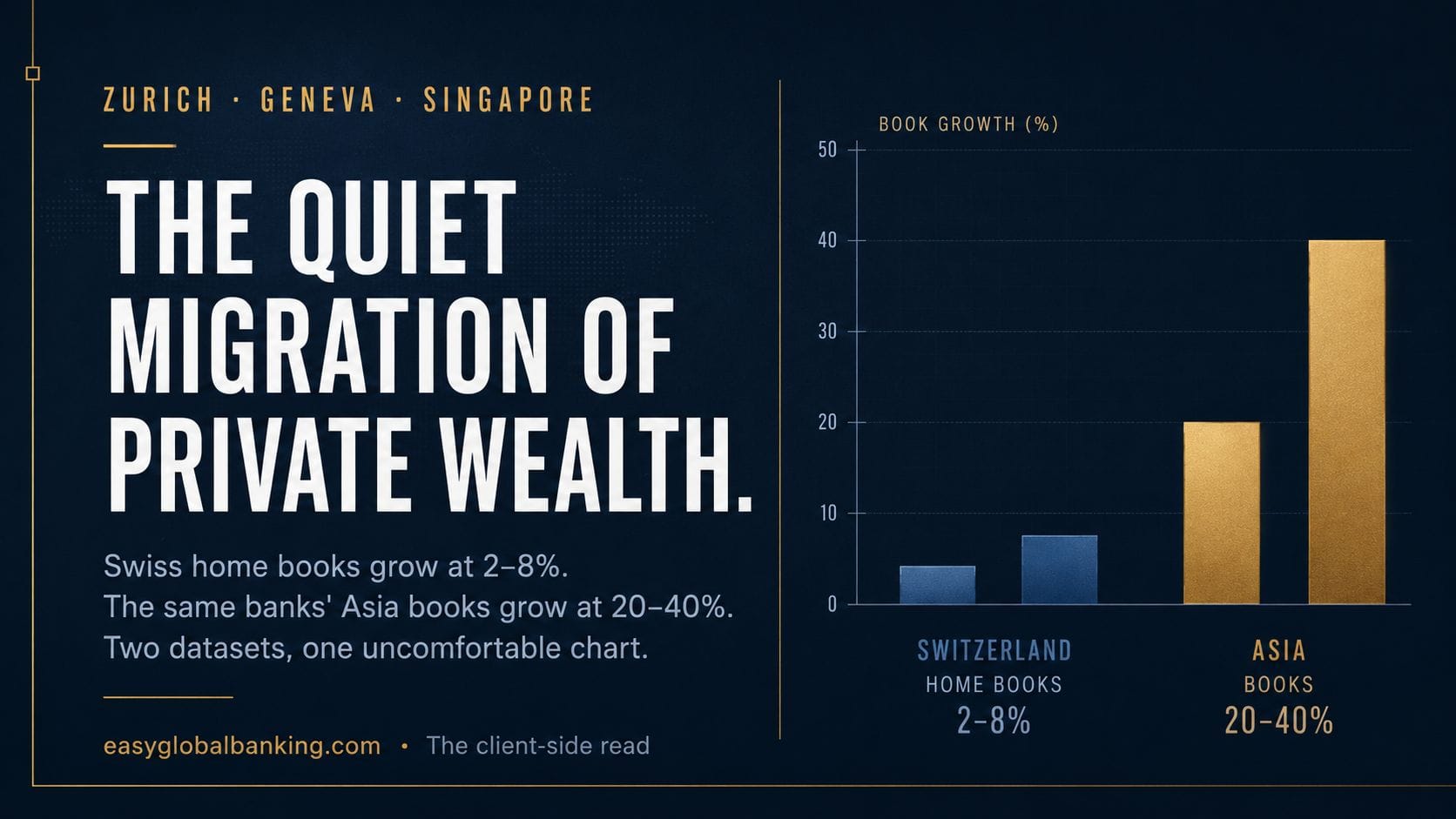
Look at the gold bars again. Slowly.
Everyone who sees this chart does the same thing: they read it as Switzerland losing. Then I point at the names. UBS — Swiss. The Julius Bär Singapore operation behind those Asia numbers — Swiss. Pictet books clients in Singapore too. The fastest-growing “Singapore private banks” are, to a remarkable degree, Swiss banks’ eastern kitchens.
That changes the question you should be asking. Not Switzerland or Singapore — your own bank stopped asking that years ago. The real question is quieter and more personal: which of my bank’s kitchens is my relationship booked in, and did anyone ever ask me? Booking centre determines governing law, regulator, deposit protection, even which crises can reach you. Most clients inherited theirs by accident of where they first walked in.
Why I stopped talking clients out of it
Five years ago, when someone asked about Singapore, I would gently test whether it was fashion. Some of it was. What changed my mind was watching the drivers turn structural. Asia now creates new wealth faster than Europe — that is demographics, not a cycle. Singapore built a deliberate policy machine for family offices, and MAS earned a reputation that makes compliance officers relax rather than brace. And the entry math is simply different: DBS opens serious wealth relationships from $200,000, where a Swiss private bank wants half a million francs before the conversation starts. The whole spread is in our Singapore ranking, next to the Swiss one — I encourage you to read them the way I do, as one industry with two speedometers.
The product engine is moving too. UOB’s agreement to sell UOB Asset Management while retaining advice and distribution shows how Singapore banks can keep the client relationship but outsource more of the fund factory. Our analysis of the UOB-AllianzGI transaction follows the fees and incentives that sit behind that shift.
At five percent, money doubles in fourteen years. At twenty-five, in three. Once you hold those two numbers in your head at the same time, boardroom behaviour — and my changed advice — needs no further explanation.
What I actually say on that phone call
Three things, and the first one usually surprises people: you are not late. The dual-centre structure is still unusual enough among private clients that building it now puts you ahead of the migration, not behind it. Fear of having missed the moment stops more good decisions than any bank ever did.
Second: this is an addition, not a defection. Switzerland remains what it has always been — the deepest custody law in Europe, inheritance planning nobody matches, the franc. Singapore adds the things Switzerland structurally cannot: Asia-hours coverage, lower entry tiers, and a second jurisdiction, which is the one diversification no amount of Swiss regulation can give you. I hold both truths for a living. They do not conflict.
| Keep Switzerland at the centre if… | Add the Singapore leg when… |
|---|---|
| Estate and inheritance planning drive everything | Your business, family or future has real Asia exposure |
| European wealth story, fully documented | You want a second jurisdiction, not merely a second bank |
| Franc stability is part of the point | Entry flexibility matters — from $200k, not CHF 500k |
| You prize the deepest private-banking bench in Europe | You want your money awake in your own time zone |
Third — and this is the part people thank me for a year later: the structure is built with one dossier. The documentation standards in Zurich and Singapore have converged so completely that a file prepared properly once clears both compliance desks with minor adaptation. Prepare it twice, separately, and you will do the worst part of this process two times for no reason. The Singapore–Hong Kong comparison and our Singapore guide cover the choosing; the dossier is the doing.
A confession, and an offer
The confession: I still feel the small pang when the gold bars come out of the spreadsheet each spring. Home ground is home ground. But my job is not to defend geography — it is to make sure that when the industry rearranges its kitchens, my clients are seated before the music stops.
The offer, without ceremony: if the phone-call question is living in your head too, do the smallest possible first step. Send us your situation in five sentences — residence, rough assets, where the wealth came from, where life is heading, what worries you. That is the whole ask. Within days you will know whether a second booking centre makes sense for you, which city should host it, and what your one dossier is missing. This is what we build, quietly, for people who were also slightly embarrassed to ask the question. None of them is embarrassed now.
Data: 2025 annual reports and bank disclosures, compiled in our Swiss and Singapore AUM rankings. Written by Asel Mamytova.