Three years ago, on a Sunday evening in March, Switzerland learned what it costs when a systemically important bank runs out of road. Credit Suisse was gone by Monday morning, folded into UBS before Asian markets opened, and a country that had built its brand on banking stability spent the next week explaining itself to the world.
Concentration risk is why many families compare UBS with partnership-led houses such as Pictet, Julius Bär, and Lombard Odier.
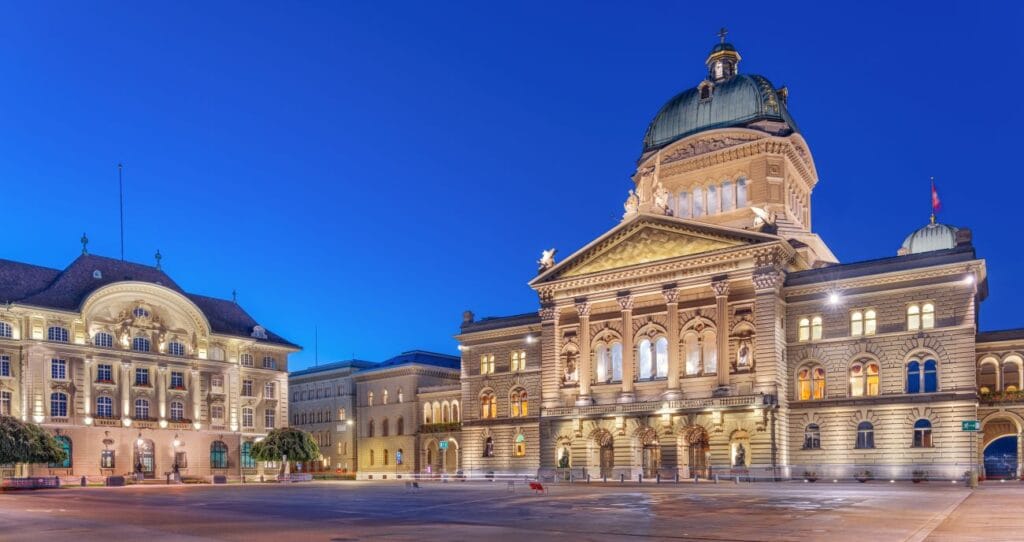
This summer, the bill for that weekend is being negotiated in Bern. Parliament is arguing over how many billions of additional capital UBS must hold — the government wants foreign subsidiaries backed one-for-one with core capital, roughly USD 23 billion; lawmakers are debating whether 70 or 80 percent might do; UBS points out it already exceeds every current requirement. The fight will run for months and produce a compromise.
While it runs, one number sits on the table that nobody disputes: UBS now holds roughly USD 7 trillion in client assets. That is about eight times Switzerland’s annual economic output, inside a single institution. And here is the thing — every person in that debate is paid to worry about the taxpayer. Nobody in Bern is paid to worry about your account. That part has always been yours.
Drawn to scale, the debate explains itself
Convert the currencies however you like; the shape does not move. The next three largest Swiss wealth managers combined — Pictet, Julius Bär, ZKB, all profiled in our Swiss private bank ranking — hold roughly a quarter of what UBS holds alone. When people say Switzerland has a concentration problem, this is the picture they mean. When UBS says it is being punished for succeeding, this is also the picture it means. Both are right, which is why the debate is loud.
What capital rules can and cannot do for you
Let us be fair to Bern: stricter capital rules genuinely matter. More core capital means a bank absorbs bigger losses before anyone panics — the probability of another March weekend goes down. If the final number lands near the government’s version, Swiss taxpayers will hold the strongest insurance policy in banking.
But probability is not exposure. Capital rules make failure less likely; they do nothing about what happens to your balance if the unlikely arrives anyway. And on that question, most clients we meet are carrying assumptions from a world that ended in 2023. Two assumptions in particular.
The two buckets that decide everything
The first assumption: “my bank is safe, so my money is safe.” In a failure, that sentence dissolves into legal categories most clients have never checked. What happens to your assets depends entirely on which bucket they sit in:
| What you hold | What happens if the bank fails |
|---|---|
| Cash on account | esisuisse protection covers up to CHF 100,000 per client, per bank. Above that line, you are a creditor in a queue. |
| Securities in custody (funds, stocks, bonds) | Segregated assets under Swiss law. They are not part of the bank’s estate — they come back to you. |
| Structured products issued by the bank | You are an unsecured creditor of the issuer. Credit Suisse clients holding CS-issued notes learned this distinction the hard way. |
| Fiduciary and money-market placements | Your risk sits with whatever counterparty the money was placed at. The terms know; the brochure rarely says. |
The second assumption: “CHF 100,000 of protection is basically fine.” It is — at CHF 100,000. Watch what happens to that protection as cash grows:
At half a million francs of cash, four-fifths of your money sits above the protected line. At three million, 97 percent does. This is not a reason for alarm; custody assets are segregated, and UBS is a well-capitalised institution. It is a reason for structure. Cash thin, custody heavy — and more than one roof.
Capital rules lower the probability of a failure. They do nothing about your exposure to one. The first is Bern’s job. The second is yours, and it takes a fortnight to fix.
The second-bank playbook, by tier
We build these structures for clients professionally, and the pattern is almost boringly consistent across wealth levels:
| Profile | The structure that actually works |
|---|---|
| Cash-heavy, up to ~CHF 500k | Two Swiss banks, each held near the esisuisse line. A cantonal bank with a state guarantee is the natural second leg — the ratings tell you which. |
| HNW, CHF 1–5m | A primary relationship plus a boutique private bank. Keep cash thin and custody heavy at both. |
| UHNW / international | Two booking centres, not merely two banks. Switzerland plus Singapore splits jurisdiction risk — the kind no Swiss capital rule can address. |
The building blocks are all published on this site: Swiss bank credit ratings for choosing the second leg, Singapore bank ratings and the Singapore banking guide for the second booking centre, our review of the best private banks for a shortlist tested on capital and ratings, and the offshore and non-resident banking guide for the wider map. When you want the structure built rather than researched, that is what we do.
One observation from the application desk, offered without charge: the clients who open their second relationship calmly, years before needing it, sail through onboarding. The ones who arrive during a banking scare meet compliance officers who read urgency as risk. The 2023 weekend produced exactly one week of frantic account-opening applications — and most of them failed. Open the umbrella while the sun is out.
The latest earnings provide a useful reality check on that concentration. Our analysis of UBS Q2 2026 flows separates the USD 36 billion inflow headline from fee-bearing mandate growth, regional mix and the economics of absorbed Credit Suisse assets. It is the companion test to this article: one asks how much depends on UBS, while the other asks how much of UBS’s reported growth is commercially durable.
What the debate will not change
Parliament will land somewhere between 70 and 100 percent on the subsidiary question, UBS will grumble and comply, and the Swiss financial centre will be marginally safer either way. None of it moves the two facts that decide client outcomes: the CHF 100,000 line and the custody distinction were true before Credit Suisse fell, and they will be true long after this debate is archived. Concentration is not UBS’s problem to solve for you. Structure beats prediction — it did in 2023, and nothing in today’s Bern suggests the lesson has an expiry date.
Sources: Swiss government and SNB Financial Stability Report 2026 via press coverage, July 2026; UBS regulatory statements; esisuisse. Peer figures from bank reports as compiled in our AUM ranking. This is analysis, not investment advice.