
The Honest Starting Point: Opening a Swiss Corporate Account as a Foreign Company Is Difficult — but Possible
If you want to open a Swiss bank account for a foreign company in 2026, you need to understand one thing first: you are entering one of the most compliance-heavy banking markets in the world. Over the past fifteen years, sustained pressure from FATCA, the OECD’s Common Reporting Standard, and FATF evaluation frameworks has changed what it costs a Swiss bank to maintain a non-resident corporate relationship.
Why Most Unprepared Applications Fail
In short, a foreign company that applies without understanding how Swiss banks classify corporate clients — and without targeting the right institution — faces a high chance of rejection. However, rejection can be prevented if you learn the classification system and present your company accordingly. This guide covers exactly that.
Two recent FINMA enforcement actions show the current climate clearly. In February 2026, FINMA revoked the banking licence of MBaer Merchant Bank AG in Zürich after finding that 80% of its client relationships carried elevated risks. Additionally, 98% of recently received assets came from high-risk clients. Meanwhile, CIM Banque in Geneva — once the most-cited entry point for foreign corporate accounts — steadily tightened its non-resident corporate appetite from 2020 onwards and today focuses mainly on individual private clients.
These are not isolated events. Instead, they signal a market-wide shift in how Swiss banks evaluate foreign corporate relationships. What follows is the information you need before you submit anything.
Statistics: 80% of MBaer client relationships were elevated-risk; 4 active FINMA fintech licences; 6–14 week timeline; 100+ CRS countries.
The Classification Matrix: How Swiss Banks Evaluate Your Foreign Company
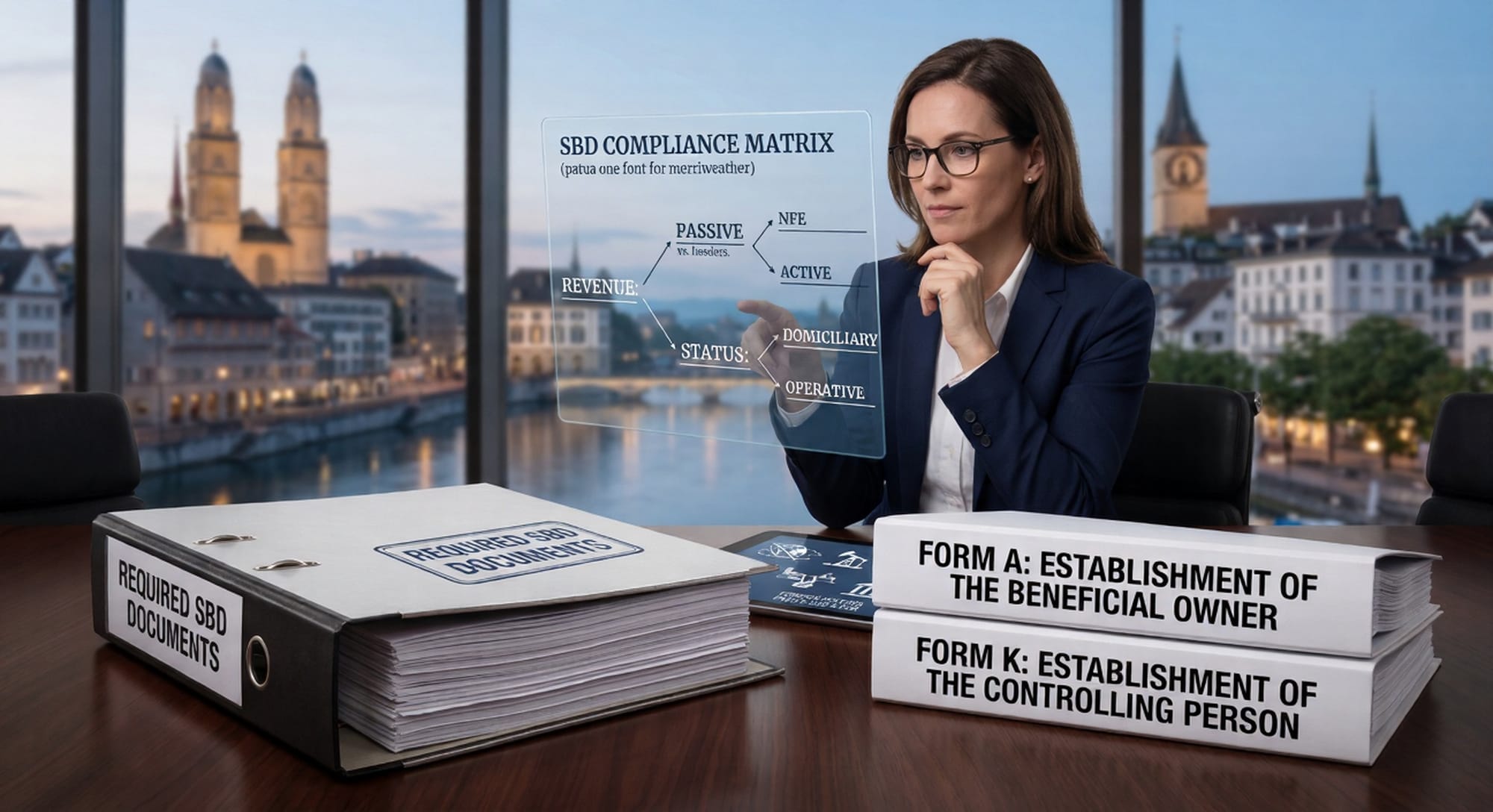
Before a single document changes hands, every Swiss bank places a prospective corporate client into a risk class. That class determines whether the relationship makes commercial sense for the bank. Therefore, understanding the three axes of this classification tells you which type of bank to approach — and how to frame your application.
Axis 1: Revenue Type — Passive NFE vs. Active NFE
Under FATCA and CRS reporting rules, your company falls into one of two categories: a Financial Entity or a Non-Financial Entity (NFE). Most foreign companies qualify as NFEs. From there, the bank draws a critical line between Passive NFEs and Active NFEs — and this distinction shapes the entire application path.
How Passive NFEs Are Treated by Swiss Banks
Passive NFEs — holding companies that collect dividends, royalties, licensing income, or interest — are well-suited to Swiss private banking. Because their transaction profile is predictable (periodic incoming flows, limited outgoing activity, stable asset base), Swiss private banks understand these structures well. In fact, they mirror the family investment vehicle or wealth preservation structure that forms these banks’ core business. As a result, holding companies with a clear ownership chain and documented income streams rank among the most straightforward foreign corporate profiles to bank in Switzerland.
Why Active NFEs Face Greater Scrutiny
Active NFEs — companies generating revenue from commercial operations and processing dozens of transactions per month across multiple countries — are far harder to bank. Banks must monitor every transaction for AML red flags, and they must document every counterparty relationship. Consequently, the compliance cost per relationship runs much higher than for a passive structure. Many Swiss banks will therefore only accept active foreign companies under specific conditions, such as trade finance arrangements, a private banking anchor, or Swiss subsidiary formation.
Axis 2: Operational Status — Domiciliary vs. Operative Company
Switzerland’s FINMA-supervised self-regulatory framework (the SBD / Due Diligence Convention) draws a sharp line between two corporate types. This distinction directly affects which compliance form the bank uses and how it assesses your risk.
Domiciliary Companies and Form A
Domiciliary companies have no physical operations in their place of incorporation — no staff, no real premises, no active trade. A BVI holding entity with a registered agent as sole director but no employees falls into this category. Under the SBD, the bank identifies the beneficial owner of a domiciliary company via Form A. In other words, the bank assumes that the entity exists to hold assets on behalf of a natural person. When the beneficial owner is clearly identifiable, when the source of assets is well-documented, and when the structure serves a legitimate wealth-holding purpose, Swiss private banks can and do accept these entities — because they treat them as extensions of a private client relationship.
Operative Companies and Form K
Operative companies, on the other hand, conduct genuine commercial activity — they employ staff, rent premises, serve verifiable customers, and file tax returns consistent with their stated operations. Under the SBD, the bank identifies the controlling persons of an operative entity via Form K. While Swiss banks generally prefer operative companies because the regulatory treatment is more straightforward, they still demand strong evidence of economic substance before proceeding.
Axis 3: Ownership Complexity — Private vs. Publicly Listed
How many people control your company? This number directly determines the bank’s KYC cost — and therefore the minimum revenue threshold at which it will proceed. For example, a single-shareholder foreign holding company with a clear chain to one natural person represents the cleanest structure. By contrast, a company with multiple beneficial owners spread across several countries is the most complex and expensive to onboard, since each UBO needs a separate KYC package, source-of-wealth narrative, and risk assessment.
Publicly listed companies with a verifiable share register and audited financials follow a different path. Because the bank can rely on stock exchange oversight as a proxy for much of the due diligence, these companies typically approach UBS, major Swiss subsidiaries of global banks (ING, Citi, Bank of America), or dedicated institutional banking desks.
Form A vs. Form K: The Compliance Paperwork That Determines Your Application Path
Under Switzerland’s Anti-Money Laundering Act (AMLA) and the Due Diligence Convention of the Swiss Bankers Association (CDB 20), every bank must identify the beneficial owner or controlling person of a corporate client before opening an account. Two standardised forms govern this identification — and which one applies to your company changes the entire onboarding process.
Form A — Declaration of the Beneficial Owner
Form A identifies the economic right-holder: the natural person who ultimately owns or benefits from the deposited assets, regardless of the legal ownership chain. Banks use it as the standard instrument for Passive NFEs and domiciliary companies — the holding structure collecting dividends, the family investment vehicle, or the trust-like entity.
Importantly, the beneficial owner must sign Form A personally and accept legal responsibility for its accuracy. After receiving the form, the bank cross-references the declared UBO against sanctions lists, PEP databases, and adverse media. Any inconsistency between the Form A declaration and the corporate structure documentation — for instance, a declared UBO who does not appear in the shareholder register without adequate explanation — ranks among the most common triggers for application delays or outright rejection.
Form K — Declaration for Operative Legal Entities
Form K identifies the controlling persons of an operative legal entity — specifically, any natural person holding 25% or more of shares or voting rights, or exercising control through other means (board control, contractual arrangements, etc.).
Complexity grows quickly at the 25% threshold. Consider a structure with three shareholders each holding 33%: it requires three complete KYC packages — three certified passport copies, three proof-of-address documents, and three source-of-wealth narratives. If those individuals reside in three different countries, the bank’s compliance team must then conduct three separate risk assessments across three jurisdictions. Moreover, some Swiss banks apply an internal threshold lower than 25% for shareholders or directors residing in higher-risk countries.
| Dimension | Form A | Form K |
|---|---|---|
| Purpose | Declare the economic right-holder (UBO) of the assets | Declare the controlling persons of an operative entity |
| Applied to | Passive NFEs, domiciliary holding companies, investment vehicles | Operative LLCs, AGs, GmbHs with active commercial business |
| Who signs | UBO personally | Authorised representative of the entity |
| Control threshold | Any person with economic entitlement to the deposited assets | ≥25% shareholding or equivalent control |
| Typical supporting documents | Apostilled ownership chain, notarised passport copy of UBO, source of assets documentation | Shareholder register, Articles of Association, board resolution, KYC package for each controlling person |
| Key rejection trigger | Mismatch between declared UBO and corporate records | Multiple controlling persons in high-risk countries, each requiring separate EDD |
Why Foreign Corporate Applications Get Rejected: The Real Reasons
Rejection letters from Swiss banks rarely explain the decision. “We are unable to proceed with your application at this time” is the standard phrasing. However, behind that line, the actual rejection usually falls into one of the following categories — and most of them can be fixed before you apply.
Rejection triggers ranked by frequency: source-of-funds fails scrutiny (most common), revenue too low versus compliance cost (very frequent), UBO in FATF-listed country (frequent), wrong bank type (frequent), complex ownership (common), missing apostilled docs (avoidable), no Swiss reason stated (avoidable).
1. A Source-of-Funds Narrative That Does Not Hold Up
“Proceeds from business activities” is not a source-of-funds declaration — it merely states that a source exists. Swiss banks under FINMA’s current framework require a traceable story: the specific business event that generated the funds, the tax returns or audited accounts confirming the income, and the bank statements showing the flow from income to the proposed deposit. If the funds passed through multiple countries or middleman accounts before reaching Switzerland, the compliance team will ask for proof at each step. Without that proof, they will often decline without reopening the conversation.
2. Revenue Too Low to Cover the Compliance Cost
This is the rejection reason almost no guide discusses honestly. A foreign company may have a clean ownership structure and solid documentation, yet the bank still declines it — because the expected revenue from the account does not cover the cost of compliance monitoring. For instance, a foreign company depositing CHF 200,000 for an operational account with 30 monthly transactions is, from the bank’s internal view, a loss-making relationship. Minimum deposit rules and private banking mandates exist precisely to solve this equation — they let banks make the compliance cost of a foreign corporate relationship commercially worthwhile.
3. Applying to the Wrong Bank Type
Different Swiss banks serve different client segments. A foreign holding company collecting passive income from overseas subsidiaries, for example, is well-suited to a Swiss private bank — not to a cantonal bank built to serve domestic retail and local business clients. Similarly, a foreign commodity trading company belongs at a specialist trade finance desk in Geneva, not at a universal bank’s SME unit. In many cases, rejections are not compliance failures at all — they are fit mismatches between the applicant’s profile and the institution’s mandate. Getting this match right is the highest-value decision in the entire process.
Strategic Bank Selection: Matching Your Foreign Company to the Right Swiss Institution
No single Swiss bank accepts all foreign corporate structures. Because the market is split by client profile, applying to the wrong institution not only wastes time — the rejection may end up in your compliance history and make later applications to the right bank harder.
| Your Company Profile | Target Bank Type | Why This Match Works | Typical Min. Commitment | Remote Opening? | Multi-Currency? |
|---|---|---|---|---|---|
| Holding company collecting dividends, royalties, or licensing income (Passive NFE) | Swiss Private Banks (Pictet, Julius Bär, Lombard Odier, EFG, Vontobel) | Mirrors the private investment vehicle at the core of their business. Low transaction volume and manageable AML profile. Form A process is familiar to these banks. | USD 1M–5M+ in private AUM (the holding account sits alongside a private banking mandate) | Yes — video KYC | CHF, EUR, USD, GBP + |
| HNW principal with private assets who also needs a corporate account for their operating company | Swiss Private Banks (same as above) | Revenue from the private banking mandate covers the compliance cost of a linked corporate account. As a result, this is the most reliable path for foreign operating companies in 2026. | USD 3M–5M+ in AUM; some banks require USD 5M minimum before opening a corporate account | Yes | Yes |
| Large publicly traded company or multinational | UBS; Swiss subsidiaries of global banks (ING, Citi, Bank of America, HSBC) | Stock exchange oversight reduces KYC friction. Additionally, existing group banking relationships can extend to Switzerland. | Varies (institutional terms negotiated) | Yes — group onboarding | Yes |
| Commodity trading, shipping, or structured trade finance company | Specialist trade finance desks: Geneva-based (BCP, BGFI), Zürich and Lugano niche banks | These desks understand commodity flows, bill-of-lading documentation, and LC structures. They accept high-volume transactional activity that other banks avoid. | USD 500K+ in deposits; full trade documentation (contracts, LC facilities, shipping docs) | Partial — initial in-person meeting often required | Yes — full trade currencies |
| Company with Chinese beneficial ownership | Swiss branches of Chinese banks (ICBC, Bank of China, China Construction Bank) | Cultural and language alignment, plus familiarity with Chinese corporate structures and documentation norms. Onboarding is noticeably faster for Chinese principals than at a traditional Swiss private bank. | Varies by institution | Depends on branch | CNY, CHF, USD, EUR |
| Foreign tech or e-commerce company needing a Swiss IBAN for operational payments | FINMA fintech-licenced providers (Relio) | Fastest onboarding, fully digital. Built for foreign companies that need SEPA and SWIFT access through a Swiss IBAN without a full private banking relationship. | No formal minimum deposit (though AML checks still apply) | Yes — fully digital | Yes — SEPA + SWIFT |
The Private Banking Pathway — Why It Is the Most Reliable Route in 2026
Currently, the most reliable way for a foreign company to open a Swiss corporate bank account runs through a private banking relationship. This is not a workaround — it is simply how the market now works. Opening a Swiss bank account can offer various advantages such as enhanced privacy and security for your assets. Additionally, having access to a range of financial services tailored to your specific needs can significantly streamline your international business operations. For many, the benefits of a Swiss bank account go beyond mere transactions; it can represent a strategic asset in managing wealth.
Private banks earn far more from wealth management mandates — custody fees, investment margins, FX — than from transactional corporate accounts. When a principal deposits USD 3–5 million in assets under management, that revenue makes the compliance cost of a linked corporate account commercially rational. In fact, several Swiss private banks will not open a corporate account for a foreign entity at all unless the beneficial owner also holds a private banking mandate of at least USD 5 million in AUM with the same institution.
For principals who meet this threshold, the private banking route also happens to be the fastest. Because KYC is completed once for the private relationship, extending it to a corporate account is straightforward — no duplicate due diligence, no second compliance committee review.
Holding Companies: A Natural Fit for Swiss Private Banking
Foreign holding companies — whether registered in BVI, Cayman, Luxembourg, Liechtenstein, or other jurisdictions — that exist to receive dividends, royalties, or investment income are among the most accepted foreign corporate profiles at Swiss private banks. These banks treat such structures as extensions of a private wealth relationship. Through the Form A declaration, they identify the beneficial owner, verify the source of assets through the performance of the underlying investments, and confirm that the transaction profile is stable and predictable.
Where holding structures run into trouble, however, is when the ownership chain is opaque, when the holding company sits between jurisdictions without clear commercial logic, or when the beneficial owner cannot produce a coherent source-of-wealth narrative. A straightforward structure with a single UBO, documented asset origin, and a clear purpose will receive a very different reception from a four-layer structure spanning three offshore jurisdictions with nominee directors at each level.
Neobanks and Fintech: Useful — but Not a Substitute for Full Banking
Relio, the most prominent FINMA fintech-licenced business account provider, deserves a specific mention because many guides present it as equivalent to a full Swiss bank account. In reality, the distinction matters.
Relio operates under a FINMA fintech licence — not a banking licence. As a result, the deposit cap is CHF 100 million per entity. Crucially, client deposits are not covered by Switzerland’s depositor protection scheme (esisuisse) up to CHF 100,000 — a major difference for clients accustomed to EU or US deposit insurance. In addition, the institution cannot offer lending, wealth management, or the full product range of a licensed bank. As of 2025, only four companies hold active FINMA fintech licences: Bivial, Relio, SR Saphirstein, and Yapeal. Notably, two previous licence holders have already been wound down.
For a foreign company that needs a Swiss IBAN for commercial payments — invoicing European clients, receiving SEPA transfers, handling international SWIFT transactions — Relio offers a legitimate and efficient option. On the other hand, if your company needs wealth management, lending facilities, or deposit protection, a licensed Swiss bank is necessary.
KYC Document Checklist for Foreign Corporate Entities
Requirements vary by institution, client risk profile, and country of incorporation. Below is a consolidated baseline drawn from the requirements of multiple Swiss private banks, specialist banks, and fintech providers. Treat it as the minimum — your specific application will likely require additional items depending on your structure.
SECTION 1: CORPORATE IDENTITY DOCUMENTS
- Certificate of Incorporation — apostilled, plus a current Certificate of Good Standing if available (within 12 months)
- Articles of Association / Memorandum & Articles — apostilled, with a certified translation into English, German, or French if originally in another language
- Commercial Register extract or equivalent (Certificate of Good Standing for common law countries, Handelsregisterauszug for Swiss entities)
- Proof of registered office address
- Board resolution authorising the opening of the Swiss bank account and naming authorised signatories
- Corporate structure chart showing the full ownership chain down to the level of natural persons (UBOs)
SECTION 2: BENEFICIAL OWNER / CONTROLLING PERSON KYC
- Certified copy of passport (or national ID for EU/EFTA citizens) for all UBOs and all Form K controlling persons
- Proof of residential address for each UBO — utility bill, bank statement, or government-issued document, no older than 3 months
- CV or professional biography for each UBO and each director / authorised signatory
- Completed Form A (Beneficial Owner Declaration) or Form K (Controlling Person Declaration) as applicable — signed in original
- PEP (Politically Exposed Person) self-declaration form for each UBO and each controlling person
SECTION 3: SOURCE OF FUNDS & SOURCE OF WEALTH
- Source of Wealth (SoW) narrative — a written letter, ideally in first person from the UBO, describing the origin of wealth (business ownership, executive pay, inheritance, investment returns, real estate). Be specific: name the business, state the years, describe the event.
- Supporting evidence: personal and/or corporate tax returns (2–3 years), audited financial statements, share sale or business acquisition agreements, inheritance documents, or equivalent
- Bank statements for the company’s existing accounts (last 6–12 months) — showing the funds that will transfer to Switzerland
- Personal bank statements for the UBO (last 6 months) — showing consistency with the SoW narrative
- Anticipated transaction pattern: expected monthly volume, currencies, counterparty countries, and nature of flows in and out
SECTION 4: BUSINESS RATIONALE & ECONOMIC SUBSTANCE
- Business plan or description of activities (2–3 pages covering products/services, client base, operating countries)
- Evidence of economic substance: employment contracts, lease or co-working agreements, customer contracts, operating history, website
- Written statement of the commercial reason for maintaining a bank account in Switzerland specifically
- Last 2–3 years of audited financial statements or management accounts
- Tax registration certificates for the countries where the company operates
SECTION 5: FATCA / CRS COMPLIANCE
- W-8BEN-E form (for non-US entities) or W-9 (for US entities or US-owned entities) — required under FATCA
- CRS self-certification form confirming the tax residency of the entity and of each controlling person
- If US persons are among the UBOs or signatories: written confirmation that FBAR filing obligations are understood and will be met
The Swiss Subsidiary Route: When It Helps — and When It Doesn’t
Forming a Swiss AG (Aktiengesellschaft) or GmbH (Gesellschaft mit beschränkter Haftung) is often recommended as the answer to the foreign company banking problem. At first glance, the logic makes sense: a Swiss-registered company is a local entity, so Swiss banks should accept it without the hurdles of a foreign corporate structure. However, the reality is more nuanced.
What Swiss Registration Actually Changes
Swiss company formation does improve your banking prospects. A Swiss AG with a locally resident director, a real registered office, and visible local activity will receive a very different compliance assessment than a foreign company with no Swiss connections. Because the bank’s risk score for a domestic entity is structurally lower, the onboarding process follows standard domestic procedures rather than the enhanced due diligence applied to non-resident foreign entities.
When the Subsidiary Route Makes Sense
Forming a Swiss subsidiary is worth the investment when your business genuinely intends to operate in or from Switzerland — hiring staff, serving Swiss or European clients, conducting real commercial activity from Swiss premises. In that scenario, the Swiss entity fits naturally into a domestic banking relationship, and account opening becomes substantially more likely (though still not guaranteed at every bank). Conversely, if the Swiss entity would serve only as a legal container for a foreign business’s bank account, the formation costs typically do not deliver the expected banking access.
What Economic Substance Means in Practice
Swiss banks and FINMA assess economic substance through specific, verifiable indicators. These include: a genuine lease or co-working agreement at a Swiss address (not a registered-agent mailbox); at least one employee with a Swiss employment contract and local payroll; client relationships generating revenue that can trace to Swiss-sourced activity; and Swiss corporate tax filings consistent with the stated operations. A website listing a Zürich address with a mail-forwarding service does not count as substance. Banks check what they are told.
FATCA, CRS, and Cross-Border Reporting: What Foreign Companies Must Know
Switzerland participates in automatic information exchange under both FATCA (with the United States) and the OECD’s Common Reporting Standard (with 100+ partner countries). For foreign companies and their beneficial owners, this creates two practical outcomes that should factor into any banking decision.
Tax Compliance Is a Prerequisite, Not an Afterthought
First, tax compliance in the home countries of both the company and its beneficial owners must be in order before the account opens — not afterwards. Account data, including balances, income, and ownership information, flows automatically to the relevant tax authorities each year. This is not a reason to avoid Swiss banking. Rather, it is a reason to confirm that all parties are fully tax-compliant before starting the application.
FATCA Obligations for US Entities and US Persons
Second, US entities and US persons face FATCA-specific requirements. Switzerland operates under a Model 2 FATCA agreement, meaning Swiss banks report US-held account information directly to the IRS. As a result, US companies must provide a W-8BEN-E or W-9. Additionally, US beneficial owners within foreign corporate structures trigger extra disclosure requirements. FBAR filing obligations also apply to any US person with signature authority over the account if aggregate foreign balances exceed USD 10,000 at any point during the year.
Realistic Timeline: What to Expect at Each Stage
- Weeks 1–2: Pre-qualification and bank selection Start by assessing your company structure against the classification matrix. Then, identify 2–3 target institutions that match your profile. Finally, prepare an initial profile summary for compliance pre-screening. This step prevents wasted applications.
- Weeks 2–4: Document preparation Gather and apostille all incorporation documents. Next, commission certified translations where needed. Draft the Source of Wealth narrative and compile the UBO KYC package(s). Keep in mind that banks will not begin their review until they receive the full dossier.
- Weeks 4–6: Application submission and initial compliance review At this stage, the bank assigns your application to a relationship manager and a compliance analyst. They run initial KYC screening against sanctions and PEP databases. Typically, the first round of supplementary questions or clarification requests arrives during this period.
- Weeks 6–10: Enhanced Due Diligence (EDD) This is standard for non-resident corporate clients. During this phase, the bank may request additional documents — further bank statements, customer contracts, tax filings, or video identification of UBOs for remote applications. Credit committee review may also apply for accounts above internal thresholds.
- Weeks 10–14: Account approval or decline If approved, you receive account details and onboarding instructions, and you make the initial deposit. If declined, the bank provides limited explanation. In that case, working with a professional intermediary (Swiss fiduciary or banking consultant) to obtain feedback is recommended before reapplying elsewhere.
Frequently Asked Questions
Can a foreign holding company open a Swiss bank account?
What is the minimum deposit to open a Swiss corporate bank account for a non-resident company?
Can a foreign company open a Swiss bank account remotely without visiting Switzerland?
Do Swiss banks offer multi-currency corporate accounts for foreign companies?
What does “beneficial owner declaration” mean under Swiss banking law?
What are typical corporate banking fees at Swiss banks for foreign companies?
What is the difference between a FINMA fintech licence and a full Swiss banking licence?
Where to Start: Three Realistic Positions
Based on fifteen years of introducing corporate clients to Swiss and international banking institutions, we consistently observe three distinct paths. Which one applies to you determines not only your probability of success, but the entire strategy you should adopt from the first conversation with a banker.
The key insight that rarely appears in banking guides is this: Swiss banks do not evaluate corporate accounts in isolation. They evaluate the total revenue potential of a client relationship. A corporate account alone — particularly for an active, transaction-heavy foreign company — generates compliance costs that rarely justify themselves. Your goal is to position your company within a relationship that is already commercially attractive to the bank before the corporate account even enters the conversation.
Position A — Private Banking Relationship First: The Most Reliable Route
This is, without exception, the path with the highest success rate. Bring your private wealth as the entry point. Establish a personal banking relationship that is genuinely profitable for the institution — sign a discretionary management mandate or, at a minimum, an advisory mandate. In doing so, you give your Relationship Manager a commercial justification to champion your file internally. A well-structured private client relationship empowers the RM to push the corporate account through compliance, because the bank’s overall book on you is attractive. The corporate account effectively rides on the coattails of the private relationship.
The practical implication: if you hold investible private assets of USD 3 million or above, always lead with those assets. Invest in the bank’s in-house products. Give the RM the revenue he needs to advocate for you. The corporate account then becomes a secondary administrative request rather than a standalone risk assessment.
What most applicants get wrong: they arrive with the corporate account as the headline ask, attach the personal wealth as an afterthought, and wonder why compliance pushes back. Reverse that sequence and the dynamic changes entirely.
Position B — Holding Company: The Natural Fit
If your goal is to open an account for a holding company that accumulates passive income — dividends, royalties, licensing fees, interest — you are already in a position that Swiss private banks understand intuitively and genuinely want. A holding structure with limited transaction volume and a growing asset base mirrors exactly what these institutions are built to serve. You are not a compliance burden; you are the core product.
The same strategic logic applies here: sign a mandate, invest in the bank’s in-house products, give the institution a reason to treat your relationship as a long-term asset rather than a one-off account opening. A holding company that simply parks funds and gives the bank nothing to manage is less compelling than one that actively engages the bank’s investment capabilities. The more revenue the relationship generates for the bank, the more institutional goodwill you accumulate — and the smoother every subsequent request becomes.
Position C — Pure Commercial Account: Enter with Realistic Expectations
This is the most challenging position. A foreign operating company seeking a Swiss account for payment flows and commercial transactions, without a private banking anchor and without significant assets to invest, faces a structurally difficult environment. In our experience, most standalone commercial account applications from foreign entities without a prior banking relationship fail — not necessarily due to compliance problems, but because the economics do not work for the bank.
If this is your position, there are two honest paths forward.
The first is to commit to keeping and investing significant amounts at the corporate account level, and to engage the bank’s products directly — mandates, structured products, treasury solutions. Make the relationship commercially meaningful, and compliance becomes considerably more flexible.
The second is to ask a more fundamental question: does a Swiss subsidiary with genuine local substance make commercial sense for your business beyond the banking question? If establishing real Swiss operations — staff, premises, local contracts — serves a genuine business purpose, then a Swiss entity opens domestic banking doors that are simply closed to foreign companies. However, if the only motivation for Swiss incorporation is banking access, the cost and complexity of maintaining credible economic substance rarely justifies itself.
For companies that primarily need a Swiss IBAN and SEPA access for operational payments while a longer-term banking relationship is being developed, a fintech-licensed provider such as Relio is a practical interim solution. It covers the core payment infrastructure without the compliance burden of a full bank application. That said, before committing significant operational funds to any fintech provider, understand the deposit protection limitations clearly — these institutions are not banks in the traditional sense, and the protection frameworks differ materially from a licensed Swiss bank.
The thread that connects all three positions is the same: Swiss banks are not gatekeepers looking for reasons to reject you. They are commercial institutions that need to justify every relationship on their books. Give them a reason to want your business, align your ask with what they are actually designed to do, and the conversation changes from compliance friction to partnership.
References
- FINMA — MBaer Merchant Bank AG: Revocation of Banking Licence, February 2026 (opens in new tab)
- FINMA — Fintech Licence: Regulatory Framework and Active Licence Holders (opens in new tab)
- Swiss Bankers Association — Due Diligence Convention (CDB 20) (opens in new tab)
- Swiss State Secretariat for International Finance — Automatic Exchange of Information (AEOI) / CRS Partner Countries (opens in new tab)
- Swiss Federal Council — Federal Act on Combating Money Laundering and Terrorist Financing (AMLA) (opens in new tab)