

Here is the honest situation for US citizens wanting a Swiss bank account in 2026. Most Swiss banks refuse to accept US persons as clients — full stop. Not because Americans are unwelcome, but because FATCA’s compliance burden makes the relationship commercially unviable for all but the largest Swiss institutions. The banks that do accept Americans do so through a specific structure: an SEC-registered advisory arm that carries the regulatory permissions to service US clients legally. And on the American side, holding a Swiss account comes with not one but four separate IRS reporting obligations that most guides reduce to “you need to file FATCA.” Understanding what those four forms require — and how they interact — is as important as understanding which banks will open the door in the first place.
Key figures: Most Swiss banks refuse US persons. 4 separate US reporting obligations. $10,000 FBAR threshold. 3 Swiss institutions with dedicated US-client structures. When considering how to open a swiss bank account, it is crucial to understand the regulations that apply to US citizens. Additionally, the process may require certain documentation to verify your identity and financial standing. Consulting with a financial advisor who specializes in international banking can be immensely beneficial for navigating these complexities.
Why Most Swiss Banks Won’t Take You — and Three That Will
The Foreign Account Tax Compliance Act, enacted in 2010, requires every foreign financial institution to identify accounts held by US persons and report them to the IRS — or face 30% withholding on their US-source payments. For a Swiss bank with a handful of American clients, the compliance infrastructure required to do this correctly — FATCA registration, specialised reporting systems, legal and tax advisory, ongoing IRS interaction — costs far more than the fee income those clients generate. The math doesn’t work. Most Swiss banks made a straightforward business decision: decline US clients entirely rather than build a compliance apparatus for a niche that doesn’t justify it. Navigating Swiss banking regulations presents a complex challenge for financial institutions. Many banks find themselves investing significant resources to ensure compliance with international standards. As a result, they often prefer to focus on markets that offer a more predictable return on investment.
The institutions that stayed in the US client market are the ones with the scale to absorb FATCA compliance costs, and — more specifically — the ones that established SEC-registered investment advisory entities to manage US client relationships legally under both Swiss and US regulatory frameworks. There are three primary pathways for US persons in 2026.
| Institution | US-client structure | Minimum | Remote onboarding | What it offers |
|---|---|---|---|---|
| Vontobel Swiss Financial Advisers (SFA) | SEC-registered investment adviser, FINMA-licensed. Vontobel acquired UBS Swiss Financial Advisers on August 1, 2022 — this is now the combined entity and the largest Swiss-domiciled wealth manager for US clients. UBS USA refers US clients seeking Swiss diversification exclusively to Vontobel SFA. | CHF 750,000 minimum | Partial — US-based offices in New York, Miami, Los Angeles; meetings possible in the US | Full Swiss wealth management in CHF, EUR, USD; FATCA-compliant reporting with 1099 tax statements; individual securities and US-domiciled ETF portfolios (PFIC-aware construction); broadest US-client infrastructure of any Swiss institution |
| Pictet North America Advisors | SEC-registered; US-facing arm of Pictet’s private banking offering | CHF 3–5M (very selective) | ❌ In-person required | Top-tier Swiss private banking for US UHNW individuals; full multi-generational wealth management; highly selective onboarding |
| PostFinance | Swiss-licensed; specialist mandate for US citizens — not SEC-registered advisory | Low / no published minimum | ✅ Online application available | Basic Swiss banking: CHF current account, IBAN, debit card, TWINT. Limited investment products. Useful for US expats living in Switzerland who need a local transactional account rather than wealth management. |
| Swissquote | FINMA-licensed; accepts US persons on a case-by-case basis for investment accounts | Low / custody-based fees | ✅ Remote available | Online investment platform; custody and trading. FATCA-compliant. Limited to investment/custody scope — not full-service private banking. PFIC-classification implications on Swiss-domiciled funds apply (see section below). |
Verified as of May 2026. Bank acceptance and minimum thresholds change — always confirm directly with the institution. Not financial advice.
Every reporting requirement described in this post applies equally to US green card holders (Lawful Permanent Residents) and US citizens. If you hold a green card and a Swiss bank account, you have the same FBAR, Form 8938, and FATCA obligations as a US citizen. This surprises many green card holders who assume their non-citizen status reduces their US tax exposure. It doesn’t — LPR status triggers full US worldwide tax and foreign account reporting obligations. If you are considering relinquishing your green card specifically to exit these obligations, note that the expatriation tax rules under IRC Section 877A may apply depending on your net worth and tax history.
Some account holders do not learn that a bank treats them as US persons until it asks for a W-9. Our guide to Accidental Americans and FATCA explains the citizenship and banking traps behind that surprise.
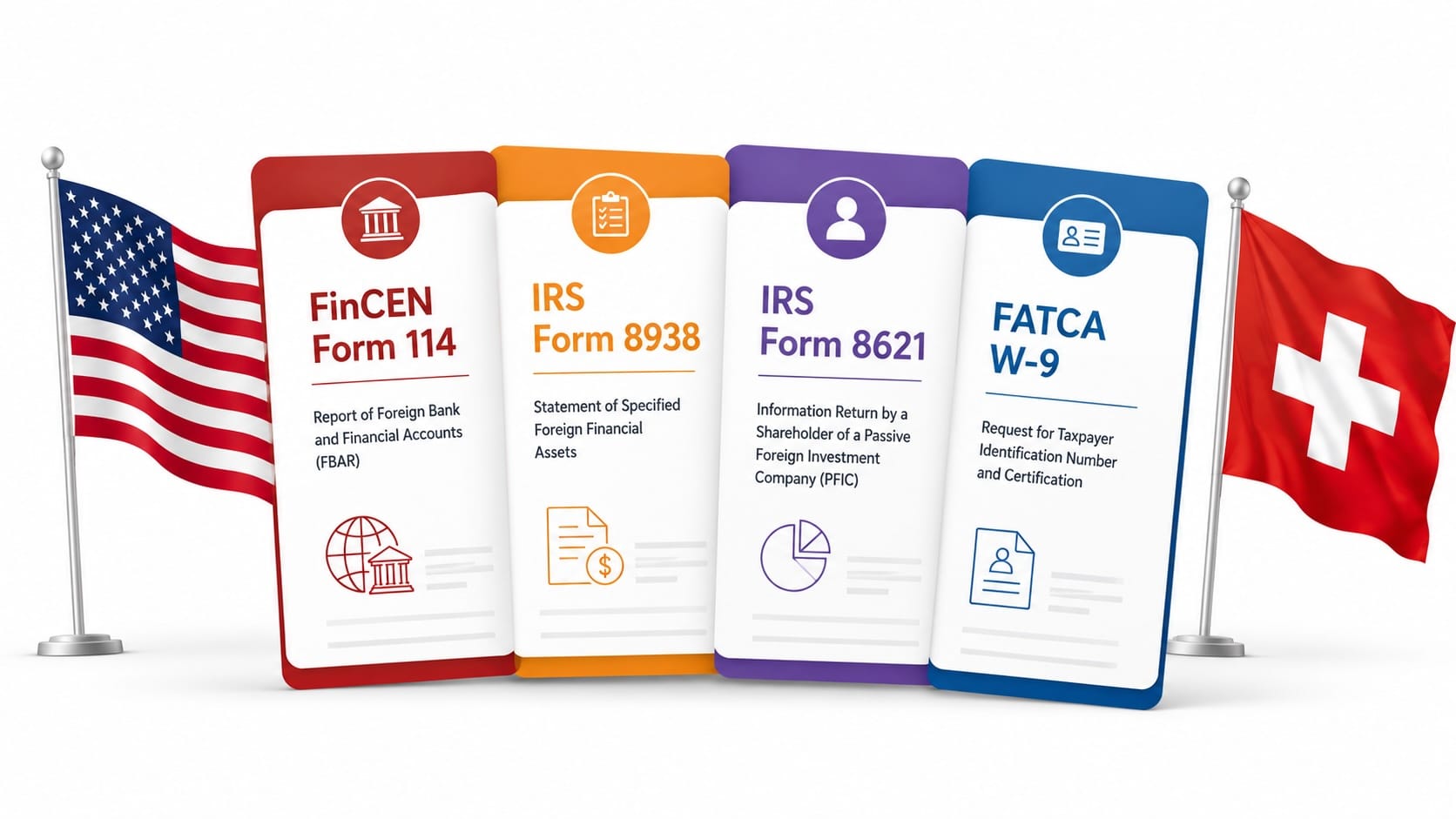
The Four-Form Stack: What the IRS Actually Requires When You Hold a Swiss Account
Almost every guide about Swiss accounts for Americans reduces the compliance picture to “FATCA” — as if FATCA is one thing you file and you’re done. It isn’t. FATCA is partly something the Swiss bank files (reporting your account to the IRS), and partly something you file (Form 8938). On top of that sits FBAR, which is a separate obligation to a separate US government department (FinCEN, not the IRS) with different thresholds and different penalties. And if you hold Swiss-domiciled funds — something most guides never mention — you may be facing annual Form 8621 filings for each Passive Foreign Investment Company in your portfolio. Missing any layer of this stack triggers independent penalties. Here is what each one requires. When funding the opening deposit, wire from your own US account — it satisfies compliance and sidesteps the new US remittance tax on cash-funded transfers.
- Filed annually with FinCEN (not IRS) by April 15; automatic extension to October 15
- Reports account holder identity, account number, financial institution name, max balance during year
- Covers bank accounts, brokerage accounts, securities accounts, mutual funds, and most other foreign financial accounts
- Civil penalty for non-wilful failure: up to $16,536 per violation (2026 inflation-adjusted amount; the statutory base rate of $10,000 understates the current figure)
- Wilful non-filing: greater of $165,353 or 50% of the account balance per violation. Criminal prosecution possible: up to $500,000 fine and 10 years imprisonment under 31 USC §5322.
- Post-Bittner v. United States (2023 Supreme Court): non-wilful penalties apply per FBAR form, not per account — one missed filing with five accounts = one penalty, not five
- The $10,000 threshold is aggregate across all foreign accounts — a CHF 6,000 account and a €5,000 account together trigger FBAR even if neither exceeds the threshold alone
- Filed with your annual US tax return (Form 1040)
- Covers a broader range of assets than FBAR: foreign bank accounts, foreign stocks and securities held outside the US, interests in foreign entities, certain foreign pensions
- The $200,000 year-end threshold for expats ($300,000 at any time during the year) means this is mainly relevant for Swiss accounts above that level
- Failure to file: $10,000 penalty; up to $50,000 for continued failure after IRS notice
- FBAR and Form 8938 overlap but are not identical — both must be filed when both thresholds are met. Filing one does not satisfy the other.
- Swiss-domiciled funds, ETFs, and most unit trusts are classified as PFICs under US tax rules
- PFICs face punitive US tax treatment: excess distributions taxed at highest ordinary income rate plus interest charges going back to the year of investment
- Form 8621 must be filed for each PFIC annually — a portfolio of 10 Swiss funds = 10 separate Form 8621 filings
- Even US-listed ETFs held through a Swiss account are exempt from PFIC treatment. The problem arises with Swiss-domiciled collective investments.
- The practical implication: US clients with Swiss accounts should generally hold only individual securities or US-domiciled ETFs in their Swiss portfolios — not Swiss collective investment funds.
- The bank files annual reports to IRS via Swiss FTA: account holder identity, account number, year-end balance, income received
- You must provide the bank a signed W-9 (US residents) or relevant W-8 form confirming your US status and TIN
- FATCA self-certification is typically required at account opening and periodically thereafter
- If you fail to provide required FATCA certifications, the bank may apply 30% withholding to US-source payments or close the account
- This operates automatically — your Swiss account data arrives at the IRS regardless of what you file. Cross-referencing against your FBAR and 8938 is routine.
Most Swiss private banks offer their clients access to Swiss-domiciled collective investments — funds managed by Swiss asset managers, registered under Swiss law. For most non-US clients these are perfectly standard portfolio instruments. For a US person, every one of them is a PFIC. The US tax treatment of PFICs is deliberately punitive: distributions that exceed 125% of the average distribution from the prior three years are taxed as “excess distributions” at the highest ordinary income tax rate (currently 37%), plus an interest charge calculated as if the tax should have been paid in the year the gain accrued. A 10% annual return on a CHF 500,000 Swiss fund position — held for five years without specialist tax advice — can result in a US tax bill that exceeds the actual gain. The solution: US clients at Swiss banks should hold individual equities and bonds, or US-domiciled ETFs (traded on NYSE/NASDAQ), not Swiss collective investment funds. The bank’s standard model portfolio is not designed for US tax efficiency. Ensure your Swiss wealth manager — or their SEC-registered adviser — constructs your portfolio with PFIC avoidance as an explicit constraint.
Why Americans Are Looking at Swiss Banking Again in 2026
The original version of this post was published in April 2025 and referenced a “trend” of wealthy Americans revisiting Swiss banking amid uncertainty. That trend has become considerably more concrete in 2025–2026. The USD weakened meaningfully against the CHF through the first quarter of 2026 — the franc is genuinely one of the few major currencies that has appreciated against the dollar over most long-term periods, and 2026 is confirming that pattern. Tariff-driven uncertainty, concern about US fiscal trajectory, and the broader question of asset concentration in US markets have all pushed international diversification up the priority list for Americans with substantial wealth.
Approximate rates for illustration. CHF/USD shows long-term USD weakness against the franc. Past performance does not predict future rates. Not investment advice.
USD/CHF: 2020 = 0.97, 2021 = 0.92, 2022 = 0.95, 2023 = 0.90, 2024 = 0.88, May 2026 ~0.83.
The case for CHF as a safe-haven asset alongside the dollar isn’t about secrecy — that era ended definitively with FATCA and the 2009–2013 DOJ Swiss Bank Program. It’s about structural features that are independent of what any US administration does: Switzerland’s fiscal discipline (federal debt-to-GDP well below 30%), the Swiss National Bank’s track record of maintaining CHF value, Switzerland’s political neutrality in global conflicts, and FINMA-supervised institutional stability that is demonstrably distinct from the US banking sector. For a US UHNW individual whose net worth is heavily concentrated in US assets — equities, real estate, USD cash — adding a CHF-denominated position at a Swiss institution is standard international diversification, legally done and fully reported.
Documentation Requirements for US Clients at Swiss Banks
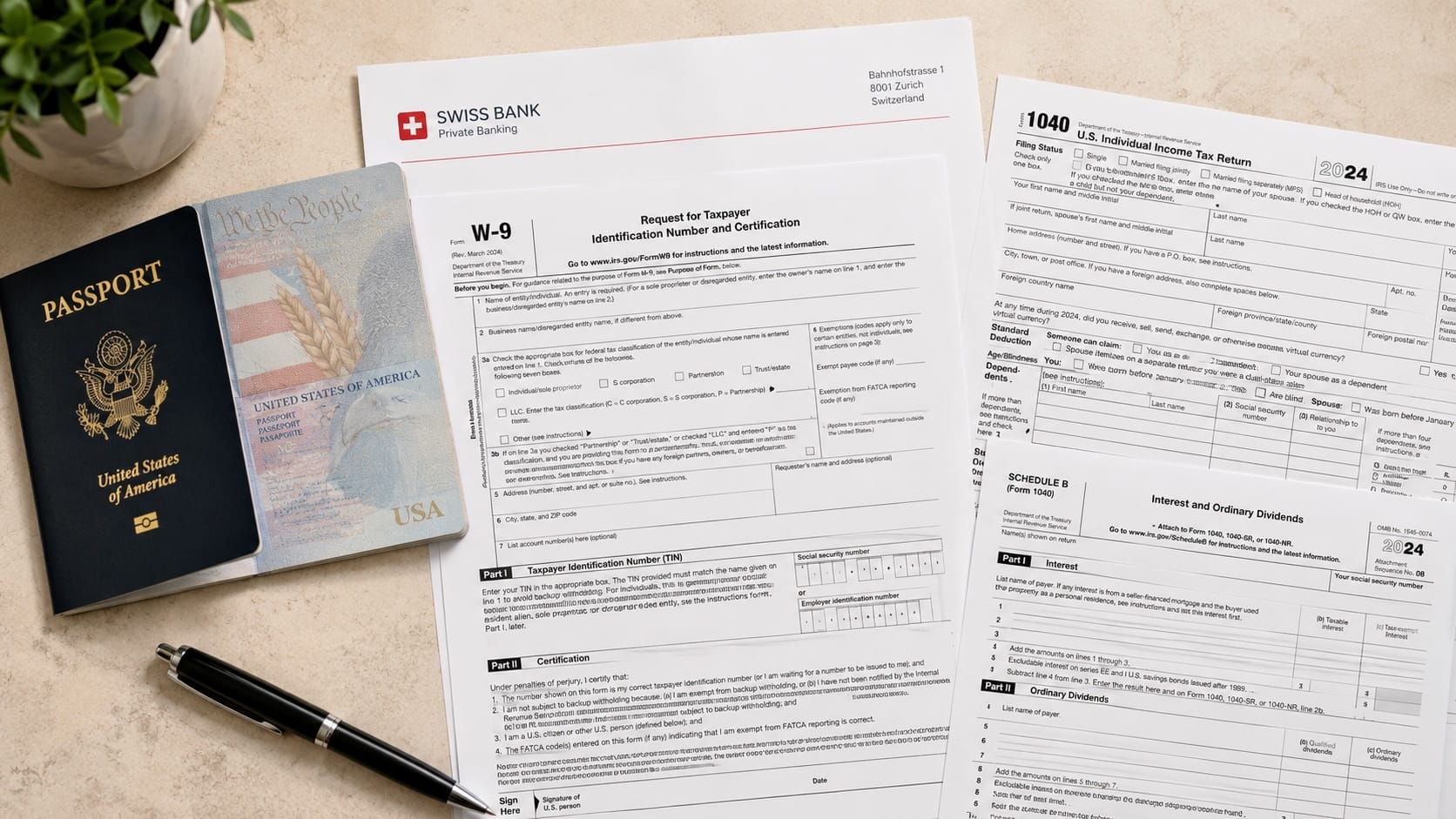
US clients face the standard non-resident documentation requirements plus a layer of US-specific certifications. The documents below are what a US applicant at UBS SFA, Vontobel Swiss Wealth Advisors, or PostFinance’s specialist US mandate will need to provide.
| Document | US-specific notes |
|---|---|
| Valid US passport | US passport widely accepted for video-ID and digital onboarding at Swiss institutions with US infrastructure. Certification by a notary or Swiss consulate if submitting certified copy. No apostille required — US documents accepted in English. |
| US Social Security Number (SSN) or Individual Taxpayer Identification Number (ITIN) | Mandatory for FATCA TIN reporting. Swiss bank cannot open an account for a US person without a valid US TIN. Green card holders provide SSN; Americans abroad with ITINs provide that instead. |
| IRS Form W-9 (Request for Taxpayer Identification) | Signed by the account holder; confirms US person status and TIN. The bank files this in its FATCA compliance records. Must be updated when circumstances change. |
| FATCA self-certification | Bank-specific form confirming whether you are a US person, your tax residency, and your TIN. Required at account opening; may be requested periodically for update. |
| Proof of US address or overseas address | US residents: utility bill or bank statement at US address. US citizens living abroad: proof of foreign residence address plus a statement of US citizenship status. Swiss banks need to know both your Swiss address (if applicable) and your IRS filing address. |
| Source of wealth documentation | Same as for any non-resident: employment income, business sale, inheritance, etc. Two years of US tax returns (Form 1040) are the most credible source-of-wealth document for US clients and are widely accepted at face value by Swiss banks — they confirm income, assets, and tax compliance simultaneously. |
| Bank statements (3–6 months) | US bank statements (Chase, Bank of America, Wells Fargo) accepted at face value; no translation or apostille needed. |
| PFIC portfolio disclosure | If you have existing Swiss accounts with Swiss-domiciled funds, the receiving Swiss institution may ask for details of your existing PFIC positions to structure the transfer and portfolio correctly for US tax purposes. This is a feature of the specialist US-client services, not standard onboarding. |
Related reading:
Frequently Asked Questions
Can US citizens open a Swiss bank account in 2026? +
What is FBAR and does it apply to Swiss bank accounts? +
What is the PFIC problem and how does it affect Americans with Swiss accounts? +
Will the IRS know about my Swiss bank account? +
Do I need an SEC-registered adviser to open a Swiss private bank account as a US citizen? +
What is the US-Switzerland Tax Treaty and what does it cover for Americans with Swiss accounts? +
References
- IRS — Foreign Account Tax Compliance Act (FATCA): Official Guidance and Filing Requirements (opens in new tab)
- FinCEN — FBAR: Report of Foreign Bank and Financial Accounts (FinCEN Form 114) (opens in new tab)
- IRS — Form 8621: Information Return by a Shareholder of a Passive Foreign Investment Company (PFIC) (opens in new tab)
- SEC EDGAR — UBS Swiss Financial Advisers AG: SEC-Registered Investment Adviser Filing (opens in new tab)
- FINMA — Swiss Banking Supervision and FATCA Implementation Framework (opens in new tab)