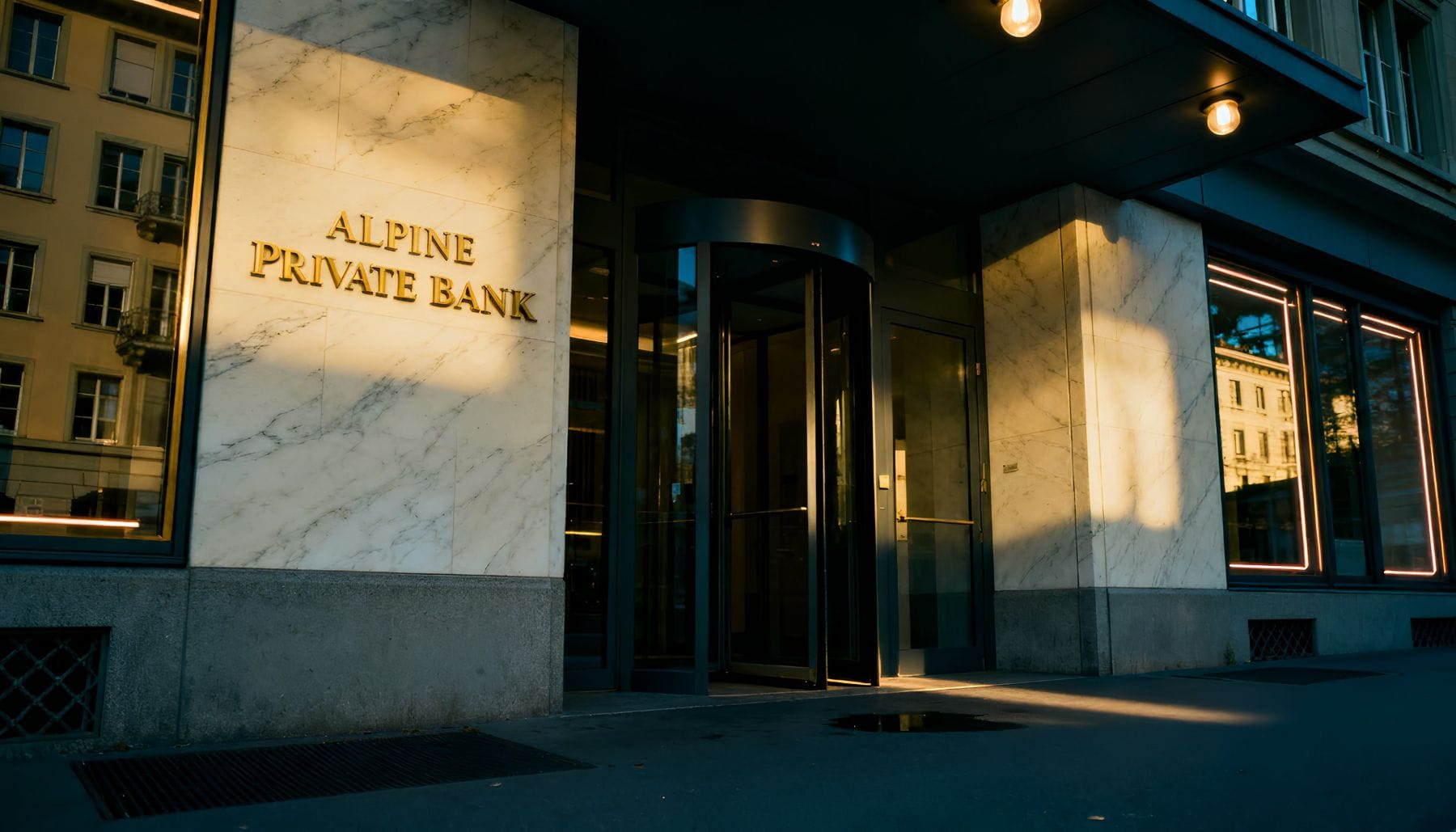
Swiss bank rejection letters are among the most carefully worded documents in the financial world. “We regret we are unable to proceed with your application at this time.” Nothing more. No reason, no guidance, no indication of whether you should try again or move on. Most people assume this is Swiss formality — polite distance dressed up as professionalism. It isn’t. The opacity is structural, and in one specific scenario it is actually a legal obligation. Understanding why Swiss banks can’t — and sometimes legally cannot — tell you why they said no is the starting point for understanding what actually happened, and what to do about it.
There are six genuine reasons Swiss bank applications fail. Five of them are fixable with the right preparation and bank matching. One of them — the one involving a Suspicious Transaction Report to MROS, Switzerland’s financial intelligence unit — cannot be resolved through documentation improvement, because the bank is legally prohibited from disclosing it under AMLA Article 9. Knowing which category your rejection falls into determines your next move entirely.
| Reason | How common | Fixable? | Immediate action |
|---|---|---|---|
| Wrong bank for your profile | Very common | ✅ Yes | Match bank to nationality, tier, structure before applying |
| Incomplete / incoherent source of wealth | Most common | ✅ Yes | Rebuild documentation with coherence review before resubmitting |
| Opaque corporate or ownership structure | Common | ✅ Yes | Write a plain-language structure narrative explaining every tier |
| High-risk nationality or residency | Common | ⚠️ Partially | Identify banks with established desks for your nationality |
| Cold application without introduction | Very common | ✅ Yes | Access through a referral — EAM, existing client, or law firm |
| STR filed — legally cannot be disclosed (AMLA Art. 9) | Less visible — rising with AI screening | 🔴 Specialist only | Stop all applications. Engage Swiss AML lawyer immediately. |
Key figures: 21,087 STRs filed with MROS in 2025 (+40%). 5 of 6 rejection categories are fixable. AMLA Article 9 prohibits disclosure of STR filings. 30+ Swiss banks actively onboard non-residents.
The Six Rejection Categories — and Which Ones You Can Fix
Not all Swiss bank rejections are the same problem. Treating them as though they are — applying better documents to a bank selection problem, or switching banks when the issue is a compliance flag — is why many applicants spend a year applying unsuccessfully to multiple institutions without understanding why nothing is working. The taxonomy below categorises the six genuine rejection reasons and signals which one requires a different approach entirely.
The most common rejection. You applied to a bank that doesn’t serve your nationality, deposit tier, or corporate structure. Solution: proper bank matching before application. Most preventable failure in the process.
Your source-of-wealth narrative didn’t hold together under compliance review — missing chain of evidence, deposit-to-income ratio mismatch, or documents that contradicted each other. Solution: complete documentation rebuild with coherence review before resubmission.
Multi-tier holding structures, offshore SPVs, or foundations that obscure UBO identity. Banks couldn’t identify who ultimately controls the account. Solution: structural narrative documentation — showing what everything is and why it exists.
Your passport or domicile triggers the bank’s country risk overlay. Not a judgment about you — a regulatory exposure calculation about the bank. Solution: bank selection that matches your nationality profile. Some banks are specifically equipped for profiles that others decline.
At private banks, cold applications from unknown profiles face a very high bar. Swiss private banking is a relationship-driven market — referrals from existing clients, law firms, family offices, or regulated EAMs change the assessment. Solution: access through a warm introduction.
The bank filed a Suspicious Transaction Report with MROS under AMLA Article 9. By law, they cannot disclose this. The rejection letter says nothing. Documents will not fix this. A different bank is not a solution until the STR trigger is identified and addressed. See full explanation below.
The Reason They Can Never Tell You: AMLA Article 9 and the STR
Under Article 9 of the Swiss Anti-Money Laundering Act (AMLA), when a Swiss bank files a Suspicious Transaction Report with MROS — Switzerland’s Money Laundering Reporting Office — the bank is under a strict legal prohibition against informing the client that a report was filed, that their account is under suspicion, or that their application was declined for compliance reasons connected to a potential STR. The prohibition isn’t customary discretion. It is a criminal law obligation. A bank employee who discloses to a client that an STR was filed can face prosecution under Article 10 AMLA.
The consequence for applicants is a specific and particularly frustrating silence. When your rejection letter says “we are unable to proceed with your application at this time” and nothing else, it may mean any of the first five categories above — or it may mean category six. From the outside, you cannot tell which. The letter is the same. The outcome is completely different.
- The bank files the STR with MROS and simultaneously freezes any assets already in their custody (if applicable). They cannot tell you this has happened.
- MROS receives the report and applies risk scoring, pattern detection, and link analysis. It determines whether to forward the case to prosecutorial authorities or close it.
- If MROS closes the case: no further action. The STR remains on record. The client never learns it was filed.
- If MROS forwards to prosecutors: an asset freeze takes legal effect. Criminal investigation may follow. Still no notification obligation to the client under civil law.
- The STR record persists in MROS databases for the statutory retention period, and is accessible to Swiss authorities in any future investigation — including investigations prompted by applications at other Swiss banks.
The practical implication: If your rejection was triggered by an STR, approaching a second Swiss bank without understanding what generated the concern is not just ineffective — it may add a second STR to the record, compounding the compliance footprint. This is the specific scenario where engaging a FINMA-registered EAM or Swiss legal counsel before any further banking application is not optional. It is the only path that doesn’t make the situation worse.
MROS received 21,087 STR filings in 2025 — a 40% increase from the prior year, driven partly by the widespread adoption of AI-assisted transaction monitoring at Swiss banks. FINMA has estimated that between 30,000 and 40,000 STRs will be filed in 2026. These are not primarily filed on active account relationships; a significant proportion originate from account opening review processes — exactly the scenario where a new applicant’s documentation or transaction history triggers an alert in the bank’s screening systems before an account is ever opened. The STR is filed on the application, not on an existing account. The application is declined. The applicant receives the standard rejection letter and has no idea what happened.
The AI Screening Layer: Why 2026 Is Different from 2020
Something changed in the Swiss bank rejection landscape between 2020 and 2026 that most guides haven’t caught up with: AI. A FINMA survey published in April 2025 found that Swiss financial institutions are increasingly deploying AI tools for suspicious activity detection — anomaly identification, pattern recognition, network mapping — as part of their customer due diligence and transaction monitoring workflows. This matters for applicants because it adds a layer of automated screening that operates before a human compliance officer reads a single document.
What the AI screening picks up varies by institution, but the documented triggers include: transaction patterns inconsistent with the stated business description, digital footprint inconsistencies (online presence that doesn’t match the stated occupation or business), connection to entities or individuals flagged in Swiss or international sanctions databases, and deposit velocity patterns that suggest structuring. A retail account application from a self-described “technology consultant” whose LinkedIn profile doesn’t mention technology consulting will, at a growing number of Swiss banks, generate an automated alert before the compliance team is involved.
This isn’t alarming — it’s just the current reality. The practical implication is that the pre-submission coherence check described in the documents guide now needs to extend to your digital profile, not just your paper file. An inconsistency that would have been caught in human review six years ago is now caught automatically before human review begins. The same rule applies in both cases — consistency between your stated profile and your verifiable footprint — but the speed at which inconsistencies are flagged has accelerated considerably.
2024 and 2025 figures: MROS Annual Report / PwC Switzerland. 2026 figure: MROS head projection. Pre-2024 figures approximate from MROS published data.
STR filings: 2021 ~7,300; 2022 ~8,700; 2023 ~10,400; 2024 15,141; 2025 21,087; 2026 projected 30,000–40,000.

The Five Fixable Rejections: What Specifically Went Wrong and What to Do
Wrong Bank — The Problem That Ruins Everything Else
Bank selection mistakes don’t produce a bad outcome only when they result in rejection — they produce a bad outcome even when they produce an approval, because you’ve opened an account at an institution that isn’t equipped for your profile. A Southeast Asian business owner who gets approved at a Swiss cantonal bank and then experiences constant compliance friction, account monitoring inquiries, and relationship manager unfamiliarity with their market would have been better served by a bank with a genuine Asia desk. The right match matters throughout the relationship, not just at the door.
The matching criteria that most guides understate: each Swiss private bank has a target geography, a target wealth segment, and a target client type — all unpublished, all discoverable only through practitioner knowledge. EFG International has a particularly strong footprint in Southeast Asia and the Middle East. J. Safra Sarasin has deep Latin American expertise. LGT Bank has established relationships in Asian family office circles. Julius Baer’s US client infrastructure is now entirely with Vontobel SFA. Applying to the right bank for your profile increases acceptance probability and relationship quality simultaneously. For a detailed institution-by-institution comparison, see the minimum deposit and bank selection guide.
Source of Wealth — Why “Documented” Isn’t the Same as “Coherent”
Source-of-wealth failures are the most common rejection cause and the most misunderstood. Applicants typically believe they failed because they were missing a document. They almost never were. What failed was the narrative — the internal logical chain between how the money was made, what the documents show, and what the proposed deposit represents. A complete document file that tells an inconsistent story fails faster than an incomplete file that tells a coherent one, because completeness is table stakes but coherence is what compliance is actually testing.
The specific coherence tests that generate the most follow-up requests and failure flags: a proposed opening deposit more than five times the annual income shown in bank statements (the plausibility flag); a business sale claim without a documentary chain from the sale completion to the current account balance (the proceeds trail gap); multiple wealth sources described in a single wealth declaration without separate documentation for each (the unsupported assertion problem); and bank statements showing a balance inconsistent with the deposit amount proposed, even when source-of-wealth documents are present (the real-time coherence gap). See the full documents guide for the Compliance File Coherence Test — a five-question pre-submission checklist.
Corporate Opacity — How Legitimate Structures Generate Suspicion
Multi-tier holding structures, offshore foundations, trusts with discretionary distributions, and special purpose vehicles are all legitimate legal instruments with entirely proper purposes. Swiss banks know this. They also know that these structures are used in AML typologies, which means a complex corporate structure without a clear, documented explanation for why each tier exists triggers compliance review regardless of the actual intent. The question compliance asks isn’t “is this legal?” — they assume it is. The question is “can I explain this structure to FINMA if I’m asked?” If the answer is no, or requires ten minutes of untangling, the bank declines rather than carry unexplainable complexity.
The solution is a structure narrative — a document, typically one to three pages, that explains the corporate structure in plain language: what each entity does, why it exists, what assets or activities it holds, and why the Swiss account is the appropriate banking vehicle for this structure. This document doesn’t need to be legal prose. It needs to be clear and convincing to a compliance officer who is reading it without any prior knowledge of your business. A well-written structure narrative turns a complex file from a compliance risk into a compliance audit trail — which is precisely what banks want.
High-Risk Nationality — What to Do When Your Passport Is the Problem
A rejection based primarily on nationality is the most difficult to address through documentation, because the issue isn’t the documents — it’s the bank’s internal country risk matrix, which is set by the compliance department and not responsive to individual applications. What changes the outcome is bank selection, not preparation. Banks vary significantly in their appetite for specific nationalities. A Turkish client rejected by a major cantonal bank may be accepted by EFG International, which has maintained a dedicated Turkish client desk for over a decade. A Brazilian client declined at a top-tier private bank may access the same quality of wealth management through a specialist mid-tier institution with established LatAm relationships.
The rule for nationality-based rejections: research which specific banks actively serve your nationality before approaching any of them. This information is not published; it is practitioner knowledge. A FINMA-registered EAM with Swiss private banking relationships across the market is the most efficient path to this information. For a nationality-specific guide see the Swiss banking for non-residents overview.
Cold Application — Why Swiss Private Banking Still Runs on Introductions
Swiss private banking is, at the relationship tier, a referral-driven market. A cold application from an unknown individual to a private bank with a CHF 5 million minimum will rarely succeed regardless of documentation quality, because the relationship manager has no basis for advocating for the client internally. Swiss compliance teams and client acceptance committees respond to applications differently when a relationship manager or an established client has vouched for the applicant. A warm introduction — from an existing client, from a FINMA-registered EAM the bank knows and trusts, or from a Swiss law firm or family office with which the bank has an established relationship — changes the internal dynamics of the application review in ways that cannot be replicated by a stronger document file.
At the digital and mid-tier end (Swissquote, Dukascopy, CIM Banque), cold applications are standard and introductions are less relevant. The warm introduction dynamic applies primarily from the CHF 500,000 tier upward at private banks, and becomes progressively more important as the tier increases. At Tier 5 institutions (Pictet, Lombard Odier, LGT), no amount of documentation compensates for the absence of a trusted introduction.

What to Do After a Rejection: A Category-by-Category Recovery Framework
| Rejection category | Immediate action | Do NOT do this | Timeline to reapply |
|---|---|---|---|
| Wrong bank for profile | Map your nationality, deposit tier, and corporate structure against known bank acceptance criteria. Use a FINMA-registered EAM or practitioner to identify 3 well-matched institutions before approaching any of them. | Apply to another well-known Swiss bank without first validating the match. Brand recognition ≠ profile fit. | Immediately — once correctly matched |
| Source of wealth failure | Run the Compliance File Coherence Test against your existing documents. Identify the specific gap — plausibility ratio, proceeds trail, or internal inconsistency. Rebuild documentation around the specific failure point before resubmitting. | Resubmit the same package to a different bank expecting a different outcome. The same gaps fail the same way everywhere. | 4–8 weeks to rebuild properly; then reapply |
| Opaque corporate structure | Write a structure narrative (1–3 pages, plain language). Explain each entity, its purpose, and the logic of the overall structure. Have a Swiss compliance practitioner review it before resubmission. | Add more documents without adding explanation. More evidence of a confusing structure is still confusing. | 3–6 weeks to draft and validate narrative; then reapply |
| Nationality / country risk | Stop applying to non-specialist institutions. Identify which Swiss banks have established relationships with your nationality. This requires practitioner knowledge — use an EAM who covers your region. | Apply to multiple banks in quick succession. Multiple rejections on record from the same time period creates a compliance pattern that is harder to explain than a single rejection. | Once correctly matched — immediately |
| Cold application | Build an introduction pathway: through an EAM the bank knows, a referring existing client, or a professional services firm with that bank relationship. Do not resubmit cold. | Resubmit the same application directly. The rejection wasn’t about the documents — it was about the channel. | Weeks to build the introduction; then approach |
| STR filing (suspected) | Engage a Swiss attorney with AML expertise and a FINMA-registered EAM immediately. Do not approach another Swiss bank without specialist advice. If assets are involved, confirm they are not frozen. Understand the MROS process and timeline before any further banking application. | Apply to another Swiss bank. File additional applications. Assume the rejection was about documents. | Indeterminate — depends on MROS case outcome. Specialist handling required. |
Related reading:
Frequently Asked Questions
Why won’t the Swiss bank tell me why my application was rejected? +
Can I apply to another Swiss bank after being rejected? +
How do I know if a Suspicious Transaction Report was filed on my application? +
Does a Swiss bank rejection show up on any record other banks can see? +
How long should I wait before reapplying to the same Swiss bank? +
Was your Swiss bank account application rejected?
If you hold — or are seeking to open — a Swiss bank account with CHF 500,000 or more, we can identify the real reason for your rejection and match you to the right institution for your specific profile, nationality, and corporate structure. We work across 30+ Swiss institutions and know which ones are accepting clients with your background in 2026. Securing swiss account approval can often be a complex process due to varying requirements across financial institutions. Understanding these criteria is essential for ensuring your application meets all necessary standards. Our team is dedicated to guiding you through each step to facilitate a smooth approval experience. Benefits of banking in Switzerland often include access to a stable financial system and favorable tax regulations. Additionally, Swiss banks are known for their privacy and security measures, providing clients with peace of mind. This unique banking environment allows for personalized services that cater to diverse investment needs.
Request a free consultation →References
- PwC Switzerland — The Rising Tide of Suspicious Activity Reports: MROS Volume Analysis 2025–2026 (opens in new tab)
- Chambers and Partners — Banking Regulation Switzerland 2026: AMLA Article 9 STR Obligations (opens in new tab)
- FINMA — Money Laundering and Sanctions: Swiss AML Supervisory Framework (opens in new tab)
- Swiss Federal Chancellery (Fedlex) — Swiss Anti-Money Laundering Act (AMLA): Articles 9 and 10 (opens in new tab)
- Sanctions.io — Switzerland’s AML Regulations 2025: MROS, FINMA and Compliance Framework (opens in new tab)