Yes, US citizens can open a bank account in Singapore — but the experience is nothing like opening one as a European or Australian. FATCA compliance changes the rules at every stage: which banks will have you, what paperwork they need, and how long the process takes. This guide covers exactly how to open a bank account in Singapore as a US citizen, which institutions actively welcome US clients in 2026, and what can go wrong if you approach it unprepared. Personal banking options in Singapore can vary significantly from those available in the US. It’s essential to research the specific services and fees that different banks offer to ensure you find the best fit for your needs. Understanding these options can make a substantial difference in your banking experience while living abroad.
Quick orientation before we get into it: the extra friction you’ll face has almost nothing to do with you personally. It’s structural. Every bank in Singapore that accepts a US-person account takes on ongoing FATCA reporting obligations — and that cost shapes which banks want US retail clients and which quietly steer them away.
For Americans who pass the FATCA filter but still need a practical shortlist, the open bank account in Singapore guide narrows the field before documents start flying.
Why Singapore Banks Treat US Citizens Differently
The short answer: Congress made it expensive for them to say yes. FATCA — the Foreign Account Tax Compliance Act, passed in 2010 — requires every foreign financial institution holding US-person accounts to identify those clients, collect a signed W-9 form, and report account data to the IRS (routed through Singapore’s IRAS under a Model 1 IGA). Fail to do so and the bank faces a 30% withholding tax on US-source income. That’s an existential threat for any institution with significant USD clearing activity.
Here’s what most guides miss: FATCA isn’t the only compliance layer US clients trigger. Banks that are not registered with the US Securities and Exchange Commission cannot offer US persons access to certain investment products — even after an account is open. So if you want a brokerage function or structured products alongside your current account, your shortlist shrinks further. The institutions that have invested in both FATCA infrastructure and SEC registration are predominantly the large local banks and the major international names with a permanent Singapore presence.
The practical result: retail banking in Singapore for US citizens is narrower than it looks on paper, but it is absolutely available — provided you approach the right institutions at the right account tier. Private banking in Singapore 2025 will likely see an increase in personalized financial services tailored to high-net-worth individuals. Wealth management strategies will become more sophisticated, catering to the unique needs of foreign investors. Furthermore, advancements in technology may enhance customer experiences, making banking more accessible and efficient.
Which Singapore Banks Actually Accept US Citizens
Not every bank in Singapore is FATCA-registered. And among those that are, not all actively court US retail or personal banking clients. Based on direct client work across this jurisdiction, here is an honest picture of where US persons land.
DBS Private Bank, HSBC and Citibank show strong acceptance for US citizens. Standard Chartered and DBS retail are limited. OCBC and UOB retail require caution.
A few things worth noting about this picture. Citibank Singapore is a US-domiciled institution’s local subsidiary — accounts held there may actually be excluded from FATCA Form 8938 reporting (though you’d still count them for FBAR purposes, since the $10,000 threshold applies regardless of bank nationality). DBS Private Bank and HSBC have built full FATCA and SEC compliance infrastructure, which is why they handle US-person relationships regularly at the premium tier. Local retail branches of OCBC and UOB often quietly discourage US retail applicants; the branch may accept your documents and then come back weeks later with a decline. That wastes time nobody wants to lose.
Document Checklist: What US Citizens Need
The paperwork falls into two categories: the standard foreign-national documents every applicant provides, and the US-specific layer that FATCA requires. Have everything ready before you walk in or submit online — incomplete packages are the single biggest cause of delays, and with US-person accounts the compliance team is already watching carefully.
| Document | Specifics | US-Person Note |
|---|---|---|
| Valid Passport | Original, current — many banks require ≥6 months remaining validity | Standard requirement for all nationals |
| Valid Long-Term Pass | Employment Pass, S Pass, Dependant Pass, Student Pass, or LTVP | Tourists and short-stay visitors cannot open standard accounts |
| Singapore Proof of Address | Utility bill, telecoms statement, or tenancy agreement — dated within 3 months | Some banks accept overseas proof if relocating; call ahead |
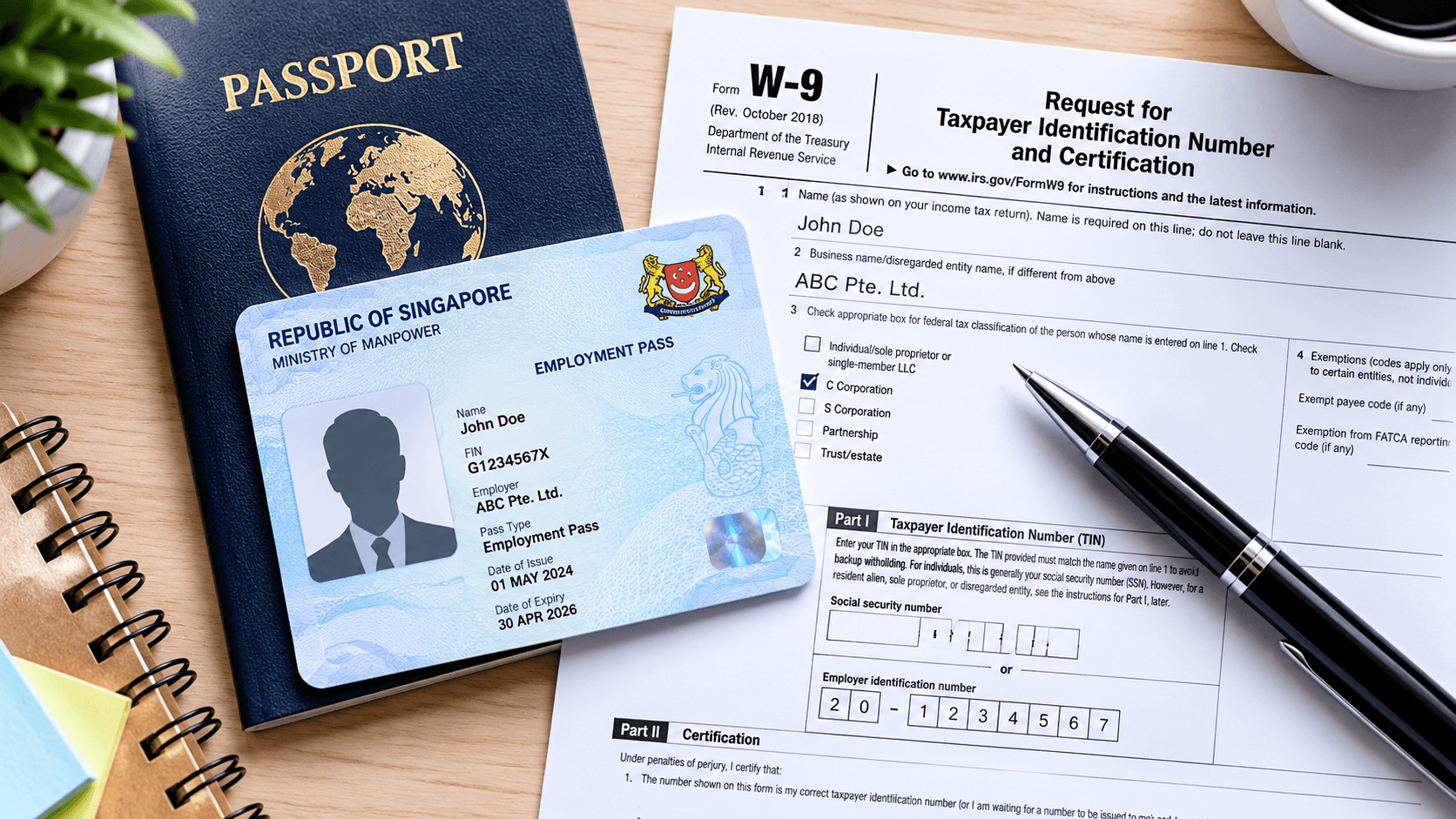
| IRS Form W-9 | Certifies your US taxpayer status and Social Security Number | Mandatory for all US persons — have your SSN ready |
| Tax Residency Self-Certification | Bank-issued form declaring all countries of tax residency | Declare US tax residency explicitly — do not omit it |
| Source of Funds / Wealth | Salary slips, employment letter, bank statements (3–6 months), investment statements | More scrutiny at premium tier; narrative matters as much as documents |
| Initial Deposit | Varies: SGD 500–1,000 (retail); SGD 200,000+ (priority); SGD 1M+ (private) | US persons often face higher informal deposit expectations at retail tier |
One thing the branch staff won’t always tell you upfront: the W-9 submission and FATCA self-certification typically trigger a secondary review by the bank’s compliance team, separate from the standard account opening queue. This is why US-person applications take longer even when every document is in order. It is not a red flag — it is the process. Knowing this in advance means you can set expectations and follow up appropriately rather than assuming something is wrong.
The 7-Step Application Process
Understanding FATCA: What Actually Applies to You
FATCA is not a tax. That’s the first thing to get straight. It is a reporting requirement — a mechanism that ensures the IRS knows about your offshore assets so they can verify your US tax returns. The tax itself is determined by your income; FATCA just closes the information gap.
As a US citizen living in Singapore, the relevant form is IRS Form 8938 — Statement of Specified Foreign Financial Assets. You file it with your annual US tax return only if the value of your foreign financial assets crosses the thresholds for expats living abroad. Those thresholds are meaningfully higher than the figures that apply to US residents stateside.
Bar chart comparing FATCA thresholds: Single/MFS filers must report if assets exceed $200,000 at year-end or $300,000 at any point. Married filing jointly: $400,000 at year-end or $600,000 at any point.
What counts toward the threshold? Bank accounts in Singapore, brokerage accounts, non-US stocks held outside an account, interests in foreign companies or funds, and certain foreign life insurance or pension arrangements. The figure is cumulative — add everything together when assessing whether you need to file.
Not filing a US return in a given year removes the Form 8938 obligation entirely for that year. But FBAR — a separate beast — has no such carve-out. More on that below.
FBAR vs FATCA: Two Different Obligations, Both Mandatory
This is the section most US expats in Singapore wish someone had shown them earlier. FATCA and FBAR are entirely separate reporting requirements. Filing one does not satisfy the other. Many people only discover this when a tax adviser reviews their situation — sometimes years after opening foreign accounts.
| Feature | FATCA (Form 8938) | FBAR (FinCEN Form 114) |
|---|---|---|
| Filed with | IRS — attached to annual tax return | FinCEN (US Treasury) — separate electronic filing |
| Threshold (abroad) | $200K year-end / $300K anytime (single); $400K / $600K (MFJ) | $10,000 aggregate across all foreign accounts — at any single day during the year |
| What it covers | Broader: bank accounts, non-account foreign assets (stocks, partnership interests, foreign pensions) | Foreign financial accounts only: bank, securities, brokerage, some insurance with cash value |
| Filing deadline | Due with your tax return (including extensions) | April 15; automatically extended to October 15 |
| Penalty — non-willful | $10,000 base; up to $50,000 for continued failure | Up to $10,000 per violation |
| Penalty — willful | 40% accuracy penalty on underpayment | Greater of $100,000 or 50% of account balance per violation; potential criminal charges |
The $10,000 FBAR threshold catches nearly every working expat. A single Singapore bank account with a month’s salary will likely push you over it. There is no income test and no connection to your tax return — if the number hits $10,001 on any single day of the year, the FBAR is due. The good news: filing is free and takes about 20 minutes electronically through the BSA E-Filing System.
What Happens If Your Application Is Rejected
It happens. Singapore banks are not obligated to explain why they decline a US-person account, and most won’t give a specific reason beyond “we are unable to proceed at this time.” What they won’t say is that your profile triggered an internal flag — perhaps a complex source of funds, a business with multiple jurisdictions, or simply a branch-level decision by a compliance officer who was not confident in the review.
A rejection at one bank is not a verdict on your eligibility in Singapore. The correct next step is to move to a bank at a higher tier with dedicated FATCA infrastructure — often a private bank or international bank with a specialist US client desk. These institutions have in-house legal capacity to properly evaluate complex profiles rather than defaulting to a decline when unsure.
If you are working with an offshore banking consultant, ask them to frame your application narrative before resubmission. The quality of the document package and the coherence of your source-of-funds story often matters as much as the documents themselves.
Singapore’s CRS Reporting: The Other Transparency Layer
While FATCA dominates the conversation for US expats, Singapore also participates in the OECD’s Common Reporting Standard — a multilateral framework for automatic exchange of financial account information across roughly 100 participating jurisdictions. Unlike FATCA, which is bilateral between Singapore and the US, CRS creates broader transparency obligations.
For US citizens living in Singapore, CRS is less directly relevant (the US has not adopted CRS domestically), but it shapes the compliance environment around you. Singapore is explicitly a transparency jurisdiction, not a secrecy one. IRAS exchanges account data annually with CRS counterparts. This context matters: do not approach Singapore banking with an offshore secrecy mindset. It does not work here, and banks will read that intent quickly.
The Singapore banking regulatory framework continues to strengthen under MAS guidance. If anything, compliance standards are moving in one direction. For a broader look at how the system compares to other jurisdictions, our Swiss and Singapore risk classification guide covers the full compliance picture.
Related reading:
- Swiss & Singapore Bank Account Risk Classification: The Complete Guide (2026)
- Fueling Your Growth: The Power of Singapore Business Banking for SMEs
- Unlocking the Vault: Exploring the Dynamic History of the Banking System in Singapore
Frequently Asked Questions
Can a US citizen open a bank account in Singapore without an Employment Pass?
Does a Singapore bank account at Citibank need to be reported on FATCA Form 8938?
Can I open a Singapore bank account remotely as a US citizen?
What is the minimum deposit to open a Singapore bank account as a US citizen?
Does Singapore report my bank account to the IRS?
If you are working with a US expat tax specialist and need Singapore banking support alongside it, our team regularly assists clients in structuring their applications for the best-fit institutions. You can reach us through the contact page — we review profiles before any bank approach, which avoids the wasted time of going to the wrong institution first.
References
- Foreign Account Tax Compliance Act (FATCA) — Internal Revenue Service (opens in new tab)
- Summary of FATCA Reporting for US Taxpayers — IRS (opens in new tab)
- FATCA Overview and Latest Developments — Inland Revenue Authority of Singapore (opens in new tab)
- Foreign Account Tax Compliance Act — US Department of the Treasury (opens in new tab)
- FATCA Guidance — The Association of Banks in Singapore (opens in new tab)