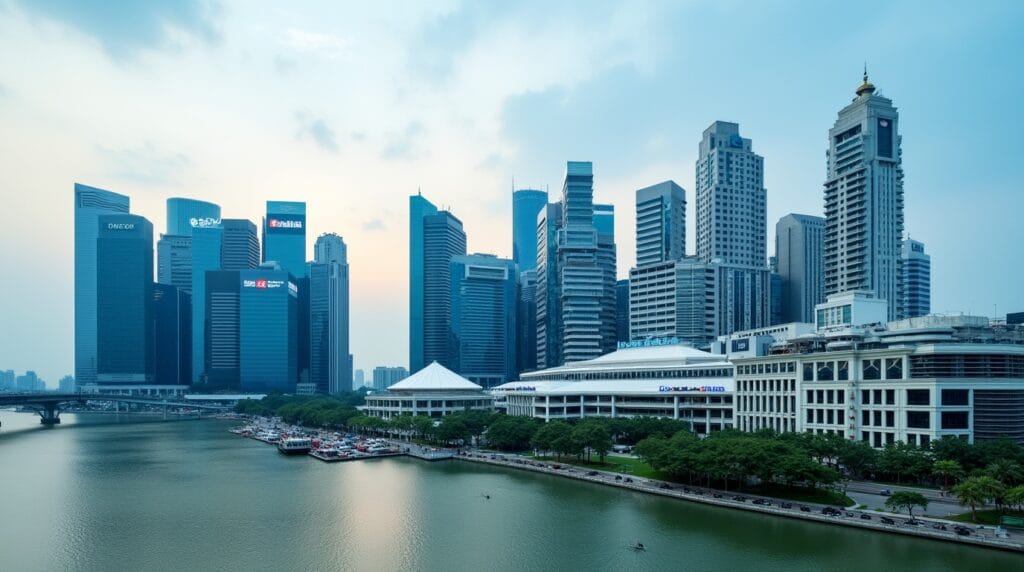
Digital nomad banking in Singapore comes down to one thing most guides never explain: what a compliance officer actually looks for when they open your file. Knowing that changes everything. Singapore is genuinely open to non-resident account holders — the Monetary Authority of Singapore (MAS) has built an infrastructure that supports international clients — but the approval process is not automatic. Banks run real KYC checks, evaluate your income source narrative, and match your profile against risk parameters. The nomads who sail through are not the ones with the cleanest passports. They are the ones who understood what story the documents need to tell before they hit submit.
This guide covers the complete picture: what Singapore banks require from non-residents, which bank fits which income profile, how the remote process actually works, what your multi-currency deposits are and are not protected against, and the tax reality for foreign-sourced income. Every figure here has been verified against current bank documentation and MAS sources as of May 2026. To open a personal account in Singapore, you need to provide valid identification and proof of address. The key difference for a digital nomad file is that the bank must see recurring income, address logic and tax-residence consistency before it reviews products.

Why Singapore Beats Every Other Banking Base for Location-Independent Earners
The most common mistake nomads make when evaluating banking options is treating institutional credibility as a soft factor. It is not. When a high-value client wants to wire USD 30,000 to you, when a corporate counterparty needs to verify your banking jurisdiction, or when a tax authority reviews your financial disclosures, a Singapore account with DBS, OCBC, or UOB carries legal and institutional weight that an EU e-money licence never will. That gap matters more as your income scale rises.
Singapore’s fintech regulation follows a tiered licence model under the Payment Services Act. Full-bank licences (which DBS, OCBC, and UOB hold) carry the strongest regulatory obligations and the strongest client protections. Digital-bank licences (GXS, MariBank, ANEXT, Green Link, Trust Bank) carry MAS oversight but with narrower balance sheet permissions. E-money licences (Wise Singapore, Revolut Singapore) carry the least. Most nomads are using the lowest tier as their primary account, which means they are carrying the most exposure to account freezes, limited recourse, and zero deposit insurance on foreign currency holdings.
On infrastructure, the case for Singapore is simple. As of March 2026, Singapore ranked first globally for fixed broadband speed at 425.46 Mbps median download, per Ookla’s Speedtest Global Index — well ahead of the UAE at 384.51 Mbps and Hong Kong at 352.40 Mbps. Changi Airport connects to over 100 countries with direct flights. The SGT time zone (UTC+8) overlaps with both Asian morning markets and European afternoon sessions simultaneously. And unlike many banking jurisdictions, Singapore has no capital gains tax, no inheritance tax, and no withholding tax on dividends received from foreign companies.
One thing to name clearly upfront: Singapore has no dedicated digital nomad visa. You apply as a non-resident, which is a specific and functional status with its own banking pathway. Singapore’s five digital banks (GXS, MariBank, ANEXT, Green Link Digital Bank, and Trust Bank) require SingPass — Singapore’s national digital identity — for onboarding. As a non-resident without SingPass access, your route runs through the major full-licence banks, not the digital-native ones. That is actually a better outcome, for reasons this guide will explain.
Singapore has 132 licensed banks, 0% capital gains tax for non-residents, SDIC deposit insurance of SGD 100,000 for SGD accounts only (foreign currency deposits not covered), and recorded S$1.1 billion in scam losses in 2024. That mix explains why banks welcome strong non-resident files but scrutinise vague ones. For higher-balance clients, the top private banks in Singapore become relevant only when the file moves beyond payment use into custody, investment or wealth management.
What Singapore Banks Actually Evaluate — The Real KYC Criteria for Non-Residents
Most guides list documents. What they miss is the underlying logic those documents serve. Singapore banks are evaluating three things: identity (who are you), source of funds (where does your money come from), and risk profile (how likely are you to create a compliance problem). Your application needs to answer all three clearly, without gaps that force a compliance officer to make assumptions.
The baseline document set for non-resident remote applications is consistent across all major banks: a valid passport (at minimum six months remaining validity), proof of residential address no older than three months (utility bill, rental agreement, or government-issued document showing your full name and physical address — PO boxes rejected universally), and proof of income. That last item is where most applications either get approved quickly or stall.
If you are an employee receiving salary payments, recent payslips work well. If you are a freelancer or consultant — which describes most digital nomads — you need to show something more structured: signed contracts with named clients, corresponding invoices, and ideally 6–12 months of bank statements showing consistent inflows that match the contracts. Banks are not looking for perfection. They are looking for a coherent narrative. A freelancer earning SGD 8,000 per month with clean documentation and a clear explanation of their work outperforms a higher earner with vague or inconsistent records every time.

Singapore participates in the Common Reporting Standard (CRS). This means you will be required to provide your Tax Identification Number from your country of tax residence, and your account information will be automatically shared with your home tax authority annually. This is not optional. Any application that omits TIN information triggers a mandatory compliance hold. For opening a Singapore bank account as a non-resident, CRS compliance is treated as a first-principles requirement by every MAS-regulated bank — understanding it in advance prevents one of the most common application delays.
On minimum deposits: DBS and OCBC standard accounts require a SGD 3,000 average daily balance to avoid a SGD 5/month fall-below fee (DBS Multiplier Account; DBS My Account has no such fee). For clients approaching SGD 200,000 in initial deposits, priority banking tiers eliminate most account fees and open access to dedicated relationship managers — a meaningful difference in service quality for complex international transactions. Nomads opening at the standard tier should budget for a SGD 3,000–5,000 maintained balance as their working baseline.
Non-Resident Remote Account: Document Checklist and What Each Item Proves
DBS, OCBC, UOB, and the Digital Banks — Matching the Right Bank to Your Income Profile
The bank choice is not generic — it depends on your income level, your primary currencies, and whether you want a relationship banking experience or a transactional account. Having worked through dozens of non-resident application files across multiple income profiles, here is the most accurate picture of what each option actually delivers in 2026.
DBS remains the strongest all-round choice for most nomads. Its digibank app is one of the few traditional bank mobile experiences genuinely worth using — real-time FX rates, instant PayNow transfers, and a multi-currency dashboard that covers 13 supported currencies: SGD, USD, EUR, GBP, JPY, HKD, AUD, CAD, CHF, CNH, NOK, NZD, and SEK. The DBS Multiplier Account earns up to 4.1% p.a. on the first SGD 100,000 when you meet transaction categories (salary credit, card spend, investments). The Multiplier fall-below fee is SGD 5/month if your average daily balance drops below SGD 3,000. DBS My Account has no fall-below fee at all — useful for nomads who prefer not to maintain a minimum balance.
OCBC and UOB both have distinctive strengths. OCBC’s Global Savings Account is particularly well-designed for holding multiple currency positions without converting, and OCBC’s onboarding team for non-residents has been more responsive in recent client experience than DBS’s standard onboarding queue. UOB’s Global Currency Account product has an edge for clients transacting heavily in MYR, THB, or other regional currencies. For the full list of banks licensed in Singapore — including niche, wholesale, and specialist institutions — the MAS Financial Institutions Directory is the definitive source.
Fintech overlays (Wise, Revolut, Airwallex) work well as transaction cost reduction tools layered on top of a Singapore bank account — not as replacements. The fintech platform risks for digital nomads that catch people off guard are not fees — they are account suspensions during volume spikes, limited appeals processes, and the complete absence of deposit insurance on any balance held in a fintech e-money account. For nomads whose primary income now exceeds USD 5,000 per month, a Singapore bank account as the credentialed backbone is worth the additional onboarding effort.
DBS / OCBC / UOB (Full-licence banks)
Wise / Revolut / Airwallex (E-money / fintech)
Sources: DBS.com.sg current fee schedules; MAS licensing register May 2026; SDIC.org.sg coverage rules. Deposit protection row reflects verified regulatory reality — SDIC covers SGD deposits only, not foreign currency holdings at any institution.
DBS/OCBC/UOB have high credibility, SDIC protection on SGD deposits only (no FX protection), 13 currencies, medium remote opening ease, medium fees. Fintechs have no deposit protection on any currency, 40-50+ currencies, high ease, low fees.
The Remote Opening Process — What Happens After You Submit
The remote account opening process has three distinct phases, each with its own timeline and failure mode. Understanding the sequence prevents the most common errors — incomplete submissions, slow responses to compliance queries, and underestimating the video KYC step.
Document submission goes through the bank’s online portal or directly to a relationship manager by email. PDF is universally preferred. Names across all documents must match exactly — a middle name present on your passport but absent from your utility bill is the kind of minor inconsistency that triggers a compliance flag. It is not a rejection; it is a request for a clarifying letter that adds 5–7 days. Submit everything in one batch where possible. Banks that receive a partial file often require you to restart the application clock.
KYC review is where most delays occur. The compliance team checks documents against international sanctions lists, PEP (Politically Exposed Person) registers, and adverse media databases. Common names trigger false-positive flags that require an additional identity clarification letter — again, not a rejection, just process. Responding to any compliance query within 24 hours is the single most effective way to maintain momentum. Applications that sit unanswered for five or more days are often deprioritised in the review queue.
The video KYC call is standard for most non-resident applications at DBS and OCBC. It typically runs 15–25 minutes. The officer will ask you to display your passport, confirm your contact details, describe your professional work, and explain why you want a Singapore account. The right preparation is not rehearsing complex answers — it is making sure your verbal explanation of your work and income matches your written application precisely. Any material inconsistency between the two is flagged for a second review.
Account activation after approval typically takes 2–10 business days. DBS and OCBC can deliver account credentials electronically; physical debit cards shipped internationally add 10–15 days depending on destination. Fund your initial deposit promptly after activation — dormant accounts (those with no transactions for extended periods) trigger additional compliance checks at the 6-month mark in most Singapore banks.
Remote Account Opening: Stage-by-Stage Timeline
Multi-Currency Accounts and the Real Savings Math
Multi-currency accounts are genuinely valuable — but the savings figures circulating online are frequently based on comparing Singapore banks against the worst possible alternatives (airport exchanges, legacy bank wire fees). A more honest comparison sets Singapore bank FX spreads against what you would pay with a well-managed fintech account, because that is the actual choice most nomads are making.
DBS publishes indicative FX rates in its app in real time. The spread over the interbank mid-market rate varies by currency pair — typically 0.5–1% for major pairs (USD/SGD, EUR/SGD, GBP/SGD) and 1–2% for less liquid pairs (THB, MYR, NOK). Wise, by comparison, charges a currency conversion fee of approximately 0.4–0.8% on major pairs (published on their pricing page, verified May 2026). The practical gap between DBS and Wise for FX conversion is smaller than most nomads assume — roughly 0–0.5 percentage points on major currencies. Where the gap is larger is in outward SWIFT transfer fees: DBS Personal Banking charges approximately SGD 20–30 per outward telegraphic transfer (plus cable charges), while Wise charges a flat percentage with no additional cable fees.
The practical playbook: use your Singapore bank for receiving client payments (critical for credibility and large sums), for holding SGD positions, and for high-value outward transfers where institutional traceability matters. Use Wise or Airwallex for high-frequency smaller conversions and transfers where per-transaction cost is the priority. Running both in parallel costs roughly SGD 15–20 per month in total fees for a moderately active nomad — significantly less than the fee drag of routing everything through a single account with suboptimal rates for one use case or the other.
One practical detail that matters more as balances grow: DBS’s 13 supported holding currencies are SGD, USD, EUR, GBP, JPY, HKD, AUD, CAD, CHF, CNH, NOK, NZD, and SEK. If a client pays you in a currency outside that list — CZK, PLN, INR — DBS will auto-convert on receipt at their posted rate. Plan your invoicing currency around the currencies your bank can hold natively, and you eliminate an unnecessary conversion at a spread you did not choose.
Based on published spread rates: legacy bank ~2.5% (Moneysense.gov.sg benchmark); DBS/OCBC ~0.75% indicative mid-range for USD/SGD; Wise ~0.5% published rate (May 2026); airport exchange ~4–5%. Calculated on USD 84,000 annual volume, 48 conversions per year.
Annual FX costs: Legacy/traditional bank at 2.5% spread: USD 2,100. Singapore bank DBS/OCBC at 0.75%: USD 630. Wise at 0.5%: USD 420. Airport exchange at 4.5%: USD 3,780.
The SDIC Coverage Gap Most Nomads Don’t Know About Until It’s Too Late
Here is the thing most guides skip entirely. Singapore Deposit Insurance Corporation (SDIC) protection applies to Singapore-dollar deposits only. Not USD. Not EUR. Not GBP. Not any other foreign currency. This is a legal definition under the Deposit Insurance and Policy Owners’ Protection Schemes Act, and it applies uniformly to every MAS-licensed bank in Singapore — DBS, OCBC, UOB, Standard Chartered, and all the rest.
The practical implication for nomads is significant. If you hold SGD 30,000 in Singapore dollars and USD 40,000 equivalent in a USD sub-account within the same bank, and that bank fails, the SGD 30,000 is covered. The USD 40,000 is not. This is not a theoretical edge case — Singapore has not had a major bank failure since the modern regulatory framework was established, but the legal structure is what it is, and holding large foreign currency balances assuming SDIC protection is a factual error.
The practical risk mitigation is straightforward: if you are holding substantial balances in any single foreign currency, consider spreading them across more than one institution. This mirrors the strategy used by family offices and institutional investors in Singapore, who routinely distribute assets across two or three full-licence banks specifically to maximise SDIC-covered SGD exposure while managing concentration risk on foreign currency positions. It does not require complex structures — just two bank accounts, calibrated intentionally.
The Protection from Scams Act 2025 — passed by Singapore Parliament on 7 January 2025 and in force from 1 July 2025 — gives police powers to issue Restriction Orders (ROs) on individual bank accounts when there is reasonable belief the account holder is being targeted by a scammer. This is distinct from deposit insurance; it is a proactive fraud prevention mechanism. Understanding the distinction matters: SDIC covers you if a bank fails; the Protection from Scams Act helps protect you if you are being manipulated into transferring your own funds to a fraudster.
What SDIC Actually Covers — The Nomad’s Deposit Safety Map
Source: Singapore Deposit Insurance and Policy Owners’ Protection Schemes Act; SDIC.org.sg coverage rules, verified May 2026.
SGD Savings & Current Accounts
Up to SGD 100,000 per depositor per bank. All your SGD accounts at the same bank are aggregated into one SGD 100K limit.
SGD Fixed Deposits
Aggregated with your other SGD deposits within the same SGD 100K per-bank cap.
Foreign Currency Deposits
USD, EUR, GBP, JPY, AUD and all other foreign currency balances at any Singapore bank — zero deposit insurance coverage, regardless of amount.
Structured Deposits & Investments
Dual currency investments, unit trusts, bonds, structured notes — not covered even if held at a SDIC member bank.
Fintech / E-money Balances
Balances at Wise, Revolut, Airwallex or any e-money institution are not SDIC-protected. These are not full-bank deposits.
CPF-IS and CPF-RSS Monies
Insured up to a separate additional SGD 100K per bank — not aggregated with your regular SGD deposits. Relevant only for Singapore residents.
Tax Reality for Non-Resident Nomads: What Singapore Taxes and What It Doesn’t
Singapore’s tax treatment of non-resident nomads is straightforward in principle and frequently misrepresented in practice. The correct starting point: Singapore taxes income on a source basis. If your income is sourced from work performed outside Singapore, it is generally not subject to Singapore income tax — regardless of whether the payment clears through a Singapore bank account. A consultant invoicing US clients from Thailand, receiving USD into a DBS account, has no Singapore income tax liability on that income. The bank account is not a taxable event.
There is no capital gains tax in Singapore. Investment returns, portfolio gains, and property sales are not taxed. There is no inheritance tax. There is no wealth tax. For high-income nomads who are building asset positions alongside their active income, this combination — no CGT, no inheritance tax, institutional-grade banking infrastructure — is the core of Singapore’s appeal as a financial domicile. It is distinct from, and more durable than, the appeal of any specific account product or interest rate.
What non-residents do face is complexity at home, not in Singapore. Most countries tax their residents on worldwide income. Some — most notably the United States — tax their citizens on worldwide income regardless of residence. Singapore’s participation in CRS means your account data is shared with your home tax authority automatically. This is not a problem to solve; it is the operating reality. Every nomad banking in Singapore should be filing appropriately in their home jurisdiction and can structure their affairs to avoid double taxation through Singapore’s 90+ bilateral tax treaties — but that structuring must be done legally, with qualified advice.
The tax question that comes up most often in our consultations is about incorporating a Singapore company. The flat 17% corporate tax rate with full tax exemption on the first SGD 100,000 of chargeable income (and 50% exemption on the next SGD 100,000) for qualifying new companies makes this attractive for consultants with stable, repeatable revenue. But incorporation makes sense when your income structure justifies it — not as a tax-minimisation reflex. For nomads considering that route, the analysis of best jurisdictions for tax-efficient relocation provides the broader comparative framework.
Related reading:
Frequently Asked Questions
Can I open a Singapore bank account remotely without a local address or SingPass?
Yes. Non-resident accounts with DBS, OCBC, and UOB do not require a Singapore address or SingPass. You provide your home-country residential address with supporting documentation. SingPass is required only for digital bank accounts (GXS, MariBank, Trust Bank) — which is precisely why non-residents are directed to the major full-licence banks instead. Your international address is valid; what matters is that the proof-of-address document matches it exactly.
How long does the remote account opening process realistically take?
With complete documentation and a clean profile, expect 2–4 weeks from initial submission to an active account. KYC review typically runs 5–10 business days. The video call and approval add 3–5 days. Activation takes 2–7 business days depending on the bank and whether you need a physical card shipped internationally. Incomplete applications or slow responses to compliance queries are the most common causes of timelines stretching beyond four weeks.
Are my foreign currency deposits protected by Singapore deposit insurance?
No. SDIC deposit insurance covers Singapore-dollar deposits only, up to SGD 100,000 per depositor per bank. USD, EUR, GBP, and all other foreign currency holdings at Singapore banks — including DBS, OCBC, and UOB — carry no deposit insurance protection under any current Singapore law. This applies to structured deposits and investment products as well. If you hold significant foreign currency balances, consider distributing them across more than one institution to manage concentration risk, since the regulatory protection that applies to your SGD holdings does not extend to those positions.
What is the minimum deposit required to maintain a non-resident account?
DBS Multiplier Account requires a SGD 3,000 average daily balance to avoid a SGD 5/month fall-below fee (waived automatically for customers under 29). DBS My Account has no fall-below fee. OCBC 360 Account requires SGD 3,000 to avoid a SGD 2/month charge. UOB One Account requires SGD 1,000. Priority banking tiers across all three banks typically start at SGD 200,000 in deposits or investments and waive most account fees. Standard accounts at the SGD 3,000–5,000 maintained balance are the practical entry point for most nomads.
Does my Singapore bank account trigger reporting to my home tax authority?
Yes. Singapore participates in the CRS (Common Reporting Standard), which means your account balance, interest earned, and income received are automatically reported to the tax authority of the country where you are a tax resident — annually. There is no opt-out mechanism. This is not a risk to manage; it is the legal structure of international financial information exchange, and it applies to every bank account you hold in any CRS-participating country. Consult a qualified international tax adviser to ensure your filing obligations in your home jurisdiction are met.
How does Singapore’s Protection from Scams Act 2025 affect my account access?
The Protection from Scams Act 2025 — passed 7 January 2025, in force 1 July 2025 — empowers Singapore Police to issue Restriction Orders (ROs) on individual bank accounts when they have reasonable belief that person is about to transfer money to a scammer. ROs restrict transfers, ATM withdrawals, and credit draws for up to 30 days, renewable up to five times. Access to funds for legitimate purposes (daily expenses, bill payments) continues through a case-by-case police assessment process. For legitimate account holders managing their own finances, this legislation has no practical impact. It is targeted at individuals actively being manipulated by ongoing scam operations.
- Monetary Authority of Singapore — Licensed Banks Register (opens in new tab)
- Singapore Deposit Insurance Corporation — Scope of DI Coverage (SGD deposits only) (opens in new tab)
- Protection from Scams Act 2025 — Singapore Statutes Online (opens in new tab)
- IRAS — Tax Obligations for Non-Residents in Singapore (opens in new tab)
- DBS — Foreign Currency Transaction Rates and Fee Schedule (opens in new tab)