
A Swiss corporate account UAE freezone bid usually fails on paperwork. The business itself is rarely the problem. Your firm trades legally. It files returns. It holds a valid licence. Yet the file reaches a Zurich desk and stalls. The reviewer is not asking if your firm is real. They ask whether the papers prove it, without guessing.
That single point decides most Swiss corporate account UAE freezone cases. Get it right, and a freezone firm opens an account in six to eight weeks. Get it wrong, and you get a polite no. Swiss banks rarely say what failed.
Key figures: the UAE left the FATF grey list on 23 February 2024. Disclosure is required at 25 percent ownership. Most Swiss reviewers trace three ownership layers. A well-prepared file takes six to eight weeks.
Why FATF Removal Did Not Reset Your Risk Score
The UAE came off the FATF grey list on 23 February 2024. Many founders read that headline and assumed Swiss banks would follow within weeks. They did not, and the reason is mechanical rather than political.
Swiss banks score country risk with their own models. FATF status feeds those models. Still, it is only one input. When the UAE was listed in March 2022, banks moved UAE files into deeper AML checks. That setting sits inside policy papers, scoring tools and staff guides. So undoing it takes a formal review. Those reviews run once or twice a year.
Here is the part nobody mentions. The officer reading your file carries personal risk. FINMA action on money-laundering failures has grown sharper. So caution is the safe move for them. Saying yes to a thin file can end a career. Saying no almost never does.
The odds start against you. Your file must remove doubt, not invite it. That is the whole task.
What The Compliance Officer Actually Sees
Picture the screen holding your Swiss corporate account UAE freezone file. The reviewer sees a firm set up in a place their model still rates as high risk. They see an owner taxed somewhere else, often through a Dubai residency route. Often a holding firm sits in a third country. Sometimes a nominee shows up. All of it legal. None of it explained.
None of that blocks approval by itself. But each open point becomes a question. Every question needs a person to chase it. Most files die right there. The gap is simple: you know your business, and the papers do not show it.
Most reviewers trace ownership three layers deep on their own. Past that, the file goes to a senior team. Waiting times then stretch. A four-layer chain is not illegal. It is simply costly in time. So flatten the chain before you apply, if you can.
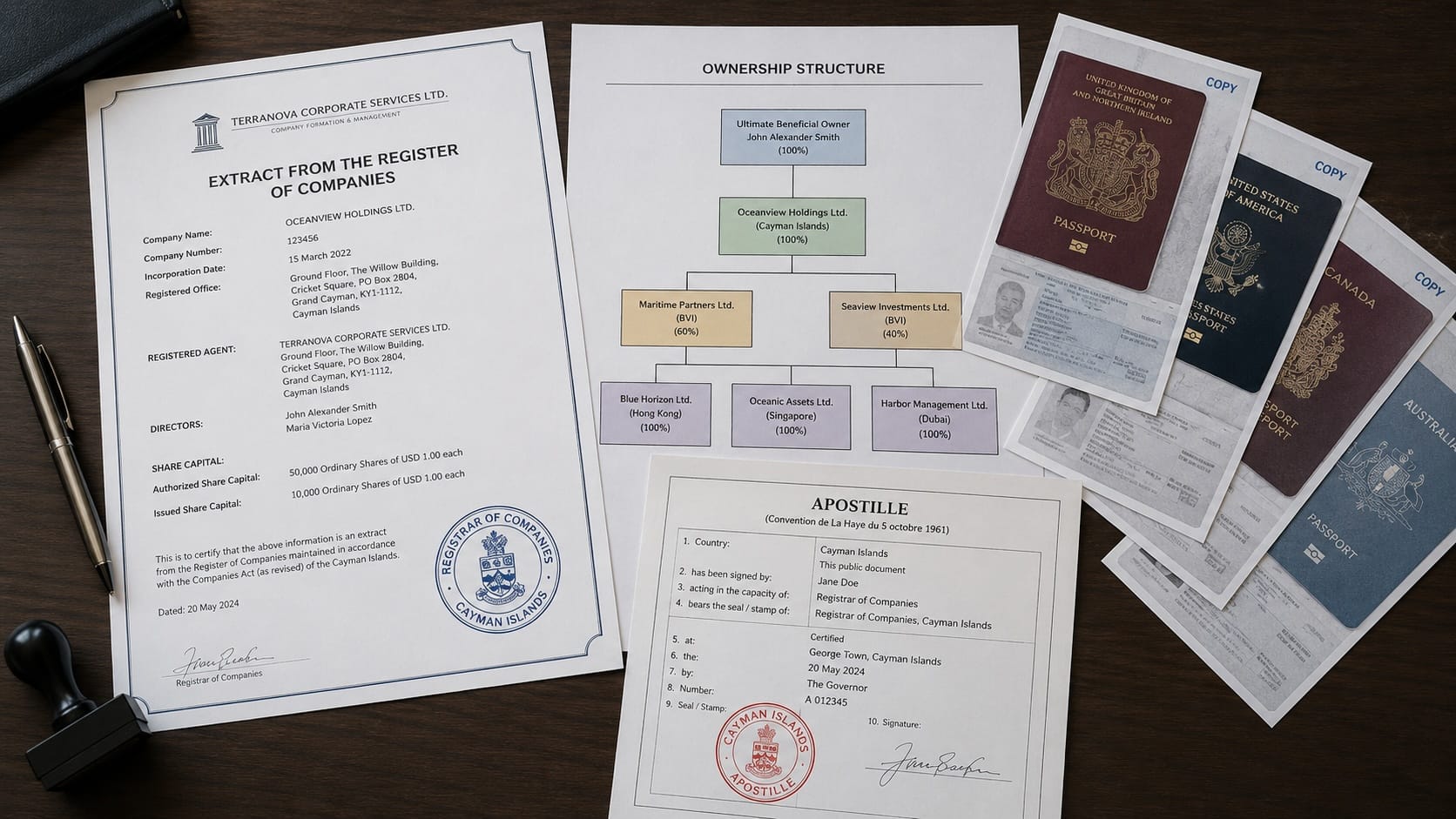
Six Reasons A Swiss Corporate Account UAE Freezone File Gets Declined
A Swiss corporate account UAE freezone file fails in two ways. Some triggers stop it dead. Others only slow it down. The gap between those two matters more than the list. Founders often panic about delays and miss the hard stops.
| Trigger | Effect | What resolves it |
|---|---|---|
| Owner appears on a sanctions or PEP list | Hard stop | Rarely resolvable; specialist counsel required |
| UBO cannot be identified from documents | Hard stop | Signed ownership chart plus registry extracts |
| Licence activity does not match stated business | Hard stop | Amend the licence before applying |
| No physical substance in the UAE | Delay, often fatal | Tenancy contract, staff records, utility bills |
| Source of funds explained only verbally | Delay | Written declaration with supporting evidence |
| Ownership chain deeper than three layers | Delay | Restructure, or supply a full chain map |
Substance deserves the most care. A licence and a mailbox no longer pass. Reviewers have seen thousands of shells with that shape. A small office with a real lease changes the whole read. Add one local hire and the file reads differently again.
We would argue substance is the best money you can spend here. It costs far less than a rebuild of your structure. And it answers the one question the reviewer cares about most.
What Compliance Checks Line By Line
Every Swiss corporate account UAE freezone review works through a fixed set of points. Knowing the order helps, because you can answer each one before it is raised. Nothing here is secret. It is simply rarely written down for applicants.
First comes identity. Passport copies must be certified, and the certification must be recent. Many files stall on a stamp that is two years old. Second comes the licence. The activity printed on it has to match what you tell the bank you sell. A trading licence paired with a consulting story raises a flag at once.
Third comes ownership. The chart must reach a named person at the end of every branch. Percentages have to add up to one hundred. That sounds obvious. It fails more often than any other item.
Fourth comes money. Where did the capital come from, and where will the first deposit come from? Those are two separate questions, and mixing them is a common error. Source of wealth covers a lifetime. Source of funds covers one transfer.
Fifth comes counterparties. Who pays you, and in which countries do they sit? A clean firm with clients in a sanctioned market still gets a hard look. Say it plainly in your narrative rather than letting the bank find it later.
Last comes purpose. Why do you want a Swiss account at all? “Diversification” is a weak answer. Supplier payments in euros, or a client base that expects a Swiss IBAN, are strong ones. Give a reason tied to how the business runs. A vague purpose reads as a warning sign, even when everything else is clean.
If you want the document list behind these checks, our guide to the documents needed to open a Swiss bank account sets out what compliance tests at each stage.
DIFC And ADGM Are Not Ordinary Freezones
Swiss banks do not treat all UAE freezones alike. Many applicants lose weeks to that fact. The Dubai International Financial Centre and Abu Dhabi Global Market run on English common law. Both have their own courts and their own watchdog. A standard trade freezone has neither.
Relative review friction by entity type, based on documentation depth Swiss reviewers typically request.
DIFC entities face the least review friction, followed by ADGM, then mainland LLCs, with standard freezone companies facing the most.
A DIFC firm arrives with audited books and a known rule set, much like any Swiss business bank account applicant. A standard freezone firm may arrive with neither. Both can open a Swiss corporate account. The second one simply has to prove more, and prove it up front.

The Dossier That Changes The Answer
A winning Swiss corporate account UAE freezone dossier does one thing well. Most applicants send papers. Strong ones send an argument, with papers as proof. That shift is the whole game. It costs nothing but time up front.
Build the file so a reviewer can answer three things fast. Who owns this? What does it really do? Where did the money come from? If any answer takes a second search, you have more work to do.
- Ownership chart — every layer to the natural person, signed and dated
- Registry extracts — current, for each entity in the chain
- Trade licence — activity wording matching what you actually sell
- Substance evidence — tenancy contract, utility bill, staff records
- Source of wealth — how the owner built the capital, with proof. Test your profile with our free AML risk score calculator
- Source of funds — where the opening deposit comes from
- Business narrative — one page: clients, suppliers, countries, volumes
- Banking history — statements from the existing UAE bank
The one-page story is the part almost everyone skips. Write it plainly. Say who pays you and why. It heads off the emails that would arrive three weeks later. For the proof standard behind it, see our guide to writing a source-of-wealth declaration.
Check one more thing first. The wider rules for foreign firms opening Swiss bank accounts apply to you as well. Some of them hold true no matter where your firm sits.
Approval Timelines By Preparation Level
Prep drives your Swiss corporate account UAE freezone timeline more than the bank you pick. That surprises people. The chart below shows what a full Swiss corporate account UAE freezone file does to review time, next to a partial one.
Elapsed time from first submission to account opening, by how the file arrives.
A full dossier takes six to eight weeks. A mostly complete file takes ten to fourteen. Documents without narrative take sixteen to twenty-four weeks. Reactive filing is frequently declined.
Look at the bottom row. Reactive filing means you answer only when asked, one email at a time. Each round trip adds a week or two. Worse, every delay makes the file look weaker than it is.
When Singapore Is Simply The Better Answer
Sometimes the honest advice on a Swiss corporate account UAE freezone plan is to stop pushing. Is your chain truly complex? Does most of your trade sit in Asia? Then Singapore may reach a yes faster. Its private banks see UAE firms often, so they ask fewer new questions.
This is not a claim that Singapore is easy. The bar there is high too, above all on source of wealth. Yet the questions differ, and habit counts for a lot. Our guide to Singapore business banking shows what those files look like.
Pick the country that fits your proof, not the one with the better name. Our offshore and non-resident banking guide compares the realistic options. A Swiss no sits in your record. A Singapore yes funds your payroll. If you want the structure checked before you apply, our advisory fees page explains how we work.
Frequently Asked Questions
Can a UAE freezone company open a Swiss corporate account at all?
Yes. Approvals happen regularly. The determining factor is documentation quality rather than the freezone itself, and a complete dossier typically clears review in six to eight weeks.
Does DIFC registration guarantee approval?
No. DIFC reduces friction because the legal framework and audit standards are familiar to Swiss reviewers. You still need ownership clarity, substance and a documented source of funds.
Why was my application declined without a reason?
Swiss banks are not obliged to explain declines, and most avoid it deliberately. In practice the cause is usually an unresolved question about ownership, substance or fund origin.
How much substance do I actually need in the UAE?
Enough to evidence real operations: a tenancy contract rather than a mailbox, at least one employee where the model allows, and utility or payroll records that match the licence.
Can I reapply after a rejection?
You can, though not immediately and rarely to the same bank. Rebuild the file first, fix whatever triggered the decline, and allow six months before approaching the same institution.
The Problem Is The File, Not Your Business
Every Swiss corporate account UAE freezone rejection we see traces back to one root. The founder knew the firm was clean. They assumed the papers would say so for them. Papers do not argue. People argue. Your file has to argue in your place.
So build the chart. Gather the proof of substance. Write the one-page story before anyone asks. Then apply. The bank will not change its view of the UAE. It will change its view of your file.
This article is general information, not legal, tax or financial advice. Bank requirements differ by institution and change over time. Confirm current requirements with a qualified adviser before acting.