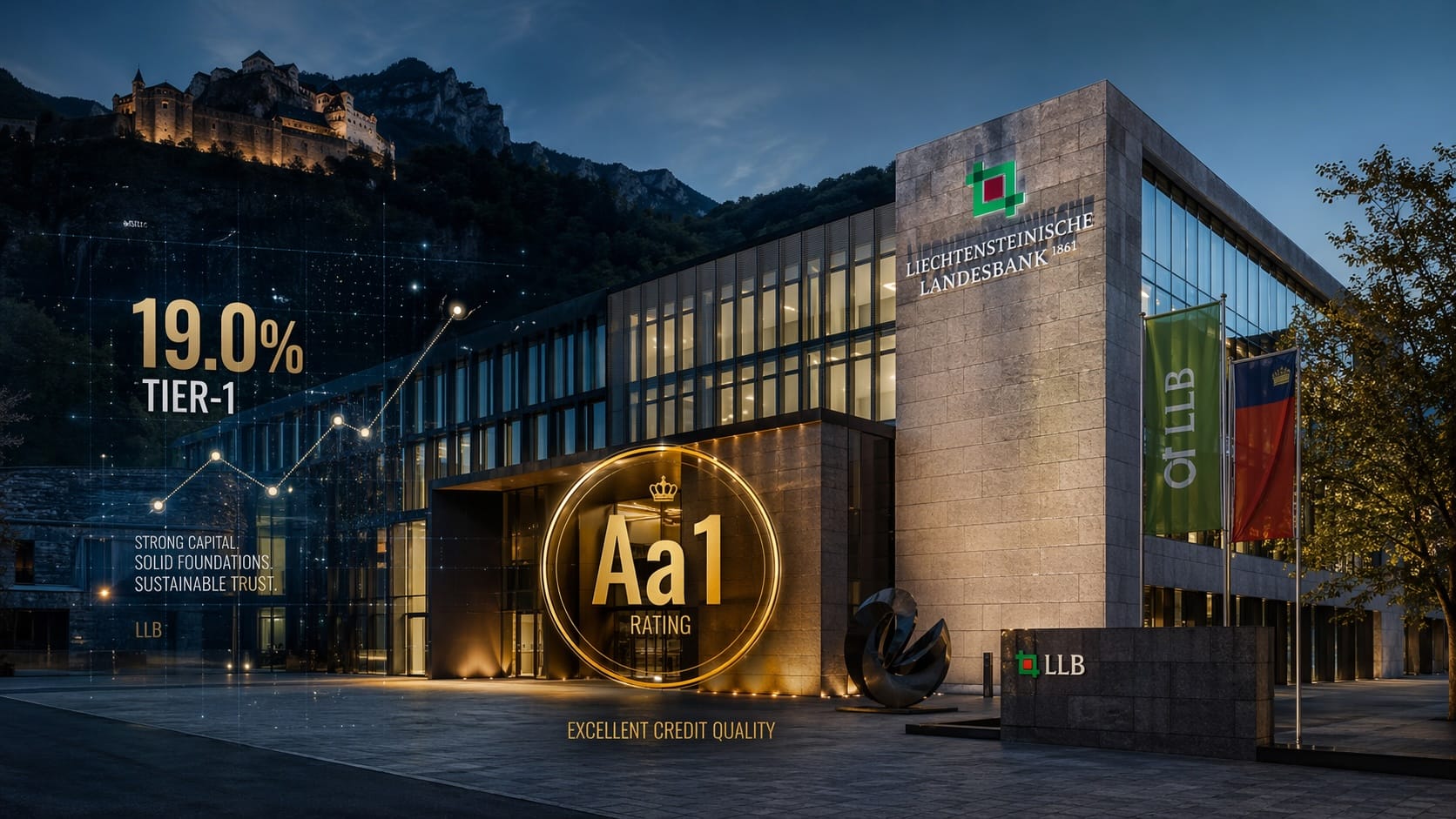
In April 2026, Moody’s Investors Service upgraded the long-term bank deposit rating and Counterparty Risk Rating of Liechtensteinische Landesbank AG (LLB) from Aa2 to Aa1 with a stable outlook. An Aa1 deposit rating places Vaduz-headquartered LLB in the second-highest rating tier on Moody’s global scale—alongside the world’s highest-rated commercial and cantonal banking institutions.
For private banking clients and corporate treasurers, however, a headline credit rating is often misunderstood. A bank being rated Aa1 is not the same thing as client cash deposits being guaranteed without limit. To evaluate the Moody’s LLB rating upgrade accurately, depositors need to understand why LLB’s deposit rating (Aa1) sits two notches above its senior unsecured issuer rating (Aa3), how Liechtenstein’s state ownership differs from an explicit sovereign guarantee, and how statutory deposit protection treats cash versus custody securities.
Executive Summary: Moody’s Aa1 upgrade reflects LLB’s 19.0% Tier 1 capital ratio, strong liquid balance sheet, Majority State Ownership (56.3% held by the Aaa-rated Principality of Liechtenstein) and European Bank Recovery and Resolution Directive (BRRD) depositor preference. Nevertheless, uninsured cash on deposit above CHF 100,000 remains a balance-sheet credit exposure to the bank, whereas custody securities are legally segregated off-balance-sheet client property.
Anatomy of the Upgrade: Why Deposits Are Rated Aa1 While the Issuer Rating Is Aa3
When reading Moody’s credit opinion on Liechtensteinische Landesbank, sophisticated investors look past the single headline number and examine the underlying rating stack. Moody’s assigns different ratings to different classes of liabilities within the same bank:
| Moody’s Rating Component for LLB AG | Verified Rating / Metric (2026) | What It Measures for Clients & Creditors |
|---|---|---|
| Long-Term Bank Deposit Rating | Aa1 (Stable Outlook) | Expected credit loss risk on junior and preferred deposits held at LLB AG. |
| Long-Term Counterparty Risk Rating (CRR) | Aa1 | Risk on operational liabilities, derivatives and covered counterparty obligations. |
| Long-Term Issuer Rating | Aa3 (Stable Outlook) | Senior unsecured debt / general corporate obligation rating before depositor preference uplift. |
| Short-Term Deposit & Prime Rating | Prime-1 (P-1) | Highest short-term rating for liquidity and ability to repay short-term obligations. |
| Baseline Credit Assessment (BCA) | a2 | Standalone intrinsic financial strength of LLB before factoring in shareholder or resolution uplift. |
| Tier 1 Capital Ratio (CET1 / Tier 1) | 19.0% | Core equity capital buffer relative to risk-weighted assets—well above regulatory minimums. |
| Sovereign Shareholder | 56.3% Principality of Liechtenstein (Aaa) | Majority state stake required by the Law on Liechtensteinische Landesbank (LLBG). |
The Three Building Blocks Behind the Aa1 Deposit Rating
- Standalone Capital and Liquidity Strength (a2 BCA): LLB maintains a Tier 1 capital ratio of approximately 19.0% and a business volume exceeding CHF 125 billion (Assets Under Management plus client loans), funded predominantly by granular client deposits rather than volatile wholesale capital-market borrowing.
- Loss Given Failure (LGF) & EEA Depositor Preference (+3 Notches): Because Liechtenstein is a member of the European Economic Area (EEA), its banking resolution framework incorporates the EU Bank Recovery and Resolution Directive (BRRD). In a hypothetical bank resolution, equity and bail-inable senior unsecured debt absorb losses before preferred and junior deposits. Under Moody’s Advanced LGF analysis, this structural subordination of debt holders protects depositors and lifts the deposit rating above the standalone BCA.
- Moderate Government Support Uplift (+1 Notch): The Principality of Liechtenstein—one of the very few sovereigns globally with an Aaa rating and virtually zero net public debt—is legally required under the LLB Act to hold at least 51% of LLB’s share capital and voting rights (currently 56.3%). Because LLB is systemically vital to the domestic economy, Moody’s factors in a moderate probability of sovereign support in a stress scenario.
Majority State Ownership vs Explicit State Guarantee: A Critical Distinction
One of the most frequent misconceptions in cross-border private banking commentary is assuming that because the Principality of Liechtenstein owns 56.3% of LLB, the state explicitly guarantees all of LLB’s liabilities. That is no longer the case.
Historically, Liechtenstein provided a statutory state guarantee for savings deposits and cash bonds at LLB, but that explicit state guarantee was abolished as Liechtenstein modernised its banking law and aligned with EEA state-aid and bank resolution standards. This creates an important legal distinction when comparing LLB with Swiss cantonal banks:
- Zürcher Kantonalbank (ZKB — Moody’s Aaa): 100% owned by the Canton of Zurich and backed by an explicit statutory cantonal state guarantee under the Cantonal Bank Act. If ZKB were ever unable to meet its obligations, the Canton of Zurich is legally bound to cover the shortfall.
- Liechtensteinische Landesbank (LLB — Moody’s Aa1 Deposits / Aa3 Issuer): 56.3% owned by the Principality of Liechtenstein and publicly listed on the SIX Swiss Exchange (ticker: LLBN). While the state is a committed majority owner and Moody’s incorporates government support uplift into its rating, there is no unlimited statutory sovereign guarantee covering uninsured deposits.
For a broader comparison across the Rhine, see our analysis of Liechtenstein vs Swiss banking and our verified list of Swiss bank credit ratings in 2026.
High Credit Rating vs Statutory Deposit Protection: What Is Actually Protected?
For a private banking client allocating CHF 1 million to CHF 10 million, understanding how assets are treated on and off a bank’s balance sheet matters far more than a one-notch credit rating change.
1. Cash Deposits: Capped at CHF 100,000 Under EAS
Cash held in current accounts, call accounts or fixed-term deposits sits on the bank’s balance sheet. Legally, a cash depositor is an unsecured creditor of the bank (albeit a preferred creditor under BRRD hierarchy). In Liechtenstein, statutory deposit protection is administered by the Deposit Guarantee and Investor Compensation Foundation PCC (EAS):
- Statutory Cash Coverage: Up to CHF 100,000 (or equivalent in EUR/USD) per depositor, per bank—matching the Swiss esisuisse limit of CHF 100,000 and the EU harmonised EUR 100,000 standard.
- Uninsured Cash Exposure: Any cash balance above CHF 100,000 is not covered by EAS deposit insurance. That excess cash relies directly on LLB’s creditworthiness (which Moody’s rates Aa1 for deposits) and its capital and liquidity buffers.
2. Custody Securities: Segregated Off-Balance-Sheet Client Property
Equities, sovereign bonds, corporate bonds, ETFs, mutual funds and allocated physical precious metals held in a custody account (Depot) are not on the bank’s balance sheet. Under Liechtenstein Banking Act provisions supervised by the Financial Market Authority (FMA) Liechtenstein, custody securities remain the legal property of the client. In a hypothetical bank insolvency, custody securities are segregated from the bankruptcy estate and transferred to another custodian bank.
Practical takeaway for HNW depositors: Even at an Aa1-rated bank like LLB, experienced private clients do not leave millions in uninvested cash on a bank’s balance sheet indefinitely. Instead, they sweep excess liquidity above operational cash needs into short-dated sovereign Treasury bills or high-grade money-market instruments held in segregated off-balance-sheet custody. Compare this with Swiss protection rules in our guide to deposit insurance in Switzerland.
How LLB Compares with Liechtenstein’s Other Major Private Banks
Liechtenstein’s banking sector is dominated by three systemically important banking groups—LLB Group, LGT Group and VP Bank Group—alongside specialised institutions such as Bank Frick and Bendura Bank (neither of which carries a public Moody’s rating). Comparing only verified, audited metrics and official rating agency disclosures shows how the three rated groups differ in scale and capital structure:
| Institution | Ownership Structure | Moody’s Long-Term Deposit / Issuer Rating | Tier 1 / CET1 Ratio (Verified) | Business Volume / AUM Scale | Primary Strategic Focus |
|---|---|---|---|---|---|
| Liechtensteinische Landesbank (LLB) | 56.3% Principality of Liechtenstein; SIX-listed (LLBN) | Aa1 Deposits / Aa3 Issuer (Stable) | 19.0% Tier 1 | ~CHF 125.9 billion business volume | Universal & private banking in Liechtenstein, Switzerland (incl. former Bank Linth) and Austria (LLB Österreich). |
| LGT Bank AG | 100% Princely House of Liechtenstein Foundation | Aa2 Deposits & Senior Unsecured (Moody’s) / A+ (S&P) | ~18.5% – 19.9% CET1 | ~CHF 350+ billion AUM | Global pure-play private banking and alternative asset management for HNW/UHNW families across Europe, Asia and Australia. |
| VP Bank AG | SIX-listed (VPBN) with anchor family/foundation shareholders | Rated by S&P (A- Long-Term Issuer); no Moody’s rating | ~23% – 25% Tier 1 | ~CHF 50+ billion client assets | International private banking and specialised platform for External Asset Managers (EAMs) and trustees. |
For a deeper look at operating earnings and fee growth across the Principality’s banks, read our analyses of LLB Group’s financial results and strategy and Liechtenstein bank results in H1 2026.
Limitations of Credit Ratings: What Moody’s Aa1 Does Not Measure
While an Aa1 deposit rating is a strong validation of balance-sheet conservatism, prospective private banking clients should keep four practical limitations in mind:
- Ratings Are Backward- and Medium-Term Indicators, Not Guarantees: Credit ratings evaluate relative probability of default and expected loss given failure; they can be revised if interest margins compress, real-estate loan books deteriorate, or acquisition integration costs rise.
- A High Rating Does Not Mean Easy Onboarding: LLB applies strict AML/KYC standards under Liechtenstein FMA and European EEA rules. Non-resident private clients typically require at least CHF 500,000 to CHF 1,000,000 in bankable assets and fully documented source-of-wealth trails.
- Fee Competitiveness Varies by Mandate Type: Because Tier 1 capital is expensive to hold, ultra-safe banks rarely compete on cut-rate custody fees for small accounts. Clients should compare custody schedules, FX spreads and advisory tiers directly.
- EEA Regulatory Scope vs Swiss Regulatory Scope: Unlike Switzerland, Liechtenstein is inside the European Economic Area (EEA). While Liechtenstein retains the Swiss franc (CHF) via the customs and currency treaty with Switzerland, its banks enjoy direct EU/EEA passporting rights and apply EU/EEA financial directives (MiFID II, CRD/CRR and BRRD).
Frequently Asked Questions
Why did Moody’s upgrade Liechtensteinische Landesbank (LLB) to Aa1?
Moody’s upgraded LLB’s long-term deposit and Counterparty Risk ratings from Aa2 to Aa1 in April 2026 based on its strong standalone capitalisation (19.0% Tier 1 ratio), resilient earnings across its Liechtenstein, Swiss and Austrian divisions, low problem-loan ratio, structural protection for depositors under EEA bank resolution rules, and 56.3% majority ownership by the Aaa-rated Principality of Liechtenstein.
Why is LLB’s deposit rating Aa1 while its issuer rating is Aa3?
Under the European Bank Recovery and Resolution Directive (BRRD) applied in Liechtenstein, client deposits rank ahead of senior unsecured bonds in a bank resolution (full depositor preference). Because senior debt holders absorb losses before depositors, Moody’s assigns a lower expected loss to deposits (Aa1) than to senior unsecured issuer obligations (Aa3).
Are deposits at LLB guaranteed by the State of Liechtenstein?
No. Although the Principality of Liechtenstein is mandated by law to hold at least 51% of LLB’s shares (currently 56.3%), the historical explicit state guarantee was abolished to comply with EEA state-aid rules. Cash deposits are protected by Liechtenstein’s statutory deposit guarantee scheme (EAS) up to CHF 100,000 per person, while custody securities are segregated off-balance-sheet assets.
Can non-residents open a private bank account at LLB?
Yes. LLB accepts qualified non-resident private clients and family foundations, provided they pass rigorous source-of-wealth and tax-compliance verification and meet private banking asset minimums (typically CHF 500,000 to CHF 1,000,000+). Learn more in our guide to Liechtenstein private banking for non-residents.
Compare Swiss and Liechtenstein Private Banking Options
Choosing between a Liechtenstein bank like LLB or LGT and a Swiss cantonal or private bank depends on your country of residence, asset structure (personal account vs foundation or holding company) and portfolio size. Review our transparent Services & Fees or contact Easy Global Banking for an independent eligibility assessment.
Primary Disclosures & Regulatory Sources
- Liechtensteinische Landesbank AG (LLB Group) — Investor Relations: Official Moody’s Rating Disclosures (Aa1 Deposit Rating, April 2026)
- Deposit Guarantee and Investor Compensation Foundation PCC (EAS Liechtenstein) — Statutory CHF 100,000 Coverage Rules
- Financial Market Authority (FMA) Liechtenstein — Banking Supervision & EEA Resolution Framework