
A business bank account in Switzerland is not a commodity — and the decision is more consequential than most guides admit. The monthly fee is rarely the real cost. What you actually pay shows up in FX markups, international transfer charges, and the friction of using a platform that wasn’t built for how you work. Switzerland offers more than 230 banks, a handful of strong fintechs, and fee structures that range from CHF 0 to CHF 480 per year before you’ve done a single transaction. This post cuts through the options and tells you which provider fits which type of business — and why the answer isn’t the same for everyone.
Key figures: Switzerland has 230+ FINMA-supervised banks. Annual account fees range from CHF 0 (Wise) to CHF 480 (Revolut Grow). FX costs at traditional banks run 3–5 times higher than at fintechs like Wise.
What a Business Bank Account in Switzerland Actually Costs
Here’s the mistake most SMEs make: they compare annual account fees and stop there. That number — CHF 36 at Migros Bank, CHF 60 at PostFinance, CHF 84 at ZKB — is real, but it’s often the cheapest line on the invoice. The real cost is what happens when you pay a supplier in euros, receive a client payment in USD, or transfer CHF 20,000 abroad. That’s where the money disappears, quietly, in the form of a “bank rate” FX conversion that can sit 2–4% above the mid-market rate.
A concrete example: if your Swiss GmbH converts CHF 200,000 to EUR annually — not an unusual volume for an export-oriented SME — a 2.5% FX spread costs you CHF 5,000 a year. That dwarfs the annual fee difference between any two traditional banks. Wise Business charges 0.41–0.57% on the same conversion. Revolut Business charges nothing up to a monthly allowance, then 0.6% above that. The math matters. And it’s rarely in the brochure. If your company trades across borders, our guide to Swiss banks for international trade covers the accounts built for it.
Quick caveat before we go further: if your business is primarily domestic — CHF invoices, CHF suppliers, the occasional EUR payment — the FX story is less important. Your priority shifts to transaction fees, digital platform quality, and whether you actually need branches. We’ll come back to that distinction in the recommendations section, because it changes the answer completely.
*UBS and ZKB both waive fees for the first 1–2 years for new clients and startups.
Annual fees: Wise CHF 0, Migros Bank CHF 36, PostFinance CHF 60, Bank Cler CHF 60, UBS Key4 CHF 80 (free year 1–2), ZKB SME Package CHF 84 (free year 1), Revolut Basic CHF 120, Revolut Grow CHF 480.
The Swiss Business Banking Landscape in 2026
The Credit Suisse collapse in 2023 reshaped the top of the market. UBS absorbed CS, making it unambiguously the dominant universal bank — and systemically important in a way that now carries real geopolitical weight. For business clients, the practical consequence is a large institution managing a complex integration, with CS products discontinued and migration still ongoing for some legacy accounts. Worth knowing before you pick UBS purely out of inertia.
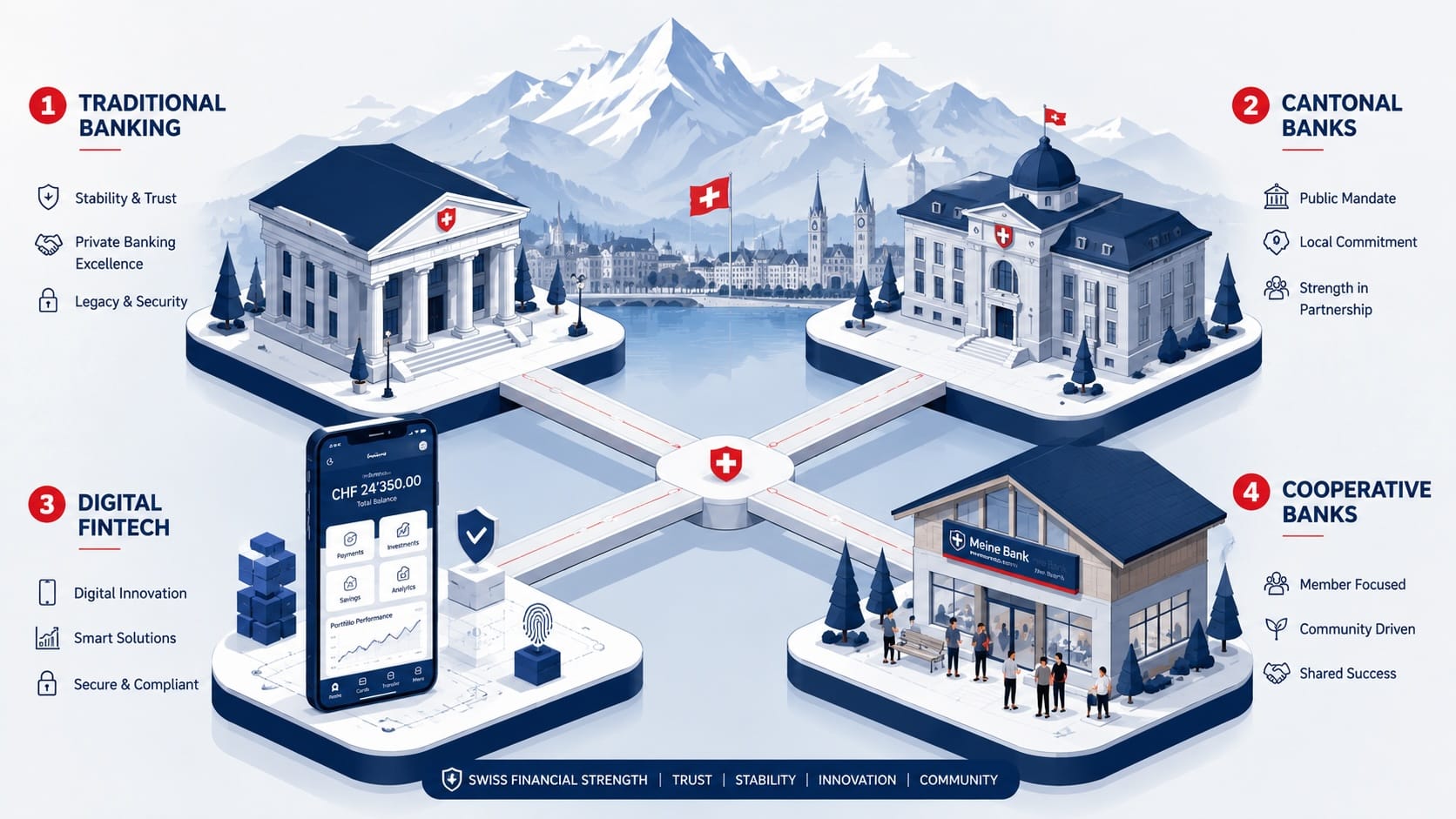
Below UBS, the market splits into four broad tiers. First, the cantonal banks: 24 government-backed institutions, each tied to its canton, collectively holding around 30% of Swiss financial institution market share. ZKB is the largest and the most internationally capable. The others (BCGE, BCV, LUKB, and so on) are excellent for businesses embedded in their region, particularly for credit and advisory. Second, cooperative and retail-focused banks: Raiffeisen (788 branches, extraordinary community presence), Migros Bank, PostFinance, and Bank Cler. Third, the fintechs — primarily Wise and Revolut at scale, but also Swiss-born challengers like Relio, Amnis, and Yuh. Fourth, a niche tier of crypto-licensed banks (Sygnum, Amina) and private wealth institutions that, honestly, aren’t relevant for most SMEs reading this.
One thing that surprises many business owners: Open Banking in Switzerland is more developed than its reputation suggests. ZKB and UBS both connect to bLink, which allows direct integration with accounting platforms like Bexio and Abacus — no manual CSV exports. If your team runs on accounting software, this matters considerably more than the annual fee difference between two providers.
Traditional Banks: Where They Win and Where They Fall Short
Most traditional Swiss banks are genuinely good at a handful of things and quietly mediocre at others. The mistake is assuming that “Swiss bank” means comprehensive excellence. It doesn’t — and understanding the gap saves you from discovering it the expensive way.
Zürcher Kantonalbank (ZKB)
ZKB is, in our view, the strongest all-around option for Zurich-based startups and growth-stage SMEs. The SME package runs CHF 84/year (free in year one), includes EUR and USD accounts, and the debit card is CHF 40/year also waived for year one. Those are decent terms. But the real differentiator is the startup financing arm: ZKB has invested over CHF 180 million in 250+ Swiss startups through equity and convertible loans. That’s not marketing — it’s a structural advantage for founders who need more than a current account. The Open Banking integrations via bLink and OpenWealth APIs are the best among Swiss traditional banks.
The limitation is geography. ZKB’s branch network is dense in Zurich and surrounding cantons but thin elsewhere. If your business is in Basel, Bern, or Lucerne, the case for ZKB gets weaker — your local cantonal bank will serve you better on advisory and credit.
UBS Group AG
UBS wins on breadth. The Key4 business package bundles a current account, capital deposit account, and debit card — free for up to two years for new clients, then CHF 80/year. For a startup in its early years, that’s genuinely attractive. The platform supports TWINT, bLink Open Banking, and EBICS/ISO messaging for larger payment volumes. Where UBS struggles is personalization: it’s a very large bank, and the experience for a small GmbH can feel transactional. Advisory gets better if your relationship grows, but don’t expect a dedicated contact in the first year.
PostFinance
PostFinance is domestically systemically important and has one legitimately excellent feature: its partnership with Institut für Jungunternehmen (IFJ), which offers free online incorporation bundled with account opening. For founders incorporating a GmbH or AG, that combination is worth real money. The base account fee is CHF 60/year (CHF 5/month), domestic and SEPA payments are free, and the platform connects to Post branches nationwide — useful if you handle physical cash. The downside: a CHF 25/month surcharge for foreign-domiciled clients, and an FX platform that lags the competition. Non-SEPA international payments cost CHF 2 each but the FX conversion is at bank rates, not mid-market.
Migros Bank
Migros Bank is the most cost-effective traditional option for domestic SMEs. The CHF business current account runs CHF 36/year — the lowest among traditional banks — and the Visa Debit card is free. Electronic domestic and SEPA payments are free. There’s no frills, no startup ecosystem, no multi-currency bells and whistles. But for a service business or sole trader working primarily in CHF, the total annual cost is genuinely low, and the brand trust (via the Migros retail network) is real.
Raiffeisen Group and Cantonal Banks
Raiffeisen’s 788 branches and cooperative structure make it the dominant community bank in Switzerland. Fees are set locally by each Raiffeisen bank, which means you can’t price-compare online — you need to call. That friction is the entry cost for what is, in many regions, the most relationship-driven banking experience available to SMEs. Credit access tends to be stronger here than at the large universals for established local businesses. The same logic applies to your canton’s own Kantonalbank — AKB in Aargau, BCV in Vaud, BCGE in Geneva — all of which have SME lending departments deeply embedded in their local economies.
Traditional Banks (ZKB / UBS / PostFinance)
Fintechs (Wise / Revolut)
Ratings are qualitative based on comparative analysis of publicly available features and fees as of 2026.
Neobanks and Fintechs: The Case for Going Digital — or Not
Wise Business and Revolut Business deserve their reputations for international payments. The FX cost advantage is real and measurable. But neither is a complete solution, and the gap between what each offers is larger than most comparisons acknowledge.
Wise Business
Wise charges the mid-market rate on currency conversions plus a transparent 0.41–0.57% fee. No markup, no hidden spread. The multi-currency account holds 40+ currencies and provides local bank details in eight major currencies for free incoming payments. The platform integrates with Xero and QuickBooks, supports batch payments, and offers multi-user access. For international SMEs, it’s genuinely one of the best tools available.
Here’s the part nobody mentions: Wise does not provide a native Swiss CHF IBAN. Receiving CHF payments requires SWIFT, which incurs a small incoming fee (approximately CHF 3.55 per transfer). For a business operating primarily in Switzerland — receiving CHF invoices, paying Swiss suppliers — this is a meaningful limitation. Wise works best as a specialist account running alongside a local bank, not as a standalone Swiss business account.
Revolut Business
Revolut does provide a Swiss CH IBAN, which makes it a more complete option than Wise for Swiss-based businesses. The Basic plan (CHF 10/month) includes local CHF transfers, a small free allowance for international transfers, and unlimited virtual cards. The Grow plan (CHF 40/month) adds bulk payments, integrations, and a more realistic transfer allowance for active businesses. Scale (CHF 120/month) adds API access and dedicated account management.
Revolut Business is genuinely impressive — and occasionally infuriating. The platform is technically polished; the support experience is inconsistent. The plans are genuinely tiered and priced well for high-volume users, but choosing the wrong plan can make Revolut expensive very quickly. If you’re processing fewer than 50 international transfers a month, crunch the numbers against the plan cost before signing up. And one real limitation: no credit or financing products, and no relationship manager until you’re at Enterprise level.
Other Digital Options Worth Considering
Relio is a Swiss-born fintech built specifically for SMEs — CHF IBAN, business focus, and a growing feature set. Worth tracking if you want a fully Swiss digital option. Amnis specialises in FX optimisation for SMEs, with margins of 0.20–0.40% on currency conversions — tighter even than Wise for some currency pairs, and a genuine tool if FX is your biggest cost line. Yuh (a PostFinance-Swissquote joint venture) suits freelancers and sole proprietors who want CHF banking plus basic investing in one app. For most limited companies, it falls short of a full business account.
Choosing the Right Business Account for Your Swiss Company
The most useful framing isn’t “which bank is best” — it’s “what does my cash flow actually look like?” Four business profiles cover most of the real decisions.
One decision that trips people up: the capital payment account. If you’re incorporating a GmbH (CHF 20,000 minimum capital) or AG (CHF 100,000), you’ll need a temporary capital deposit account to hold the founding capital before registration. PostFinance charges CHF 145 for this. Migros Bank charges 0.05% of the deposited amount (minimum CHF 300). ZKB charges 0.025% (minimum CHF 125). UBS includes it free in the Key4 package. It’s a one-time fee, but on CHF 100,000 in AG founding capital, the difference between 0% and 0.05% is CHF 50 — worth knowing in advance.
Opening a Business Bank Account in Switzerland: What to Expect
The Swiss business account opening process is more involved than in many other countries, and the requirements vary depending on whether you’re a resident or non-resident, and whether you’re applying as a GmbH/AG or as a sole trader. Understanding what’s ahead prevents the most common source of delays.
One more thing worth saying plainly: Swiss banks have tightened onboarding in recent years under FATF and FINMA pressure. If your business has any unusual features — international shareholders, transactions in higher-risk jurisdictions, cash-intensive operations — expect additional questions. This isn’t adversarial; it’s compliance. Coming prepared with a clear business description and clean documentation structure makes the process faster for everyone.
Swiss Business Banking Fee Comparison (2026)
The table below consolidates the main fee categories across seven providers. Use it to calculate indicative total annual costs based on your transaction profile. Fees are indicative and subject to change — verify current rates directly with each bank before applying.
| Provider | Annual Fee | Capital Account | CHF IBAN | Free Domestic Payments | Non-SEPA Int’l | FX Margin |
|---|---|---|---|---|---|---|
| UBS Key4 | 80 (free 1–2 yrs) | Free in pkg | Yes | Included | Varies | Bank rate |
| ZKB SME | 84 (free yr 1) | 0.025% / min 125 | Yes | Free (<600/mo) | 4 | Bank rate |
| PostFinance | 60 | 145 | Yes | Free | 2 | Bank rate |
| Migros Bank | 36 | 0.05% / min 300 | Yes | Free | 5 | Bank rate |
| Bank Cler | 60 | 0.05% / min 250 | Yes | Free | 4 | Bank rate |
| Wise Business | 0 (setup fee) | N/A | No (SWIFT) | ~0.41–0.57% | Low + mid-market | ~0.41–0.57% |
| Revolut Grow | 480 | N/A | Yes | Free (<100/mo) | Free <5/mo, then 7 | 0% to 20k, 0.6% above |
A note on “bank rate” FX: Swiss traditional banks do not publish their FX spreads for business accounts the way fintechs do. The spread is embedded in the conversion rate offered at the time of the transaction and varies by currency pair and amount. As a rough benchmark, expect 1.5–3% above mid-market for common pairs like CHF/EUR — the higher end applying to smaller transactions. Moneyland.ch offers a useful comparison tool to run scenarios for your specific volume.
Related reading: