Every time a major finance site publishes an ETF guide, the same advice appears: “keep your expense ratio low.” It’s not wrong. But for non-US investors — expats in Dubai, residents of Singapore, HNW clients in Switzerland — it focuses on the wrong number.
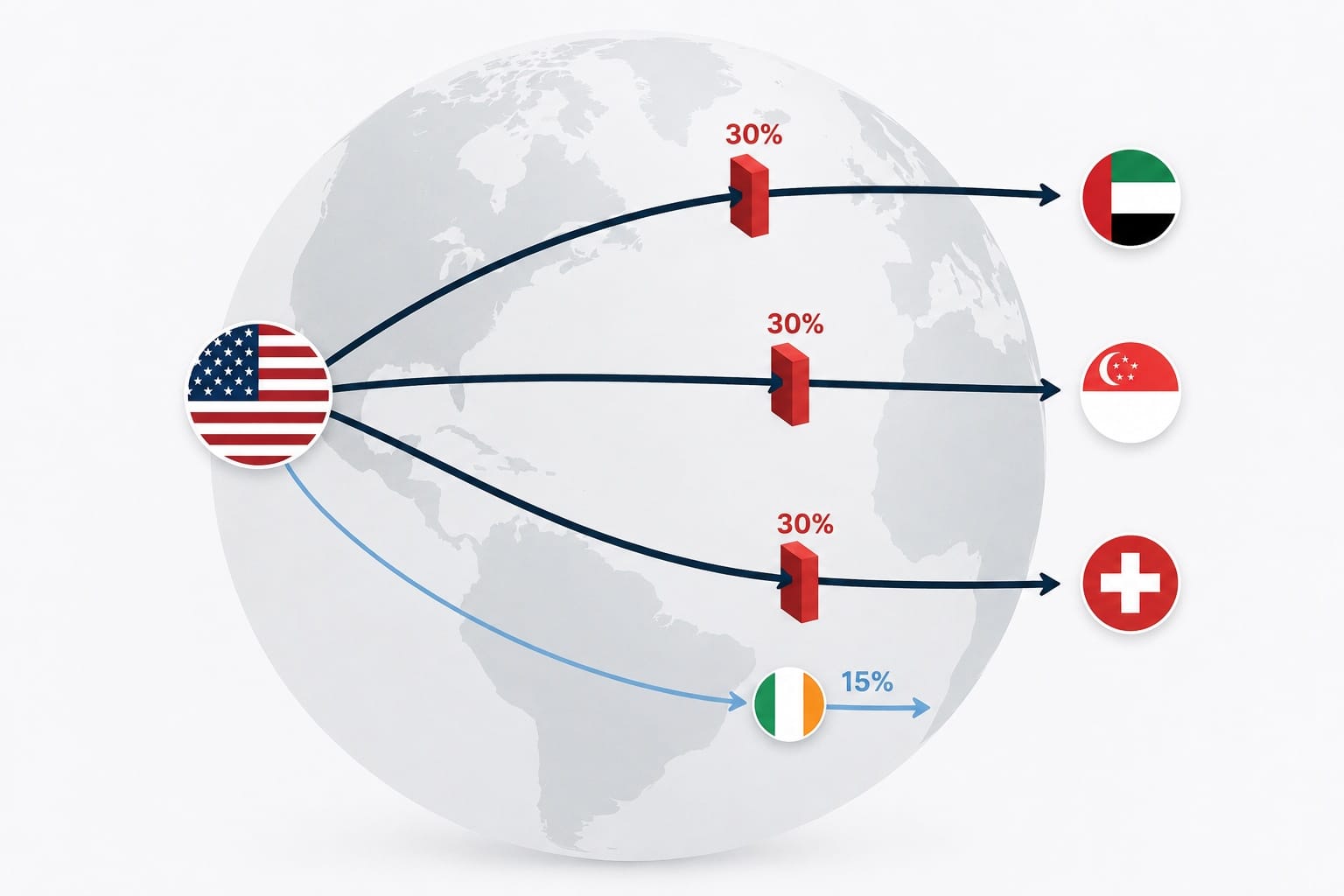
The expense ratio is the fee you can see. There is another fee you cannot see. It is deducted at source, before any money reaches your ETF, and it never appears on your brokerage statement as a line item. For investors in countries without a US tax treaty — which includes the UAE, Singapore, Hong Kong, and most of the Middle East — that invisible fee runs to 30% of every dividend your fund receives from US stocks.
Here is the number that should change how you think about ETF selection: a US-domiciled ETF like QQQ costs 0.20% per year in management fees. The withholding tax drag on that same ETF for a UAE-based investor is approximately 0.18% per year. You are spending nearly as much on a tax you have never seen as you spend on the fee you scrutinize carefully. Switch to the Irish-domiciled equivalent — EQQQ, CNX1, or similar UCITS funds — and the withholding drag drops to roughly 0.09%. That is not an abstraction. Over 25 years on a $500,000 portfolio, that difference compounds to a material sum.
This post explains how ETF withholding tax works, why the domicile of your ETF matters more than its expense ratio for most non-US investors, and exactly which structures make sense depending on your tax residence. We work with private clients across Dubai, Singapore, Switzerland, and Monaco at Easy Global Banking, and this is one of the most consistently misunderstood issues we encounter — even among financially sophisticated clients.
What Is ETF Withholding Tax — and Why Don’t You See It?
Withholding tax is a source-country tax — collected by the country where the income originates before it leaves that country’s borders. In the context of ETFs, it operates at the fund level, not the investor level. That distinction is the entire reason most investors miss it.
Here is the sequence. Apple pays a quarterly dividend. That dividend flows to every fund holding Apple shares — including your ETF. Before that dividend enters the ETF’s net asset value, the US Treasury deducts a withholding tax. The ETF then reflects the post-tax amount. By the time you check your account, the gross dividend never existed in any number you could read. Your statement shows NAV movements and, if you hold a distributing ETF, a distribution figure — both already net of withholding. You have no visibility into what was taken.
This is what the financial industry calls dividend leakage. It is structural, not a billing error, and it is entirely legal. The rate depends on one thing above all: where your ETF is registered.
The Three Layers of Withholding Tax Nobody Draws on a Diagram
ETF withholding tax is not a single event. It cascades through three layers, and each layer is governed by different rules. Most guides explain one layer, usually the investor-level one, and stop. That gives you an incomplete picture.
US companies pay dividends to the ETF. The US withholds tax at source before the dividend enters the fund. Rate depends on the ETF’s country of domicile. Irish UCITS ETFs pay 15% (US–Ireland DTC). US-domiciled ETFs pay 0% here — but investors without a treaty pay 30% at Level 3 instead. This is the layer that most expat investors never account for.
When an Irish UCITS ETF pays a distribution to a foreign investor, Ireland imposes no additional withholding tax on non-Irish residents. This is a deliberate policy designed to make Ireland the preferred ETF domicile in Europe — and it works. Luxembourg is similar, but Ireland dominates for US-equity exposure due to the treaty advantage.
Your country of residence may levy its own dividend or investment income tax on what you receive. UAE investors pay 0%. Swiss investors may reclaim some Level 1 tax via the DA-1 form. German investors face the Vorabpauschale (a notional annual tax on accumulating ETFs). French investors pay prélèvements sociaux. This layer is where your local tax adviser earns their fee.
Three-layer withholding tax structure: Level 1 is source country tax at 30% (or 15% via Ireland treaty), Level 2 is ETF domicile country tax (0% for Ireland), Level 3 is investor home country tax (0% for UAE).
The critical insight: an Irish-domiciled UCITS ETF eliminates Level 1 tax down to 15% (from 30%), pays 0% at Level 2, and leaves Level 3 to your local rules. A US-domiciled ETF skips Level 1 entirely for the fund — but hits a no-treaty investor with 30% at Level 3, which is worse. And an accumulating UCITS ETF goes further still by avoiding the Level 3 distribution event altogether, deferring any local tax obligation indefinitely while dividends compound internally.
QQQ vs EQQQ: Running the Numbers That Nobody Publishes
Finance content loves to compare expense ratios. EQQQ charges 0.30% per year against QQQ’s 0.20%. On that basis alone, QQQ looks cheaper. That conclusion is wrong for most non-US investors, and the gap between perception and reality widens as your portfolio grows.
The calculation below uses a dividend yield of 0.60% (the approximate trailing yield for both funds tracking the Nasdaq-100) and applies the relevant withholding rates for a UAE-domiciled investor — 30% on QQQ (no treaty), 15% at fund level for EQQQ (US-Ireland treaty), with 0% at Level 2 and Level 3 for both.
At a 0.60% Nasdaq-100 dividend yield, QQQ costs a UAE investor approximately 0.38%/yr total (0.20% fee + 0.18% withholding drag). EQQQ costs approximately 0.39%/yr (0.30% fee + 0.09% withholding drag). The funds are effectively equal on the Nasdaq-100 — but EQQQ is the accumulating version, eliminating Level 3 distribution events entirely and compounding gross returns internally.
Countries With No US Tax Treaty: You Are Paying Full Price
The 30% statutory rate applies to every country that has not negotiated a tax treaty with the United States covering dividend withholding. The list is long and includes most of the world’s highest-growth economies — and some of the most popular destinations for HNW expats.
| Investor Country | US Treaty? | Rate via US ETF (QQQ) | Rate via Irish UCITS (EQQQ) | Verdict |
|---|---|---|---|---|
| 🇦🇪 UAE | None | 30% | 15% (fund level only) | UCITS wins clearly |
| 🇸🇬 Singapore | None | 30% | 15% (fund level only) | UCITS wins clearly |
| 🇭🇰 Hong Kong | None | 30% | 15% (fund level only) | UCITS wins clearly |
| 🇮🇳 India | Limited | 25% | 15% (fund level only) | UCITS wins |
| 🇧🇷 Brazil | None | 30% | 15% (fund level only) | UCITS wins clearly |
| 🇨🇭 Switzerland | Yes (15%) | 15% | 15% (fund level only) | UCITS still preferred (DA-1 complexity, estate tax) |
| 🇩🇪 Germany | Yes (15%) | 15% + Vorabpauschale | 15% (fund level) + Teilfreistellung benefit | UCITS wins (Teilfreistellung advantage) |
| 🇬🇧 UK | Yes (15%) | Blocked by PRIIPs regulation | 15% (fund level) + ISA-eligible | UCITS only option |
| 🇺🇸 US resident | N/A (domestic) | 0% (no withholding on residents) | Avoid — PFIC rules apply | Use US ETFs only |
One clarification worth making explicit: for EU and UK retail investors, the question of QQQ vs EQQQ is largely academic. Since 2018, PRIIPs regulation has required any fund marketed to EU or UK retail investors to provide a standardized Key Information Document (KID). US ETFs do not produce these. Your European or UK broker almost certainly cannot offer you QQQ at all — not because they choose not to, but because they are legally prohibited from doing so. The decision has already been made for you. The withholding tax argument is the additional reason to be glad it has.
Why Accumulating ETFs Cut the Damage Even Further
There is a second variable that compounds the withholding tax advantage of Irish UCITS funds: the accumulating vs distributing share class distinction. This is where the structure becomes genuinely powerful for long-term, growth-oriented investors.
A distributing ETF (often labelled “Dist” or “Inc”) pays dividends out to investors. That distribution is a taxable event in many jurisdictions. In the UK, you pay income tax on it. In Germany, it triggers your Abgeltungssteuer. Even in the UAE — where there is no personal income tax — distributing dividends means the money leaves the fund, gets temporarily held as cash, and must be reinvested manually. Every reinvestment involves a spread, a commission, and a delay during which that capital is not compounding.
An accumulating ETF (labelled “Acc”) solves this structurally. When US companies pay dividends into EQQQ Acc, those dividends are reinvested internally within the fund. You never receive a distribution. There is no taxable event at Level 3 (in most jurisdictions, including the UAE). The compounding continues uninterrupted, and the fund continues to hold a larger position in each underlying stock on your behalf. The withholding tax at Level 1 still applies — the fund pays 15% on US dividends received — but it is halved compared to QQQ, and nothing further is taken.
The $61,000 difference between QQQ and EQQQ Acc over 20 years on $200,000 is not generated by superior stock selection or better index exposure. Both track the same 100 companies. The gap is entirely structural — the direct result of where the fund is registered and whether it distributes or accumulates. That gap widens on every additional dollar invested and on every year that passes.
Practical UCITS Alternatives by Index and Provider
EQQQ is the most widely cited UCITS alternative to QQQ. But non-US investors also need UCITS coverage for the S&P 500, global equities, and emerging markets. The table below lists the main US-domiciled funds and their Irish UCITS equivalents for each major index. We have included both accumulating and distributing share classes where both exist, and flagged which is preferred for most non-US investors without domestic dividend tax obligations.
| Index | US ETF (avoid for non-US) | Irish UCITS Equivalent | Acc / Dist | TER |
|---|---|---|---|---|
| Nasdaq-100 | QQQ / QQQM | EQQQ (Invesco) | Dist | 0.30% |
| Nasdaq-100 | QQQ / QQQM | NASD (Xtrackers) | Acc ✓ preferred | 0.20% |
| S&P 500 | SPY / VOO / IVV | CSPX (iShares) | Acc ✓ preferred | 0.07% |
| S&P 500 | SPY / VOO / IVV | VUSA (Vanguard) | Dist | 0.07% |
| Global All-World | VT | VWRA (Vanguard) | Acc ✓ preferred | 0.22% |
| Emerging Markets | VWO / EEM | VFEG (Vanguard) | Acc ✓ preferred | 0.22% |
| Total US Market | VTI | VUAG (Vanguard) | Acc ✓ preferred | 0.10% |
| MSCI World | URTH | IWDA (iShares) | Acc ✓ preferred | 0.20% |
TERs as of early 2026. Always verify current TERs on the fund manager’s fact sheet. UCITS equivalents listed are Irish-domiciled unless otherwise noted.
The Decision Framework: Which ETF Structure for Your Situation
The right ETF structure depends on three variables: your country of tax residence, whether you receive dividends as income or reinvest everything, and whether estate tax exposure matters for your family’s planning. Here is how to think through it.
- You are a UAE, Singapore, or Gulf-based investor with no local dividend tax → Irish UCITS accumulating ETF. Dividend leakage minimized at 15%, zero distribution event at Level 3, full compounding. The case is clear.
- You are a US citizen or green card holder living abroad → US-domiciled ETFs only. Foreign funds (including Irish UCITS) trigger PFIC rules, which impose punitive tax treatment that eliminates any withholding advantage. This is the one case where QQQ and its peers remain the correct answer.
- You are a UK investor → PRIIPs regulation means US ETFs are not available to you on a regulated platform anyway. Use Irish UCITS, preferably accumulating within an ISA wrapper if eligible. The ISA eliminates Level 3 tax on distributions and capital gains entirely.
- You are a Swiss investor → You can access both US and UCITS ETFs. Irish UCITS accumulating ETFs remain preferable for US equity exposure — they reduce Level 1 tax to 15% and avoid the estate tax exposure that comes with US-situs assets. Some Swiss investors reclaim Level 1 withholding on US-domiciled funds via the DA-1 form, but the process adds administrative complexity each year that UCITS structures eliminate entirely.
- You are a German investor → Choose UCITS accumulating ETFs listed on XETRA. The German Teilfreistellung rule exempts 30% of gains in equity ETFs from tax, and the Vorabpauschale (annual notional tax on unsold accumulating ETF gains) is manageable. The withholding advantage of Irish domicile still applies at Level 1.
- Your primary concern is passing wealth to heirs → Move US-domiciled ETFs to Irish UCITS regardless of the dividend yield comparison. US estate tax applies to US-situs assets — including US-domiciled ETFs — held by non-US persons above $60,000. At 40% on the excess, this dwarfs any expense-ratio difference. Irish-domiciled funds fall outside US estate tax jurisdiction entirely.
What This Means for Where You Bank and Invest
ETF structure and banking jurisdiction are two sides of the same decision for internationally mobile investors. A private bank account in Singapore or Switzerland does not just provide a home for your capital — it determines which instruments you can access, which custody arrangements are available, and how your dividends and distributions are treated from a reporting standpoint.
Investors who hold their portfolio through a US broker — even while residing in the UAE — face a structural disadvantage. US brokers apply Form W-8BEN withholding at the investor level. Many US platforms do not offer UCITS ETFs at all. An account at a Swiss private bank or a Singapore licensed institution typically provides access to Irish UCITS funds, multi-currency custody, and reporting structures aligned with CRS rather than FATCA-only frameworks.
If you are restructuring your investment portfolio to use UCITS accumulating ETFs, the custody arrangement matters as much as the fund selection. Some platforms charge higher custody fees for UCITS than for US-listed ETFs; others are structured specifically for international investors and price accordingly. We help clients at Easy Global Banking navigate Swiss private bank account opening and Singapore private banking — both jurisdictions where UCITS custody is standard practice for HNW non-resident investors.
Your ETF Structure and Your Banking Jurisdiction Should Work Together
We work exclusively with qualified non-resident investors to open private accounts in Switzerland, Singapore, Monaco, and Liechtenstein — where UCITS custody, multi-currency portfolios, and international tax structuring are the default, not an afterthought.
Speak With Our Team →Related reading:
Frequently Asked Questions
Does withholding tax apply to accumulating ETFs, or only distributing ones?
Can I hold QQQ through a UAE broker and avoid the withholding tax?
Is EQQQ exactly the same as QQQ in terms of underlying holdings?
Do Irish UCITS ETFs have any disadvantages compared to US ETFs?
I am an American living in Dubai. Should I use UCITS ETFs?
- Bogleheads Wiki: Nonresident Alien Investors and Ireland-Domiciled ETFs
- Bogleheads Wiki: Non-US Investor’s Guide to Navigating US Tax Traps
- Banker on Wheels: UCITS vs US ETFs — Pros and Cons for Non-US Investors
- Endowus: An Inconvenient Truth — Taxes on US-Listed ETFs
- KPMG: Withholding Tax Rates by Country