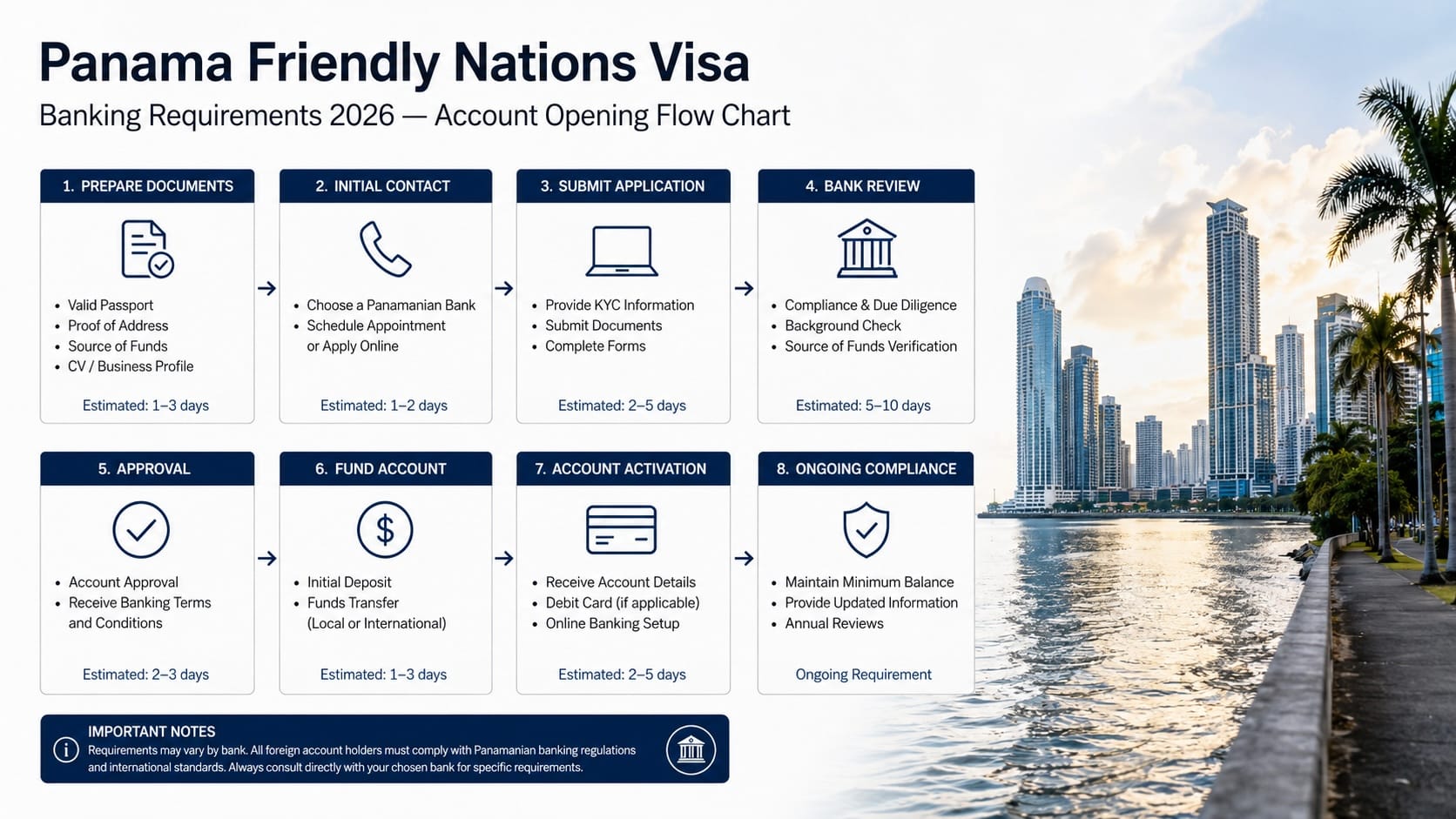
Panama’s Friendly Nations Visa banking situation changed fundamentally in August 2021, and almost nobody has updated their guidance to reflect it. The old playbook — incorporate a shell company, drop in $5,000, open a bank account, collect your cedula — is gone. The new process is staged, compliance-heavy, and far more nuanced. If you approach Banco General or BAC — the bank that absorbed Multibank in 2026 — the way articles from 2019 tell you to, you will be rejected, flagged in the Superintendencia de Bancos de Panamá’s shared KYC system, and you’ll have made your next attempt harder.
This guide covers what actually changed, what the new banking sequence looks like from day one of your application through to permanent residency, and which banks are genuinely foreigner-friendly in 2026 versus which ones perform that role in their marketing copy only.
Key figures: 40+ regulated banks in Panama; $5,000 proof-of-solvency deposit; $200,000 CD or real estate minimum; 2-year provisional residency before permanent status.
What the 2021 Reforms Actually Changed for Banking
Before August 7, 2021, the Friendly Nations Visa granted immediate permanent residency. You could walk into most Panamanian banks with your new cedula and be treated like any other permanent resident. Compliance officers knew exactly what tier of customer you were, and the banking relationship was straightforward.
Executive Decrees 197 and 226 of 2021 changed that two-step structure entirely. Applicants now receive a two-year provisional residency — a status that sits in a legal grey zone that most Panamanian banks had not anticipated. During this provisional period, you hold valid immigration documents, but you do not yet hold a cedula. You are not a tourist, not a non-resident foreigner, and not yet a permanent resident. Banks, which run their compliance frameworks on clean categorical risk profiles, struggled to classify this new applicant type. Many still do.
Then, effective January 10, 2025, a further change cut the initial temporary permit — issued while immigration processes the application — from one year down to six months. The timeline pressure on applicants increased. Practically, this means the window between arriving in Panama, assembling your banking documents, and submitting your immigration file has compressed significantly. Getting your banking in order before you land, not after, is no longer optional.
Before August 2021
Post-2021 Rules (Current)
Under the old rules, applicants received immediate permanent residency, a cedula within roughly 3 months, and straightforward banking access with low KYC complexity. Under the current post-2021 rules, applicants receive only provisional residency for 2 years, wait 2–3 years for a cedula, face higher compliance scrutiny, and find that account access varies significantly between institutions.
The Banking Status Ladder: Three Tiers, Three Different Experiences
Understanding where you sit on what we call the Banking Status Ladder is the single most important concept in this guide. Your position determines what accounts you can open, at which banks, with what documentation, and under what compliance scrutiny. Most applicants spend months confused because they are applying to banks using the wrong tier assumptions.
Tier one is the pre-application non-resident. You hold a foreign passport, no Panamanian immigration documents, and no local ties beyond what you can manufacture in a conversation. A handful of banks — historically Multibank, Scotiabank, and Global Bank, primarily — would consider non-resident applications, but the compliance bar is steep. Two of those three names no longer exist as independent institutions: Multibank merged into BAC in 2026, and Scotiabank’s Panama book now sits with Davivienda. Global Bank remains independent and is still worth approaching at this tier; treat BAC and Davivienda as unknowns until you’ve confirmed their current non-resident policy directly, since post-merger institutions frequently spend a year or more harmonizing the more permissive legacy policies out of the combined entity. Expect requests for two bank reference letters on official letterhead, professional reference letters, three to six months of bank statements showing a clean income history, and an initial deposit of $1,000 to $5,000 depending on the institution. Rejections at this tier are common, and a declined application creates a compliance note that can complicate future attempts across Panama’s shared banking network.
Tier two is the in-process applicant. You have submitted your Friendly Nations Visa application and hold the six-month temporary permit issued while immigration reviews your file. This is where things get genuinely useful. Reputable immigration law firms in Panama City will issue applicants a letter certifying that a residency application is actively in progress. Tower Bank, in particular, has developed an internal compliance framework for exactly this applicant profile, and it is now the clearest option at this tier. Multibank used to share that reputation, but Multibank no longer exists as a separate bank — it was absorbed into BAC in a merger the Superintendencia de Bancos de Panamá authorized in May 2026 and BAC completed operationally in June 2026. Reader reports reaching us since that merger describe a more conventional, locally focused account-opening experience at BAC than Multibank offered before the deal. Confirm BAC’s current in-process-applicant policy with a relationship manager before counting on it. Present the law firm letter, your full immigration file documentation, proof of solvency showing your $5,000 minimum deposit, and the standard KYC package. The account approval rate at this tier is substantially higher than at tier one, and the account you open now becomes the foundation for your entire Panama banking relationship.
Tier three is permanent residency with a cedula. This is when Panama banking becomes genuinely powerful. Banks classify cedula holders differently — lower risk, longer relationship horizon, eligible for mortgage products, securities trading accounts, private banking tiers, and multi-currency structures. Everything changes at this point, and it’s why the two-year provisional period, while frustrating, is worth navigating carefully rather than shortcutting. A poorly managed provisional period that results in an expired permit or a compliance flag can delay cedula issuance and push your entry to tier three banking back by a year or more.
Proof of Solvency: What Banks Actually Want vs What the Immigration File Requires
Here is where most online guides conflate two separate requirements that run in parallel but are not identical. The immigration file proof of solvency and the bank’s own solvency assessment are different exercises, evaluated by different parties, against different standards.
The immigration requirement: Panama’s National Immigration Service requires evidence of economic solvency to demonstrate you can support yourself in Panama without becoming a public charge. The standard benchmark is a bank certification letter from a Panamanian general-license bank confirming you hold a deposit of at least $5,000. Add $2,000 for each dependent included in the application. This certification must come from a bank licensed and supervised by the Superintendencia de Bancos de Panamá — foreign bank statements alone are insufficient.
The bank’s own KYC solvency check: Every bank regulated by the SBP conducts its own anti-money laundering and source-of-wealth assessment. This is separate from, and more rigorous than, the immigration file requirement. Providing a $5,000 deposit letter to immigration is not the same as satisfying a bank’s compliance team that you are a suitable customer. Banks want to understand how you earned your wealth globally — not just how much you currently hold. A clean paper trail connecting the income source (employment history, business ownership, investment returns, inheritance) to the funds being deposited is what compliance officers are actually reviewing.
What the documentation package should actually contain, beyond the standard passport and application form: three to six months of foreign bank statements showing regular, consistent income; a source-of-wealth declaration letter written in Spanish (your law firm can draft this); supporting documents for each income type — employment contracts, business registration documents, tax returns, or notarized declarations for investment income. If your wealth originates from real estate sales or inheritance, expect the bank to request additional verification. Prepare that documentation before you arrive in Panama, not after your initial account application is rejected.
The Correct Banking Sequence for FNV Applicants in 2026
The order in which you execute these steps matters more than almost any other variable in the process. Getting this wrong — for example, attempting to open a corporate account before establishing a personal account, or choosing a bank without confirming their current policy on in-process applicants — wastes months and creates compliance flags that follow you through the system.
Six-step banking sequence: (1) Prepare KYC package before arrival; (2) Open personal account at foreigner-friendly bank in weeks 1–2; (3) Obtain official solvency letter in weeks 2–3; (4) Submit immigration file with banking documentation in weeks 3–6; (5) Manage the provisional residency period with active account use for months 1–24; (6) At month 24+, apply for permanent residency and upgrade the banking relationship.
Which Banks Actually Work for FNV Applicants in 2026
Not all of Panama’s 40-plus general-license banks are equally accessible to foreigners in the in-process category. Several institutions market themselves as international-friendly while maintaining internal risk policies that effectively exclude most FNV applicants until permanent residency is confirmed. The following analysis reflects the current compliance posture of the major institutions — acknowledging that bank policies change and always warrant direct verification before you commit to an appointment.
Tower Bank rates high for accessibility during the application process and is the most stable recommendation post-consolidation. Global Bank rates moderate. BAC, which absorbed Multibank, and Banistmo, under new Cuscatlan ownership, both rate moderate but are marked verify given their recent ownership changes. Davivienda, which absorbed Scotiabank’s Panama operations, rates uncertain pending direct confirmation of its current non-resident and in-process applicant policy. Banco General rates low for applicants who have not yet received their cedula.
Tower Bank is, in our updated assessment, the strongest first-choice bank for FNV applicants in mid-2026. It caters explicitly to the international community, maintains a bilingual compliance team, and — unlike three of its longtime peers — has not changed ownership in the current consolidation wave. Processing times for in-process applicants run roughly 10–15 business days from full document submission, and approval rates for well-documented applications are strong. Tower Bank is particularly well suited if your primary need is international wire transfer capabilities, as its correspondent banking network is robust. We moved it to the top of this list specifically because it’s the one recommendation in this section we’re not hedging.
BAC is the bank Multibank became. BAC International Bank completed its majority acquisition of Multi Financial Group, Multibank’s parent, on March 18, 2026; the Superintendencia de Bancos de Panamá authorized the full absorption merger on May 14, 2026 (Resolution SBP-BAN-R-2026-00284); and BAC finished the operational integration in June 2026, with BAC as the surviving legal entity. The combined bank is now roughly Panama’s second-largest by assets. What that means for you: Multibank’s old reputation as an FNV-friendly, English-service, internationally minded bank was built by Multibank’s own compliance team over several years, and that team’s specific playbook does not automatically survive a merger. Readers who wrote in after this article first published described exactly that — an account-opening experience at BAC that felt more conventional and locally oriented than the one Multibank offered. That matches what we’d expect from a bank mid-integration, not a bank abandoning the segment, but we can’t confirm which way it settles until the dust clears. Treat BAC as a bank to call and ask about, not a bank to assume will work the way this article previously described.
Banco General is Panama’s largest private bank, and this is precisely the problem for FNV applicants who haven’t yet received their cedula. Its compliance framework is calibrated for established residents with documented local ties. Attempting to open a Banco General account during the provisional period, without a cedula and without an existing banking relationship in Panama, produces rejections at a high rate. Wait until you have your cedula, and Banco General becomes one of the best options for mortgage products and long-term wealth management. Banco General is one of the few names in this section whose ownership and posture haven’t changed in the past year.
Davivienda is the bank Scotiabank became in Panama. Scotiabank and Davivienda closed the transaction transferring Scotiabank’s Colombia, Costa Rica, and Panama banking operations to Davivienda on December 1, 2025, with Scotiabank taking roughly a 20% stake in the combined Davivienda Group rather than continuing to run the Panama business itself. Davivienda now operates the former Scotiabank branches, staff, and license under its own brand. Scotiabank’s old FATCA-servicing reputation for US applicants was earned over years of dealing with American clients specifically; whether Davivienda has kept that same team and workflow in place, or is rebuilding its US-client process from a more conventional Colombian retail-banking template, is not something we can confirm from public sources. If you’re a US citizen counting on the old Scotiabank playbook, call Davivienda directly and ask about their current FATCA onboarding process before you build a plan around it.
Banistmo also changed hands during this window, though its brand survived intact. Colombia’s Bancolombia group (via holding company Grupo Cibest) sold Banistmo to Inversiones Cuscatlán Centroamérica for approximately $1.4 billion, in a deal that closed June 30, 2026. Banistmo has stated it will keep its name, staff, products, and service channels unchanged for now, which is a meaningfully different transition than the BAC or Davivienda situations — there’s no brand or systems migration to absorb. That said, “new ownership” and “several weeks old” are still reasons to confirm current FNV-applicant policy before relying on Banistmo’s pre-2026 reputation.
The $200,000 CD Route: Banking Implications Most Guides Skip
If you are qualifying for the Friendly Nations Visa through the fixed-term deposit route rather than employment or real estate, the $200,000 CD you place in a Panamanian bank is simultaneously a visa qualification instrument and the foundation of your entire banking relationship in the country. This dual function is enormously powerful — and almost entirely ignored in the immigration-focused guides that dominate the search results.
Placing a $200,000 three-year CD at a Panamanian bank makes you, immediately, one of the more significant individual depositors at most institutions. Banks recognize this. The compliance review for your personal account application becomes substantially easier when the same bank holds a $200,000 time deposit under your name — the source of funds is sitting in their system, the beneficial ownership is documented, and the relationship is already established. You are no longer an unknown applicant; you are a depositor seeking additional account services.
One critical point that most articles miss: the $200,000 CD must be held at a bank licensed by the Superintendencia de Bancos de Panamá with a general license — not an international or representative license. The CD certificate must be encumbrance-free, meaning it cannot be used as collateral for any loan during the minimum three-year period. The certificate must explicitly state the term, interest rate, opening date, and the depositor’s full legal name matching the passport presented to immigration. Any discrepancy between the CD documentation and the immigration file is treated as a deficiency and will delay or block the provisional residency grant.
Panama’s Territorial Tax System and What It Means for Your Banking Records
Panama operates a strict territorial tax system: income generated outside of Panama is not subject to Panamanian income tax. This is one of the country’s most cited financial advantages, and it genuinely is significant. But the way this system interacts with your banking records creates obligations that are poorly understood and routinely mismanaged by new residents.
Banks under SBP supervision are required to implement CRS — the Common Reporting Standard — which means that financial account information for non-Panamanian tax residents is automatically shared with the account holder’s country of tax residence. If you maintain tax residency in your home country during the provisional period (common, since most FNV applicants do not relocate immediately), your Panamanian bank account activity is being reported back to your home tax authority. Panama’s territorial tax advantage only applies to you as a Panamanian tax resident — a status that is not automatically conferred by immigration residency alone.
The practical implication: maintain consistent records of where your income is being generated, and be prepared to demonstrate to both Panamanian banking compliance and your home country tax authority that the flows through your Panama account are consistent with your declared income sources. Banks that see large, unexplained international transfers into a newly opened account during the provisional period will flag the account for review — regardless of how legitimate the underlying income is.
For US citizens specifically, the FATCA overlay adds another layer. US persons are required to report foreign financial accounts where the aggregate value exceeds $10,000 at any point during the year (FinCEN Form 114), and may also have FATCA reporting obligations on Form 8938. US citizens dealing with Panamanian banks will be required to sign the bank’s FATCA compliance forms during account opening — non-signing is grounds for account refusal. Ensure your chosen bank has a documented FATCA compliance program before you submit your application.
Corporate Accounts: Timing, Sequencing, and the Mistake Most New Residents Make
Panama allows — and many FNV applicants need — corporate bank accounts for their local business activities. The employment route for the visa requires a Panamanian company with legitimate operations, at least ten Panamanian employees, and Social Security registration. Setting up that company requires a corporate bank account. The question is when to open it and in what relationship to the personal account.
The mistake we see repeatedly is applicants attempting to open a corporate account simultaneously with or prior to establishing a personal account. Banks assess corporate accounts by looking at the beneficial owners’ personal banking profiles. If the individual owner has no established banking history in Panama, the corporate account application has no reference point for the bank’s compliance team. The result is either rejection or a months-long review process that delays the entire immigration timeline.
The correct approach: establish and actively use your personal account for 60–90 days before applying for a corporate account at the same institution. By that point, your personal account shows consistent, documented activity. The compliance officer reviewing your corporate application can cross-reference your personal file, the source-of-wealth narrative is already approved, and the corporate application becomes substantially more routine. This sequencing alone reduces corporate account approval timelines from several months to several weeks at the major institutions.
One additional consideration for the employment route: the Panamanian company that employs you must demonstrate real operations — this is not a shelf company, not a nominee director structure, but a genuinely active entity with documented commercial activity. Banks performing due diligence on corporate account applications for this category are looking specifically at evidence of real operations: contracts, invoices, payroll records. Prepare that documentation from the moment the company is incorporated, not in response to a bank information request weeks later.
Panama is one route. Our guide to offshore and non-resident banking sets it against the others, side by side.
Escrow Accounts and the Real Estate Route: A Banking Consideration That Gets No Coverage
The $200,000 real estate route for the Friendly Nations Visa creates a banking wrinkle that affects timing in ways that catch applicants off guard. Property purchases in Panama above certain thresholds are commonly structured through escrow accounts — a specialized financial instrument regulated separately under Panamanian law. The escrow holds your purchase funds until the Public Registry of Panama confirms clear title transfer and the transaction is complete.
For immigration purposes, the property must be registered in the Public Registry under your name (or under a legal entity in which you are the verified ultimate beneficial owner) with a declared value of at least $200,000. Financed purchases are permitted — local bank financing is explicitly allowed under the Friendly Nations Visa rules — but the mortgage must be from a Panamanian general-license bank, and the net equity position is what matters for immigration solvency calculations, not the gross property value.
The banking timing implication: if you are financing the real estate purchase through a local bank, you will be in an active mortgage relationship with that bank before your residency application is submitted. This is actually an advantage — the bank holding your mortgage has already conducted a full KYC assessment on you as part of the loan underwriting process. That existing relationship makes opening a personal deposit account at the same institution significantly smoother. The compliance team has already approved your source-of-funds profile. In this scenario, the mortgage bank becomes your natural primary banking partner for the provisional period.
Frequently Asked Questions: Panama Friendly Nations Visa Banking 2026
Can I open a Panama bank account before my Friendly Nations Visa application is submitted?
What documents does a Panamanian bank need that immigration doesn’t require?
Does the $5,000 proof of solvency need to stay in the Panama account permanently?
Can US citizens open Panama bank accounts given FATCA?
Can I open a Panama bank account remotely, without traveling to Panama?
How does the Panama bank account affect CRS reporting back to my home country?
References
- Superintendencia de Bancos de Panamá — Official Regulatory Authority (opens in new tab)
- Chambers & Partners — Panama Corporate Immigration Practice Guide 2025 (opens in new tab)
- Servicio Nacional de Migración de Panamá — National Immigration Service (opens in new tab)
- Registro Público de Panamá — Public Registry of Panama (opens in new tab)
- OECD — Common Reporting Standard (CRS) Framework Documentation (opens in new tab)
- Superintendencia de Bancos de Panamá — Resolution SBP-BAN-R-2026-00284 authorizing the BAC–Multibank absorption merger, May 14, 2026 (opens in new tab)
- Newsroom Panama — BAC completes operational integration of Multibank, June 2026 (opens in new tab)
- Scotiabank and Davivienda — Closing of transaction transferring Scotiabank’s Colombia, Costa Rica and Panama operations, December 2025 (opens in new tab)
- Rio Times — Cibest/Bancolombia completes $1.4 billion sale of Banistmo to Inversiones Cuscatlán, June 2026 (opens in new tab)