There are two completely different situations that fall under “Swiss business bank account opening,” and they have almost nothing in common in terms of requirements, bank options, and likely outcomes. The first: a company incorporated outside Switzerland — a UK Ltd, a BVI holding company, a US LLC, a UAE freezone entity — that wants to open a Swiss bank account for that foreign entity. The second: a company incorporated inside Switzerland as a GmbH or AG, where the shareholders are foreign nationals or non-residents. Both are legitimate and both are possible. But they require different approaches, different documentation, and different bank selection strategies. Mixing them up is one of the most common reasons applications go to the wrong bank and fail.
Foreign company wants a Swiss account
Swiss GmbH/AG with foreign shareholders
Scenario A — Foreign Company Opening a Swiss Bank Account
For the narrower compliance checklist, see how Swiss private banking eligibility changes when a foreign company, foreign director, or offshore shareholder sits in the file.
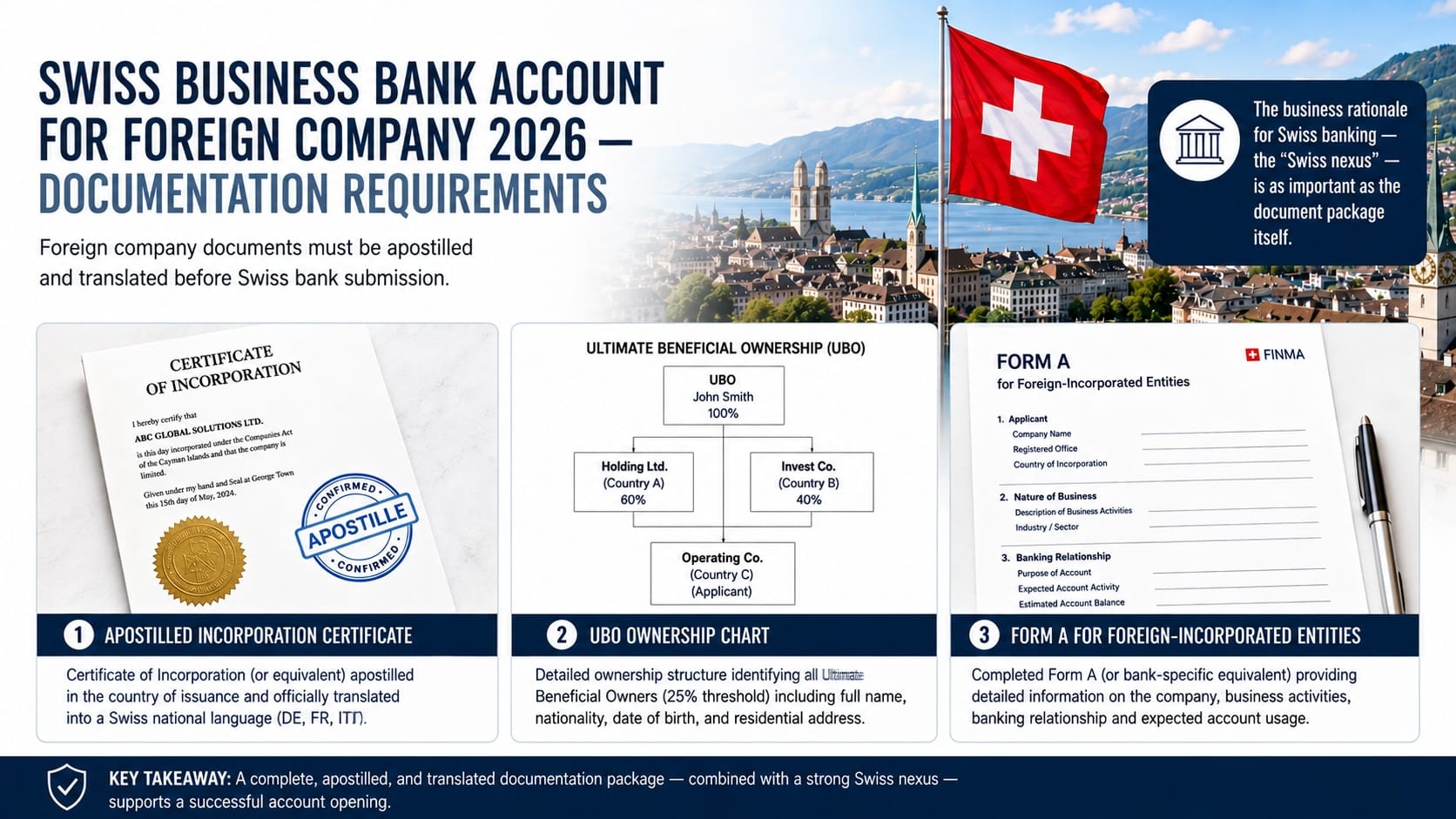
A foreign company — one incorporated in the UK, BVI, Cayman Islands, UAE, USA, or anywhere else outside Switzerland — faces a fundamentally different challenge than a Swiss company when approaching a Swiss bank. Swiss banks assess foreign companies against one core question: what is the legitimate reason this company needs to bank in Switzerland specifically? Without a convincing answer — and usually some demonstrable connection to Switzerland — most Swiss banks will decline the application before reviewing a single document.
The reason isn’t arbitrary. Under FINMA’s Anti-Money Laundering Ordinance and the Swiss Banking Due Diligence Convention (CDB 20), Swiss banks are required to assess the business rationale of every corporate relationship. A foreign company with no Swiss operations, no Swiss clients, no Swiss assets, and no Swiss counterparties is a compliance question the bank has to answer to FINMA: why are we holding this relationship? If there is no good answer, the bank’s rational choice is to decline rather than take on the AML exposure. This reality explains why most Swiss banks — including UBS for most of its retail corporate offering, PostFinance, and ZKB — will not open business accounts for foreign-incorporated entities unless there is a demonstrable Swiss nexus.
What Counts as a Swiss Nexus
Swiss nexus takes several forms, and some are stronger than others in the eyes of a bank’s compliance team. A Swiss branch registered with a cantonal commercial register is the clearest and most widely accepted nexus — the foreign company has a legal presence in Switzerland. Regular documented transactions with Swiss counterparties (suppliers, clients, service providers) establishes commercial nexus. A Swiss-resident director or authorised signatory demonstrates operational presence. Ownership of Swiss real estate or holding Swiss securities in custody creates asset nexus. A private banking anchor relationship at the same Swiss institution — where the company’s beneficial owner already has a personal account — is often the most practical path for passive holding structures.
Nexus built on paper alone — a virtual office address and a Swiss fiduciary director who signs everything without any real management involvement — is exactly what FINMA’s Due Diligence Convention targets. Banks check, and when the substance doesn’t match the structure, applications fail. Genuine economic activity or a genuine personal banking relationship at the same institution are the two most reliable nexus types.
Domiciliary Company vs Active Company — Why It Changes Everything
FINMA’s Due Diligence Convention draws a sharp line between two types of foreign corporate clients. A domiciliary company has no physical operations in its jurisdiction of incorporation — no employees, no real office, no active trade. These include most BVI, Cayman, Seychelles, and similar offshore structures used as holding vehicles. An active company generates revenue from genuine commercial operations, processes regular transactions with real counterparties, and has employees or operational staff. Swiss banks handle these two categories completely differently.
| Company type | Examples | Swiss bank assessment | Most viable bank option | Key requirement |
|---|---|---|---|---|
| Passive holding / domiciliary | BVI holding company, Cayman SPV, Seychelles IBC owning investments or real estate | Form A (UBO declaration). Bank treats as private wealth vehicle. Compliance cost relatively low if UBO is clean and documented. | Swiss private bank (via personal banking relationship); CIM Banque historically — now more selective | Clear single UBO; clean source of wealth; private banking anchor at same institution |
| Active operating company | UK Ltd trading internationally, US LLC providing services, UAE freezone company processing transactions | Form K (controlling persons) required. Bank must monitor every transaction for AML. Compliance cost is high. Many banks decline. | Relio (European companies, no US nexus); Swissquote (investment-focused); specialist trade finance banks if commodity sector | Demonstrated Swiss nexus; clear business rationale for Swiss banking; clean UBO chain; economic substance |
| Publicly listed company | Listed on recognised stock exchange with public shareholder register and audited financials | Simplified UBO verification — stock exchange oversight serves as compliance proxy | UBS institutional banking; ING, Citi, Bank of America Swiss subsidiaries; dedicated institutional desks | Verifiable exchange listing; audited accounts; institutional banking mandate |
If your foreign company has any US person at the shareholder, director, or UBO level — even a minority stake — most Swiss banks will decline the application. The reason is FATCA: US persons trigger IRS reporting obligations, and many Swiss banks have decided the compliance infrastructure required to manage FATCA for foreign corporate relationships is not worth carrying for most account sizes. Relio — the most accessible Swiss fintech for foreign European companies — explicitly rejects any company with US nexus at any level. Swissquote and CIM Banque handle US persons on a case-by-case basis but with elevated scrutiny. For foreign companies with US shareholders, the realistic Swiss banking options narrow significantly and specialist advice is essential before approaching any institution.
Banks That Accept Foreign Companies in 2026
The honest picture, as of May 2026, is that the field has narrowed. CIM Banque, which was the most widely recommended option for offshore holding companies through most of the 2010s, tightened its foreign corporate appetite significantly from 2020 onward and no longer actively pursues foreign corporate relationships as a growth area — the legacy book is maintained, not expanded. Relio, a FINMA-licensed Swiss fintech, is currently the fastest and most accessible path for European-owned operating companies needing a functional Swiss corporate account, but it explicitly excludes US nexus and caps deposits at CHF 100 million. For passive holding structures connected to a private banking relationship, most mid-tier and top-tier Swiss private banks will accommodate the foreign corporate vehicle through the same onboarding as the personal client.
| Institution | Company types accepted | US nexus | Monthly cost | Remote onboarding | Key limitation |
|---|---|---|---|---|---|
| Relio | Active European operating companies with genuine business activity | ❌ Explicitly rejected | CHF 249/month | ✅ Video verification; fast onboarding | CHF 100M deposit cap; no investment services; European companies only |
| Swissquote | Investment-linked foreign companies; holding structures with securities mandate | ⚠️ Case by case — enhanced scrutiny | Low / custody-based fees | ✅ Fully remote | Investment platform focus — not full transactional banking for operating companies |
| CIM Banque | Private clients with offshore holding vehicles; legacy corporate relationships | ⚠️ Case by case | Relationship-based | ✅ Video conference | No longer a growth area for new foreign corporate clients. Economic substance now required since 2020. |
| Swiss private banks (EFG, VP Bank, Julius Baer) | Passive holding companies linked to a personal private banking relationship | ⚠️ Possible with private banking anchor but complex | Included in private banking mandate | ❌ In-person preferred | Requires active private banking relationship at the same institution. Minimum CHF 1M+ at the private level. |
| TradeXBank / Nexent Bank | Commodity trading companies (energy, agricultural, metals) with genuine Swiss trade finance flows | ⚠️ Case by case | Trade finance facility-based | ❌ In-person required | Only relevant for genuine commodity trade finance transactions — not general corporate banking |
Documents for Scenario A — Foreign Company
Foreign company documents must be apostilled under the Hague Convention and professionally translated into German, French, or English before submission to any Swiss bank. A company incorporation certificate older than six months will typically be rejected. Every document in the package needs to be current.
| Document | Required | Format |
|---|---|---|
| Certificate of incorporation / company registration | ✅ Yes | Apostilled; max 6 months old |
| Articles of Association / constitutional documents | ✅ Yes | Apostilled; certified translation to DE/FR/EN |
| Certificate of good standing | ✅ Yes (for offshore jurisdictions) | Apostilled; max 3 months old |
| Shareholder register | ✅ Yes | Current; showing all shareholders with % holdings |
| Ownership/UBO chart | ✅ Yes | Full chain to natural persons above 25%; signed by director |
| Form A (beneficial owner declaration) | ✅ Yes — signed personally by UBO | Signed by each UBO; bank-specific form |
| Form K (controlling persons) — for operating companies | ✅ Yes — if active company | Identifies all natural persons with 25%+ control; bank-specific form |
| Passport of each UBO/director | ✅ Yes | Certified copy; bank or notary stamp |
| Proof of address for each UBO/director | ✅ Yes | Utility bill or official correspondence, max 3 months |
| Source of wealth — each UBO above 25% | ✅ Yes | Per wealth category — see documents guide |
| Business description and Swiss nexus explanation | ✅ Yes | Written statement: what the company does, why it needs a Swiss account, what transactions are expected |
| Bank statements (company) | ✅ 6–12 months | From the company’s existing bank relationship |
Scenario B — Swiss GmbH or AG with Foreign Shareholders
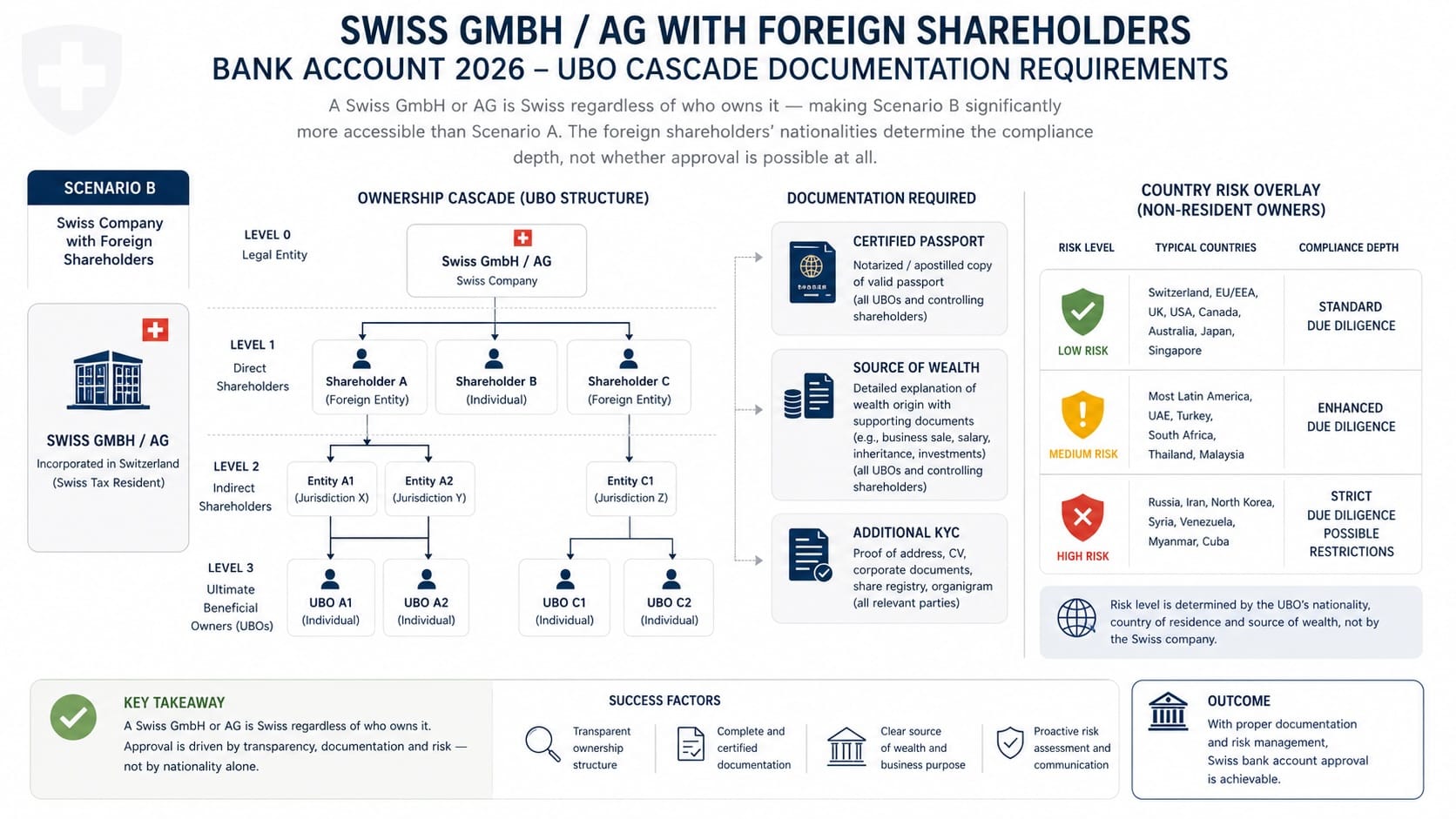
A Swiss-incorporated company — a GmbH or AG registered in the Swiss commercial register — is a Swiss legal entity regardless of who owns it. There are no restrictions on foreign ownership of a Swiss GmbH or AG. A company can be 100% owned by a single foreign national or by a foreign corporate entity, and it is still fully Swiss for banking purposes. The Swiss commercial register entry, the Swiss legal address, and the Swiss corporate governance structure make this an entirely different proposition for a bank compared to Scenario A.
Most Swiss banks — including UBS, ZKB, PostFinance, Migros Bank, and all cantonal banks — will consider opening a business account for a Swiss-incorporated company even when the shareholders are entirely foreign. The company is Swiss. The bank’s question is no longer “why does this company need to bank here?” — it’s “who owns this company, and does their profile pass compliance?” The focus shifts entirely from the company’s structure to the shareholders’ KYC profiles. That’s a very different problem, and a much more manageable one. Requirements for opening a Swiss account typically involve providing detailed information about the company’s ownership and financial history. Additionally, banks may request documents that verify the legitimacy of the shareholders’ sources of income. Meeting these requirements can help facilitate a smoother account-opening process for foreign-owned entities operating in Switzerland.
What Foreign Shareholders Change in the Banking Process
Every beneficial owner above 25% of the Swiss company must go through a full personal KYC process — exactly the same as a non-resident individual opening a personal Swiss account. This means a certified passport copy, proof of address, Tax Identification Number from the shareholder’s country of residence, and source-of-wealth documentation. For a Swiss company with three equal foreign shareholders (each at 33%), all three go through full KYC. For a company with one 100% foreign owner, that one person provides the complete personal package.
The nationality of the foreign shareholders directly affects the complexity and timeline of the application. The bank applies its country risk matrix to each shareholder’s passport profile independently. A Swiss AG owned by a German and a French national — both EU, low-risk jurisdictions — goes through standard onboarding at most Swiss banks. The same Swiss AG owned by shareholders from a FATF-listed jurisdiction, or from a country with which Switzerland has elevated compliance obligations, triggers Enhanced Due Diligence for the entire application. The company is Swiss; the risk profile is determined by who owns it.
| Shareholder nationality profile | EDD required | Documents beyond standard | Expected timeline |
|---|---|---|---|
| EU / EEA nationals | Standard | Passport, proof of address, TIN, source of wealth — standard package | 3–5 weeks at most Swiss banks |
| Non-EU low-risk (UK, Singapore, Japan, Australia, Canada) | Standard to slightly elevated | Same as above; UK documents: no apostille needed. Other countries: apostille required. | 4–7 weeks |
| US nationals / green card holders | Enhanced — FATCA | Form W-9, FATCA self-certification, additional IRS-related disclosures | 6–10 weeks; some Swiss banks decline US shareholders entirely |
| FATF grey-listed jurisdiction nationals | Enhanced — EDD mandatory | 12 months bank statements; reference letter from existing bank; expanded source-of-wealth documentation | 8–14 weeks; approval not guaranteed regardless of documentation quality |
| Politically Exposed Persons (PEPs) | Enhanced — special approval required | PEP declaration; enhanced source of wealth; senior bank management approval in most cases | 10–16 weeks; many banks decline PEP shareholders regardless of other factors |
| Russian / Belarusian nationals (post-2022) | ❌ Most banks decline | Swiss residency permit or citizenship required at most major banks; Federal Council sanctions ordinance applies | Structural exclusion at UBS and most universal banks regardless of timeline |
US Shareholders — the FATCA Problem
US shareholders in a Swiss company create FATCA reporting obligations for the Swiss bank — it must identify, report, and comply with IRS disclosure requirements for any account where a US person has ownership or control. This is manageable but costly, and many Swiss banks — particularly at the SME banking tier — have decided it isn’t worth carrying for smaller relationships. ZKB and PostFinance generally accept US shareholders in Swiss companies but apply additional documentation requirements. UBS manages FATCA through its institutional infrastructure. Relio explicitly excludes US nexus at any level. Before approaching a Swiss bank with US shareholders in your Swiss company, confirm directly whether the bank accepts that profile for business accounts — it varies considerably and is worth verifying before preparing your full documentation package.
Dividends and Withholding Tax for Foreign Shareholders
When a Swiss GmbH or AG distributes dividends to its foreign shareholders, Switzerland applies a 35% withholding tax at source. This is not a banking matter — it’s a tax matter — but it directly affects how foreign shareholders structure their Swiss company relationships and is worth understanding before incorporating. Under Switzerland’s network of Double Taxation Agreements (over 100 treaties), most foreign shareholders can claim a reduction of the 35% withholding to a treaty rate — typically 5%, 10%, or 15% depending on the country and the ownership percentage. The reduction requires a formal claim through the Swiss Federal Tax Administration. EU companies holding Swiss subsidiaries may qualify for the EU-Switzerland Bilateral Agreement’s reduced withholding arrangement, which can bring the rate to 0% under certain conditions for qualifying structures.
Documents for Scenario B — Swiss Company with Foreign Shareholders
| Document | For the Swiss company | For each foreign shareholder / UBO above 25% |
|---|---|---|
| Commercial register extract (Handelsregisterauszug) | ✅ Required — max 3 months old; in German from cantonal register | N/A |
| Articles of Association (Statuten) | ✅ Required — notarised copy | N/A |
| UBO ownership chart | ✅ Required — full chain showing all shareholders and ultimate natural persons | N/A |
| Passport (certified copy) | N/A | ✅ Every shareholder/UBO above 25%; certified by notary or Swiss consulate |
| Proof of address | Swiss registered address confirmation | ✅ Utility bill or official correspondence, max 3 months old |
| Tax Identification Number (TIN) | Swiss UID number | ✅ TIN from each shareholder’s country of tax residence |
| Source of wealth | Explanation of company’s initial capitalisation source | ✅ Personal source-of-wealth documentation per shareholder; category-specific evidence |
| Bank statements | If the company has existing banking history — 3–6 months | ✅ Personal bank statements for each shareholder; 3–6 months standard; 12 months for elevated-risk nationalities |
| Business description | ✅ What the company does; expected transaction volumes; main clients and counterparties | N/A |
| FATCA self-certification | N/A | ✅ Required only for US shareholders — Form W-9 and FATCA declaration |
Foreign shareholders in a Swiss company do not need apostilles on their personal documents — the company is Swiss, so the bank’s compliance review for the entity itself uses Swiss commercial register documents, which are already in the correct format. Apostilles are only required for documents issued in foreign countries: foreign shareholders’ passports (via Swiss consulate certification is standard), any foreign corporate documents if a foreign holding company is an intermediate shareholder, and foreign source-of-wealth documentation. For EU/EEA shareholders, the process is straightforward. For non-EU shareholders, the certification approach for the personal KYC documents is the same as for non-resident personal account applicants.
Related reading:
Frequently Asked Questions
Can a foreign company (incorporated outside Switzerland) open a Swiss bank account? +
Can a Swiss GmbH or AG be 100% owned by a foreign national or foreign company? +
Does the nationality of shareholders affect which Swiss bank will open a business account? +
What is Form A and Form K in Swiss corporate banking? +
Which Swiss bank is best for a Swiss company with foreign shareholders in 2026? +
References
- FINMA — Swiss Banking Due Diligence Convention (CDB 20) and Corporate KYC Requirements (opens in new tab)
- Goldblum & Partners — Swiss AG Formation: Foreign Ownership Rules, Director Residency and Banking (2026) (opens in new tab)
- Goldblum & Partners — Swiss GmbH Formation: Foreign Shareholders, Withholding Tax and Banking (2026) (opens in new tab)
- Lenz & Staehelin — LETA: Federal Register of Beneficial Owners (October 2025) (opens in new tab)
- esisuisse — Swiss Deposit Protection: CHF 100,000 Per Depositor Per Bank (opens in new tab)