The documents needed to open a Swiss bank account for non-residents are not a mystery — passport, proof of address, source of wealth. Every guide on the internet lists those three categories, and every guide on the internet is missing the point. Because Swiss banks don’t collect documents. They build a compliance case. The documents you submit are evidence in that case, and whether the case holds together is what decides your application — not whether the checklist is complete. Securing swiss accounts for nonresidents can be particularly challenging due to the stringent regulations in place. Applicants must maintain transparency regarding their financial background to build a strong compliance case. Ultimately, the relationship you establish with the bank and the clarity of your financial narrative can greatly influence the outcome of your application.
That distinction matters enormously in practice. In more than a decade of working with non-resident applicants, the most consistent pattern in rejected files isn’t a missing document. It’s a file where the documents contradict each other, or where the income picture doesn’t fit the deposit amount, or where the source-of-wealth narrative breaks down under scrutiny. Those applications fail not because the applicant did something wrong, but because they prepared a document pile instead of a compliance file.
This post reframes the preparation process. Rather than listing what to submit, it explains what each document category is actually testing — and how to build a file that holds together as a coherent story under Enhanced Due Diligence review.
Key figures: 1 in 3 non-resident applications face rejection or delays. 80% of compliance review time goes to source-of-wealth. Review timelines run 3–12 weeks. Swiss banks manage CHF 9.4 trillion, 45.5% from foreign clients.
How a Compliance Officer Actually Reads Your File
Most applicants imagine document review as a checklist exercise: did this item arrive, yes or no. It isn’t. Swiss banks operating under FINMA’s Enhanced Due Diligence framework review non-resident files as a narrative. The compliance officer’s first question isn’t “is the passport here?” It’s “does this file make sense?” The documents are read in a specific logical sequence, and each one is evaluated against what the others have already established. Understanding that sequence changes how you prepare.
Here is the actual reading order most Swiss banks follow — and what each stage is testing for. This isn’t publicly documented anywhere. It’s reconstructed from the pattern of which documents banks request as follow-ups when initial submissions stall.
The implication is direct: if you want your application to move through these stages without unnecessary delays, prepare your documents in the order compliance will review them — not in the order they appear on the bank’s checklist. Start with identity coherence. Then address coherence. Then build the source-of-wealth narrative from the ground up.
Dual citizens and investment-migration clients should map every identity before selecting a primary document. See our second-passport banking disclosure guide for the correct sequence and the omission that can turn enhanced review into rejection.
Identity Documentation: The Certification Gap Most Applicants Miss
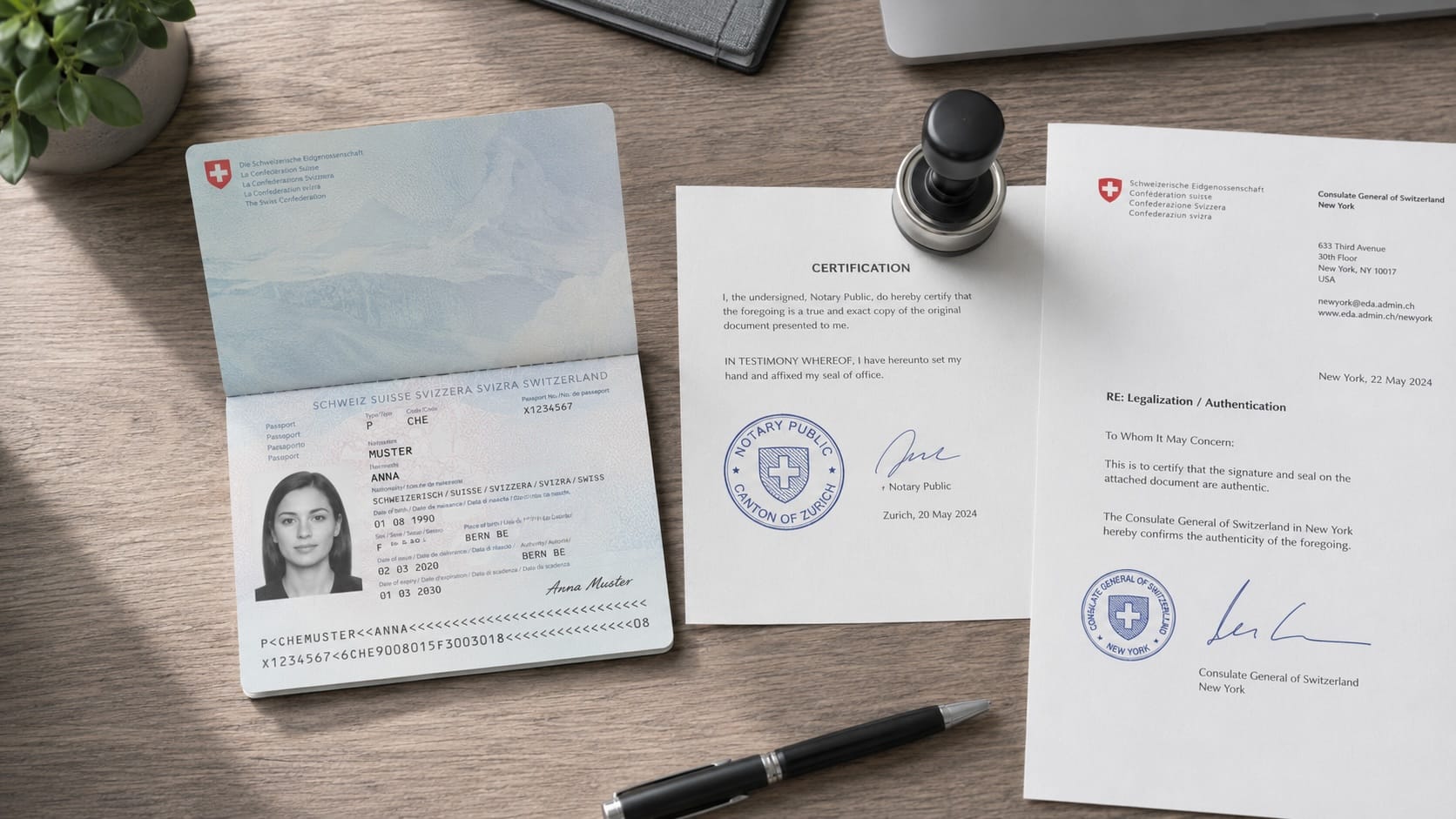
A valid, unexpired passport is not, by itself, what Swiss banks require. What they require is a certified copy of a valid passport — and those are not the same thing. This distinction trips up a significant number of first-time applicants, usually because the certification requirement is described in the application form but not explained. A phone photo of your passport, uploaded to an application portal, is not a certified copy. Neither is a high-resolution scan from a home printer. The copy must be authenticated by a person or institution whose authority is recognised in Swiss legal context.
Who qualifies as a certifier? The safest options are a Swiss consulate or embassy in your country, a Swiss-registered notary, or a bank official from a bank with Swiss correspondent relationships. A local notary from your home country may be accepted, but this is worth confirming directly with your target bank before investing the time. What is almost universally not accepted: a certification by a non-licensed individual, a stamp from a business address rather than a legal professional, or a certification letter attached separately from the copy it authenticates. The certification must physically appear on the copy itself. For who may certify under the Swiss banks’ own due-diligence code, and when an apostille or legalisation is needed, see our guide to certifying documents for a Swiss account from abroad.
For non-EU/EEA applicants, national ID cards are almost always insufficient as a standalone identity document. Your passport is the only option. And here’s the practical detail that most checklists omit: some private banks also request recent passport-style photographs — 35mm × 45mm, plain background, taken within six months — as part of the final onboarding package. It’s worth having a set prepared before you start, because being asked for these mid-process adds days to the timeline for a trivially avoidable reason.
Proof of Address: Why Three Documents That Each Pass Still Fail Together
The proof-of-address requirement for Swiss bank accounts is one of the most straightforward-sounding parts of a non-resident application. A recent utility bill, a bank statement, an official government letter — all are acceptable, all are commonly available, and almost all applicants have at least one. Yet address documentation is the second most common reason applications stall, behind source-of-wealth issues. The reason isn’t the document itself. It’s the coherence test it fails when read alongside everything else in the file.
Here is the specific problem. Many non-resident applicants have genuinely complicated address situations: they have moved recently, they maintain a home in one country while working in another, or their passport was issued at an old address that no longer reflects their current residence. Each individual document — the utility bill, the passport, the tax certificate — is accurate. But they point to three different addresses, none of which the compliance officer can easily reconcile without an explanation. That explanation is the part most applicants don’t think to provide, because each document, taken alone, looks perfectly valid.
The fix is to include a brief cover note — one page, no legal language required — that explains your address history chronologically. “Passport issued 2019 at address A; relocated to address B in January 2023 (copy of lease attached); current utility bill reflects address B.” That one paragraph converts three conflicting data points into a coherent narrative. It doesn’t need to be notarised. It just needs to exist, and to be placed at the front of your file where the compliance officer will see it before the documents themselves.
One hard rule: PO box addresses, virtual office addresses, and shared office mailboxes are categorically rejected as proof of address for Swiss bank applications. This applies even if those are your legitimate registered addresses for other purposes. Swiss banks require a residential address — a place where you actually live — documented by a utility bill, lease agreement, or official government correspondence. The Tax Identification Number from your country of residence must also be included and must match the address you’ve declared. Since Switzerland joined the OECD Automatic Exchange of Information framework, the TIN is how your account details get reported to your home tax authority — a missing or incorrectly formatted TIN creates a reporting gap the bank is legally required to resolve before approval.
Source of Wealth: The Document That Isn’t a Document
Every guide lists source of wealth as a required document category. What almost none of them explain is that source of wealth is not, at its core, a document — it’s a narrative. The documents you submit are evidence in support of that narrative, and the narrative has to be internally consistent, chronologically coherent, and proportionate to the deposit amount you’re proposing. The evidence stack looks different depending on how the wealth was generated, and getting this wrong is the single most common reason non-resident Swiss bank applications fail.
Swiss compliance teams recognise six primary wealth generation categories. Each has a different evidence requirement. Using the wrong evidence for your category — or using the right evidence incompletely — generates the follow-up requests that extend review timelines by weeks.
| Wealth source | Primary evidence | Supporting evidence | Common failure point |
|---|---|---|---|
| Employment income (salary) | 3–6 months payslips, employment contract | 6 months bank statements showing salary credits | Payslips not matching bank statement deposits |
| Self-employment / consulting | 2 years tax returns, business registration | Client contracts, invoices, business bank statements | Gap between declared income and proposed deposit |
| Business sale / exit | Share purchase agreement or asset sale contract | Company accounts pre-sale, legal completion statement, proof of proceeds received | Missing the proceeds trail from sale completion to current account |
| Inheritance / gift | Probate documentation or notarised gift deed | Testator’s death certificate, estate valuation, account statement showing receipt | Gift from living donor without a gift deed — most suspicious scenario |
| Real estate sale | Sale and purchase agreement, completion statement | Property valuation history, land registry extract, proof of mortgage discharge | Sale price inconsistent with property type or market for the region |
| Investment returns | Brokerage account statements covering full investment period | Capital gains tax returns, dividend income records | Returns not matching account statements; undocumented offshore accounts |
One pattern worth calling out specifically: gifts from living donors. Banks are required to treat these with particular scrutiny under AML frameworks, because an undocumented gift between related parties is one of the most common methods of disguising proceeds of crime. A gift is not inherently suspicious — but a gift without a formal deed, without any documented relationship to the donor, and without a plausible explanation for why the transfer occurred, is. If your wealth includes a gift from a family member, prepare the gift deed and a brief explanation of the donor relationship before you submit.
Bank statements covering the last three to six months are required regardless of wealth category — and this means all accounts, not just the account you intend to link to the Swiss application. A compliance officer reviewing a file that shows substantial wealth claims but only one domestic bank account with modest balances will flag the discrepancy. The statements need to show the wealth actually sitting somewhere, and the somewhere needs to be consistent with the wealth generation story you’ve told.
Source-of-wealth gaps: 34%. Incomplete bank statements: 28%. Address inconsistency: 19%. Missing TIN: 12%. Corporate document issues: 7%.
The Country Risk Overlay: How Your Passport Rewrites the Requirements
Here is something the standard document checklist doesn’t tell you: the documentation requirements for a Swiss bank account are not uniform across nationalities. They are adjusted — sometimes substantially — based on the country risk profile of your passport and your country of residence. The same deposit, the same wealth source, and the same documentation package can be accepted without comment from one applicant and trigger months of follow-up from another, purely because the compliance team is applying different regulatory overlays to different passport profiles.
The FATF grey list is the most direct driver of this. Applicants from countries currently on the FATF list of jurisdictions under increased monitoring — which has included the UAE, South Africa, Morocco, and others at various points — face automatic additional scrutiny under FINMA guidelines, regardless of their personal financial history. The bank isn’t making a judgment about you; it’s complying with a regulatory obligation that your passport triggers. The practical consequence is that applicants from grey-listed jurisdictions typically need to provide 12 months of bank statements rather than three to six, more detailed source-of-wealth documentation, and often a reference letter from an existing bank relationship.
US citizens face a different kind of overlay. FATCA — the Foreign Account Tax Compliance Act — requires Swiss banks to report account information for US persons to the IRS, and many Swiss private banks have historically preferred not to take on the associated compliance burden. This has eased somewhat since 2020, with Swissquote, Dukascopy, and several private banking groups now accepting US clients under FATCA-compliant frameworks. But the documentation requirements remain more extensive: Form W-9 and a FATCA self-certification are mandatory additions to the standard package, and the onboarding process is typically longer.
Russian and Belarusian nationals face the most significant restriction as of 2026. Since March 2023, UBS has required a Swiss residency permit or Swiss citizenship from Russian clients — and most other major institutions have adopted comparable policies. The practical reality for Russian passport holders without Swiss residency is that the universe of accessible Swiss banks has narrowed significantly to specialised private banks and independent asset managers who are willing to manage the associated sanctions compliance obligations. If this applies to you, the documentation question is almost secondary — bank selection comes first. See our dedicated guide on non-resident Swiss banking eligibility by nationality for the full 2026 picture.
Standard Non-Resident Profile
FATF / Elevated-Risk Profile
Requirements vary by bank and individual profile. This comparison reflects observed patterns across private bank and universal bank onboarding, not a guaranteed standard.
Corporate Non-Residents: The UBO Cascade That Doubles Your Document Load
If you’re applying to open a Swiss bank account on behalf of a company rather than as an individual, the document requirements don’t just expand — they branch. Every legal entity in the ownership chain must be documented, and every individual with beneficial ownership above a threshold (generally 25% of shares or voting rights) is treated as a separate personal applicant for KYC purposes. This is the UBO cascade, and underestimating it is one of the most common reasons corporate applications take two to three times longer than individual ones.
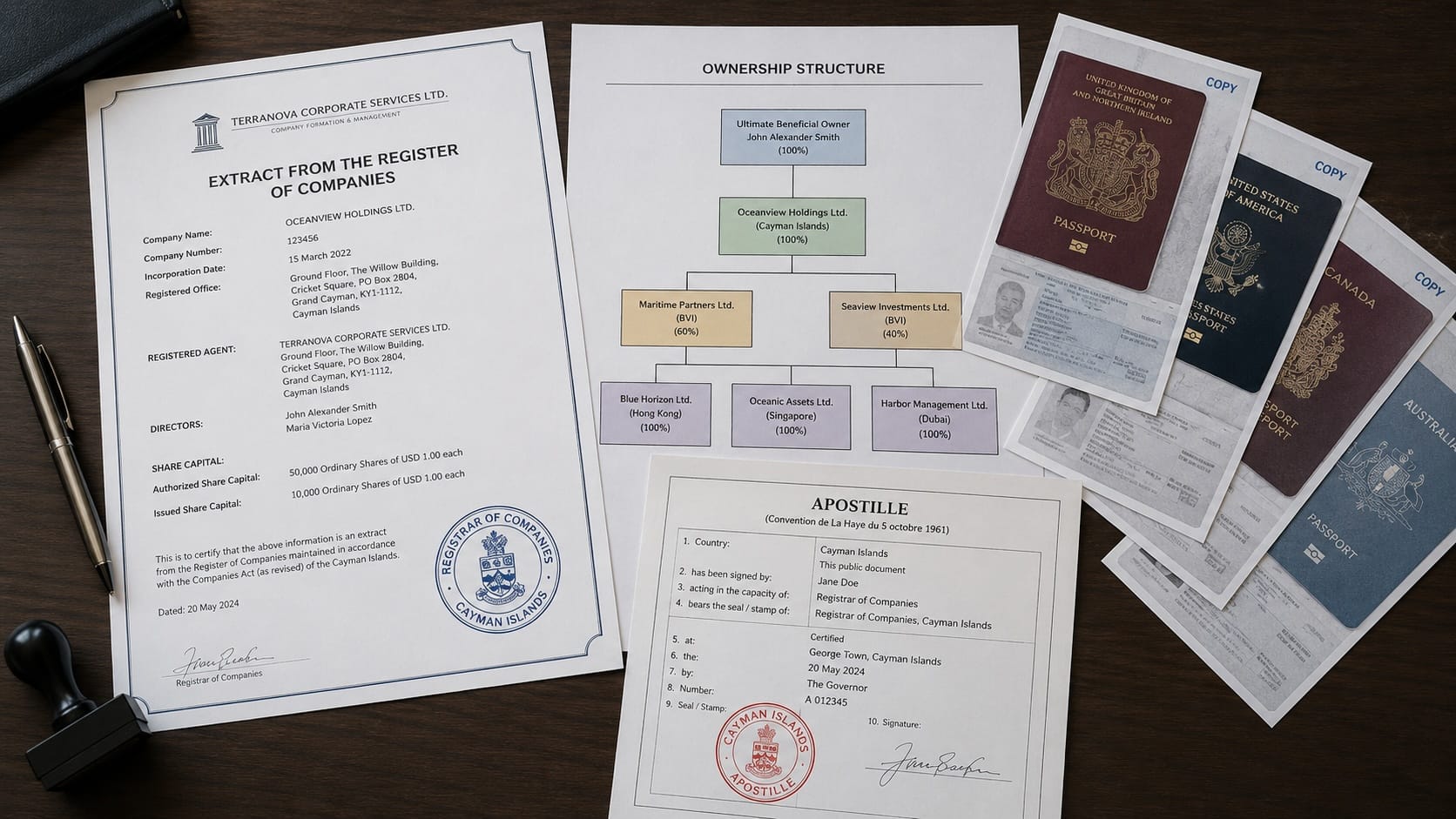
The corporate documentation package starts with what most applicants expect: commercial register extract, articles of association, certificate of incorporation. What surprises many applicants is what comes next. A full organisational chart showing the ownership structure to ultimate beneficial ownership level — meaning not just the immediate shareholders but every holding company, trust, or special purpose vehicle in the chain above them. The chart must identify every individual whose aggregate beneficial interest, direct or indirect, exceeds 25%. Each of those individuals then needs to provide a complete personal KYC package: certified passport, proof of address, TIN, and their own source-of-wealth documentation.
Corporate documents from outside Switzerland must typically be apostilled under the Hague Convention. This is the detail that most applicants discover after they’ve already submitted their initial package — and it adds time, because apostilles are issued by government authorities in your home country and can take days to weeks depending on the jurisdiction. The commercial register extract generally needs to be no more than three months old at the time of submission. If your corporate structure involves jurisdictions not party to the Hague Convention, you’ll need to confirm the authentication requirement directly with your target bank.
One thing worth flagging plainly: complex or multi-layered corporate structures — multiple holding companies, offshore SPVs, structures involving foundations or trusts — are not disqualifying, but they are time-consuming to document properly and they require a compliance team that is experienced with them. Not every Swiss bank has that experience, and submitting a complex corporate file to a bank that isn’t equipped to process it is a waste of months. If your company structure has more than two tiers of ownership, or involves a trust or foundation as an intermediate vehicle, work with a specialist to match your structure to the right institution before preparing any documentation. The Swiss business banking guide covers which institutions are better equipped for complex corporate onboarding.
The Compliance File Coherence Test: A Pre-Submission Framework
Before any document package goes to a Swiss bank, run it through five questions. These aren’t from any official FINMA checklist — they’re the questions a compliance officer will implicitly ask when reading your file, reversed so you can catch problems before submission. Finding a weakness at this stage costs you nothing. Finding it during review costs you weeks.
- Address alignment: Does every document in the file that shows an address point to the same address — or, if not, is the discrepancy explicitly explained by a cover note?
- Income-to-deposit ratio: Is the proposed opening deposit amount consistent with what your bank statements and income documents show about your financial position? A ratio of more than 5:1 (deposit to annual income) without explanation will trigger a plausibility flag.
- Source-of-wealth chain: Can you trace the proposed funds from their origin event (salary credit, business sale completion, property sale) through to a current account, with documents supporting every link in the chain?
- TIN consistency: Does the Tax Identification Number on your application match the TIN on any tax documents you’ve included? A mismatch — even from a clerical error — delays the AEOI reporting setup and holds the account open.
- Document recency: Are all time-sensitive documents (utility bills, bank statements, commercial register extracts, reference letters) dated within the bank’s required recency window — typically three months for personal documents, three months for corporate extracts?
If all five questions get a clean yes, your file is coherent. Submit it. If any question surfaces a gap, fix the gap before submission rather than hoping compliance won’t notice. They will notice — because the job of a Swiss EDD review is specifically to find exactly these kinds of inconsistencies. The banks’ reputation for rigour is built on this process. Work with it, not against it.
One final note on timing. If your application involves a Swiss business account opening that needs to be coordinated with company incorporation, the document recency requirements become more complicated — corporate register extracts have a three-month validity window, and if incorporation is delayed, documents submitted early may expire before the account review completes. Plan the sequencing carefully, and submit the application as close as possible to the moment your company registration is finalised.
Related reading:
Frequently Asked Questions
What documents do I need to open a Swiss bank account as a non-resident? +
Can I open a Swiss bank account online without visiting Switzerland? +
How important is source of wealth documentation compared to everything else? +
Does my nationality affect the documents I need to provide? +
How long does it take to open a Swiss bank account as a non-resident? +
What happens if my application is rejected? +
References
- FINMA — Supervision of Banks and Securities Firms (opens in new tab)
- Swiss National Bank — Banking Statistics 2025 (opens in new tab)
- esisuisse — Swiss Deposit Protection Scheme (opens in new tab)
- FATF — Jurisdictions Under Increased Monitoring (Grey List) (opens in new tab)
- OECD — Automatic Exchange of Financial Account Information (AEOI/CRS) (opens in new tab)