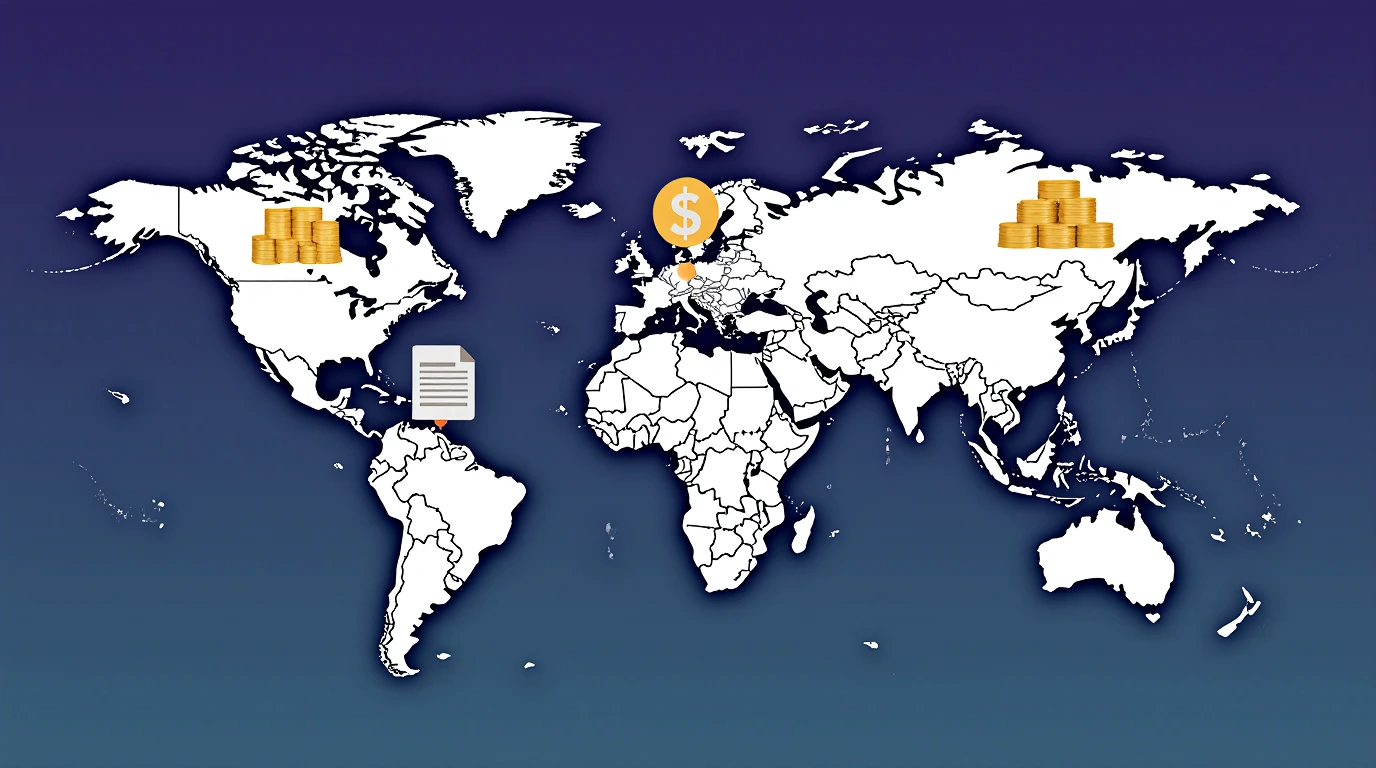
- Concentrating all wealth in one country exposes you to currency collapse, capital controls, asset freezes, and even direct military disruption—risks that have materialized repeatedly in 2025 and 2026.
- The 2026 Iran war wiped $120 billion off Dubai and Abu Dhabi stock markets in weeks, proving that even the world’s most celebrated “safe haven” for wealthy expatriates can face sudden, severe disruption.
- The Allianz 2026 Country Risk Atlas shows systemic vulnerabilities are now concentrated in major economies including the US, France, and China—not just emerging markets.
- International diversification across jurisdictions like Switzerland and Singapore reduces portfolio volatility by up to 67% during regional downturns.
- Establishing multi-jurisdiction banking now—before a crisis strikes—is the only reliable way to protect against capital controls, currency devaluation, and geopolitical shocks.
Picture this: you’ve spent decades building a comfortable financial cushion. Your savings, investments, and property all sit neatly within a single country’s borders. Then, almost overnight, geopolitical tensions escalate. Your government slaps on capital controls. The banking system buckles. Your currency nosedives. In one swift blow, the financial security you worked a lifetime to build evaporates—because every last cent was concentrated in one place.
This isn’t a far-fetched nightmare. In practice, wealthy individuals across the globe have already lived through exactly this scenario. Russian investors watched roughly €185 billion in private assets get frozen in European custody accounts when sanctions hit. Argentine families saw their peso-denominated savings lose over 40% of purchasing power during the 2023 currency crisis. In China, households that had parked an estimated 70% of their urban wealth in apartments found themselves trapped as property markets collapsed around them. And in February 2026, even Dubai—long marketed as the world’s premier safe haven for wealthy expatriates—saw its stock market plunge 16%, hotel bookings collapse over 60%, and over 220,000 foreign residents scramble to leave as conflict erupted across the Gulf. The sharpest recent argument for spreading custody across countries is corridor failure: as Vanuatu’s 2025 debanking showed, a solvent bank can lose its ability to move money overnight.
The lesson from these real-world catastrophes is straightforward: keeping all your wealth in a single country is one of the riskiest financial decisions you can make. Geographic diversification—spreading your assets across multiple jurisdictions, currencies, and banking systems—isn’t a luxury strategy reserved for the ultra-rich. It is a fundamental pillar of sound wealth preservation in 2026.
Understanding Country Risk: The Hidden Threat to Your Assets
Country risk refers to every economic, political, and financial threat that can erode your wealth simply because it is located within one nation’s borders. Unlike investment risk—where your personal choices determine outcomes—country risk strikes every asset holder in the affected jurisdiction at once, regardless of how shrewdly they’ve invested.
The Allianz 2026 Country Risk Atlas paints a nuanced picture. On one hand, global short-term country risk actually improved to “Medium” in 2025, with 36 economies receiving upgrades including Argentina, Italy, Spain, and Vietnam. On the other hand, systemic vulnerabilities are now clustering in the world’s largest economies. The United States, France, Belgium, and Brazil all saw their risk profiles deteriorate—and these nations collectively represent about a third of global GDP.
For individual savers, these macro-level risks become deeply personal when they materialize. Your bank account freezes. Your securities become inaccessible. Your property values crater. Your currency’s purchasing power melts away. In every case, these outcomes stem from decisions made by governments and central banks—forces completely outside your control.
The Real Cost of Concentration: Lessons from 2025–2026
Understanding country risk in the abstract is one thing. Seeing its devastating real-world consequences is another. Let’s examine what happened to investors who kept their wealth concentrated in a single jurisdiction.
Russia: Frozen Assets and Indefinite Lockouts
When geopolitical tensions escalated, approximately €185 billion in private assets held by Russian investors in European custody accounts became frozen within days. Contractual guarantees meant nothing when political decisions overrode them. Years later, many investors still cannot access their holdings. Those who had diversified across non-European jurisdictions—maintaining accounts in Singapore, the Middle East, or Latin America—retained far greater access to their wealth.
Argentina: Currency Collapse and Capital Traps
Argentina’s peso lost over 40% of its value in 2023 after years of fiscal mismanagement. However, the country’s risk profile has since improved dramatically. Deloitte’s 2026 global outlook notes that Argentina’s country risk ratings dropped from 2,500 basis points in late 2023 to approximately 600 by the end of 2025, reflecting serious fiscal consolidation. Still, the damage to peso-concentrated savers was already done. Those with diversified holdings in dollar-denominated accounts or best non-resident bank accounts in 2026 preserved their purchasing power through the crisis.
China: The Real Estate Trap
With roughly 70% of Chinese urban household wealth concentrated in property, the ongoing real estate downturn has been catastrophic for domestic savers. Property values have declined 20–40% in many markets. Meanwhile, households that had invested even a modest portion of their wealth internationally—through offshore equities, foreign currency accounts, or international real estate—maintained far more stable portfolio values.
The United States: Not Immune to Risk
Americans often assume their assets are inherently safe at home. However, the US dollar fell nearly 9% during 2025 against a basket of developed-market currencies—one of its sharpest declines in recent memory. Fidelity’s 2026 international stock outlook confirms the dollar still appears overvalued relative to both developed-market and emerging-market currencies, suggesting further depreciation may follow. Additionally, US federal debt climbed to 124% of GDP by 2025, a steep rise from 108% before the pandemic, raising long-term fiscal sustainability questions.
Dubai and the Gulf: When the “Safe Haven” Itself Becomes the Risk
Perhaps the most striking—and most current—example of concentration risk in 2026 is Dubai. For years, the emirate cultivated a reputation as the ultimate refuge for global wealth. Some $63 billion in private capital reportedly flowed into Dubai during 2025 alone, attracted by zero personal income tax, Golden Visa residency programs, and gleaming skyscrapers that projected an image of permanence and security. The city was home to 237 centimillionaires and more than 20 billionaires. It felt untouchable.
Then, on February 28, 2026, the US and Israel launched coordinated military operations against Iran. Iran retaliated across the Gulf—and Dubai, despite not being a party to the conflict, found itself directly in the crossfire.
The fallout was immediate and devastating across every sector. Iranian drones and missiles struck near iconic landmarks including Dubai International Airport, Burj Al Arab, and Palm Jumeirah. The Dubai Financial Market suspended trading for two consecutive sessions—an almost unprecedented step. When markets reopened, the DFM General Index plunged nearly 16% within weeks, while $120 billion was erased from Dubai and Abu Dhabi stock exchanges combined. Hotel bookings collapsed by over 60%. More than 80% of flights through the world’s busiest international airport were cancelled, with over 4,000 daily flight cancellations across Gulf states stranding hundreds of thousands of passengers.
The real estate market—Dubai’s crown jewel—also felt the tremor. While completed property prices have held relatively steady, residential transactions slowed sharply as international buyers paused. Off-plan launches were postponed. Fitch Ratings had already predicted a 15% correction before the conflict even began, and UBS had ranked Dubai as having the fifth-highest property bubble risk of 21 major cities globally. Expatriate departures now threaten to add further downward pressure.
However, here’s where the Dubai story becomes a powerful lesson in diversification rather than a simple cautionary tale. Despite the severe short-term shock, Dubai’s underlying economic structure has shown resilience precisely because the emirate itself diversified away from oil decades ago. Oil contributes less than 1% of Dubai’s GDP. Trade and logistics, financial services, technology, and tourism collectively drive the economy. Dubai’s Department of Economy and Tourism still projects 4.5% growth for 2026—far above the global average. The government quickly deployed a Dh1 billion economic support package to stabilize businesses.
The takeaway isn’t that Dubai is a bad place to hold wealth—it isn’t. The takeaway is that no single jurisdiction, no matter how well-managed, can guarantee immunity from external shocks. Investors who held 100% of their assets in Dubai real estate and UAE stocks suffered devastating short-term losses. Those who maintained diversified positions across Switzerland, Singapore, and other jurisdictions watched the crisis unfold without existential financial anxiety. Their Dubai holdings may recover—but their overall wealth was never at risk.
Dubai’s own resilience story is, in fact, a master class in diversification at the national level. The emirate diversified its economy away from oil, and that diversification is now paying off. Individual investors should take the same approach with their personal wealth: spread it across jurisdictions so that no single geopolitical event—no matter how unexpected—can devastate your financial future.
The Geopolitical Reality: Why Every Jurisdiction Carries Risk
In 2026, no single country—no matter how developed or how carefully marketed—offers a completely risk-free environment for your wealth. The Iran war that erupted in late February 2026 has driven this point home with unprecedented clarity. Cities like Dubai, Doha, and Riyadh—which had spent decades building reputations as stable global business hubs—found themselves exposed to direct military disruption for the first time since the Gulf War era.
The transmission channels in this conflict operated through every mechanism simultaneously. The Strait of Hormuz, through which roughly one-third of the world’s crude oil, methanol, and fertilizer exports pass, became a flashpoint. Airlines including Emirates, Etihad, and Qatar Airways suspended all operations. Airspace closures across six Gulf states led to over 4,000 daily flight cancellations. European gas benchmarks nearly doubled as the crisis coincided with historically low storage levels. Oil spiked above $110 per barrel. Gulf stock markets splintered—Saudi Arabia’s Tadawul rose 5.8% on energy gains while Dubai’s DFM crashed 16%.
This divergence within the same region illustrates a crucial point: even neighboring countries experience crises differently. Geographic diversification works not because it eliminates risk entirely, but because different jurisdictions respond to shocks in different ways. Saudi investors concentrated in energy benefited. UAE investors concentrated in real estate and tourism suffered. Those diversified across both—and beyond the region entirely—weathered the storm.
BlackRock’s 2026 Investment Outlook captures the broader mood: traditional diversifiers like long-term Treasuries no longer offer the portfolio ballast they once did, as elevated government debt keeps yields high. In this environment, investors need conviction in distinct return drivers—whether in hedge funds, private markets, gold, or deliberate geographic positioning—rather than relying on correlations that have weakened over time.
For investors concentrated in a single country, these geopolitical forces create layered risks. Your stock portfolio declines as markets react. Your currency weakens as capital flees. Your banking access narrows as regulators tighten controls. And your real estate holdings lose value as foreign buyers retreat. Each of these effects compounds the others, creating a downward spiral that concentrated investors cannot escape.
Currency Devaluation: The Silent Wealth Destroyer
Among all country risks, currency devaluation may be the most insidious. Unlike a dramatic banking crisis or sudden asset freeze, currency erosion operates quietly—steadily reducing your purchasing power month by month until your savings buy a fraction of what they once could.
The US dollar offers a powerful 2025–2026 case study. As Fidelity’s analysts note, the dollar declined roughly 9% in 2025 against developed-market currencies, with further room to fall given continued overvaluation. For Americans holding 100% dollar-denominated assets, this translates directly into diminished international purchasing power. A European investor holding euros during the same period effectively gained significant relative value—without making a single active investment decision.
Emerging-market currencies face amplified risks. When geopolitical uncertainty spikes, investors flee local currencies en masse. Central banks attempt to defend exchange rates through interest rate hikes and reserve deployment, but eventually the dam breaks. Those holding diversified currency portfolios through multi-currency Swiss bank accounts or Singapore bank accounts preserve real value. Those concentrated in devaluing currencies lose massively.
Home Bias Exposure: How Concentrated Are Investors by Region?
Consider a practical example. A Brazilian investor with 1 million reais (approximately €165,000) in 2020 would have seen currency depreciation alone reduce that to roughly €130,000 by 2023—a loss of €35,000 without any negative investment performance. Had that same investor held even 40% of assets in dollar- or euro-denominated accounts, the currency diversification would have offset most of those losses.
Capital Controls: When Governments Trap Your Money
Capital controls are perhaps the most frightening form of country risk because they eliminate your ability to move money freely. When a government perceives economic crisis or currency flight, it restricts—or outright prohibits—international transfers, currency conversions, and cross-border transactions.
An IMF working paper published in January 2026 confirms what practitioners already know: countries implement and liberalize capital controls opportunistically, often in response to macroeconomic crises. The paper tracked capital flow restrictions across 190 countries from 1999 to 2022, revealing cyclical patterns where controls tighten precisely when citizens most need access to their money.
Argentina’s experience illustrates this vividly. During its currency crisis, authorities progressively tightened capital controls until international transfers were capped at just $10,000 per month. Citizens with millions in savings could access only tiny fractions of their wealth for international purposes. Individuals who had established foreign bank account succession planning before the controls hit faced far fewer restrictions—their assets were already positioned beyond the government’s reach.
Russia’s post-2022 controls demonstrated how quickly restrictions can escalate. International brokerage accounts became inaccessible. Currency conversions were frozen. Dollar transfers faced severe limitations. And Cyprus’s 2013 banking crisis proved that even EU member states can impose capital controls, deposit freezes, and daily withdrawal limits that persist for years.
Banking Crises: Systemic Risk That Crosses Borders
While global banking crisis probability has declined from pandemic-era peaks, significant vulnerabilities persist—particularly in the world’s second-largest economy. China faces elevated banking crisis risk due to persistently high leverage, an unresolved real estate downturn, and weakening household confidence.
A Chinese banking crisis would not stay contained within China’s borders. Global equity markets would suffer through exposure to Chinese companies and financial institutions holding Chinese assets. Commodity prices would decline sharply as manufacturing demand collapses. Real estate valuations worldwide would shift as capital flows are disrupted. And currency markets would experience severe volatility.
For individuals concentrated in a single country’s banking system, a systemic crisis creates potentially catastrophic outcomes. Deposits become inaccessible for months or years during resolution. Cyprus’s experience showed how banking crises trigger forced haircuts on uninsured deposits, prolonged account freezes, and strict transaction limits.
Those with internationally diversified banking relationships, however, experience containment. If their home country faces a banking crisis, their international assets remain safe and accessible. They can sustain their lifestyle through foreign accounts while waiting for domestic recovery. They retain financial flexibility when their neighbors are trapped. Understanding how modern bank resolution regimes work—and how to structure around them—is increasingly critical knowledge for wealth preservation.
Why International Diversification Is the “Only Free Lunch” in Investing
Modern portfolio theory founder Harry Markowitz famously called diversification “the only free lunch in investing.” In 2026, this principle extends well beyond mixing stocks and bonds. Geographic diversification—spreading your wealth across multiple countries, currencies, and banking systems—provides benefits that no amount of domestic asset allocation can replicate.
The data in 2026 strongly supports this approach. Morningstar’s analysis confirms that international stocks outperformed US equities in 2025 and have continued doing so in early 2026. iShares data shows investors channeled $32 billion into emerging market equity ETFs in just the first eight weeks of 2026—with single-country ETF flows already surpassing full-year 2025 totals. And Kiplinger’s 2026 assessment argues bluntly that the greatest risk facing investors today is concentration risk, not market risk.
The mathematical foundation is elegantly simple: returns across different countries rarely correlate perfectly. When one nation experiences a crisis, others continue performing well. A portfolio fully invested in European equities might suffer 15% losses during a regional slowdown. The same investor with 50% European, 30% US, and 20% Asia-Pacific allocation would experience only about 5% overall decline—a 67% reduction in losses—through geographic diversification alone.
Strategic Diversification: Where to Position Your Wealth
Effective geographic diversification goes far beyond buying a foreign stock ETF. It requires deliberate positioning of assets across jurisdictions with different risk profiles, regulatory frameworks, and economic drivers.
| Jurisdiction | Key Strengths | Currency | Best For | Key Risks |
|---|---|---|---|---|
| Switzerland | Political stability, banking privacy, strong legal protections | CHF | Wealth preservation, multi-generational planning | High minimums, regulatory complexity |
| Singapore | Asia-Pacific gateway, strict AML framework, tax efficiency | SGD | Asia exposure, active trading, corporate banking | High onboarding standards, geographic distance |
| United States | Deep liquidity, innovation-driven markets, global reserve currency | USD | Equity exposure, technology sector access | Rising debt, currency depreciation risk, fiscal deficits |
| Dubai/UAE | Zero income tax, Golden Visa residency, diversified economy, high rental yields | AED (USD-pegged) | Tax optimization, real estate, Middle East gateway | Regional conflict exposure (2026 Iran war), dollar-peg inflation risk |
| European Union | Value opportunities, regulatory oversight, lower valuations | EUR | Diversified industrial exposure, defensive positioning | Fiscal slippage in major economies, political fragmentation |
| Emerging Markets | Growth potential, improving governance, currency diversification | Various | Capital appreciation, demographic tailwinds | Higher volatility, governance variability |
Goldman Sachs Research highlights that investments in emerging market assets, gold, or safe-haven currencies like the Swiss franc can meaningfully reduce US-dollar risk. Emerging market assets are negatively correlated with the US currency, providing natural hedging benefits. Meanwhile, BlackRock recommends maintaining conviction in distinct return drivers—including private markets, hedge funds, and deliberate geographic positioning—rather than spreading risk indiscriminately.
The UBS Global Family Office Report reinforces this principle with striking data: family offices in emerging markets allocate only 12% domestically, investing 88% internationally. They understand country concentration risk intimately. In contrast, US family offices maintain an 86% domestic allocation—a level of concentration that, given current fiscal and geopolitical realities, may prove dangerously high.
Currency Hedging and Multi-Denomination Strategy
Geographic diversification must be accompanied by deliberate currency positioning. Holding assets in multiple currencies provides an additional layer of protection that pure market diversification cannot match.
Hard currencies like the Swiss franc, euro, and Japanese yen tend to appreciate when global uncertainty spikes—precisely when you need protection most. Non-correlated currencies such as the Australian dollar and select emerging-market currencies provide additional diversification, often strengthening alongside commodity prices or when geopolitical tensions specifically affect major currency zones.
Multi-currency banking makes this practical. Services like Easy Global Banking facilitate holding USD, EUR, GBP, CHF, SGD, and JPY simultaneously within individual accounts, eliminating forced currency conversions and dramatically reducing devaluation exposure. The core principle is never to hold 100% of your assets in a single currency. With monetary policies diverging sharply across central banks, some currencies will strengthen while others weaken. Diversification ensures you benefit from the winners while limiting damage from the losers.
Building Your Diversification Strategy: A Step-by-Step Approach
Converting diversification theory into practice requires a systematic, disciplined approach. Here’s how seasoned wealth advisors structure the process for their clients.
Step one: Audit your exposure. Document every asset you own by country and currency. Calculate what percentage of your total wealth resides in each jurisdiction. From real-world client experience, most individuals discover they hold 70–90% of their total wealth in their home country—far higher concentration than they assumed.
Step two: Plan your target allocation. Conservative investors typically target 20–30% international exposure. Balanced profiles aim for 40–50%. More aggressive diversifiers pursue 60% or higher. Morningstar’s 2026 diversification checklist recommends international stocks represent 20–40% of equity holdings as a baseline, with no single sector exceeding 25% of stock holdings.
Step three: Implement through multi-jurisdiction accounts. This means establishing banking relationships in stable jurisdictions with different risk profiles. Swiss banking provides unmatched stability and legal protections. Singapore banking offers Asia-Pacific gateway access and excellent regulatory frameworks. Combining both creates a resilient two-pillar foundation for international wealth positioning.
Step four: Manage currencies deliberately. If you earn in euros, reduce euro concentration by holding portions of your wealth in USD, CHF, and SGD. If you earn in dollars, establish positions in euros and Swiss francs. The objective is to ensure that no single currency’s decline can devastate your overall wealth.
Step five: Rebalance and monitor. Country risks are dynamic. The Allianz atlas tracks quarterly changes across 83 economies. Your diversification strategy should evolve with shifting conditions—rebalancing ensures your allocation remains aligned with current risks and opportunities.
Professional advisors who specialize in international diversification significantly accelerate this process while reducing costly errors. International banking specialists like Easy Global Banking homepage help establish accounts, navigate regulatory requirements, and position assets across jurisdictions with institutional-grade compliance support.
The Consequences of Inaction: What Concentrated Investors Lost
The cost of maintaining single-country concentration only becomes visible when crisis actually arrives. By then, it is too late to diversify.
Russian investors concentrated in European holdings lost access to €185 billion—with many still locked out years later. Chinese households concentrated in domestic real estate watched 20–40% of their primary wealth source evaporate. Argentine savers concentrated in pesos experienced devastating purchasing power loss. American investors concentrated entirely in dollar assets saw their international purchasing power erode by nearly 9% in 2025 alone. And wealthy expatriates who had concentrated everything in Dubai—real estate, stocks, business operations—watched $120 billion vanish from UAE markets in weeks when the Iran war erupted, with no warning and no time to react.
The pattern is unmistakable. Those who maintained geographic concentration suffered catastrophic losses. Those who had diversified internationally—even modestly—preserved their wealth. As a practical matter, planning for cross-border wealth also includes ensuring that your heirs can access international accounts. Understanding what happens to foreign bank accounts in estate situations is an essential component of any serious diversification strategy.
Looking Forward: Why 2026 Demands Action Now
The convergence of multiple risk factors in 2026 creates an unusually urgent case for international diversification. The Iran war has shattered the perception that Gulf cities are permanently safe destinations for expatriate wealth—a narrative that attracted $63 billion to Dubai in 2025 alone. Allianz’s Country Risk Atlas confirms that while many economies have strengthened their shock-absorption capacity, systemic vulnerabilities are becoming more concentrated in a smaller number of influential markets—including the US, France, and several major emerging economies.
Corporate defaults are expected to reach levels 24% above pre-pandemic averages by 2026. US federal debt continues its steep climb. The Middle East conflict has disrupted global energy markets and shipping routes. Currency markets show persistent instability. And banking stress, particularly in China, remains a live risk. The Gulf conflict has also triggered a second energy crisis for Europe, with gas benchmarks nearly doubling as the war coincided with low storage levels.
These conditions create a narrowing window. Those who diversify today position themselves with international accounts already operational, assets already spread across jurisdictions, currencies already diversified, and banking relationships already established. Those who wait until the next crisis erupts will discover what Russian, Argentine, Chinese, and now Dubai-concentrated investors have already learned: once a crisis begins, the doors to diversification slam shut. Charter jets sell out. Bank account openings freeze. Transfer systems stall. The time to act is now.
Frequently Asked Questions About International Asset Diversification
Most financial research recommends 20–40% of your equity holdings in international stocks as a baseline. Conservative investors might target 20–30% total international exposure, while balanced profiles aim for 40–50%. The right allocation depends on your income currency, risk tolerance, and time horizon. The key principle is that any international diversification reduces single-country risk significantly—even modest allocations of 15–20% make a meaningful difference during regional crises.
Yes, holding foreign bank accounts is entirely legal in most developed countries, provided you comply with relevant reporting requirements. US citizens, for example, must file a Report of Foreign Bank and Financial Accounts (FBAR) if combined foreign account balances exceed $10,000 at any point during the year. Under AEOI and CRS frameworks, banks automatically report account information to your home country’s tax authority. Compliance is straightforward—international banking is legal and legitimate.
Switzerland and Singapore consistently rank among the most stable jurisdictions for international wealth holding. Switzerland offers strong legal protections, political neutrality, and a currency (CHF) that functions as a safe-haven asset. Singapore provides access to Asia-Pacific markets, strict regulatory oversight from the Monetary Authority of Singapore, and tax-efficient structures. A combined approach—holding assets in both jurisdictions—creates a diversified banking foundation across two independent financial systems.
Capital controls can severely limit or completely prevent international money transfers, currency conversions, and cross-border transactions. Argentina capped international transfers at just $10,000 per month during its crisis. Russia made foreign currency transactions nearly impossible after 2022. Cyprus imposed daily cash withdrawal limits that lasted for years. The critical takeaway is that capital controls are typically implemented without advance warning, making pre-crisis diversification the only reliable protection. Once controls are in place, it becomes extremely difficult to move wealth internationally.
While global market correlations increase during severe crises, geographic diversification continues to provide meaningful benefits. Different countries recover at different speeds, currencies move in varied directions, and banking systems in stable jurisdictions remain operational even when others fail. As Morningstar notes, international stocks outperformed US stocks in both 2025 and early 2026 during the “anti-AI” rotation. Moreover, diversification across banking jurisdictions—not just investment markets—ensures you retain access to your funds even if your home banking system faces a crisis.
Dubai remains a significant global financial hub with strong fundamentals—its diversified economy, zero personal income tax, and projected 4.5% GDP growth for 2026 still make it attractive. However, the Iran war exposed a critical vulnerability: proximity to regional conflict can disrupt even the most carefully built safe-haven reputation. The DFM plunged 16%, hotel bookings dropped over 60%, and tens of thousands of expatriates departed. The lesson isn’t to avoid Dubai entirely—it’s to avoid concentrating all your wealth there or in any single jurisdiction. Using Dubai as one node in a multi-jurisdiction strategy alongside Switzerland, Singapore, or other stable banking centers provides the benefits of Dubai’s tax and business environment while mitigating regional conflict risk.