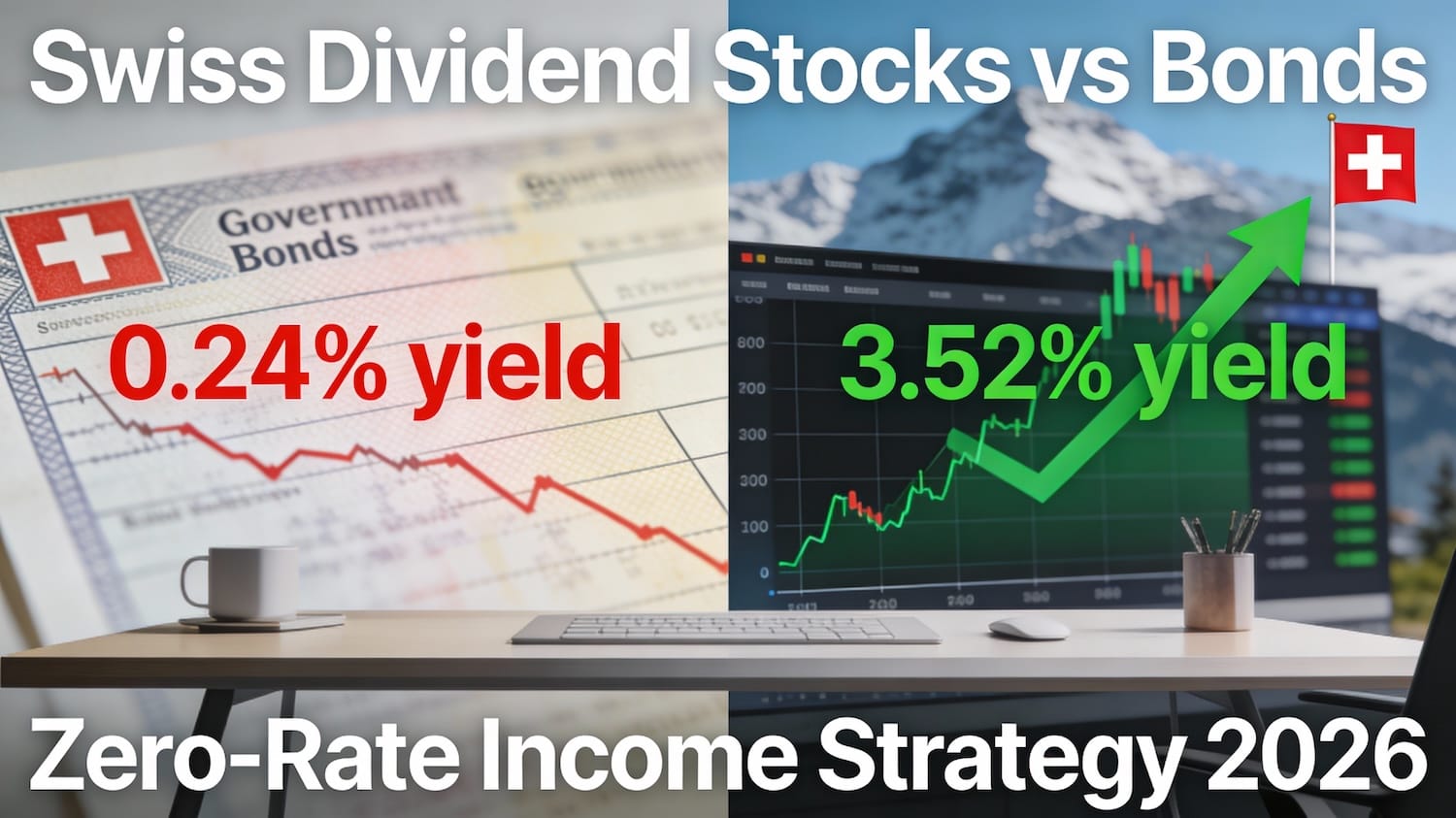
The Swiss financial landscape has become brutally clear in 2026: traditional safe investments no longer deliver returns. A 10-year Swiss government bond yields 0.24%. CHF corporate bond ETFs deliver 1.20%. Zero-interest deposit accounts offer nothing. For investors seeking genuine income while preserving capital, this environment forces an uncomfortable but unavoidable choice: either accept real return erosion or accept equity-like volatility in carefully selected dividend stocks and real estate funds.
There is no middle ground in Switzerland’s zero-rate economy.
The Brutal Math: Why Bonds Cannot Be Your Answer
Let me be direct about the numbers. If you hold CHF 100,000 in deposits earning 0% interest, you lose purchasing power at the rate of Swiss inflation—currently 0.10% year-over-year, but the SNB projects 0.3% for 2026. Over a decade, that CHF 100,000 becomes worth CHF 99,700 in real terms.
If you move that same CHF 100,000 into Swiss government bonds at 0.24% yield, you earn CHF 240 annually. After inflation of 0.3%, your real return is negative: -0.06% per year. After a decade, inflation erodes more than your coupon generates.
The only response available to serious investors is to deploy capital into dividend-paying equities where yields of 3.6–5.0% dwarf inflation expectations. Yes, this means accepting portfolio volatility. But the alternative—mathematical wealth erosion through negative real returns—is worse.
The Dividend Stock Foundation: iShares Swiss Dividend ETF
The most straightforward entry point for CHF dividend exposure is the iShares Swiss Dividend ETF (CHDVD). Rather than selecting individual stocks, this fund tracks the 20 largest Swiss dividend-paying companies, providing instant diversification and professional rebalancing.
Core Metrics (as of January 2026):
| Metric | Value |
|---|---|
| Dividend Yield | 3.52% |
| 1-Year Return | 18.56% |
| 3-Year Annualized Return | 12.64% |
| Maximum Drawdown (5-year) | -14.96% |
| Expense Ratio (TER) | 0.15% |
| Distribution Frequency | Quarterly |
| Typical Holdings | 20 companies |
The fund’s composition reveals its defensive characteristics. It doesn’t hold speculative growth companies—it holds Swiss companies with demonstrated pricing power and institutional commitment to shareholder returns. The three largest holdings are Zurich Insurance (14.84% weight), Nestlé (14.54%), and Swiss Re (9.77%). These are not high-growth technology names; they’re defensive businesses with recurring revenue and stable cash flows.
The PRIIIPS stress scenario (the regulatory baseline for downside stress testing) shows that under adverse conditions, a CHF 10,000 investment could fall to CHF 7,030 after one year in a severe market stress event. However, in moderate scenarios (which reflect typical market conditions), that same CHF 10,000 grows to CHF 14,870 over five years—an 8.3% annualized return.
The Reality of Drawdown: The -14.96% maximum drawdown occurred in March 2020 during the COVID-19 acute phase. For investors with 10+ year investment horizons, this represents a temporary paper loss, not permanent capital destruction. The fund recovered all losses within 18 months.
The Dividend Aristocrats Behind the ETF
Rather than treat CHDVD as an abstract index, understanding the companies that drive returns is important.
Zurich Insurance Group trades at 4.4% dividend yield (January 2026) with a formal 75% payout policy, meaning the company distributes three-quarters of net profit to shareholders while retaining one-quarter for growth. The dividend has grown from CHF 17.00 per share in 2016 to CHF 28.00 in 2025—a 5.0% compound annual growth rate. This is not aggressive growth, but it is predictable, institutional-grade capital return.
Nestlé maintains the longest consecutive dividend growth streak among large Swiss companies, with annual increases sustained across multiple decades. Current yield is approximately 3.0%, with earnings growth expected at 2–3% annually. For investors seeking the most conservative exposure to Swiss blue-chip growth, Nestlé is the default choice.
Swiss Life Holding achieved the highest relative dividend growth, with a 21% compound annual growth rate over the past decade. At current yields of 4.5–5.0%, this reflects both yield growth and share price appreciation. Swiss Life’s business model—asset management, insurance, and life insurance—generates recurring revenue with minimal cyclicality.
Swisscom is the domestic telecommunications oligopoly with limited competitive threats. The dividend yield stands at 3.62%, with the company maintaining strict dividend discipline despite mature revenue growth. For income investors, Swisscom represents the stability of essential infrastructure investment.
Real Estate Funds: The Tax-Efficient Alternative With Lower Drawdown
Swiss real estate investment funds (REITs) occupy an unusual niche in the global investment landscape. They combine yield levels comparable to dividend stocks (3.0–3.5%) with lower volatility and a critical tax advantage: distributions are exempt from the 35% dividend withholding tax that applies to corporate dividends.
This tax exemption creates a tangible cash-flow benefit. Compare two CHF 100,000 investments:
| Investment | Annual Distribution | Withholding Tax | Net Cash Received | Tax Advantage |
|---|---|---|---|---|
| CHDVD (3.52% yield) | CHF 3,520 | CHF 1,232 (35%) | CHF 2,288 | — |
| Real Estate Fund (3.3% yield) | CHF 3,300 | CHF 0 | CHF 3,300 | CHF 77/year |
Over a 20-year investment horizon, that CHF 77 annual advantage compounds. While not transformative on a single year, it becomes material over decades.
Current Fund Performance (FY 2024–2025):
Dominicé Swiss Property Fund delivered an exceptional 6.38% investment return in fiscal year 2024–2025 (ending June 2025), with dividend raised to CHF 3.20 per unit. The fund focused acquisition strategy—17 strategic property purchases across Lake Geneva region—generated CHF 10 million in incremental annual rental income. Year-to-date performance through October 2025 reached 15%, substantially exceeding the 6.5% sector average.
Patrimonium Swiss Real Estate Fund maintains consistent performance with CHF 3.70 annual dividend distribution and a 5.32% return on investment (ROI). The fund pursues a disciplined strategy focused on Western Switzerland residential real estate where rental demand structurally exceeds supply. Share price premium to net asset value (NAV) sits at 16.71%, suggesting the fund maintains reasonable valuation relative to underlying property values.
Risk Profile vs. Equity: During the 2008–2009 financial crisis, Swiss real estate funds experienced approximately -8% to -12% drawdowns compared to general equity markets’ -40%+ declines. This 70% cushion in downside protection reflects the fundamental nature of real assets—they cannot be destroyed or abandoned. Real estate has intrinsic value grounded in shelter, not trading momentum.
Liquidity Constraint: Unlike publicly traded stocks, real estate fund shares trade on the SIX Swiss Exchange with constrained liquidity. Position sizing should assume 2–5 day settlement for trades exceeding CHF 100,000 and bid-ask spreads of 1–2%. For strategic buy-and-hold investors with 10+ year horizons, this friction is immaterial. For tactical traders, it represents a material cost.
Why Government Bonds Are Objectively Wrong for Income
The counterargument always emerges: “Bonds are safe. Why take equity risk?”
The answer is mathematical. A Swiss 10-year government bond yielding 0.24% provides capital certainty but not return certainty. Over a 10-year holding period, you receive CHF 240 in annual interest on a CHF 100,000 investment. Inflation at 0.3% annually erodes CHF 300 of purchasing power. You’ve locked in negative real returns.
Advocates for bonds sometimes argue for capital appreciation if interest rates decline further. However, SNB Chairman Martin Schlegel has explicitly stated that negative interest rates are not being considered, meaning rates are unlikely to move materially lower. The scenario that generates bond capital gains (unexpected rate cuts) is off the table.
The investment verdict is unavoidable: for investors with income needs, bonds are not an alternative to equities in 2026 Switzerland. They are an erosion of wealth disguised as safety.
Currency Positioning: USD/CHF Dynamics
For investors holding USD assets or considering USD-denominated investments, the CHF positioning creates an additional tailwind. The USD/CHF pair has traded toward historical weakness, with the 10-year expectation favoring CHF appreciation. By holding CHF-denominated dividend stocks and real estate, investors capture both:
- Dividend yield: 3.5–4.0% annually
- Currency appreciation: 2–3% annually if USD weakness persists
This dual return stream—combining yield and currency appreciation—creates total return potential of 5.5–7.0% over the medium term, substantially above the 0.24% available from bonds.
Portfolio Construction: A Pragmatic Allocation
For investors with moderate risk tolerance seeking real returns, a three-pillar structure addresses capital preservation alongside income generation.
Allocation Framework:
| Asset Class | Weight | Expected Yield | Risk Characteristics |
|---|---|---|---|
| iShares Swiss Dividend ETF (CHDVD) | 50% | 3.52% | Moderate drawdown (-15% max), daily liquidity |
| Real Estate Funds (Dominicé or Patrimonium) | 30% | 3.3% | Lower drawdown (-8% est.), constrained liquidity |
| CHF Corporate Bonds (iShares CHCORP) | 15% | 1.20% | Minimal drawdown, daily liquidity |
| Cash/Emergency Reserve | 5% | 0% | Zero drawdown, instant liquidity |
This blended portfolio generates approximately 2.8–3.0% yield—12 times superior to zero-rate deposits. Portfolio maximum drawdown during equity market stress would approximate -11% to -12%, substantially less severe than a pure equity allocation.
Rebalancing discipline matters more than asset selection. By automatically selling winners (dividend stocks that appreciate) and buying underperformers (bonds that decline in value when rates rise), rebalancing forces the discipline of “buy low, sell high” without emotional decision-making.
The Withholding Tax Mechanism: What Actually Happens
Swiss dividend income triggers a 35% anticipatory tax (withholding tax) deducted at source. This creates confusion among investors about whether taxes “are taken” or “recoverable.” The reality: both are true sequentially.
When Nestlé pays a CHF 10 dividend, Swiss banks deduct CHF 3.50 withholding tax and deposit CHF 6.50 to the shareholder’s account. At tax return time, the full CHF 10 dividend is declared as income. The withholding tax is then claimed as a credit against total tax liability. For most Swiss tax residents, this results in a full refund of the CHF 3.50.
The withholding tax thus functions as an advance payment mechanism, not a permanent tax burden. However, it does create a cash-flow timing mismatch: you receive net proceeds immediately but recover the tax at the following year’s filing.
Real estate fund distributions, by contrast, are exempt from withholding tax entirely, meaning you receive the full distribution immediately.
External Validation: SNB’s Official Stance
The Swiss National Bank has explicitly acknowledged the low-rate environment and provided guidance on savings. SNB communications confirm:
- Policy rate remains at 0% and will stay anchored through 2026
- Inflation projections: 0.3% (2026) and 0.6% (2027)
- Neither rate cuts nor rate increases are warranted in current conditions
This confirms that bond yields will remain anchored at 0.24% (10-year) and will not provide positive real returns. The SNB’s own projections validate the strategic choice: dividend equities are the only asset class generating real income.
The Honest Risk Admission
I would be negligent not to state the genuine risks:
Market Drawdown Risk: A severe market correction (2008-style) would create -40% to -50% drawdowns even in dividend equity portfolios. If you require access to capital within 2–3 years, this risk is real and material.
Dividend Cut Risk: If economic conditions deteriorate severely, even dividend aristocrats may reduce payouts. Swiss companies maintain strong balance sheets, but this risk never reaches zero.
Real Estate Liquidity Risk: If you need to liquidate a real estate fund position quickly, you may face 1–2% bid-ask spreads and 2–5 day settlement delays. This is not emergency-liquidity suitable.
Inflation Risk: If Swiss inflation accelerates unexpectedly above current SNB projections, the 3.5–4.0% yields may fail to keep pace, creating negative real returns.
These risks are real. They are not arguments against the strategy; they are arguments for sizing positions appropriately to your risk tolerance and time horizon.
The Decision Framework
With a 10+ year investment horizon, you can tolerate -15% portfolio drawdowns in exchange for 3.5–4.0% annual yield, making dividend equities the mathematically superior choice to zero-rate deposits or 0.24% government bonds.
A 5–10 year timeline demands more stability. The three-pillar allocation (50% dividends, 30% real estate, 15% bonds, 5% cash) provides a balanced framework that sacrifices some yield for meaningful downside protection.
Capital requirements within 2–3 years shift the calculus entirely. Accepting near-zero returns through bonds or cash becomes rational—the downside protection exceeds the opportunity cost of foregone dividend income.
The real question isn’t whether dividend stocks are “safe.” It’s whether the real return opportunity justifies accepting equity-like volatility. In Switzerland’s zero-rate environment, the mathematical answer is unambiguous: yes.
Here’s what matters most: In a zero-rate economy, refusing to accept equity risk is simply choosing a different risk—the risk of wealth erosion through inflation. The only choice available is which risk you’ll consciously accept.