
From Seychelles’ historic EU grey list removal to US crypto legislation and the collapse of IRS enforcement, the global financial architecture has been fundamentally redrawn. Here is the definitive briefing.

1. The Double-Green Jurisdictional Shift: Seychelles & Cayman Redefine Tier-1 Status
The offshore financial world has long operated on a spectrum of compliance credibility — with greylists, blacklists, and informal rankings determining which jurisdictions attract serious institutional capital. In early 2026, that spectrum was redrawn decisively, with two jurisdictions achieving what analysts are now calling “double-green” status: full compliance credibility paired with active regulatory innovation.
Seychelles: The Most Significant Offshore Headline of 2026
On February 13, 2026, the Financial Action Task Force (FATF) confirmed that Seychelles would remain off the AML/CFT grey list. Four days later, on February 17, 2026, Seychelles was formally removed from the EU’s “Annex II” — the so-called grey list of jurisdictions subject to enhanced due diligence. Together, these two milestones represent the most consequential offshore regulatory development in the first half of 2026.
The practical significance is enormous. Correspondent banking relationships that were strained or severed due to grey-list exposure are now eligible for restoration. EU-based institutions that applied automatic EDD to Seychelles-linked transactions can now reassess those cost-intensive procedures. For businesses operating through Seychelles corporate structures, the reputational and operational costs of grey-list association have been lifted.
Why this matters for your offshore strategy: Seychelles removal from the EU grey list is not merely symbolic. It directly reduces compliance friction for European counterparties, reopens correspondent banking pathways, and reinforces Seychelles as a credible incorporation and licensing hub — not a jurisdiction of last resort.
This achievement follows years of capacity-building coordinated through the OECD Global Forum’s tax transparency program, which reached new heights in 2025. Seychelles’ success is a case study in how a small island jurisdiction can leverage international technical assistance to transform its regulatory standing.
The Death of Nominee Directorships
Alongside its grey-list removal, Seychelles has implemented structural reforms that signal the end of the old offshore playbook. The Securities (Amendment) Act, 2024, effective in early 2025, now requires all licensed firms to have at least two full-time resident personnel — directors or compliance officers — physically based in Seychelles. This effectively terminates the use of nominee directorships as a substance-free compliance workaround. Offshore structures that relied on absent nominators providing a registered address and signature service are no longer viable for licensed entities.
This aligns Seychelles with the OECD’s BEPS Action 5 on “substantial activities” and mirrors requirements already implemented in the BVI, Cayman, and Malta. The message is clear: presence must be real, not performed.
Feb 13
FATF confirmation — Seychelles remains off AML/CFT grey list, 2026
Feb 17
EU removes Seychelles from Annex II enhanced-due-diligence list
2+
Full-time resident personnel now required for all Seychelles-licensed firms
Dec 31
Deadline for first annual disclosures under Seychelles Corporate Governance Code
Cayman: Transparency Hardening and the End of Lenient Compliance
The Cayman Islands, long the world’s preeminent offshore fund domicile, has taken parallel steps to reinforce its regulatory seriousness. The Beneficial Ownership Transparency (Amendment) Regulations, 2026, issued on January 23, 2026, introduced two structural changes that professionals describe as ending “the era of comfortable non-compliance.”
First, the timeline for notifying the regulator of discrepancies in beneficial ownership information was shortened from 30 days to just 5 days. This is a profound operational change for trustees, fund administrators, and corporate service providers who manage large portfolios of registered entities. What was once a manageable month-long remediation window is now a near-immediate obligation.
Second, and arguably more significant in behavioral terms, the Regulations abolished the 25% administrative penalty reduction that was previously available to parties who voluntarily cured a breach before enforcement action. This penalty reduction had functioned as an implicit incentive to disclose and remediate. Its removal signals that regulators no longer wish to reward belated compliance — the expectation is compliance at all times, not compliance when caught.
Operational impact: Fund administrators, TCSPs, and corporate service providers operating in the Cayman Islands must review their beneficial ownership monitoring workflows immediately. The 5-day notification window leaves no room for manual processes or periodic batch-review systems.
2. GOBI 2026: Global Offshore Banking Index Rankings
The Easy Global Banking Global Offshore Banking Index (GOBI) provides the most comprehensive annual ranking of offshore jurisdictions, scoring them across dimensions of accessibility, regulatory stability, privacy standards, banking infrastructure, and digital adoption. The 2026 edition covers 24 jurisdictions and reveals a bifurcating landscape: a small cluster of elite jurisdictions pulling further ahead, and a middle tier under intense pressure to differentiate or consolidate.
| # | Jurisdiction | Primary Strength | GOBI Score (Accessibility) |
|---|---|---|---|
| 1 | Singapore | Accessibility & Tech Infrastructure | |
| 2 | Switzerland | Stability & Private Wealth | |
| 3 | Cayman Islands | Fund Domicile & Tokenization | |
| 4 | Seychelles | Reformed Compliance / EU Access | |
| 5 | BVI | Corporate Structures |
Singapore’s lead in accessibility reflects its position as the primary gateway for Asia-Pacific wealth management, its robust fintech ecosystem, and its MAS regulatory framework — which has consistently attracted digital asset firms seeking a credible licensing environment. Switzerland’s score reflects the enduring primacy of its private banking infrastructure, political neutrality, and the stability of the CHF as a reserve asset.
Notably, Seychelles’ improved GOBI ranking is expected to improve further in the 2026 mid-year update, reflecting the February grey-list removal and its positive downstream effects on correspondent banking access.
“The offshore banking of 2026 is no longer a place. It is a protocol — a set of verified, interoperable compliance standards that can be implemented from Singapore to Seychelles.”
— EGB Research Desk, Global Offshore Banking Index 2026
3. The US Legislative Surge: Domesticating Crypto Infrastructure
While offshore jurisdictions compete on compliance quality and innovation, the United States is engaged in what regulators describe as an “onshoring” campaign — a deliberate effort to bring digital asset infrastructure within the perimeter of federal regulation. The first half of 2026 has produced two watershed developments.
The Digital Asset Market Clarity Act: A Dodd-Frank Moment for Crypto
On May 14, 2026, the Senate Banking Committee voted 15-9 to advance the Digital Asset Market Clarity Act. Legislative analysts are comparing this to the passage of Dodd-Frank in 2010 — a foundational restructuring of regulatory jurisdiction over an entire asset class. The White House has set July 4, 2026 as its target date for full passage, attaching symbolic significance to what it describes as a declaration of American leadership in digital finance.
The Act attempts to resolve the years-long jurisdictional conflict between the SEC and CFTC over digital asset classification. It provides statutory definitions for “digital commodities” and “digital securities,” establishes disclosure requirements for token issuers, and — critically — includes provisions for “interest-like” payments on stablecoins that have generated significant lobbying opposition from traditional banking groups.
The banking industry objection: Trade groups representing US commercial banks are lobbying against the Clarity Act’s stablecoin payment provisions, arguing that yield-bearing stablecoins will function as uninsured deposit substitutes, draining capital from federally insured deposit accounts into the digital ecosystem. This is the same disintermediation argument made against money market funds in the 1970s — and the political resolution will likely define stablecoin regulation for a decade.
The Kraken Experiment: Crypto’s First Fed Master Account
In March 2026, Kraken Financial became the first crypto-linked firm to secure what the Kansas City Federal Reserve describes as a “skinny” Federal Reserve master account. This is not a full master account in the traditional sense. Kraken gains access to Fedwire — the backbone of US large-value payment settlement — but the account structure explicitly and strictly prohibits access to the discount window, intraday credit, and interest on reserves.
The Kansas City Fed has described this as a pilot program, framing it as a controlled experiment in granting payment infrastructure access to non-bank financial entities. The significance is hard to overstate: for the first time, a cryptocurrency exchange has direct access to the US central bank’s payment rails, bypassing the commercial bank intermediary layer that has historically been both a compliance bottleneck and a source of friction for crypto firms.
This development exists in sharp contrast to Custodia Bank’s five-year legal battle for a full Fed master account, which ended in a 7-3 appeals court loss. The Kraken pilot suggests the Fed is prepared to extend limited access on its own terms — terms that preserve its control over monetary policy transmission while acknowledging the operational reality of digital asset firms.
4. The Enforcement Gap: US Retreat vs. Offshore Step-Up
Perhaps the most consequential and underreported development of 2026 is the simultaneous collapse of US domestic tax enforcement and the intensification of offshore compliance inspection programs. These trends are moving in precisely opposite directions — creating a dynamic that practitioners describe as “the boldness window.”
United States: Enforcement Collapse
- IRS-CI investigations into abusive tax schemes fell 63% in 2025
- 25% reduction in total IRS workforce
- Significant funding clawbacks limiting investigative capacity
- Congressional probe launched by Senators Whitehouse, Wyden & colleagues
- Promoters of abusive schemes growing bolder as footsteps of enforcement quiet
BVI: Compliance Intensification
- BVI FSC announced 25% increase in compliance inspections for 2026–2027
- 50 licensees targeted for on-site examination
- Heavy focus on TCSPs, VASPs, and Banks
- Proactive response to FATF mutual evaluation cycle
- Signals BVI’s intent to maintain Tier-1 credibility
The IRS-CI data is stark. A 63% decline in investigations into abusive tax schemes in a single year represents not a natural ebb in illicit activity, but a structural collapse in detection capability driven by political decisions about staffing and budget. Senators Whitehouse, Wyden, Merkley and colleagues have launched formal probes into the collapse, warning that the “footsteps of enforcement” are growing so quiet that promoters of abusive offshore tax schemes are accelerating their marketing.
The BVI’s simultaneous step-up is partly a response to its own FATF evaluation cycle, and partly a strategic choice to protect its international standing. The 25% increase in compliance inspections — with a specific focus on Trust and Corporate Service Providers (TCSPs) and Virtual Asset Service Providers (VASPs) — signals that the BVI is determined not to become a beneficiary of the US enforcement vacuum.
The Iranian Shadow Rail: A FinCEN Warning
Against this enforcement backdrop, FinCEN issued a significant warning in 2026: Iran is using a combination of crypto infrastructure and shell company networks to evade international sanctions at scale, with activity estimated in the billions of dollars annually. The methodology — layering stablecoin transactions through multiple VASPs across offshore jurisdictions — exploits the enforcement gap created by reduced IRS-CI and FinCEN capacity while taking advantage of the pseudonymous nature of blockchain transactions.
Sanctions compliance alert: Financial institutions and VASPs operating in offshore jurisdictions must review their screening protocols for Iran-linked transactions. The FinCEN advisory identifies specific typologies involving shell company-mediated stablecoin flows that may not trigger standard name-screening controls.
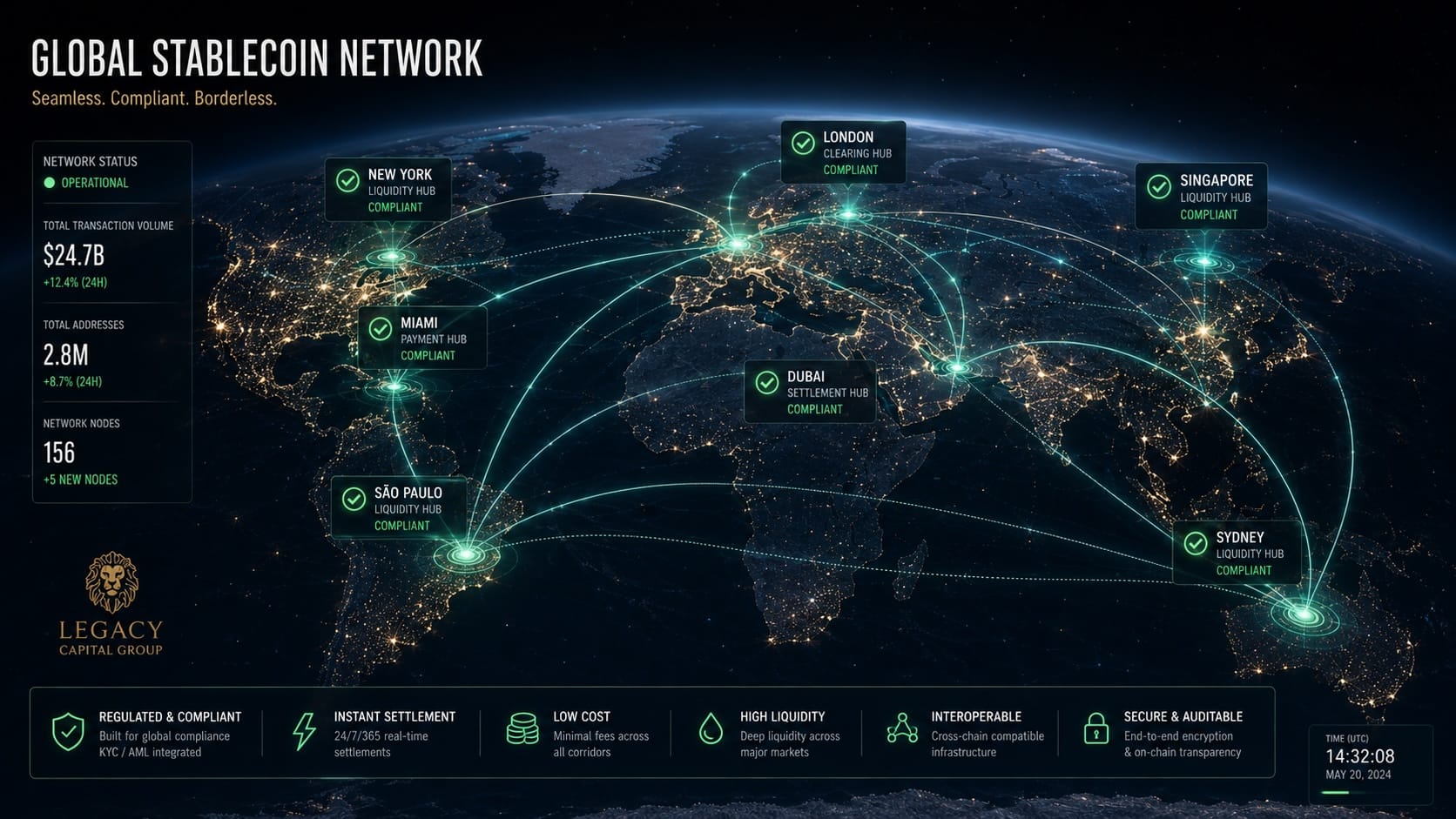
5. Stablecoins & Tokenization: From Experiment to Statutory Reality
2026 will be recorded as the year that two digital finance technologies — stablecoins and tokenized funds — completed the transition from speculative innovation to regulated infrastructure.
The 3% Threshold: Stablecoins Go Mainstream
Stablecoins are projected to represent 3% of all US dollar payments by the end of 2026. This threshold, while modest in percentage terms, represents an enormous absolute dollar volume given the scale of the US payment system, and marks the inflection point at which stablecoins become systemically significant. The GENIUS Act provides the legal definitions and reserve requirements necessary for mainstream institutional adoption, establishing a two-tier licensing framework distinguishing between “payment stablecoins” and other digital dollar instruments.
3%
Projected share of all US dollar payments via stablecoin by end 2026
GENIUS
Act provides statutory definitions enabling mainstream stablecoin adoption
Jul 4
White House target date for Digital Asset Market Clarity Act passage
63%
Decline in IRS-CI investigations into abusive tax schemes in 2025
Cayman’s Tokenization Framework: A Global First
The Cayman Islands has delivered perhaps the most technically sophisticated regulatory response to tokenized finance anywhere in the world. As of March 24, 2026, amendments to both the Mutual Funds (Amendment) Act and the Private Funds (Amendment) Act provide statutory definitions for “digital equity tokens” and “digital investment tokens.”
The elegance of the Cayman approach lies in what it avoids: rather than creating a parallel virtual asset regulatory regime (as many jurisdictions have done, with significant transition costs and jurisdictional uncertainty), the amendments integrate tokenized fund interests into the existing securities law framework. A digitally issued limited partnership interest in a Cayman fund is regulated as a fund interest — not as a “virtual asset” requiring a separate VASP licence.
This framework positions Cayman to capture the tokenized fund market as institutional asset managers — particularly in private equity and hedge funds — begin issuing token-based share classes for secondary market liquidity. The combination of Cayman’s existing fund legal infrastructure, its tax neutrality, and its new statutory tokenization framework creates a compelling proposition for fund sponsors exploring digital issuance.
AI-Guided Cyber Risk: The Emerging Threat Layer
Regulators are increasingly focused on a new threat vector: AI-guided cyberattacks targeting financial infrastructure. Both the Bank of England and the European Central Bank have issued formal warnings in 2026 about the potential for disruption from advanced AI models. Financial institutions operating across multiple offshore jurisdictions — which typically rely on complex multi-party technology stacks — are considered particularly vulnerable to coordinated AI-assisted attack patterns that exploit the seams between regulatory perimeters.
6. 2026 Compliance Calendar: Key Deadlines
The regulatory changes described above come with concrete compliance deadlines that practitioners must track. The following timeline synthesizes the most operationally significant dates across jurisdictions.
January 23, 2026 — Cayman Islands
Beneficial Ownership Amendment Regulations effective5-day discrepancy notification window and removal of 25% penalty reduction now in force for all Cayman financial institutions.
February 13–17, 2026 — Seychelles
FATF confirmation + EU grey list removalHistoric double-green status achieved. Correspondent banking reviews should be initiated for Seychelles-linked entities.
March 24, 2026 — Cayman Islands
Tokenized fund framework effectiveMutual Funds and Private Funds Amendment Acts in force, providing statutory basis for digital equity and investment tokens.
April 30, 2026 — Seychelles
MNE and CBCR Survey filing deadlineAll qualifying multinationals with Seychelles entities must file the country-by-country reporting survey via the official FICS portal.
April 30, 2026 — Cayman Islands
DITC Portal registration deadlineCayman financial institutions must complete registration on the DITC Portal for CRS and FATCA reporting obligations.
May 14, 2026 — United States
Digital Asset Market Clarity Act advancesSenate Banking Committee votes 15-9 to advance the Act. Full passage targeted by July 4, 2026 — a Dodd-Frank level event for crypto.
July 4, 2026 — United States (Target)
Clarity Act passage deadlineWhite House target date for full Congressional passage of the Digital Asset Market Clarity Act.
December 31, 2026 — Seychelles
Corporate Governance Code — first annual disclosureAll entities subject to the new Seychelles Code of Corporate Governance must file their first annual disclosure by year-end.
7. Strategic Implications: What This Means for Global Banking Clients
The regulatory landscape described in this briefing is not merely of academic interest. For individuals and businesses managing global assets, banking relationships, and corporate structures, the 2026 reset creates both opportunities and obligations that demand strategic attention.
For Seychelles-based structures: The grey-list removal creates a genuine window to renegotiate correspondent banking terms, re-approach European counterparties who had applied automatic EDD, and position new licensing applications (particularly for securities dealers and fund administrators) against a dramatically improved regulatory background. The April 30 CBCR deadline must be met without exception, and the Corporate Governance Code annual disclosure should be prepared now rather than at year-end.
For Cayman fund structures: The new tokenization framework is a strategic opportunity for private equity and hedge fund managers exploring secondary market liquidity through digital token issuance. The 5-day beneficial ownership notification window requires immediate operational review of compliance workflows — manual processes are no longer viable.
For US-connected digital asset operations: The Clarity Act’s imminent passage will create both licensing requirements and market structure clarity that have been absent since Bitcoin’s inception. Firms operating in legal ambiguity under the current SEC/CFTC jurisdictional conflict should engage counsel now to position for the new framework.
For all offshore structures: The IRS-CI enforcement collapse creates a window of reduced detection probability for abusive schemes — but the BVI FSC step-up, Cayman’s tightened beneficial ownership rules, and the OECD’s expanded tax transparency capacity-building program mean that offshore opacity is genuinely and irreversibly diminishing. The sustainable strategy is not exploitation of enforcement gaps, but structural alignment with the new compliance architecture.
“Offshore banking of 2026 is no longer about secrecy. It is about jurisdiction-selection as competitive advantage — choosing regulatory environments that are transparent enough to be bankable and innovative enough to be efficient.” Clients are increasingly exploring offshore banking options for individuals, seeking personalized services and global access to their funds. Enhanced digital platforms provide these individuals with tools to manage their accounts efficiently while ensuring compliance with international regulations. As a result, the appeal of offshore solutions continues to grow in a rapidly evolving financial landscape.
— EGB Research Desk
Key Deadlines
GOBI Top 2 Scores
Compare Jurisdictions
Access the full GOBI 2026 rankings covering 24 offshore jurisdictions.
View Full Rankings →Primary Sources & References
- Vistra — 2026 Cayman Beneficial Ownership Regulations
- Bank Policy Institute — BPInsights May 16, 2026
- Maples — BVI FSC Expanded Compliance Inspection Programme
- Loeb Smith — Cayman Tokenized Funds Framework
- The Block — Custodia Fed Master Account Appeal
- Easy Global Banking — GOBI 2026 Rankings
- SALVUS Funds — Securities Dealer in Seychelles 2026
- OECD — Global Forum Tax Transparency 2025
- KuCoin — Kraken Financial Fed Master Account
- FATF — Ministerial Declaration April 2026
- Conyers — Cayman Regulatory Review Q1 2026
- Appleby — Seychelles Corporate Governance 2026
- BBCIncorp — Seychelles MNE and CBCR Survey
- Abacus Offshore — The Great Reset
- ETAF — Weekly Tax News May 11, 2026
- Corporate Compliance Insights — Regulators in 2026
- World Economic Forum — Digital Assets 2026
- Sen. Whitehouse — IRS Investigation Collapse Probe
- FinTech Weekly — Stablecoins Go Mainstream 2026
- Sen. Wyden — IRS Enforcement Collapse