
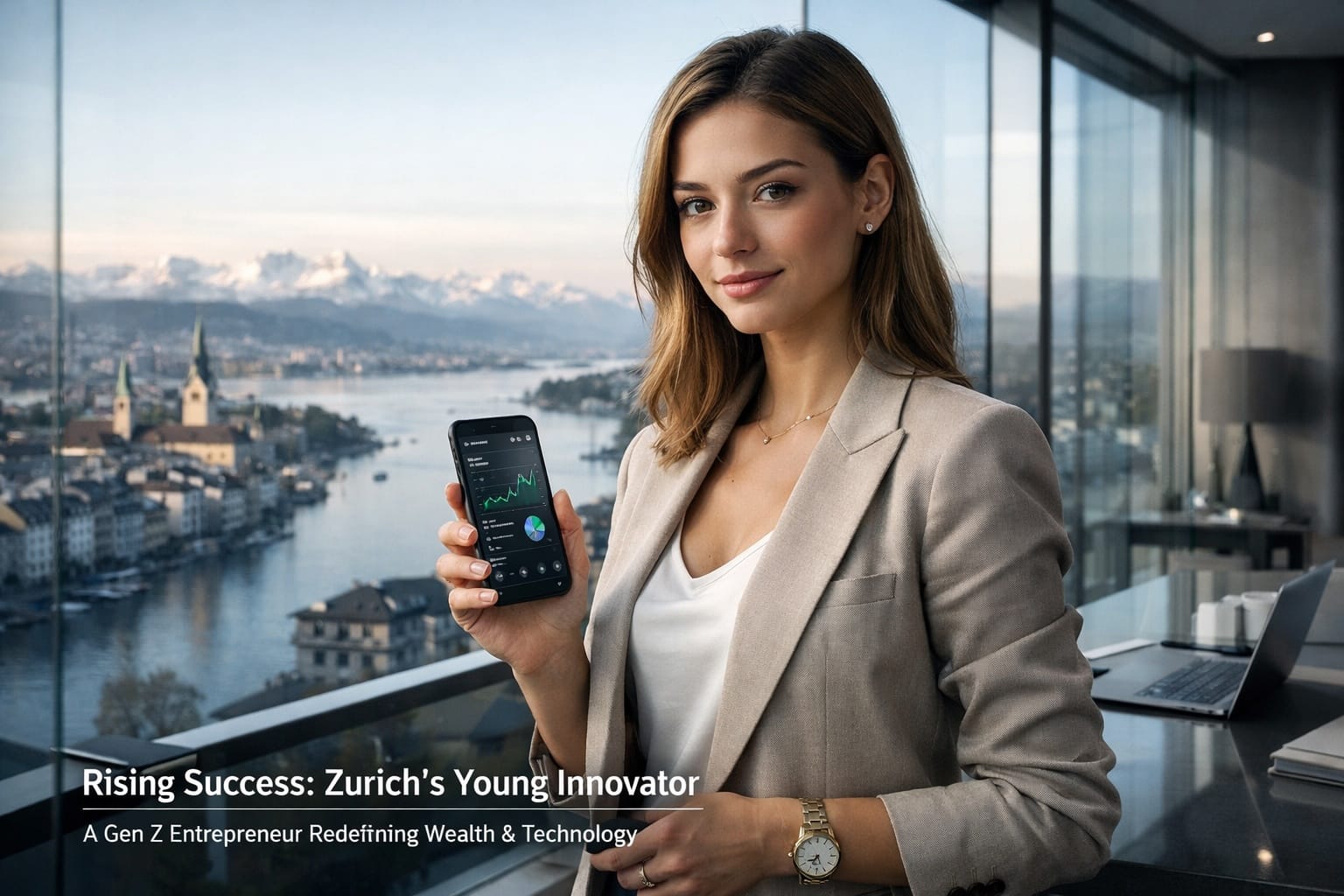
Swiss banking for Gen Z millionaires is no longer a theoretical future scenario — it is the defining strategic challenge of 2026. While the Alpine republic manages over $2.4 trillion in international assets and still ranks as the world’s largest offshore wealth centre, the generation now preparing to inherit could walk out the door without a second glance if Swiss private banks fail to adapt fast enough.
The numbers are almost impossible to absorb. A Cerulli Associates report published in June 2025 revised the global great wealth transfer upward to $124 trillion — a figure inflated by pandemic-era equity gains, surging real estate values, and a simple demographic reality: the wealthiest generation in human history is ageing. Specifically, Gen Z alone stands to receive roughly $15 trillion of that total, according to Bank of America research cited by Fortune.
Here’s the thing most bankers still underestimate: this isn’t just a money story. It’s a values story. And the values in play are fundamentally different from anything Swiss private banking has navigated before.

The $124 Trillion Wealth Transfer: What Swiss Banks Are Actually Facing
Scale matters here, so let’s be precise. According to Cerulli’s updated projections, three forces drove the $84 trillion estimate from 2020 all the way to $124 trillion by mid-2025. First, inflation adjustments added roughly $16 trillion in nominal terms. Second, equity markets grew 27% between 2020 and 2023. Third, US real estate surged 39% in the same window, locking in generational wealth at levels no prior cohort ever experienced.
For Swiss institutions, the implication is urgent. The Capgemini World Wealth Report 2025 found that 81% of younger HNWIs plan to switch their wealth management firm after receiving an inheritance — unless those firms adapt to digital-first expectations and risk-forward preferences before the transfer happens. That’s not a gentle warning. That’s a defection timeline.
Meanwhile, the wealth is moving faster than expected. Many affluent parents are choosing to transfer assets while still alive — giving shares in private companies, funding impact investments, or simply gifting significant capital years before a formal estate event. Consequently, this “give while living” trend shortens the runway Swiss banks have to build relationships with the next generation.
For families considering how to structure assets across jurisdictions during this transition, understanding how Swiss bank inheritance actually works for foreign heirs is often the critical first step.
Gen Z Investment Priorities vs. Traditional Swiss Banking Clients
The portfolio gap between Gen Z heirs and their parents’ generation is wider than most private bank product teams have acknowledged internally. Below, the data tells the story more clearly than any boardroom slide.
| Asset Class | Gen Z & Millennials | Older Investors (44+) | Shift Direction |
|---|---|---|---|
| Traditional Assets (stocks & bonds) | 47% | 74% | ↓ Declining |
| Alternative Investments (total) | 53% | 26% | ↑ Rising sharply |
| Real Estate | 31% | 32% | → Stable |
| Crypto & Digital Assets | 28% | 4% | ↑ Dominant growth driver |
| Private Equity | 26% | 16% | ↑ Rising |
| Passion Investments (art, collectibles) | ~12% | ~6% | ↑ Rising |
The crypto figure deserves special attention. Industry statistics published in 2026 show that over 40% of Swiss HNWI portfolios now include some form of digital asset. At the same time, the OECD’s Crypto-Asset Reporting Framework (CARF) is moving into preparation phase, with full cross-border data exchange expected by 2027. Swiss banks and crypto service providers are already building the infrastructure to track every transaction — so the era of anonymous crypto wealth is effectively over, even in Zug’s Crypto Valley.
Why 75% of Gen Z Millionaires Prioritise Purpose Over Pure Returns
Nearly three-quarters of Gen Z millionaires say they would accept lower financial returns to invest in causes they believe in — climate action, social equity, and ethical governance. That statistic, drawn from Deloitte’s 2025 Next Gen Wealth Report, is the number Swiss relationship managers need tattooed somewhere visible.
Traditional Swiss private banking built its brand on capital preservation, discretion, and multi-generational continuity. Those qualities still matter. However, they are now table stakes, not differentiators. What Gen Z heirs are actually shopping for — consciously or not — is a firm that can fluently speak the language of ESG integration, impact measurement, and sustainable portfolio construction without defaulting to greenwashed brochures.
Furthermore, Capgemini’s 2025 report found that 61% of younger Millennial and Gen Z Swiss HNWIs are willing to actively invest in high-growth niche markets. In practice, that means private equity in climate tech, tokenised real assets, and early-stage biotech — not the conservative balanced mandates that built Swiss banking’s 20th-century reputation.
What most advisors miss is that purpose and performance aren’t opposites for this cohort. Gen Z heirs who have grown up watching climate risk price into real assets, and ESG laggards underperform in equity benchmarks, simply see impact investing as sensible risk management. As a result, the conversation shifts entirely when advisors understand that framing rather than resist it.
Gen Z HNWI Priority Stack: What They Want From a Wealth Manager
How UBS, Julius Baer, Pictet, and Lombard Odier Are Responding
Switzerland’s major private banks have not been passive. Each institution is carving a distinct path, which reflects the fragmented nature of Gen Z preferences. One size demonstrably does not fit all.
The Scale-and-Tech Camp: UBS and Julius Baer
UBS is betting on scale and artificial intelligence. After absorbing Credit Suisse’s next-generation client programs in 2024, the combined entity is integrating AI-enhanced advisory tools that give relationship managers real-time portfolio insight across a client’s full asset picture — including digital assets and private market positions. As a result, the bank can now deliver hyper-personalised advice at institutional scale, which suits heirs managing complex cross-border portfolios.
Julius Baer, meanwhile, takes a community-first approach. The bank has built exclusive peer networks for younger clients who share interests in thematic investing — climate infrastructure, healthspan biotech, and digital arts. The commercial rationale is straightforward: Gen Z heirs trust people like themselves. Consequently, a Baer-facilitated introduction to a credible peer investor carries more weight than any sales pitch from an advisor.
The Heritage-and-Dialogue Camp: Pictet and Lombard Odier
Pictet, in contrast, leans into its 220-year partnership heritage. The Geneva firm offers bespoke family governance frameworks — written charters that articulate a family’s investment philosophy across generations, alongside structured succession coaching. For heirs who want continuity anchored in family values, Pictet’s approach resonates most deeply.
Lombard Odier, similarly, leads on what it calls the “digital and dialogue” model. The bank combines a sophisticated digital client platform — offering real-time performance transparency across all asset classes — with multigenerational family forums where heirs, wealth holders, and advisors align on strategy together. For Gen Z clients who distrust opacity, seeing exactly where every franc is deployed fundamentally changes the relationship dynamic.
For a detailed comparison of how these institutions stack up by assets under management, the ranking of Switzerland’s top private banks by AUM provides useful context on relative scale and strategic positioning.
Projected Wealth Transfer by Generation: The 2045 Outlook
| Beneficiary Group | Projected Share | % of Total | Key Driver |
|---|---|---|---|
| Gen X (born 1965–1980) | $45T | 36% | First in line for Boomer estates |
| Millennials (born 1981–1996) | $46T | 37% | Largest beneficiary cohort |
| Gen Z (born 1997–2012) | $15T | 12% | Growing share via direct gifting |
| Charities & Foundations | $18T | 15% | Philanthropic transfer from Boomers |
Switzerland’s Regulatory Transformation: From Secrecy to Structured Transparency
Swiss banking secrecy — that 20th-century pillar — is now more myth than reality. The Swiss Federal Tax Administration reports that the Automatic Exchange of Information (AEOI) now covers over 100 partner states, with millions of financial accounts exchanged globally in 2025 alone. By the 2026–2027 cycle, moreover, the net is tightening further.
Here’s the counterintuitive part: Gen Z heirs actually prefer this. Deloitte’s 2025 Next Gen Wealth Report shows that younger investors demand radical openness — on fees, on ESG metrics, on tax compliance. They don’t want the legal risk associated with opaque account structures. In practical terms, therefore, Swiss banks are pivoting their value proposition from “we won’t tell” to “we will protect” — meaning robust data privacy and cybersecurity, not old-school secrecy.
Additionally, Switzerland’s voters reinforced the country’s wealth-friendly positioning in late 2025, when 78% rejected a proposal to impose inheritance taxes on estates above CHF 50 million. For Gen Z heirs managing large cross-border estates, that policy stability matters enormously — particularly when combined with Switzerland’s zero capital gains tax and the absence of a federal inheritance tax at the national level.
For non-resident heirs navigating Swiss banking compliance from abroad, understanding the full landscape — including source of wealth documentation, FINMA requirements, and minimum deposits across institution tiers — is essential before approaching any bank. Our detailed guide on opening a Swiss bank account as a non-resident in 2026 covers exactly that territory.
7 Proven Strategies for Gen Z Millionaires Approaching Swiss Private Banking
Based on real-world client experience and current Swiss banking dynamics, here is a practical framework for next-generation wealth holders approaching the Swiss private banking system.
Before You Approach Any Bank
- Compile your Source of Wealth documentation before any approach. Swiss compliance officers reject confusion above all else. A well-structured KYC narrative — explaining how wealth was built, where it sits, and how assets have moved — determines the outcome more than any other factor. This applies equally to crypto wealth and traditional family business assets.
- Match your institution to your actual portfolio mix. Online banks like Swissquote and Dukascopy serve digital-asset-heavy portfolios with remote onboarding and zero minimum. Mid-tier private banks like Julius Baer (CHF 2M minimum) serve impact-oriented heirs who want community and thematic access. Moreover, elite institutions like Pictet (CHF 5M+) suit those prioritising multigenerational governance. There is no universal “best” choice.
- Request ESG integration as a structural feature, not an add-on. Sustainable investing mandates should be embedded in the investment policy statement from day one — not offered as an optional module. Banks that can’t articulate a clear ESG framework in their first meeting are unlikely to improve later.
During the Selection and Onboarding Process
- Use digital platforms as a quality signal. Any institution that cannot provide real-time mobile portfolio reporting in 2026 is behind the curve. Furthermore, good digital infrastructure correlates with operational efficiency across the board — it signals how the whole bank runs, not just its app.
- Engage the bank’s next-gen programme before transferring assets. Most major Swiss private banks run dedicated programmes for heirs — educational workshops, peer networks, leadership cohorts. These are genuinely valuable and, in addition, allow you to assess advisor quality and cultural fit before committing capital.
- Consider multi-jurisdiction structuring from the start. A multi-hub approach — combining Swiss preservation with Singapore’s Asian growth access or another complementary jurisdiction — delivers risk diversification that a single-country strategy cannot. This is especially relevant for families with cross-border business interests. Our global comparison of the best private banks for HNWIs outlines how Switzerland, Singapore, the USA, and the UK each serve different client needs.
- Understand the inheritance mechanics before you need them. Swiss succession law, cantonal inheritance tax variation, and PILA rules for foreign domicile are genuinely complex. Families where the wealth holder is still alive have the luxury of planning — and should use it. For instance, the Swiss federal government’s 10-year dormant-account deadline (after which unclaimed assets vest to the state) is one of many details that surprises foreign heirs who haven’t done their homework early.
If you’re ready to structure your approach, the team at Easy Global Banking specialises in exactly this kind of complex onboarding — from KYC preparation to bank selection to account management. You can learn about their full process for opening a Swiss bank account with professional support.
The 2026 Transparency Paradox: Why Gen Z Actually Welcomes It
There’s a paradox at the heart of modern Swiss banking that took the industry a few years to fully absorb. The end of traditional banking secrecy — accelerated by AEOI, FATCA, and now CARF — was supposed to drive assets away. Instead, Switzerland still manages over $2.4 trillion in cross-border wealth, a number that has grown through the transparency transition, not despite it.
The reason is generational. For Baby Boomer clients, secrecy was a feature. For Gen Z heirs, however, it’s a liability. They don’t want accounts that might attract regulatory scrutiny or reputational risk. Rather, they want legally watertight, transparent structures that can withstand any audit and still protect their data privacy from third-party cyber threats. That’s a fundamentally different product — and Swiss banks that understand the distinction are actively building it.
How AI Is Replacing Secrecy With Smart Compliance
AI-driven compliance tools are central to this transformation. Swiss institutions are deploying what some wealth managers now call “client brains” — AI systems that manage compliance reporting seamlessly in the background. As a result, government tax authorities get the data they require, while the client’s personal financial information remains shielded from unauthorised access. For a Gen Z millionaire managing a complex, multi-asset, multi-jurisdiction portfolio, that kind of infrastructure is genuinely reassuring.
Frequently Asked Questions: Swiss Banking for Gen Z Millionaires
The Decade Ahead: Earn Gen Z Loyalty Before the Transfer Arrives
The great wealth transfer is not a future event. It is already happening — in living rooms, via digital gifting platforms, and through early equity stakes in family businesses. The Swiss banks that will capture the $15 trillion earmarked for Gen Z heirs are not waiting for formal estate events. Instead, they are building relationships now — through education programmes, digital infrastructure, ESG integration, and a genuine willingness to let a 26-year-old have real input into their portfolio strategy.
What This Means for Gen Z Heirs Right Now
For Gen Z heirs themselves, the message is equally urgent. Swiss private banking remains the most robust, legally stable, and internationally sophisticated wealth management ecosystem on the planet. However, it rewards preparation. A well-documented source of wealth, a clear understanding of which institution tier matches your asset profile, and a firm grasp of the transparency framework you’re entering will determine whether your first Swiss banking relationship is a frustrating compliance exercise or a genuinely productive partnership.
For families working through the complexity of multigenerational wealth structuring across borders, speaking to an independent specialist before approaching any bank directly tends to produce significantly better outcomes. Consequently, Easy Global Banking’s team of international banking consultants, based in Chur, Switzerland, can help identify the right institution, prepare your compliance profile, and manage the introduction — all with a documented 98% approval success rate. A free initial consultation is a sensible first step.
References
- Cerulli Associates via Fortune: The $124 Trillion Great Wealth Transfer — June 2025 Update
- Capgemini World Wealth Report 2025: NextGen HNWIs Redefining Wealth Management
- Thematica: Preparing Millennials and Gen Z for the Great Wealth Transfer — Deloitte Next Gen Report 2025
- Fortune: Switzerland Rejects Inheritance Tax — EFG International CEO on Swiss Banking’s Future (December 2025)
- UBS Global Wealth Report 2025 — Great Horizontal and Vertical Wealth Transfer Analysis