Singapore AI banking has reached an inflection point. DBS Bank generated $750 million in economic value from artificial intelligence in 2024 — across 350 live use cases and 1,500 models running in production — with projections exceeding $1 billion for 2025. These are reported outcomes from the most documented AI banking deployment in the world, not projections or case study estimates.
But here is what most coverage misses. Those numbers describe what AI banking has done for DBS. They say very little about what it does for you — specifically, whether you are a Singapore resident who has banked with DBS for a decade, or an international client opening an account from Geneva or Dubai for the first time. The experience differs significantly, and that gap matters when you are making real decisions about where to hold assets.
This post breaks down what is actually running inside Singapore’s AI banking infrastructure, which layers benefit international clients immediately, where the personalization stack takes time to develop, and what the regulatory framework governing all of it means for your account. Start with the architecture — because that is where the real story is.

DBS Didn’t Just Automate — It Rebuilt from the Ground Up
Most banks that describe themselves as AI-powered mean they have added intelligence on top of existing infrastructure. A fraud scoring model here, a chatbot there, maybe a recommendation engine in the mobile app. The underlying core banking system — often 30 years old, sometimes still running on COBOL — stays largely unchanged. The AI sits as a layer on top of it, which is a meaningful architectural constraint that limits what AI can actually do.
DBS took a different path, and it started early. Around 2014, CEO Piyush Gupta began an internal repositioning that framed the bank not as a financial institution adopting technology, but as a technology company that holds a banking license. That was not marketing language — it was an operational directive that changed how the bank allocated capital, structured hiring, and made infrastructure decisions for the next decade.
By 2025, DBS runs over 1,500 AI models in live production. To calibrate that number: most global systemically important banks operate fewer than 200 production models. The gap is not a measure of effort or investment size alone — it is a measure of operational dependency. When 1,500 models are generating live pricing decisions, credit assessments, and risk outputs daily, the bank’s operations are structurally dependent on AI in a way that competitors cannot easily match by deploying a few new tools. That architectural depth is why the $750 million figure is credible. You do not generate returns at that scale from a collection of pilot projects.
One caveat worth stating clearly, though — and I want to be precise here. The $1 billion is an “economic value created” estimate, not reported profit. It includes revenue uplift, cost savings, and risk reduction, measured through DBS’s internal AI value accounting framework. These figures are not independently audited the way earnings are, and the bank has an obvious incentive to measure on the optimistic side. The number is directionally credible, but the methodology deserves scrutiny before treating it as a hard figure.
Sources: DBS investor disclosures and annual AI value reporting (2024–2025).
Three Numbers That Tell the Real Story of Singapore AI Banking
The $1 billion headline is accurate but structurally vague. To understand what AI transformation actually does inside the bank, three sub-numbers are more useful than the aggregate.
Revenue enhancement drives roughly 60% of the value creation. The primary mechanism is targeting precision: DBS’s AI models identify cross-sell opportunities with enough accuracy that product uptake rates improved 30% compared to non-AI approaches. In banking, that is not a small gain — incremental uptake across millions of accounts compounds quickly into significant income. Dynamic pricing on loans and deposits contributes to this too. The bank’s pricing models adjust in real time based on market conditions, customer risk profiles, and competitive positioning, which has tightened net interest margins without sacrificing volume.
Cost reduction accounts for roughly 30%. Process automation cut manual handling time by up to 80% on routine transactions. Over 80% of customer service inquiries now resolve through AI systems without a human agent. Quick note, though: resolution quality varies sharply by query type. Simple, high-frequency requests — balance checks, payment status, account information — are handled well. Complex edge cases, especially those involving cross-border nuances or unusual account structures, still escalate to human agents at noticeably higher rates. So the 80% figure is real, but it does not mean all customer service has been AI-resolved at equal quality.
The remaining value sits primarily in fraud detection and risk management. Real-time transaction monitoring achieves roughly 95% accuracy, with a meaningful reduction in false-positive rates — fewer legitimate transactions blocked for review. That second number matters more than it might initially seem. Every blocked legitimate transaction is a friction point, and for international clients making cross-border transfers, false positives are disproportionately disruptive. Reducing them has real quality-of-life value for the account holder, not just operational savings for the bank.
Where Singapore AI Banking Actually Lives — And What It Doesn’t Do Yet
The 350+ use case number spans the full bank: back office, treasury, compliance, HR, and retail customer-facing functions. From a customer perspective, however, the AI lives in three distinct layers — and those layers do not deliver equally. This is the part of the AI banking story that gets compressed into a single transformation narrative when it deserves more careful framing.
The first layer is fraud and security. This runs universally — on every account, from day one, regardless of account age or transaction volume. Real-time behavioral monitoring, device fingerprinting, and transaction pattern analysis apply whether you opened your account last week or a decade ago. If you have a DBS account anywhere, you benefit from this layer immediately. It is not gated by account tenure or relationship depth.
The second layer is personalization and recommendations. This is where the AI banking experience described in DBS’s case studies actually lives — the engine that surfaces relevant products, suggests financial adjustments, and generates personalized insights. Here is the part nobody says directly: it works on behavioral data the bank has already collected. A new account, especially one opened remotely by a non-resident, starts with a thin data profile. The AI has almost nothing to work with. The personalized advisory experience that features prominently in transformation coverage typically develops over 12 to 18 months of active account use, not from the moment of opening.
The third layer is credit and pricing intelligence. For loan applications, AI-driven models incorporate non-traditional signals alongside financial metrics — transaction patterns, behavioral consistency, account activity. For clients with established DBS account histories, this can work in their favor because the models surface positive signals that traditional credit scoring might miss. For new applicants with limited Singapore financial records, the same models simply have less favorable input data to work with. That is not a design flaw; it is how machine learning functions. Still, it means the credit benefits of AI banking accrue faster to established account holders than to new entrants.
What Singapore AI Banking Means If You’re Banking from Outside the Country
This is the section almost entirely absent from mainstream coverage of DBS’s AI results — and it is the section that matters most if you are evaluating Singapore as a banking jurisdiction for international wealth, business, or asset management. Private banks ranking by AUM can provide valuable insights into the financial landscape of different regions. Evaluating these rankings helps identify the most reputable institutions for high-net-worth individuals seeking exceptional service. Additionally, understanding these dynamics can guide investors in making informed decisions about their asset management strategies.

The compliance infrastructure is the strongest immediate advantage for international clients. Singapore’s AI-driven AML monitoring and CRS reporting automation produces a more consistent, less arbitrary compliance process than many alternative offshore jurisdictions offer. When monitoring is rule-governed and automated, outcomes become predictable. For clients managing cross-border reporting obligations under multiple regulatory regimes, that predictability has real practical value. The AI does not bend to interpretation drift — it applies the same standards across accounts, regardless of relationship size or account history. That consistency is actually harder to find than most analyses acknowledge. You can review the broader Singapore banking trends shaping the sector if you want the wider context.
Onboarding for non-residents has improved substantially in recent years, but it remains human-supervised at key decision points. Remote account opening for international applicants involves document verification and risk assessment checkpoints that still require compliance officer review. AI accelerates the preliminary stages — document processing, initial risk scoring, identity verification — but it does not yet replace the final compliance judgment on complex non-resident applications. That is the right design choice, frankly, given the regulatory stakes. But it does mean the “open an account in minutes” narrative that appears in DBS’s AI banking marketing applies to domestic retail customers, not to international applicants.
Wealth management and AI advisory services are accessible to non-residents but function best for clients who maintain DBS as a primary banking relationship. If you hold a DBS account primarily for asset custody while your main banking activity sits elsewhere, the AI advisory layer has limited behavioral data from which to generate meaningful recommendations. The practical framing for international clients: the strongest benefits of Singapore AI banking are infrastructure reliability, regulatory clarity, and fraud protection — not the personalization features that drive the transformation narrative. Those develop with time and account activity, which is worth planning for rather than expecting upfront.
The MAS Framework That Keeps Singapore AI Banking Honest
Here is where Singapore has a structural advantage that matters more than any individual bank’s model count — and it is consistently underweighted in coverage of DBS’s results. The technology is impressive. The regulatory architecture around it is what makes it durable.
The Monetary Authority of Singapore developed the FEAT framework — Fairness, Ethics, Accountability, and Transparency in AI — in 2019, with substantive updates through 2023. Under this framework, financial institutions must be able to explain AI-driven decisions that affect customers. Credit decisions, account restrictions, risk classifications — if an AI system generates an outcome that affects your account, the bank must be able to describe how that decision was reached. Equally, you have regulatory recourse to challenge it. Explainable AI is therefore not optional for Singapore banks; it is a cost of operation built into the licensing requirements. That is a meaningful protection that does not exist in every jurisdiction where international clients consider holding assets.
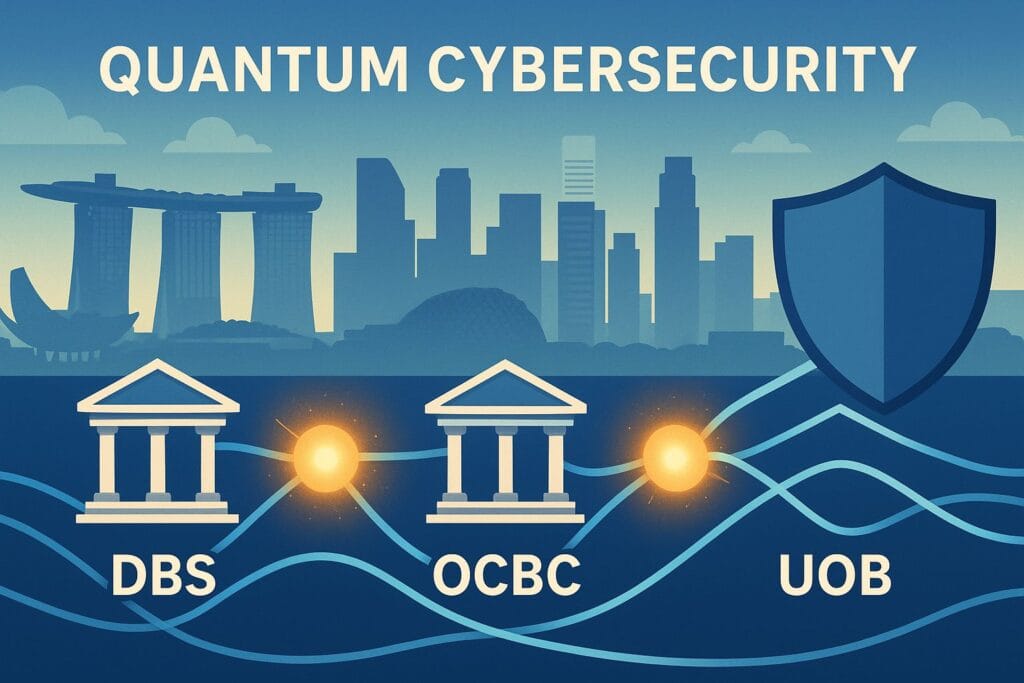
The MAS sandbox framework matters separately. It allows banks to test novel AI applications under regulatory oversight, rather than deploying first and managing consequences afterward. This has produced a faster deployment cycle for genuinely new use cases than most jurisdictions achieve, without the governance failures that appear when banks move without oversight structures. The competitive pressure this creates has elevated AI standards across the sector — OCBC and UOB have both accelerated AI investment directly in response to DBS’s lead, and all three operate under the same FEAT requirements. The sector-wide effect is arguably more durable than any individual institution’s advantage. You can review how each institution compares in our full list of banks in Singapore.
Most regulatory environments offer one option: either strict control that slows innovation, or permissive conditions that allow fast deployment without accountability guardrails. Singapore has built a functional combination of both, and that combination is genuinely harder to replicate than any individual bank’s technology stack. For international clients choosing a banking jurisdiction, the regulatory architecture matters as much as the specific bank’s feature set — and often more.
| Feature | DBS | OCBC | UOB |
|---|---|---|---|
| Production AI models | 1,500+ | Not publicly disclosed | Not publicly disclosed |
| Reported AI value (2024) | $750M (economic value) | AI-accelerated programs reported | AI-accelerated programs reported |
| Non-resident account opening | Yes — remote-assisted | Yes — remote-assisted | Yes — branch or digital |
| AI advisory / robo-investing | DBS digiPortfolio | OCBC RoboInvest | UOB Wealth Management AI |
| MAS FEAT compliance | Required — all banks | Required — all banks | Required — all banks |
| Real-time fraud detection | Yes — 95% accuracy reported | Yes | Yes |
| AI-driven credit scoring | Yes — 350+ models | Yes | Yes |
How to Access Singapore’s AI Banking Infrastructure as a Foreign Client
If you are considering Singapore banking guide for personal wealth, business accounts, or asset holding structures, the AI transformation at institutions like DBS is a genuine draw — not only for the features, but for what it signals about the jurisdiction’s infrastructure reliability and regulatory seriousness. Few banking markets have built this combination of operational AI depth and governance accountability at the same time.
The access path for non-residents has specific requirements that the AI infrastructure does not yet navigate independently on your behalf. Non-resident applications sit at the intersection of banking compliance, international tax law, and KYC procedures that vary by bank, account type, and applicant profile. Specifically, your country of tax residence, source of wealth documentation, and intended account use all affect how the bank classifies your application and which review process it enters. Working with an advisor who understands both the banking side and the compliance side of that process reduces both processing time and rejection risk — often substantially. If you are new to this, the requirements for opening a Singapore bank account as a non-resident are a useful starting point.
At Easy Global Banking, we facilitate Singapore bank account opening for international clients — individuals and businesses — with a process built specifically around the requirements non-resident applications face. If you are ready to establish a banking relationship in one of the world’s most advanced AI banking environments, contact us to discuss opening a Singapore bank account. The right guidance at the application stage makes a material difference in both speed and outcome.