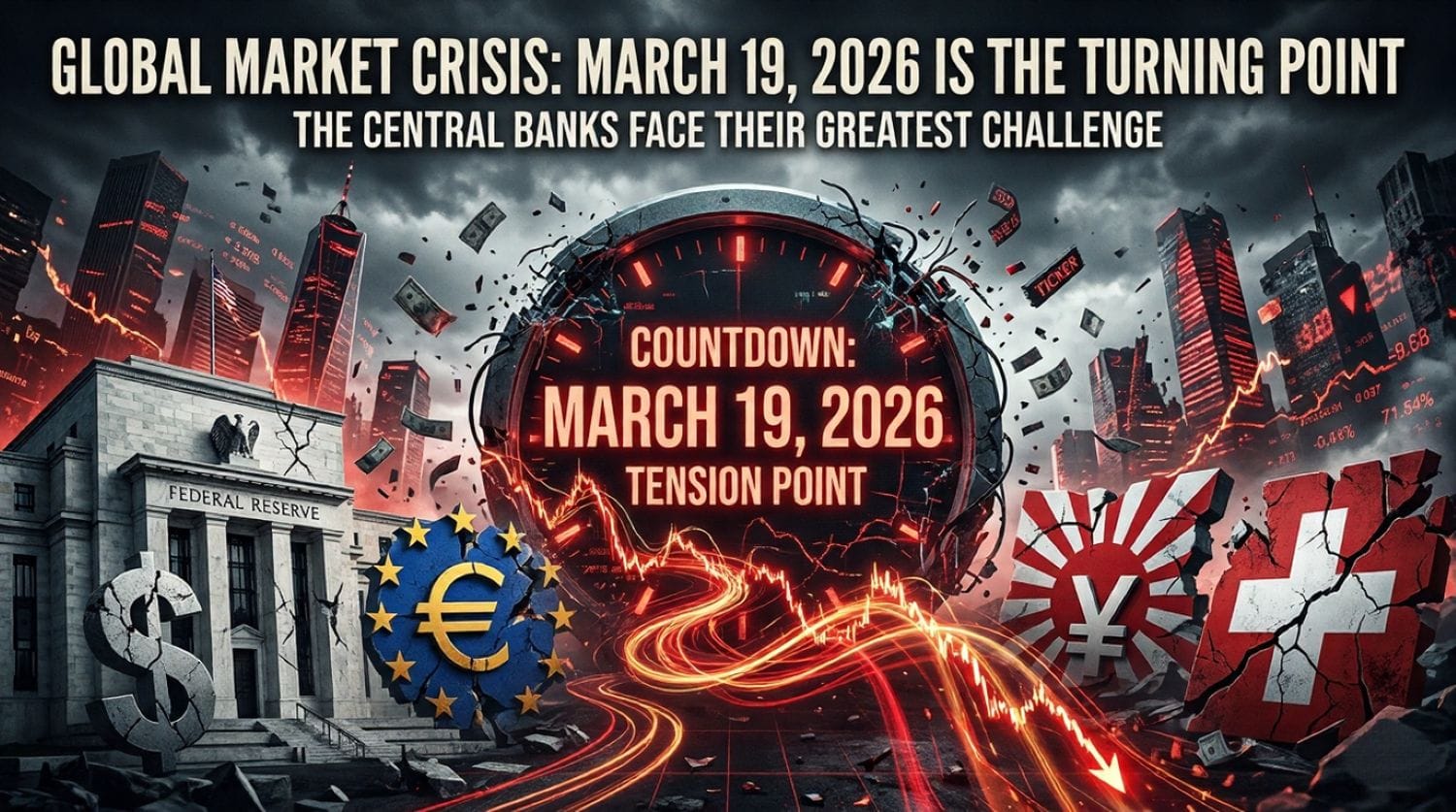
Thursday, March 19 could become the most dangerous trading day of 2026. Not because one central bank will speak. Because several of the world’s most powerful policy makers will hit markets almost back-to-back, while traders are still absorbing the Federal Reserve’s March 18 decision. At the same time, the Iran conflict has pushed oil, inflation risk, and safe-haven flows back to the top of the macro agenda.
That mix is rare. It is also dangerous. Markets can usually process one policy shock at a time. This week, they may have to process several. That raises the odds of sharp moves in currencies, bonds, equities, and commodities.
Why March 19 matters
The Federal Reserve meets on March 18, and markets are widely positioned for a hold. Tastyfx says the more important issue is tone, not the rate itself, with attention centered on when the first cut may come and how the Fed reads rising geopolitical risk. Then Thursday brings the heavy concentration: the Bank of Japan, Swiss National Bank, European Central Bank, and Bank of England all land on March 19.
ForexRev calls Thursday, March 19 the most difficult day to trade in Q1 2026 because four decisions may arrive within hours of each other and create overlapping signals and unusually wide spreads. That matters because modern markets trade on relative policy, not just domestic policy. A hawkish surprise in Tokyo can hit the euro. A cautious ECB can hit the franc. A safe-haven rush can distort everything.
This is why March 19 feels like a collision course. It is not one story. It is several stories colliding in one session.
Central bank schedule
Why the Iran conflict matters
The Iran conflict matters because central banks do not react to war headlines alone. They react to what those headlines do to oil, inflation expectations, and business confidence. CNN reported that U.S. crude jumped 7.5% and Brent rose 6.2% after the latest escalation, with Brent briefly moving above $82 a barrel. The New York Times also reported a roughly 7% jump in oil prices and said the market was worried about disruption in a critical oil-producing region.
That is the problem for policy makers. Energy shocks can lift inflation even as growth slows. BloombergNEF noted earlier this year that Iran produces roughly 3.3 million barrels per day and warned that a severe disruption could push Brent materially higher through 2026. A rise in oil feeds into transport, shipping, manufacturing, and household costs. Over time, that can push inflation expectations higher.
This creates a hard choice. Central banks may need to sound tougher on inflation. But they may also fear damaging a fragile economy. That tension sits at the heart of this week’s market risk.
The Fed lights the fuse
The Fed’s decision comes first. That makes it the opening signal for the whole sequence. Tastyfx says markets are overwhelmingly leaning toward no change, with the key issue being how Chair Jerome Powell frames future cuts and geopolitical risk. If the Fed sounds patient, the dollar may stay firm. If it sounds worried about growth, risk assets may get short-term relief.
Either way, the market may not have much time to digest the message. Thursday comes next. That means traders could enter the European session still adjusting to the Fed while preparing for the Bank of Japan, the Swiss National Bank, the European Central Bank, and the Bank of England.
This sequencing matters more than many traders admit. The Fed shapes the dollar. The dollar shapes global pricing. So even a “hold” can become a major event if the language changes the path of rate expectations. Once that happens, every other central-bank message lands on a market that is already moving.
That is what makes this so dangerous. The first spark may come on Wednesday. The full fire risk arrives on Thursday.
The four-bank collision
The Bank of Japan may be the biggest wildcard. Tastyfx says the BoJ is expected to hold in March, but it also warns that USD/JPY is back above 159 and intervention risk is rising again. ForexRev adds that USD/JPY has the highest surprise potential of the week and says any move toward tighter policy could send the pair down by 200 to 300 pips in one session. That is a huge move for a major currency pair.
The European Central Bank faces a different dilemma. Tastyfx says the ECB is expected to hold because the war-related shock makes it harder to separate inflation risk from growth risk. In other words, the ECB may face hotter prices and weaker activity at the same time. That is exactly the sort of setup that can make a single sentence in the statement move EUR/USD hard.
The Swiss National Bank is quieter, but not less important. Tastyfx says the SNB is focused less on rates and more on CHF strength after safe-haven flows lifted the franc. The SNB’s own framework confirms that March is one of its four in-depth policy assessments each year. In a risk-off market, even mild intervention language can move USD/CHF and EUR/CHF sharply.
Three possible market scenarios
The first scenario is a hawkish shock. In that version, the Fed sounds patient on cuts, the BoJ leans tighter, and the ECB or SNB sounds firmer than expected. That mix could push yields higher, pressure equities, and trigger sharp FX moves as traders chase relative-rate advantages.
The second scenario is a dovish pivot. Here, central banks acknowledge the oil shock and geopolitical stress, but they lean toward stability. That could support stocks and bonds at first. But the relief may fade fast if oil stays elevated. Markets would then ask whether policy makers are falling behind inflation risk again.
The third scenario is divergence. This may be the most realistic. The Fed could sound cautious. The BoJ could lean firmer. The ECB could stay balanced. The SNB could focus on the franc more than rates. In that case, volatility would arrive in waves, not one single burst. A market-reaction chart would show repeated spikes through the session as each pair repriced on a different story.
Why volatility could spread fast
This kind of volatility rarely stays inside forex. A sharp move in USD/JPY can hit equity futures. A stronger franc can deepen risk-off sentiment. A jump in oil can pull inflation fears back into bond markets. Once correlations tighten, asset classes stop moving separately. They start moving together.
Algorithmic trading adds another layer of risk. Headlines now hit machines before humans can fully process them. That can widen spreads, reduce depth, and turn a modest surprise into a much larger move. ForexRev warns that March 19 may bring unusually wide bid-ask spreads because several major decisions land within hours.
Safe-haven demand can also distort normal reactions. In a geopolitical shock, traders often rush into the dollar, yen, franc, sovereign bonds, and gold. But on this day, the yen and franc are not passive havens. Their own central banks are part of the event risk. That makes the usual protection trades less stable than normal.
How traders and investors can prepare
Preparation starts with accepting the obvious. This is not a day for oversized conviction. A trader can get the Fed right and still lose money if the BoJ surprises, the ECB shifts tone, or the SNB changes its messaging.
ForexRev explicitly advises traders to reduce position size during the March 16 to 19 window, especially around Wednesday and Thursday, because wide spreads and post-decision gapping are highly likely. It also says USD/JPY and EUR/JPY can act as sentiment barometers during the week. That is useful because those pairs often react first when macro stress spreads across the board.
For investors, the message is simpler. Do not confuse intraday chaos with a permanent trend change. Review currency exposure. Review energy sensitivity. Review rate sensitivity. Know where your portfolio is vulnerable before the headlines start flying.
March 19 may be remembered as the day geopolitics and global monetary policy collided in real time. When several major central banks speak under the shadow of an oil shock, markets do not just react. They reveal how fragile confidence really is.