Are Swiss bank accounts safe during war? For most legitimate depositors — yes, they remain among the safest places on earth to store wealth during armed conflict. Switzerland has preserved its depositors’ assets through two world wars, the Cold War, and the 2022 Russia-Ukraine crisis. But “safe” comes with caveats that most commentators gloss over. Since February 2022, Switzerland has frozen over CHF 7.1 billion in Russian-linked assets and aligned itself with EU sanctions for the first time in modern history. That means the old story — “put your money in Zurich and forget about it” — needs serious updating.
Here’s what actually protects your Swiss account during a war, what can get it frozen, and why the distinction between these two things is the single most important fact about Swiss neutrality and bank protection that nobody seems to explain clearly.
The Myth That Died in February 2022
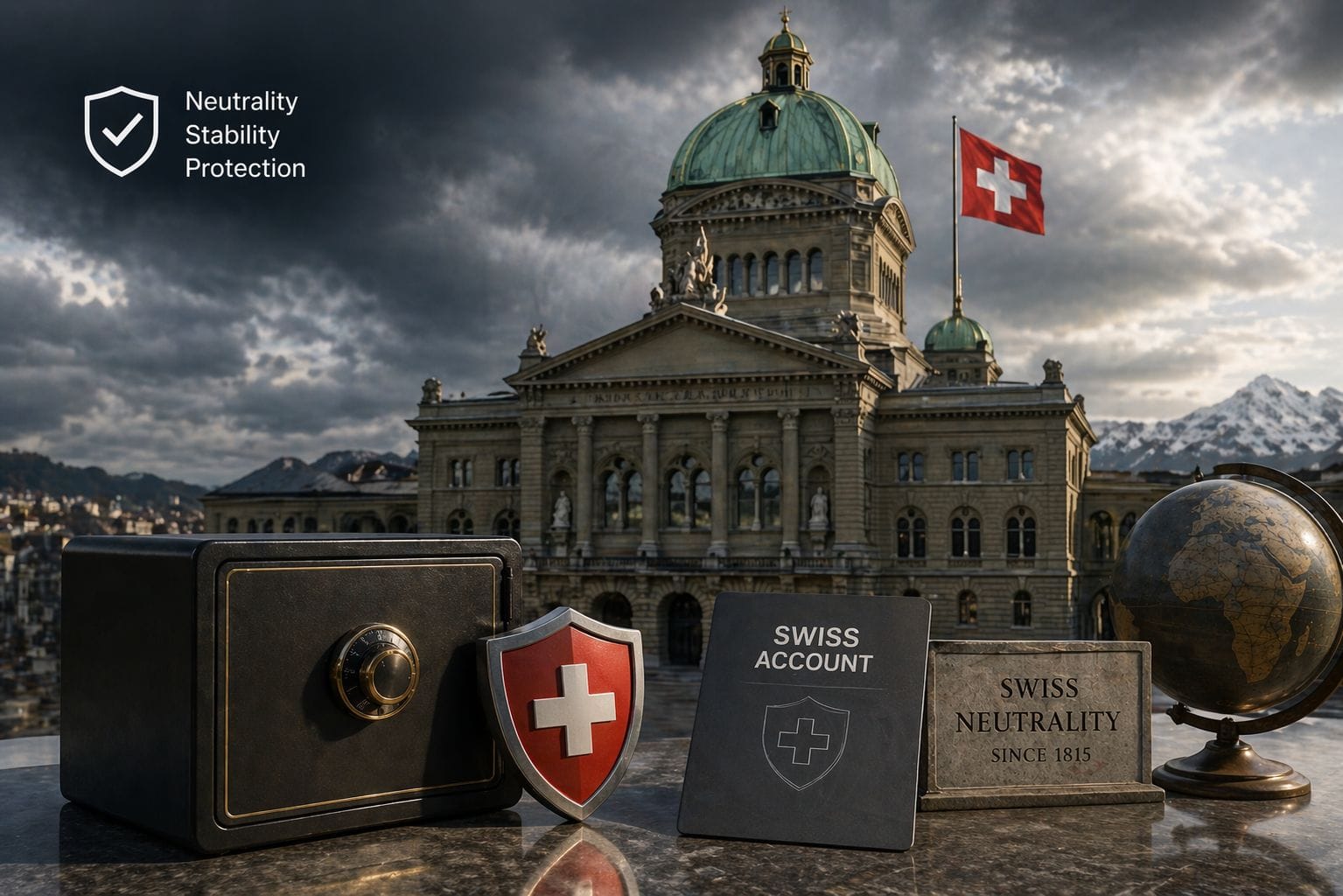
For decades, a persistent belief held that Swiss accounts were untouchable. Wars could rage across Europe, sanctions could hammer entire economies, and your CHF sitting in a Zurich vault would stay exactly where you left it. That narrative had some basis in reality. Switzerland maintained its neutrality through both World Wars without being invaded. The Congress of Vienna formally recognized Swiss neutrality in 1815, and the country has not participated in a foreign war since.
Then Russia invaded Ukraine on February 24, 2022. Four days later, the Swiss Federal Council — meeting at the Federal Palace in Bern — did something that rattled the foundations of two centuries of banking doctrine. Switzerland adopted the European Union’s sanctions against Russia. Asset freezes went into effect immediately. Swiss Foreign Minister Ignazio Cassis said something worth remembering: “Playing into the hands of an aggressor is not neutral.”
That single sentence redefined what Swiss neutrality means for your bank account. And for anyone evaluating the world’s safest financial jurisdictions (opens in new tab), it’s the most consequential shift since 1934.
Who Gets Frozen — and Who Doesn’t
This is where most articles fall apart. They mention sanctions, wave their hands about “geopolitical risk,” and leave you wondering whether your perfectly legal savings account could vanish overnight. The reality is far more structured than that.
SECO — the State Secretariat for Economic Affairs — is Switzerland’s sanctions authority. It maintains the lists. It enforces compliance. And the rules it follows are specific. Under the Swiss Sanctions Act (the Embargo Act), assets get frozen when an individual, company, or entity appears on SECO’s Annex 8 list. That list mirrors EU sanctions designations, though Switzerland can deviate. Everyone else? Their accounts continue to function normally.
After Russia’s invasion, Swiss banks froze accounts belonging to sanctioned oligarchs, state-connected entities, and individuals on the OFAC sanctions list or EU equivalents. Names like Igor Sechin, Alisher Usmanov, Gennady Timchenko, and Vladimir Putin himself appeared on these lists. But here’s what matters for ordinary depositors: the freeze applied exclusively to listed persons and their controlled entities. A Brazilian entrepreneur, a German family office, or an American tech founder holding CHF in a Swiss account? Completely unaffected.
The critical distinction: Swiss sanctions target who you are, not where you’re from. Being Russian doesn’t automatically mean your account gets frozen. Being on the sanctions list does. That said, Swiss banks now cap new deposits from Russian nationals and residents at CHF 100,000 — a restriction that applies regardless of sanctions status.
Are Swiss Bank Accounts Safe During War? The WWII Stress Test
To understand today’s protections, you need to understand what happened — and what went wrong — during World War II. Switzerland’s WWII banking history is not a simple success story. It’s a cautionary tale wrapped in a security blanket.
During the war, Swiss banks accepted gold deposits from Nazi Germany — at least 1.7 billion Swiss francs worth, much of it looted from occupied nations and Holocaust victims. The Swiss National Bank processed these “triangular transactions” while maintaining the fiction of neutral commerce. UBS reportedly held an account for Adolf Hitler estimated at 1.1 billion Reichsmarks. At the same time, UBS actively protected accounts belonging to Jewish depositors, even contracting the Swiss Armed Forces to move assets to underground military bunkers when Hitler contemplated invading Switzerland in 1940. The crisis behaviour of the currency itself — why it rises on the worst days — is covered in our piece on the Swiss franc at zero interest.
After the war, the reckoning was ugly. Heirs of Holocaust victims spent decades trying to recover dormant accounts. Swiss banks demanded death certificates — documents the Nazis never issued. The World Jewish Congress lawsuit, launched in 1995, eventually resulted in a $1.29 billion settlement paid to approximately 458,400 claimants. Switzerland paid 250 million Swiss francs to compensate looted western European central banks.
The lesson from WWII isn’t “Swiss accounts are unsafe.” The lesson is that Swiss neutrality has always been more pragmatic than principled, and the protections it offers depend heavily on which side of history you’re standing on. For legitimate, non-sanctioned depositors, Switzerland war asset protection worked — imperfectly, sometimes unjustly slowly, but the underlying accounts survived the war intact.
How Swiss Banking Protections Evolved: 1934 to 2026
Federal Act on Banks codifies banking secrecy into criminal law. Unauthorized disclosure becomes a criminal offense.
WWII reveals dual role: Swiss banks protect some depositors while processing looted Nazi gold. Neutrality doctrine tested.
$1.29B Holocaust settlement forces accountability. Dormant accounts scandal reshapes Swiss banking oversight.
esisuisse deposit protection scheme established. Formalizes depositor guarantees up to CHF 100,000 per client.
Switzerland joins Automatic Exchange of Information (AEOI). Tax secrecy effectively ends for foreign account holders.
Russia sanctions adopted. CHF 7.1B frozen. Swiss neutrality doctrine permanently redefined.
Swiss Sanctions Geopolitics: The New Rules of the Game
The 2022 decision didn’t happen in a vacuum. Switzerland’s alignment with EU sanctions reflects a broader shift in how the country interprets its neutrality doctrine. Under The Hague Convention principles — which Switzerland officially follows — neutrality means no participation in wars, no military alliances, and no provision of weapons. Nowhere does it say a neutral country must serve as a financial lifeline for aggressors.
SECO now administers the Swiss Sanctions Act with increasing sophistication. Banks must declare all assets belonging to sanctioned persons and entities. In August 2024, Switzerland’s Office of the Attorney General launched criminal investigations into potential sanctions violations and money laundering, temporarily freezing an additional CHF 1.65 billion in assets.
For international clients thinking about Swiss bank account for non-residents, this matters immensely. The system works. Compliance is real. But if you’re not on a sanctions list, the system works in your favor — your assets receive the same institutional protections that have survived 200 years of European conflict. Securing swiss account approval tips can help streamline the process for clients. Understanding the specific requirements and documentation needed is crucial for success. Additionally, staying informed about the latest regulations will further enhance your chances of gaining approval. Many clients choose to open an account with Swiss banks due to the country’s long-standing reputation for financial privacy and security. This allows individuals to protect their assets while benefiting from a stable economic environment. Moreover, Swiss banks often offer a range of services tailored to meet the needs of diverse clientele, further enhancing the appeal of establishing a banking relationship there.
Line chart showing Russian assets frozen in Switzerland rising from approximately CHF 6.3 billion in March 2022 to CHF 7.7 billion by March 2024, then settling at CHF 7.1 billion by August 2024 after some assets were released following review.
Asset Freeze vs. Asset Forfeiture: A Difference Worth Billions
Most people confuse these two concepts. The difference is enormous, and it reveals something fundamental about how Swiss law protects property rights — even for sanctioned individuals.
An asset freeze means your money can’t move. You can’t withdraw it, transfer it, or invest it. But it’s still legally yours. Swiss law is explicit about this: freezing does not remove property rights from the sanctioned person, company, or organization. Think of it as a pause button, not a delete button.
Asset forfeiture is confiscation. The government takes the money permanently. And here’s the part that surprises people: as of 2026, Switzerland has no legal basis for forfeiting sanctioned Russian assets. The Swiss government stated this clearly in a November 2024 report to parliament. The Embargo Act doesn’t provide for it. The ordinance on Ukraine-related measures doesn’t address it. Three motions have been introduced in parliament to create such a legal framework, but none have passed.
Canada is the only G7 country that has actually forfeited sanctioned assets — a modest US$26 million from a single oligarch’s company. Switzerland, despite holding over CHF 7 billion in frozen Russian assets, has taken zero forfeiture action. Property rights still matter, even in wartime. Even for adversaries. That’s not an accident — it’s a deliberate feature of Swiss law that protects everyone, including you.
| Feature | Asset Freeze | Asset Forfeiture |
|---|---|---|
| Ownership | Retained by original holder | Transferred to the state |
| Legal basis in Switzerland | Embargo Act + SECO ordinances | No current legal basis (as of 2026) |
| Reversibility | Yes — lifted when sanctions are removed | Permanent — no reversal mechanism |
| Affected Russian assets | CHF 7.1 billion + 17 properties | CHF 0 (none forfeited) |
| Property rights | Preserved under rule of law | Extinguished upon forfeiture |
| Due process | Administrative — SECO list designation | Judicial review required (if law created) |
How esisuisse Deposit Protection Actually Works
Geopolitics aside, there’s a second layer of Swiss account safety that operates independently of sanctions, wars, or neutrality debates. It’s called esisuisse, and it’s the mechanism that protects your money if a bank itself fails — whether because of war, mismanagement, or systemic crisis.
Esisuisse is a self-regulatory foundation established in 2005 by the Swiss Bankers Association. Every bank and securities firm operating a branch in Switzerland must be a member. Here’s how the mechanics work: if a bank goes bankrupt, esisuisse guarantees deposit payouts up to CHF 100,000 per client, per institution. Private accounts, savings accounts, numbered accounts, business accounts — all covered.
Since January 2023, protections were strengthened. Banks must now pre-deposit 50% of their payment obligations as collateral with a third-party custodian. The total pool available stands at approximately CHF 7.9 billion, equal to 1.6% of all protected deposits in Switzerland. Beyond that, every bank is legally required to hold assets in Switzerland worth at least 125% of its total protected deposits.
For anyone evaluating how to evaluate bank safety beyond credit ratings (opens in new tab), this is the structural answer. FINMA supervises. The Swiss National Bank backstops systemic stability. And esisuisse covers individual depositors. Three overlapping safety nets, each operating independently.
Doughnut chart showing the three layers of Swiss depositor protection: FINMA regulatory supervision (ongoing bank oversight), esisuisse deposit insurance (up to CHF 100,000 per client, backed by bank commitments of about CHF 8.1 billion), and Swiss National Bank systemic stability measures.
Your Practical Risk Assessment: 5 Questions That Actually Matter
Abstract analysis doesn’t help much when you’re actually trying to protect real money. After examining the historical record, the sanctions framework, and the deposit protection system, here’s the practical framework. These five questions determine whether a Swiss account frozen scenario could realistically affect you.
Question 1: Are you — or any beneficial owner on the account — on any sanctions list? Check SECO’s sanctions database, the EU consolidated list, and the OFAC SDN list. If you’re not on any of them, your account is not subject to freeze. Period.
Question 2: Do you hold citizenship or tax residency in a country currently under Swiss/EU sanctions? Even without being personally listed, certain nationalities face enhanced restrictions. Russian nationals can no longer deposit more than CHF 100,000 in Swiss accounts. Similar restrictions could theoretically apply to other nationalities if future sanctions are imposed.
Question 3: Are any of your business entities controlled by or connected to sanctioned persons? SECO traces beneficial ownership. If a company in your structure has a sanctioned shareholder, the entire entity’s accounts could be frozen. Indirect control counts.
Question 4: Can you fully document your source of wealth? Swiss banks conduct aggressive KYC/AML checks. During periods of geopolitical tension, these checks intensify. If your wealth documentation is clean and comprehensive, you pass through periods of heightened scrutiny without disruption. The banks that accept non-resident accounts (opens in new tab) today are particularly thorough about documentation.
Question 5: Is your account at a systemically important Swiss bank? PostFinance, UBS, Raiffeisen, and ZKB carry implicit government backing. Smaller banks rely more heavily on the esisuisse pool. During extreme scenarios, a top-tier Swiss private bank (opens in new tab) with strong capitalization offers structural advantages.
Horizontal bar chart comparing risk levels across depositor profiles. EU/Swiss residents with clean documentation face near-zero risk. US citizens face moderate compliance complexity. Nationals of sanctioned countries face high restriction risk. Sanctioned individuals face total asset freeze.
The Swiss Franc Factor: Why Currency Matters in Wartime
There’s a dimension to Swiss account safety during war that goes beyond institutional protections. It’s the currency itself. The Swiss franc has been one of the most consistently strong currencies in modern history. During both World Wars, the franc appreciated against every major belligerent currency. In the early months of Russia’s 2022 invasion, the franc initially strengthened as capital fled into perceived safe havens.
Switzerland holds approximately 1,040 tonnes of gold reserves — more per capita than virtually any nation on earth. Unlike many countries that store gold reserves abroad, Switzerland keeps the majority domestically in deep Alpine vaults, immune to foreign government seizure. That gold backing underpins the franc’s stability in ways that paper currencies backed by government promises alone cannot match.
For depositors worried about wartime scenarios, this means a Swiss account offers dual protection: the institutional framework (FINMA, esisuisse, banking law) and the monetary framework (gold reserves, conservative central banking, current account surplus). Both matter. Both have proven resilient during actual wars.
What a Real War on Swiss Soil Would Mean
I should address the elephant in the room. Everything above assumes Switzerland itself is not invaded. That assumption has held for 210 years, but war planning ignores no scenario. So what happens if the unthinkable occurs?
Switzerland maintains a citizens’ militia army of approximately 140,000 troops. The Alpine terrain provides natural defensive barriers. The country has extensive underground military infrastructure — bunkers, command centers, and hardened facilities. Swiss banks themselves maintain geographically distributed data centers and backup facilities designed to survive physical attacks.
More practically, Swiss banking data — account records, transaction histories, ownership documentation — is replicated across multiple secure facilities. Even in a scenario where one or more Swiss cities were physically damaged, the banking system’s records would survive. The question wouldn’t be whether your account data exists, but how quickly access could be restored.
This is an extreme edge case. No credible military analyst puts a Swiss invasion among probable scenarios. But the infrastructure exists precisely because Switzerland treats its banking system as a strategic national asset, not just a commercial industry.
Bilateral Treaties and International Enforcement
Swiss bank account safety during war also depends on the web of bilateral treaties Switzerland maintains with other nations. These treaties create mutual legal obligations that survive conflicts between third parties. Switzerland has bilateral investment protection treaties with dozens of countries, and its banking agreements include provisions for handling cross-border assets during periods of international instability.
The Geneva Conventions, hosted and heavily shaped by Switzerland, establish frameworks for protecting civilian property during armed conflict. While these conventions primarily address occupied territory, they reinforce the principle that neutral nations have obligations to protect foreign assets held within their borders. Switzerland takes these obligations seriously — partly from genuine principle, partly because its entire economic model depends on the world believing it will.
For depositors concerned about specific countries or conflict scenarios, a conversation with a qualified international banking advisor is essential. General frameworks provide comfort. Specific situations require specific analysis.
Swiss Neutrality in Major Conflicts: What Happened to Depositors
| Conflict | Swiss Position | Impact on Depositors | Accounts Frozen? | Long-Term Outcome |
|---|---|---|---|---|
| World War I (1914–1918) | Armed neutrality maintained | Capital inflows from belligerent nations; Swiss franc appreciated | No | Swiss banking reputation strengthened globally |
| World War II (1939–1945) | Diplomatically neutral; economic ties to Axis powers | Jewish depositors’ assets protected but access delayed for decades | No general freezes; dormant accounts became disputed | $1.29B settlement in 1998; 250M CHF paid to Allied banks in 1946 |
| Cold War (1947–1991) | Tacit Western alignment; formal neutrality | No disruption; Switzerland became premier safe haven | No | Banking sector grew to manage ~25% of global cross-border wealth |
| Gulf War / Yugoslav Wars (1990s) | Neutral; adopted limited UN sanctions | Targeted freezes on specific regimes and leaders only | Yes — targeted sanctions lists only | Non-sanctioned depositors fully unaffected |
| Russia-Ukraine War (2022–present) | Adopted EU sanctions; broke with strict neutrality interpretation | CHF 7.1B frozen from sanctioned individuals/entities | Yes — 100+ individuals, dozens of entities | Non-sanctioned depositors fully unaffected; no forfeitures |
The Bottom Line for Non-Sanctioned Depositors
Swiss banking has survived every major war of the past 200 years. Not perfectly — the WWII dormant accounts scandal proved that. Not without evolution — the 2022 Russia sanctions proved that too. But for legitimate, compliant depositors whose names don’t appear on sanctions lists, Swiss bank accounts have maintained an unbroken track record of asset preservation through armed conflict.
The protections are layered: constitutional neutrality dating to 1815, the Swiss Banking Act of 1934, FINMA regulatory oversight, esisuisse deposit insurance up to CHF 100,000, mandatory 125% collateralization of protected deposits, and a currency backed by 1,040 tonnes of domestically stored gold.
Are Swiss bank accounts safe during war? For the overwhelming majority of depositors — including international clients, family offices, and HNWIs who maintain clean documentation and stay off sanctions lists — the answer is yes. The system is not perfect. No system is. But two centuries of stress testing have produced a framework that no other jurisdiction matches.
If you’re seriously considering structuring your wealth to withstand geopolitical uncertainty, the starting point is clean documentation, proper KYC compliance, and choosing the right institution. The infrastructure is there. The track record is there. The question is whether you’ve done the work to position yourself on the right side of it.
Related reading:
Frequently Asked Questions
Can Switzerland freeze my account if my country goes to war?
Only if you personally appear on a SECO-administered sanctions list or if Switzerland adopts sanctions against your country that include financial restrictions. Being a citizen of a country at war does not, by itself, trigger an account freeze. However, enhanced due diligence and deposit caps (like the CHF 100,000 limit for Russian nationals) could apply during active conflicts.
How much money does esisuisse protect in a Swiss bank account?
Esisuisse protects deposits up to CHF 100,000 per client, per institution. This covers private accounts, savings accounts, numbered accounts, and business accounts. The total pool available is approximately CHF 7.9 billion. Since January 2023, banks must pre-deposit 50% of their obligations as collateral, and all banks must hold Swiss-based assets worth at least 125% of protected deposits.
Did Switzerland really break its neutrality by sanctioning Russia?
Switzerland adopted EU economic sanctions against Russia but maintained that this doesn’t violate its neutrality doctrine. Swiss officials argued that under The Hague Convention, neutrality prohibits military participation — not economic measures. The Swiss Foreign Minister stated that supporting an aggressor by remaining financially passive would itself be a violation of neutral principles. A ballot initiative (“Pro Souveräne Schweiz”) was launched to constitutionally enshrine stricter neutrality, but it hasn’t succeeded.
Can Switzerland confiscate frozen Russian assets?
Not currently. As of 2026, Switzerland has no legal basis for asset forfeiture under sanctions law. Frozen assets remain the legal property of the sanctioned person or entity — the freeze prevents transactions but doesn’t transfer ownership. Several parliamentary motions have been introduced to create a forfeiture framework, but none have been enacted. This protection of property rights applies equally to all depositors under Swiss law.
What happens to Swiss bank accounts if Switzerland is invaded?
This is an extreme edge-case scenario. Swiss banks maintain geographically distributed data centers and hardened backup facilities designed to survive physical attacks. Account records are replicated across multiple secure locations. Switzerland also maintains extensive underground military infrastructure. No credible military analysis places a Swiss invasion among probable scenarios, but the banking system is built to preserve data integrity even under severe disruption.
Is the Swiss franc a safe currency during wartime?
Historically, yes. The Swiss franc has appreciated against major currencies during both World Wars and during the 2022 Russia-Ukraine conflict. Switzerland holds approximately 1,040 tonnes of gold — more per capita than nearly any nation — stored primarily in domestic Alpine vaults. The currency is backed by a conservative central bank policy, persistent current account surpluses, and one of the lowest debt-to-GDP ratios among developed nations.
References
- esisuisse — The Swiss Deposit Insurance System (opens in new tab)
- White & Case — Switzerland Reinforces Sanctions Against Russia (opens in new tab)
- OCCRP — Switzerland’s Frozen Russian Assets Continue to Climb (opens in new tab)
- Global Investigations Review — Swiss Seizure and Forfeiture of Russian Assets (opens in new tab)
- Wikipedia — Swiss Neutrality (History and Modern Doctrine) (opens in new tab)