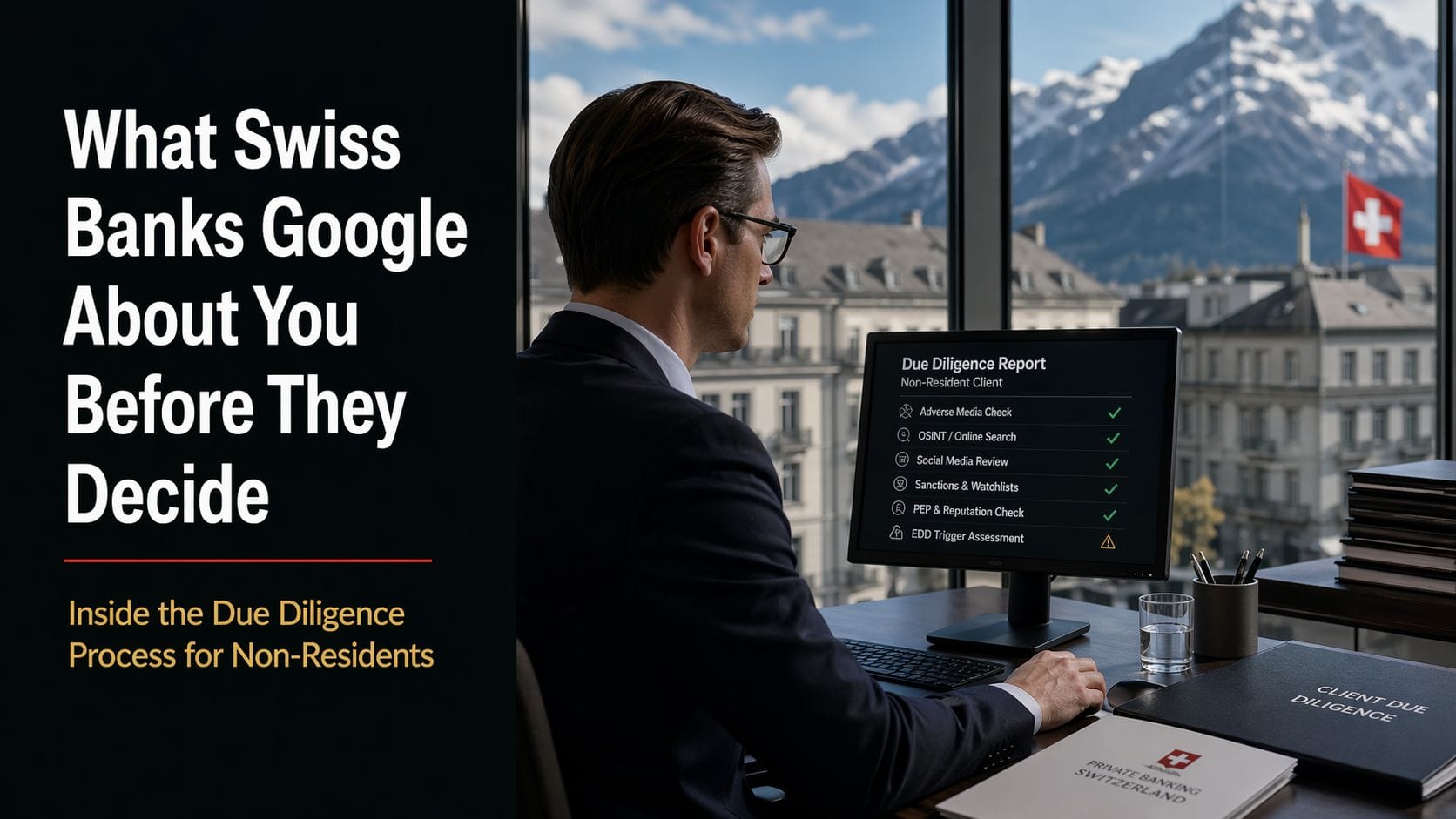
What banks check before opening account non-resident applicants goes far beyond passport copies and utility bills. Swiss banks systematically Google your name, scan your LinkedIn profile, search adverse media databases, and run your identity through Refinitiv World-Check — all before a compliance officer ever picks up the phone. Your digital footprint can kill your application faster than a missing signature.
That probably contradicts everything you’ve read about Swiss bank account requirements. Most guides list documents: passport, proof of address, source of funds declaration. They make it sound like a paperwork exercise. In reality, the paperwork is table stakes. What actually determines whether your application advances or dies in committee is what the bank’s compliance team finds when they type your name into Google.
Reputation screening happens everywhere, not only in Zurich. Our offshore banking guide covers how other jurisdictions run the same checks.
The checklist still matters, but the real answer to how to open Swiss bank account is whether the documents support the story the bank is already testing.
I’ve spent over a decade helping international clients navigate Swiss compliance, and here’s what still surprises most applicants: roughly 1 in 3 non-resident applications get rejected or abandoned before they reach a relationship manager. Not because the client lacks wealth. Because something in their digital profile raised a flag nobody anticipated. An old news article. A LinkedIn connection to a sanctioned entity. A business partner who appeared on a watchlist five years ago. These aren’t hypothetical scenarios — they’re Tuesday morning for a Swiss compliance officer.
The Myth: Banks Only Check Your Documents
If you’ve been told that Swiss account opening service is purely about gathering the right PDFs, you’ve been given incomplete advice. Swiss banks operate under FINMA regulations that mandate a multi-layered due diligence process. Your documents are layer one. Your digital existence is layer two. And layer two often matters more.
The Swiss Financial Market Supervisory Authority (FINMA) requires all licensed banks to implement Know Your Customer (KYC) procedures that go well beyond document verification. Under the Swiss Anti-Money Laundering Act (AMLA), banks must take “reasonable measures” to verify the identity, background, and risk profile of every prospective client. For non-residents, those measures automatically escalate to enhanced due diligence (EDD).
So what does that actually look like from the inside?
How Swiss Banks Investigate You: The 7-Step OSINT Process
Open-Source Intelligence — OSINT — is the term compliance professionals use for information gathered from publicly available sources. Every Swiss bank background check follows a remarkably similar sequence. Here’s the process flow that most applicants never see.
Name Screening
Your name is run through Refinitiv World-Check, LexisNexis Risk, and internal databases. Matches against sanctions, PEP, and EEP lists are flagged instantly.
Google Search
Compliance officers search your full name, variations, and business entities. Results from the first 3–5 pages are reviewed and archived.
Adverse Media Check
Dedicated screening tools scan global news archives for negative coverage: fraud allegations, lawsuits, regulatory actions, criminal associations.
LinkedIn & Social Media
Your professional profile is checked for consistency with your application. Job titles, connections, endorsements, and company affiliations are verified.
Corporate Registry Check
Any companies you own or direct are verified through national registries, offshore databases, and beneficial ownership records.
Network Analysis
Your known associates, business partners, and family members are screened for sanctions, PEP status, or adverse media connections.
Risk Scoring & Decision
All findings are compiled into a risk profile. Low-risk profiles proceed. Medium triggers EDD. High-risk profiles go to committee — or get declined.
That seven-step process typically unfolds within 5–15 business days. For straightforward European profiles with clean digital footprints, it can be completed in a single afternoon. For clients from FATF high-risk jurisdictions or those with complex corporate structures, the OSINT review can stretch for weeks.
What Banks Check Before Opening Account Non-Resident: The Database Layer
Before any human reads your application, automated systems have already produced a preliminary risk score. Swiss banks rely on two primary commercial databases for initial screening, and understanding how they work gives you an immediate advantage. This information will be crucial when considering swiss bank ratings for 2026. A favorable rating can enhance your credibility and open doors for investment opportunities. Moreover, being informed about the current trends and regulatory changes in the banking sector will further bolster your position.
Refinitiv World-Check: The Gatekeeper
Every major Swiss bank — from UBS to the smallest cantonal institution — uses Refinitiv’s World-Check database. This isn’t optional. It’s a regulatory expectation. World-Check aggregates data from over 650 sanctions and regulatory lists, PEP databases spanning 240 countries, and adverse media from thousands of sources across multiple languages.
A “hit” on World-Check doesn’t automatically disqualify you. But it escalates your file from standard due diligence to enhanced due diligence instantly. That escalation means longer timelines, more documentation requests, and senior management involvement. If you’re considering which institution to approach, our guide to top Swiss banks for foreigners (opens in new tab) explains how different banks handle risk tolerance differently.
LexisNexis Risk Solutions: The Deep Scanner
While World-Check catches the obvious flags, LexisNexis Risk Solutions goes deeper into litigation records, regulatory filings, and corporate ownership chains. Banks use LexisNexis to verify claims you’ve made about your business history, cross-reference corporate structures, and identify hidden connections between entities.
Here’s the thing most applicants miss: LexisNexis doesn’t just search for your name. It searches for your name in combination with entity names, addresses, and known associates. That web of connections can surface a risk flag you didn’t know existed — like a dormant company you forgot to dissolve that shares an address with a sanctioned entity.
What Actually Triggers Enhanced Due Diligence
Enhanced due diligence (EDD) is where most non-resident applications get stuck. The bank doesn’t say “no” — it says “we need more,” and the requests can feel endless. Based on publicly available FINMA guidance and industry reporting, here’s where EDD triggers concentrate.
Doughnut chart showing EDD trigger distribution: High-risk jurisdiction residence 28%, Adverse media findings 22%, PEP or EEP status 18%, Complex corporate structures 14%, Inconsistent source of wealth documentation 10%, Large cash-based businesses 8%.
The largest single trigger — accounting for roughly 28% of EDD escalations — is residence in a FATF high-risk or grey-list jurisdiction. That’s a factor you can’t change. But notice the second-largest trigger: adverse media findings at 22%. That one is often fixable. And it’s the one most applicants completely ignore.
The Google Search: What Compliance Officers Actually Look For
Here’s the part nobody talks about publicly but every compliance professional does privately: the Google search. It’s mandated by the European Banking Authority’s EDD guidelines, referenced in the FCA’s Financial Crime Guide, and built into the standard operating procedures of every Swiss compliance department I’ve encountered.
A compliance officer doesn’t casually browse your search results. They conduct structured Google search compliance queries designed to surface specific categories of risk. A typical search protocol includes your full legal name in quotes, your name combined with terms like “fraud,” “lawsuit,” “investigation,” or “sanctions,” your business name with similar modifiers, and image searches to verify identity consistency across platforms.
From the compliance desk: Compliance officers typically review the first 3–5 pages of Google results. They archive screenshots of anything flagged. That archived screenshot becomes part of your permanent compliance file. Even if the original article disappears, the bank’s record doesn’t.
What most people don’t realize is that a negative news check doesn’t require the story to be true. The mere existence of a negative article — even one that was later retracted — creates a compliance obligation. The bank must document it, assess it, and justify any decision to proceed.
Adverse Media Screening: Beyond Simple Googling
Google is just the starting point. Dedicated adverse media screening goes far deeper. Banks use specialized platforms that scan archived web pages (over 600 billion indexed), court records across multiple jurisdictions (1.8 billion+ records), social media across major platforms, and more than 40,000 media sources in over 100 countries.
The technology has evolved dramatically. Modern adverse media tools use natural language processing to distinguish between “John Smith the CEO” and “John Smith the tennis player.” They filter by sentiment, geography, and relevance. And critically, they pick up content in languages you might not expect — including local-language news from your country of origin that you may never have seen yourself.
The OSINT Toolkit: Which Data Sources Banks Actually Use
Open-source intelligence for banking compliance draws from a surprisingly wide range of sources. Not all carry equal weight, but understanding the full spectrum helps you audit your own exposure.
Horizontal bar chart showing relative importance of OSINT sources: Sanctions and watchlists (critical, 95%), Adverse media databases (high, 88%), Corporate registries (high, 82%), Google search results (moderate-high, 75%), LinkedIn profiles (moderate, 68%), Court and litigation records (moderate, 65%), Social media (lower, 45%), Domain and website ownership (lower, 40%).
Sanctions and watchlists sit at the top because they carry a binary legal consequence: if you’re sanctioned, the bank can’t proceed. Period. But for most legitimate applicants, it’s the middle tier — Google results, LinkedIn, and corporate registries — that shapes the practical outcome of your application.
Your LinkedIn Profile: The Compliance Check Nobody Warns You About
LinkedIn compliance checking has become standard practice in private banking. A 2024 industry survey found that over 70% of compliance professionals in financial services actively use LinkedIn during client onboarding reviews. Here’s what they’re looking for — and what raises flags.
| LinkedIn Element | What Banks Verify | Red Flag Indicators |
|---|---|---|
| Job titles & timeline | Consistency with source-of-wealth narrative in your application | Gaps, inflated titles, timeline mismatches with CV or documents |
| Connections | Links to PEPs, sanctioned individuals, or adverse media subjects | Direct connections to flagged individuals, especially in small networks |
| Company pages | Whether companies listed actually exist and match registry records | Companies with no web presence, employees, or verifiable activity |
| Endorsements & recommendations | Signals of authentic professional relationships | Empty profile with no activity despite claimed senior positions |
| Activity & posts | Professional credibility and consistency of public persona | Content promoting high-risk investment schemes or unregulated financial products |
| Profile photo | Identity consistency with passport and other documents | No photo, stock photo, or significant appearance discrepancy |
What’s most interesting about LinkedIn checks is what they reveal about consistency. A compliance officer doesn’t expect your LinkedIn to be a carbon copy of your formal CV. But they do expect the core narrative to align. If your application says “CEO of a construction company for 15 years” and your LinkedIn shows “Marketing Consultant” with three connections and no activity since 2019, that inconsistency will generate questions.
No LinkedIn profile at all is actually a flag in itself. In private banking, the absence of a digital footprint for someone claiming to run a significant business is treated with suspicion. It suggests either deliberate obscurity or a fabricated identity. Neither interpretation helps your application.
Social Media Beyond LinkedIn: What Banks Can and Cannot Access
A social media check during a bank application operates within clear legal boundaries. Swiss data protection law (the revised Federal Act on Data Protection, or nFADP) restricts what banks can do with personal data. However, publicly available social media content is fair game for compliance purposes.
Banks typically check Facebook, Instagram, Twitter/X, and any platform where your profile is public. They’re not looking at your holiday photos. They’re scanning for posts or associations that contradict your stated profession or wealth source, public displays of wealth that seem inconsistent with your declared income, connections or interactions with known high-risk individuals, and content suggesting involvement in unregulated financial activities.
Private accounts are off-limits. Banks cannot request your social media passwords, and they don’t. But anything publicly visible is documented. I’ve seen applications delayed because a client’s Instagram showed cryptocurrency trading content while their source-of-wealth form stated “real estate income” only. That inconsistency — even on a casual platform — triggered a formal clarification request that added three weeks to the process.
The Numbers Behind Swiss Bank Due Diligence
Understanding what banks check before opening account non-resident applications becomes more concrete when you look at the operational scale involved. These figures reflect publicly reported industry data and regulatory disclosures.
Those numbers aren’t static. The coverage of adverse media screening alone has expanded roughly 20% year-over-year as platforms add more non-English language sources. If you were screened three years ago and came back clean, that doesn’t guarantee the same result today — new databases and new sources may surface information that wasn’t previously indexed.
Real Rejection Scenarios: When Your Digital Footprint Sinks the Application
In my practice, I’ve seen patterns emerge consistently. These anonymized examples illustrate how online reputation and banking compliance intersect in ways most applicants don’t anticipate.
The forgotten lawsuit. A tech entrepreneur applied with CHF 2 million in assets, clean source of wealth documentation, and a European passport. Everything looked solid on paper. But a Google search turned up a class-action lawsuit from 2018 naming their company in a data breach complaint. The lawsuit had been settled years earlier. The entrepreneur had completely forgotten about it. The bank hadn’t. It triggered EDD, required a legal opinion letter from the entrepreneur’s attorney, and delayed the opening by six weeks.
The business partner problem. A successful retailer from the Middle East had impeccable personal documentation. But their business partner — listed as a co-director in the corporate registry — appeared on an older adverse media list connected to a tax evasion investigation in a neighboring country. The partner had been cleared. But the historical association was enough to trigger enhanced network screening. Three banks declined before a fourth agreed to proceed with ongoing monitoring conditions.
The LinkedIn ghost. A wealth manager recommended a client with CHF 5 million in liquid assets from professional services income. The client’s LinkedIn profile was created in 2012 but showed no activity, no connections, and a generic profile photo. For someone claiming 20 years of senior consulting experience, the empty digital presence created a credibility problem. The bank asked for client reference letters, additional employment verification, and a detailed explanation of why the professional digital footprint was so thin. What should have been a 4-week process became a 3-month ordeal.
Your Digital Footprint Audit Checklist: 9 Steps Before You Apply
This is the part where you take action. Before approaching any Swiss bank — or before engaging a consultant to do so on your behalf — conduct this self-audit. Think of it as seeing yourself the way a compliance officer will.
Pre-Application Digital Footprint Audit
1. Google yourself. Search your full name in quotes, your name plus your business, and your name plus your country. Review the first five pages. Flag anything negative, confusing, or outdated.
2. Check for adverse media. Search your name with keywords like “fraud,” “lawsuit,” “investigation,” “arrest,” or “scandal.” Even false hits need addressing.
3. Audit your LinkedIn. Ensure your work history matches your source-of-wealth narrative exactly. Remove any inconsistencies. Add a professional photo if you don’t have one.
4. Review corporate registries. Check that every company you own or direct shows correct, current information. Close or update dormant entities.
5. Screen your social media. Review all public profiles. Remove content that contradicts your application or associates you with high-risk activities.
6. Check your associates. Google your business partners, co-directors, and close family members. Their digital exposure can affect your application.
7. Look for name confusion. If someone with your exact name has negative press, prepare a disambiguation statement in advance.
8. Prepare explanations. For any flagged item that can’t be removed, draft a brief written explanation with supporting documentation.
9. Run a World-Check equivalent. Several commercial services offer personal screening against sanctions and PEP lists. Use one before the bank does.
Preparing for what banks check before opening account non-resident applications is the single most effective thing you can do to shorten your timeline and increase your approval odds. Our team at Easy Global Banking runs its own sanctions, PEP and adverse-media screening before any bank sees a client file — it’s the first step in every non-resident Swiss banking engagement (opens in new tab).
How Long Does the OSINT Screening Take?
Timeline expectations differ wildly based on your risk profile. Here’s a realistic breakdown.
The difference between the 3-day scenario and the 16-week scenario is rarely about wealth or legitimacy. It’s about preparation. A well-prepared compliance dossier with pre-addressed risk factors can compress a 6-week process into 2 weeks. Showing up unprepared doesn’t just slow things down — it creates a first impression of disorganization that colors every subsequent interaction with the compliance team.
EDD Triggers: The Full Reference Table
Not every flag carries equal weight. Swiss compliance departments categorize triggers by severity level, which determines the depth of additional review required. Understanding these categories helps you anticipate what your specific profile will trigger and whether you should choose to evaluate bank safety beyond credit ratings (opens in new tab) when selecting an institution that fits your risk profile.
| EDD Trigger | Severity | Typical Bank Response | Applicant Action Required |
|---|---|---|---|
| Active sanctions match | Critical | Automatic rejection | Legal counsel required; no self-remedy |
| PEP or EEP status | High | Senior management approval, ongoing quarterly monitoring | Detailed family/political exposure declaration |
| FATF high-risk jurisdiction | High | Extended review, higher minimum deposits, surcharges (CHF 500–1,500/yr) | Enhanced source-of-wealth documentation |
| Adverse media (current) | High | Independent verification, possible committee review | Written explanation with legal support documents |
| Adverse media (historical, resolved) | Medium | Additional documentation, note in compliance file | Court clearance letters, settlement documentation |
| Complex multi-jurisdiction corporate structure | Medium | Full beneficial ownership mapping | Organizational chart with registry confirmations |
| Inconsistent digital footprint | Medium | Additional identity verification requests | Update LinkedIn, prepare reference letters |
| Cash-intensive business | Medium | Transaction monitoring with lower thresholds | Audited financial statements, business activity reports |
| Crypto-derived wealth | Medium | Blockchain analysis, enhanced source-of-funds review | Full transaction history, exchange records, wallet provenance |
| No digital footprint | Low-Medium | Additional identity and employment verification | Create professional online presence, provide employer references |
One important nuance: severity levels aren’t fixed across all banks. A cantonal bank might treat “crypto-derived wealth” as high-risk and decline outright, while a specialized institution like Sygnum or AMINA Bank has built its entire compliance framework around digital assets. This is exactly why choosing the right jurisdiction and institution (opens in new tab) matters as much as having the right documents.
How to Clean Your Digital Footprint Before Applying
Prevention beats remediation every time. But if your self-audit surfaces problems, here’s how to address them practically.
Outdated negative articles. Contact the publisher directly with a correction request. Under the EU’s Right to Erasure (GDPR Article 17) and Switzerland’s equivalent nFADP provisions, you may have grounds for removal if the information is inaccurate, outdated, or irrelevant. If removal isn’t possible, request a correction or update. Even a note stating “This matter was resolved” at the end of an article changes how a compliance officer interprets it.
Name confusion. If someone with your exact name has problematic press, proactively build your own digital presence. Publish professional content under your real name, maintain an active LinkedIn profile, and consider a personal website that clearly establishes your identity and career history. The goal is to ensure the first page of Google results unambiguously points to you — not someone else.
Social media inconsistencies. Don’t delete accounts in a panic. Deletion itself can look suspicious during a bank investigation timeline. Instead, set profiles to private, remove contradictory content, and ensure your public-facing information aligns with your application narrative.
Corporate registry issues. Close dormant companies. Update outdated information. Ensure beneficial ownership records are current. A forgotten BVI company with your name on it will surface during corporate registry screening, and the bank will want to know why it exists, whether it’s active, and how it fits into your wealth structure.
What Happens After the OSINT Check?
Assuming your digital footprint passes review, the compliance process enters its documentation verification phase. This is where traditional requirements — passport, proof of address, source of wealth — get formal scrutiny. But your OSINT results travel with you throughout the entire process. Every subsequent document is evaluated against the digital profile the bank has already built.
For non-residents who pass initial screening smoothly, the remaining steps to open a Swiss bank account (opens in new tab) focus on source-of-wealth documentation, tax compliance declarations (CRS and FATCA forms), initial deposit planning, and — for private banking relationships — a meeting with your prospective relationship manager. If you are applying from outside Switzerland, our guide to remote account opening in Switzerland covers identification, certified copies and the first transfer.
The banks that handle this most efficiently are the ones that receive applications pre-structured in a compliance-ready format. That’s the difference between a 3-week approval and a 3-month headache.
Related reading:
Frequently Asked Questions
Do Swiss banks actually Google every applicant?
Yes. Google search compliance is a standard component of the OSINT review that Swiss banks conduct on every non-resident applicant. The European Banking Authority and Switzerland’s own FINMA guidelines reference open-source internet checks as part of expected enhanced due diligence procedures. This applies to all non-resident applications without exception, though the depth of the search varies by the applicant’s risk classification.
Can an old, resolved lawsuit prevent me from opening a Swiss bank account?
A resolved lawsuit typically won’t prevent account opening, but it will almost certainly trigger enhanced due diligence. The bank will require documentation proving the resolution — such as a settlement agreement, court dismissal order, or attorney confirmation letter. The key is proactive disclosure. If you mention it upfront with supporting documentation, banks treat it as transparency. If they discover it during screening without you having mentioned it, they treat it as a concealment risk.
What is adverse media screening and how does it affect my bank application?
Adverse media screening — also called negative news checking — is the systematic search of global news databases, court records, and public filings for information linking you to criminal activity, fraud, regulatory violations, or reputational risk. Banks use platforms like Refinitiv World-Check and LexisNexis that scan over 40,000 media sources across 100+ countries. A hit doesn’t mean automatic rejection, but it does trigger enhanced review, longer processing times, and additional documentation requirements.
Should I create a LinkedIn profile specifically for my bank application?
You shouldn’t create a profile solely for a bank application — compliance officers can see when a profile was created and will notice if it appeared days before your application. Instead, if you don’t have a LinkedIn presence, build one now and give it time to develop organically. Add a professional photo, accurate work history, and a few connections. The goal isn’t to impress — it’s to be findable and consistent with the professional identity you’re presenting on paper.
How is OSINT different from a traditional background check?
Traditional background checks verify specific documents and records — criminal history, credit reports, employment verification. OSINT goes broader by searching all publicly available information: news articles, social media, corporate registries, court filings, domain ownership records, and more. The distinction matters because OSINT captures context and associations that a document check never would, such as a business partner’s sanctions exposure or a news story about your industry that mentions your company in passing.
Can I find out if I’m on Refinitiv World-Check?
Under the EU General Data Protection Regulation (GDPR) and Switzerland’s nFADP, you have the right to submit a Subject Access Request (SAR) to LSEG (formerly Refinitiv) to ask whether your data appears in World-Check and, if so, to review the information held about you. The process typically takes 30 days. If the data is inaccurate or outdated, you can request correction or deletion. This is worth doing before any banking application, particularly if you’ve ever held a government position, been involved in litigation, or operated in a high-risk jurisdiction.
References
- FINMA — Anti-Money Laundering Supervision (opens in new tab)
- European Banking Authority — AML/CFT Regulation and Policy (opens in new tab)
- FATF — International Standards on Combating Money Laundering (opens in new tab)
- LSEG (Refinitiv) — World-Check Risk Intelligence (opens in new tab)
- Neotas — Regulators Now Require OSINT for AML and CDD (opens in new tab)