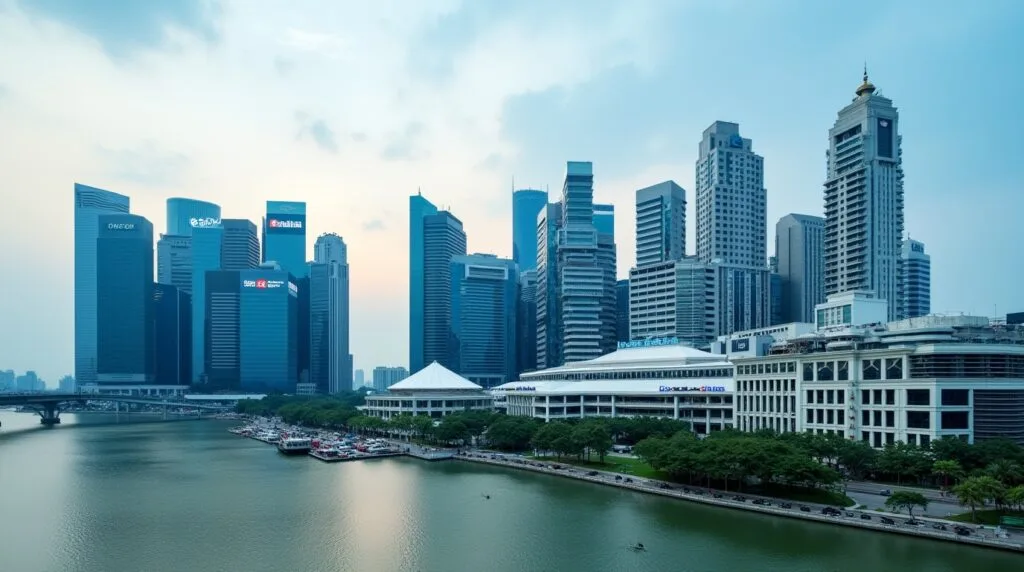

Cryptocurrency banking in Singapore for non-residents is more accessible than most people realise — but it is also more regulated than it was two years ago. Singapore still offers zero capital gains tax on crypto holdings, a stable rule of law, and a banking sector that does not treat digital assets as inherently suspicious. What has changed is the compliance bar. The Monetary Authority of Singapore (MAS) raised it significantly in 2025, and non-residents who do not understand the new framework risk being rejected outright during the account-opening process.
At Easy Global Banking, we help high-net-worth individuals and corporate clients navigate Singapore’s banking system from abroad. The pattern we see repeatedly is this: sophisticated investors arrive with strong financials and genuine crypto exposure, but fall at the first hurdle because they have not prepared for what Singapore banks now require. This guide covers what the current rules actually say, which banks are realistic options, and how to structure your approach so that a crypto-active background is an asset to your application, not a liability.
Why Singapore’s 2025 Regulatory Overhaul Actually Helps Serious Non-Residents
There is a prevailing assumption that more regulation means a harder environment for crypto users. In Singapore’s case, the opposite is closer to the truth — at least for compliant, high-net-worth applicants.
The June 30, 2025 Financial Services and Markets Act (FSMA) deadline was the most significant update to Singapore’s crypto framework since the Payment Services Act of 2019. Before FSMA, Singapore-incorporated platforms could serve overseas customers without being licensed locally, creating a grey zone that attracted poorly capitalised operators. MAS closed that gap entirely. Any Singapore-incorporated entity offering digital token services to overseas clients must now hold a Part 9 FSMA licence or cease operations — no transitional period, no exceptions.
What this means for non-resident banking clients is that the counterparties they are dealing with — the exchanges, custody providers, and payment institutions touching their assets — are now subject to the same oversight framework as traditional financial institutions. Banks that were previously nervous about crypto-related transaction flows now have a cleaner compliance environment to work within. That matters when you are applying for a Singapore bank account and need to explain the source of your funds.
As of mid-2025, MAS had granted licences to 33 digital payment token service providers, up from just 13 at the start of 2024. The accelerating licence count reflects MAS’s commitment to growing the regulated space, not shrinking it. Non-residents who have transacted through any of these licensed platforms are in a far stronger position with Singapore banks than those whose crypto history runs through unlicensed overseas exchanges.
33 MAS-licensed DPT providers as of 2025. Zero percent capital gains tax on crypto for individuals. FATF Travel Rule applies from SGD 1,500. Non-resident bank account processing takes 3 to 8 weeks on average.
The Tax Reality: What “No Capital Gains Tax” Actually Means for Non-Residents
Singapore’s capital gains tax exemption on cryptocurrency is real, but it comes with a condition most guides skip over: it applies when your activity is classified as investment, not trading as a business. The Inland Revenue Authority of Singapore (IRAS) determines this based on factors including frequency of transactions, your holding period, and whether crypto is your primary source of income. An investor who holds Bitcoin or Ether for months at a time and sells occasionally is clearly on the investment side. A professional who executes dozens of trades per week on margin is not.
For the typical non-resident reading this — someone with substantial holdings who wants Singapore-based banking infrastructure — the exemption almost certainly applies. But document everything. IRAS can and does reclassify activity after the fact if records are thin.
The corporate tax rate tells a different story. Singapore-incorporated businesses pay a flat 17% on crypto trading profits. That is lower than most OECD jurisdictions, but it is not zero — and several clients we have worked with were surprised to discover that the “no tax” reputation applied to individuals, not their Singapore entities. Digital Payment Tokens (DPTs) like Bitcoin and Ether are also exempt from Goods and Services Tax, which reduces friction on transactions but should not be confused with an income exemption.
Singapore, UAE, and Switzerland all offer 0% capital gains tax on crypto for individuals in investment mode. Portugal and Germany also offer 0% under certain conditions. The US taxes short-term crypto gains at up to 37%. Germany taxes gains on holdings under one year at up to 45%.
Source: IRAS Singapore, TokenTax 2026 Crypto Tax Guide, PwC Tax Summaries. Individual investor rates; professional/trading income may differ.
Crypto-Friendly Banks in Singapore: Which Institutions Will Actually Work With You
Describing a Singapore bank as “crypto-friendly” in 2026 requires more precision than most content in this space bothers to provide. Here is the reality from our practice: no major Singapore bank will accept a client whose primary income is undocumented crypto trading from an unlicensed exchange. Several will work with high-net-worth individuals who hold significant crypto as part of a diversified portfolio, can document the source of those assets, and are willing to meet minimum balance requirements that start at seven figures USD for private banking services.
DBS Bank is the clearest example of institutional crypto integration in Singapore. Through DBS Digital Exchange (DDEx), the bank offers regulated trading, custody, and tokenisation services — but access is restricted to institutional investors and accredited investors with at least SGD 350,000 in financial assets (the DBS Treasures threshold). Non-residents with verified, compliant crypto portfolios at that level are realistic candidates. Retail non-residents are not.
OCBC and UOB approach crypto-related clients on a case-by-case basis. Neither has a published crypto product suite like DBS, but both have participated in MAS’s Project Guardian — OCBC and UOB both completed tokenised interbank lending trials using Singapore dollar CBDC in 2025. Banks piloting these instruments internally are clearly not allergic to blockchain; they are cautious about unverified exposure on the client side. The distinction matters when you are building your application.
For non-residents with crypto exposure below the private banking threshold, digital-native banks and MAS-licensed payment institutions — such as those with Major Payment Institution licences — often provide a more realistic entry point. These are not traditional bank accounts in the Swiss private banking sense, but they serve legitimate transaction and custody needs while you build the compliance track record that larger institutions require.
| Institution Type | Minimum Capital | Crypto Stance | Non-Resident Access |
|---|---|---|---|
| DBS Private Banking (DDEx) | SGD 350,000+ (Treasures) / USD 5M+ (Private Bank) | Active crypto product suite via DDEx | Accredited / institutional investors |
| OCBC / UOB Private Banking | SGD 200,000–500,000+ | Case-by-case; blockchain-participating internally | HNWI with documented source of funds |
| MAS-Licensed MPI (Digital Bank) | Varies; often USD 10,000–50,000 | DPT services included in licence scope | Broader access; varies by institution |
| Standard Payment Institution (SPI) | Lower thresholds | Permitted for smaller DPT volumes (<SGD 3M/month) | Possible for smaller-scale non-residents |
Opening a Bank Account in Singapore as a Crypto-Active Non-Resident: What the Process Really Looks Like
Non-residents consistently underestimate the documentation burden that comes with a Singapore bank account application — and crypto exposure adds another layer on top of the standard requirements. What follows is an honest account of the process as we run it with clients.
The standard timeline runs three to eight weeks from submission to approval, assuming no material gaps in documentation. Complex cases — which typically means significant crypto holdings, multi-jurisdictional corporate structures, or high-risk source countries — regularly extend past twelve weeks. Every bank conducts its own KYC and AML review independently; there is no shared application infrastructure.
- Stage 1 — Pre-Clearance (Week 1–2) Preliminary review of your profile, source of funds, and crypto transaction history. The bank assesses whether your risk profile falls within its appetite before you submit a formal application. At Easy Global Banking, this is where we identify the right institutions to approach — our pre-clearance rate for Singapore private banking clients is 95%.
- Stage 2 — Document Compilation (Week 2–3) Passport, proof of address, source of wealth declaration, bank reference letters, and crypto transaction records (exchange statements from MAS-licensed or equivalent regulated platforms). For corporate clients: incorporation documents, beneficial ownership declaration, and board resolutions.
- Stage 3 — Formal Submission (Week 3–4) Application submitted with full KYC package. The bank’s compliance team conducts enhanced due diligence (EDD) for crypto-related source of funds — expect detailed questions about specific transactions and counterparty exchanges.
- Stage 4 — Compliance Review (Week 4–7) Internal AML and risk review. Banks apply the FATF Travel Rule framework — transactions above SGD 1,500 must be traceable to identified counterparties. Any gaps in your exchange records at this threshold will generate follow-up requests.
- Stage 5 — Decision & Onboarding (Week 7–8) Approval, conditional approval, or decline. Conditional approvals often require additional fund transfer restrictions on crypto-sourced deposits during an initial period.
- Stage 6 — Account Active Initial deposit processed. Minimum deposits for Singapore private banking range from SGD 200,000 to USD 3,000,000 depending on the institution and account tier. Our professional fees start from CHF 1,000 and scale with complexity.
Timeline has six stages: pre-clearance in weeks one to two, document compilation in weeks two to three, formal submission in weeks three to four, compliance review in weeks four to seven, decision in weeks seven to eight, and account activation after approval. Minimum deposits range from SGD 200,000 to USD 3 million.
The document that trips most applicants is the crypto transaction record. Banks want to see full exchange statements — not just screenshots of a portfolio value — that demonstrate where assets originated. If your crypto was acquired through peer-to-peer trades, OTC desks, or early mining activity, you will need a clear narrative with supporting evidence. “I mined it in 2017” is a legitimate source of wealth, but it requires documentary support that many clients have not preserved.
One thing we tell clients consistently: do not attempt to minimise your crypto exposure in an application to avoid scrutiny. Banks in Singapore run blockchain analytics as part of their EDD process. If your disclosed position does not match what they can see on-chain, the application will be declined and your profile flagged. Transparency, combined with clean documentation, is the strategy that works.
For non-residents seeking to open a personal bank account in Singapore, our team handles the full pre-clearance and submission process — including preparing the crypto source of funds narrative required by MAS-regulated institutions. Key financial institutions in Singapore are known for their stringent compliance requirements, which can be challenging for newcomers. Understanding the specific documentation needed can greatly expedite the account opening process. Our specialists are familiar with these requirements and can provide tailored guidance to ensure a smooth experience.
The FSMA 2025 Update: Four Changes Non-Residents Must Know Now
The June 2025 deadline under the Financial Services and Markets Act introduced requirements that directly affect non-residents using Singapore-connected crypto infrastructure. Most coverage focused on the impact on Singapore-incorporated exchanges. Here is what the changes mean specifically if you are a non-resident account holder or investor.
Customer asset segregation is now mandatory. Licensed DPT service providers must hold client assets separately from their own operating funds. For non-residents with assets on any Singapore-licensed exchange or custody provider, this reduces counterparty risk significantly — an important point when evaluating where to hold digital assets alongside a Singapore bank account.
Retail investor knowledge tests are required. Singapore residents trading DPTs through licensed platforms must pass a product knowledge assessment. Non-residents using Singapore-based exchanges need to verify whether the platform’s onboarding flow treats them as retail or professional clients — institutional classification avoids the test requirement but typically requires higher minimum balances.
Overseas-serving entities are now fully in scope. If you are using a Singapore-incorporated DPT platform to manage crypto from your home country, that platform must now hold a Part 9 FSMA licence. Platforms that have not secured a licence since the June 30, 2025 deadline are operating unlawfully. Any transactions routed through unlicensed platforms will create source-of-funds problems when you apply for a bank account. Check whether your platform is on the MAS public register before using it as documentary evidence.
For broader context on how Singapore’s regulatory framework applies to CRS reporting and tax transparency obligations, our Singapore banking guide covers the Common Reporting Standard implications for non-resident account holders in detail.
Compliance You Cannot Skip: AML, the Travel Rule, and Record-Keeping
Singapore’s AML framework for crypto is not theoretical. MAS has enforcement teeth, and banks enforce the requirements upstream on clients. Three areas matter most for non-resident account holders.
The FATF Travel Rule requires that any crypto transaction above SGD 1,500 must be accompanied by originator and beneficiary information — name, account details, and jurisdiction. This is enforced at the platform level, not by you directly, but it means every significant transaction in your history should have a clear counterparty trail. Transactions between self-custodied wallets with no exchange intermediary are the hardest to document under Travel Rule requirements and will generate the most follow-up questions.
Customer Due Diligence (CDD) and Enhanced Due Diligence (EDD) are applied differently depending on your risk profile. If you are from a FATF high-risk jurisdiction, have PEP exposure, or have crypto transaction history that intersects with flagged addresses, you will face EDD regardless of your net worth. There is no workaround for this — only preparation. Arriving with a pre-prepared source of wealth file that includes exchange statements, tax records, and a clear transaction narrative shortens the process materially.
Ongoing record-keeping is not optional after your account is open. Banks in Singapore conduct periodic reviews of crypto-active accounts — typically annually for private banking clients and more frequently for accounts with high transaction volumes. Keep full records of every exchange transaction, custody transfer, and wallet interaction. We recommend maintaining a rolling 36-month archive, which covers most review windows and source-of-funds lookback periods.
If you are a non-resident with a more complex setup — for instance, assets held through a Singapore holding company — you may want to review our guidance on Singapore bank accounts for non-residents alongside the corporate structuring considerations that apply to crypto-holding entities.
Do I need a MAS licence to hold crypto in a Singapore bank account as a non-resident?
Which Singapore banks are most accessible for non-residents with significant crypto holdings?
Is there capital gains tax on cryptocurrency in Singapore for non-residents?
What changed for non-residents under Singapore’s 2025 FSMA update?
How long does it take a non-resident with crypto assets to open a Singapore bank account?
What documents do I need to prove crypto source of funds for a Singapore bank application?
If you would like to assess your current AML risk profile before beginning a bank account application, our free AML Risk Calculator generates an indicative score based on your residency, source of funds, and transaction profile — useful as a first-step benchmark before any formal submission.
References
- Monetary Authority of Singapore — Digital Payment Token Services (opens in new tab)
- Inland Revenue Authority of Singapore — Digital Payment Tokens Tax Treatment (opens in new tab)
- Global Legal Insights — Blockchain & Cryptocurrency Laws: Singapore 2025–2026 (opens in new tab)
- Signzy — Singapore Crypto Regulations: Complete Guide 2026 (opens in new tab)
- TokenTax — A Comprehensive Guide: Crypto Taxes in Singapore 2026 (opens in new tab)