

Singapore bank account requirements for non-residents changed significantly between 2021 and 2026 — and most guides haven’t caught up. The short version: retail banking is effectively closed to pure non-residents. Private banking is the only viable path. And the documentation burden is considerably heavier than the published checklists suggest. This guide covers what the requirements actually are in 2026, what has changed under MAS, and what you need to prepare before approaching a single bank.
This is not a guide for expats holding a Singapore Employment Pass — those requirements are straightforward and well-documented elsewhere. This is for non-resident individuals who have no Singapore pass, no local address, and no existing Singapore banking relationship, and who need to understand what the process genuinely looks like from the outside.
The 2026 Reality: What Changed and Why
Most non-resident individuals attempting to open a standard bank account in Singapore since 2024 have encountered a barrier they didn’t anticipate: outright refusal. The window for basic retail banking as a non-resident has effectively closed. This shift is not accidental — it reflects regulatory tightening under MAS, increased scrutiny of cross-border flows following the 2023 banking crisis, and stricter source-of-funds requirements that make small or dormant non-resident accounts commercially unattractive for banks to maintain.
The practical result: the only viable path for non-resident individuals in 2026 is private banking — which requires demonstrating significant wealth, a clear source of funds, and genuine investment intent. Banks are not interested in dormant cash-holding accounts from foreign clients. They want asset-management relationships.
Minimum Deposit Requirements by Bank — Non-Residents (2026)
The figures quoted in most guides are outdated or refer to resident thresholds. For pure non-residents, the realistic minimums in 2026 are considerably higher. These are assets under management commitments — not simple deposit balances. Cash sitting idle without investment intent typically triggers compliance questions about the purpose of the account.
Bar chart: Pictet USD 5M, Bordier USD 5M, Julius Baer USD 5M, Standard Chartered Private USD 5M, UBS Private USD 10M, DBS Private Bank USD 20M. Source: individual bank disclosures and direct advisory experience. These are AUM minimums, not deposit minimums.
Standard Chartered Priority Private and HSBC Premier offer lower entry points — S$1.5M and S$200,000 respectively — but these tiers are generally only accessible to non-residents who already have an existing relationship with those banks in their home country, or who come through a recognised introducer. Cold applications without an introduction rarely reach the desk of a relationship manager in 2026. The compliance algorithm filters them before a human reviews the file.
Core Document Requirements — What Every Non-Resident Needs
Every non-resident application starts with the same baseline documents. These are non-negotiable regardless of bank, tier, or nationality. What varies — and what most guides miss — is the depth of evidence banks actually need beyond this list.
| Document | Standard Requirement | Certification Needed? |
|---|---|---|
| Passport | Valid, unexpired copy — all pages if travel history is relevant | Certified copy; notarised if not in English |
| Proof of Residence | Utility bill, residential lease, or bank statement issued within last 3 months in your name | Often certified; two separate documents from different sources frequently requested |
| Tax Residency Certificate / TIN | Tax identification number and certificate of tax residency from your home country | Official government issue required; translations certified |
| Source of Wealth Narrative | Written explanation of how wealth was accumulated over the past 10 years with supporting documents | Supporting documents certified; narrative signed and dated |
| Source of Funds | Evidence of where the specific funds being deposited originated — different from source of wealth | Bank statements, sale proceeds, dividend records as applicable |
| PEP Declaration | Self-declaration of politically exposed person status — self, spouse, adult children, siblings in public office | Mandatory; concealment is grounds for immediate account rejection and ban |
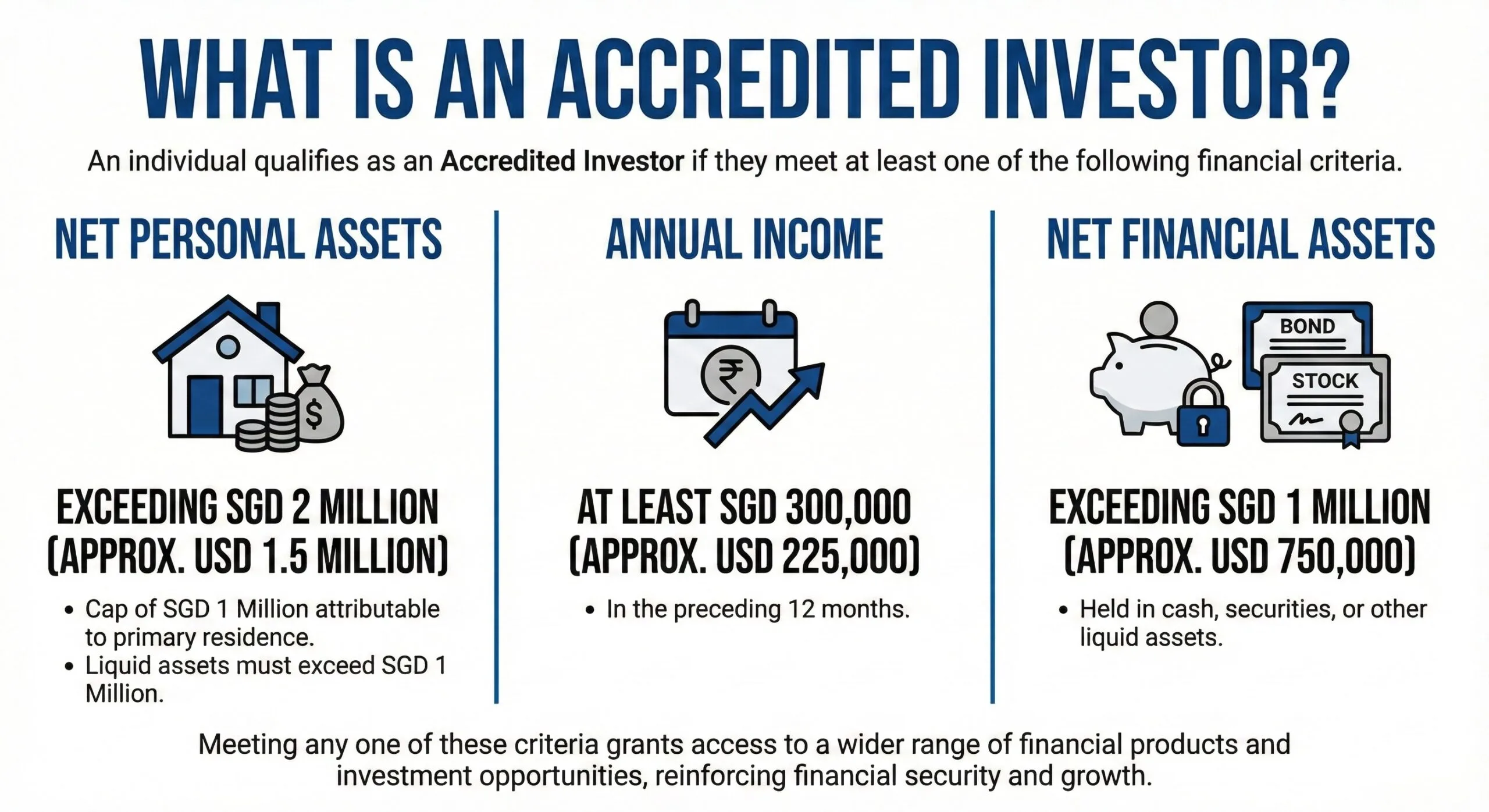
| Investment Objectives Statement | Written statement of what you intend to do with the account — investment goals, risk appetite, time horizon | Bank-provided form; required for Accredited Investor opt-in |
Documents not originally in English require professional handling — not Google Translate, not informal translations. Banks will reject improperly certified translations, and that rejection restarts the clock. If you are applying from a jurisdiction where official documents are issued in a non-English language, factor in 2–4 weeks for certified translation before you even begin the application.
Source of Wealth Documentation by Wealth Origin
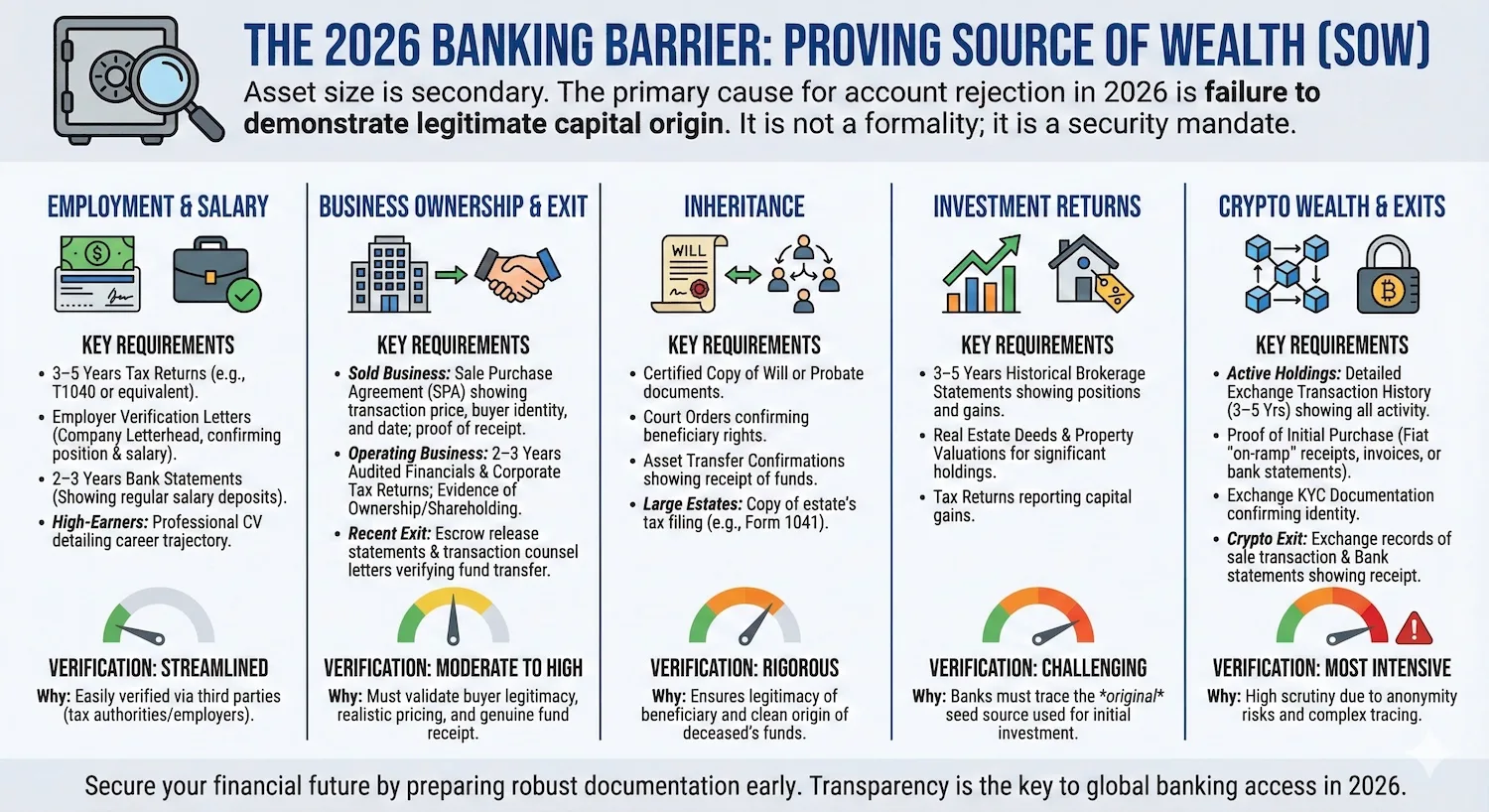
This is where most non-resident applications fail. Source-of-wealth documentation is the single most commonly incomplete part of any non-resident application — not because applicants don’t have money, but because they haven’t assembled a coherent narrative with the right supporting evidence. What banks are verifying is not the amount, but the legitimacy and traceability of the origin. Each wealth type requires a specific document set.
| Wealth Origin | Documents Required | Common Rejection Trigger |
|---|---|---|
| Employment / Salary | 2–3 years of payslips, employment contracts, tax returns showing income accumulation over time | Gap between declared income and current asset level — banks will question how salary alone generated the wealth |
| Business Sale / Exit | Share purchase agreement or asset sale agreement, proof of sale proceeds received, company financial statements for 2–3 years pre-sale | Vague explanation of business valuation; gap between sale price and industry comparables without explanation |
| Business Ownership / Dividends | Company ownership documentation, audited accounts or management accounts, dividend payment records, board resolutions authorising distributions | Complex ownership structures with multiple intermediate entities; unclear beneficial ownership chain |
| Inheritance | Probate documents, will or trust deed, estate valuation, bank statements showing receipt of inheritance proceeds | Unsigned or unauthenticated will; inheritance from non-transparent jurisdictions without probate documentation |
| Real Estate Sale | Property sale agreement, proof of original purchase, capital gains documentation, bank statements showing receipt of proceeds | Property in a higher-risk jurisdiction; significant appreciation without market evidence; related-party transactions |
| Cryptocurrency | KYC documentation from the exchange; proof of original purchase; tax returns showing reported crypto gains/losses; exchange records of the sale transaction; bank statements showing receipt of fiat proceeds | Wealth from mining, airdrops, or anonymous wallets with unclear origins; absence of tax reporting on gains |
| Investment Gains | Historical investment account statements showing portfolio growth, brokerage records, tax returns reporting investment income | Gains from jurisdictions with no equivalent regulatory framework; unexplained concentration in a single instrument |
Cryptocurrency Wealth — The 2026 MAS Position
Crypto wealth is increasingly acceptable to Singapore private banks in 2026 — but only if it is compliant and properly documented. The position has shifted considerably from 2021, when most institutions treated crypto as an automatic red flag. The change reflects MAS’s progressive regulatory stance on digital asset businesses and the growing number of HNWIs whose wealth is partially crypto-derived.
Banks that actively welcome crypto-wealthy clients include Sygnum and AMINA — both licensed digital asset specialists with full private banking infrastructure. More traditional institutions like Julius Baer and Standard Chartered Private have also developed frameworks for accepting crypto-sourced wealth, provided the documentation is complete. What they all require: the wealth must have come through licensed exchanges, gains must have been reported for tax purposes, and the chain from crypto to fiat must be traceable through verifiable bank statements.
PEP and Enhanced Due Diligence — What Triggers It
MAS expanded the definition of Politically Exposed Person (PEP) in recent guidance to include indirect relationships. If your spouse, adult child, or sibling holds a public office — government position, state enterprise leadership, judicial appointment, senior military rank — you may be flagged as PEP-related even if you have no public role yourself. The implication is significant: PEP-related clients face enhanced due diligence as a matter of policy, not as a reflection of suspicion.
The correct response is to disclose any family ties to government or public positions upfront — in your initial application narrative, before being asked. Concealing PEP relationships and having them discovered by the bank’s screening process is one of the most reliable ways to guarantee immediate rejection and a record that complicates every future application in Singapore.
Bar chart showing FATF grey-listed jurisdiction adds the most time (6–10 weeks), followed by PEP status (4–8 weeks), crypto or corporate complexity (3–6 weeks each), missing translations (2–4 weeks), and incomplete SOW (2–3 weeks).
The Application Process — Realistic Timeline for Non-Residents
The process follows a consistent sequence regardless of which private bank you approach. What varies is how long each stage takes — and that depends almost entirely on the quality and completeness of your documentation. The clients who move fastest through this process are invariably those who front-load preparation rather than assembling documents reactively as the bank requests them.
Digital Alternatives for Non-Residents Below Private Banking Thresholds
If your investable assets sit below the USD 2 million private banking floor, the honest answer is to use a digital payment account as an operational bridge while you build your profile. Platforms like Wise, Aspire, and Airwallex provide SGD payment account details and are fully accessible remotely with no minimum deposit. They are not bank accounts — they don’t offer investment products, lending, or custody — but they function well for operational cash flow, receiving payments, and holding SGD for regular transactions.
Singapore private banking is not designed for smaller clients, and pretending otherwise wastes time for everyone involved. The more useful question for clients below the threshold is: what is the fastest path to reaching the private banking minimum? For most, the answer involves either consolidating assets from multiple institutions into a single demonstrable pool, or accelerating the source-of-wealth narrative to make existing assets more legible to a bank’s compliance review. Both of these are preparation tasks, not banking tasks — and they are worth doing before making any bank approach. Our non-resident account guide covers this in more detail.
Frequently Asked Questions
Can a non-resident open a retail bank account in Singapore in 2026?
What documents do I need to open a bank account in Singapore as a non-resident?
How long does it take to open a Singapore bank account as a non-resident?
Can I open a Singapore bank account remotely as a non-resident?
What is the difference between source of wealth and source of funds in Singapore banking?
Will Singapore banks accept cryptocurrency as a source of wealth?
If you would like a pre-assessment of your profile against current Singapore private bank requirements — before submitting any formal application — the Easy Global Banking team can review your documentation, identify any gaps, and match your profile to the right institution. A rejected application at the wrong bank creates a record that complicates future applications. Getting the approach right from the start is worth more than the time saved by going directly. Contact us for a no-obligation consultation. You may also find our free AML risk score calculator useful as a first step — it shows how banks are likely to classify your profile before you make any approach.
References
- Anti-Money Laundering — Monetary Authority of Singapore (opens in new tab)
- Accredited and Institutional Investors — Monetary Authority of Singapore (opens in new tab)
- FATF Country Risk Classifications — Financial Action Task Force (opens in new tab)
- Common Reporting Standard (CRS) — Inland Revenue Authority of Singapore (opens in new tab)
- Singapore’s Revised Tax Incentive Schemes for Funds (2025) — ASEAN Briefing (opens in new tab)