Bank account denied red flags are specific signals in your application — missing documentation, inconsistent information, opaque ownership, or a mismatch between your profile and the institution — that give compliance teams a concrete reason to say no. Most of these flags are fixable before you submit. But once an application is rejected, the damage to your file is done. This guide covers the 10 reasons international banks deny applications in 2026, grouped by severity, and tells you exactly what to do about each one.
The rejection almost certainly wasn’t personal. That’s the first thing to understand. A Swiss private banker put it plainly in a conversation I’ll always remember: “We don’t reject people because we want to. We reject them because something in their file makes it impossible to say yes.” Banks are businesses. Every denial costs them processing time and a potential client. The problem was something specific — and specific problems have specific solutions.
Global AML enforcement fines reached $3.8 billion in 2025, according to Fenergo’s annual penalties report. EMEA region fines alone jumped 767% that year. TD Bank paid $3.09 billion — the largest U.S. banking AML penalty in history — for systemic compliance failures. The EU’s new Anti-Money Laundering Authority (AMLA) began operations in July 2025, headquartered in Frankfurt, and will directly supervise up to 40 high-risk financial institutions starting in 2028. Banks aren’t overcautious because they enjoy rejecting people. They’re overcautious because the cost of approving the wrong client is now catastrophic.
What Actually Happens When You Submit an Application
Most applicants picture a single compliance officer reading their file over coffee. The reality is a layered gauntlet — part automated, part human — where your application can be stopped at any stage. Understanding the flow helps you predict where your specific vulnerabilities might surface.
Stage 2 is where sanctioned individuals and PEPs get caught immediately — no human involved yet. Stages 3 and 4 are where the vast majority of legitimate-but-unprepared applicants get denied. That’s the manual review. Compliance officers at this stage aren’t looking for reasons to reject you. They’re looking for enough evidence to say yes. If the evidence isn’t there, they can’t.
Doughnut chart showing approximate distribution of denial causes: Source of funds issues 31%, sanctions or high-risk nationality 19%, inconsistent documents 15%, opaque ownership structure 12%, vague business rationale 10%, undisclosed PEP status 5%, negative banking history 5%, and profile/deposit mismatch 3%.
The Three Flags That Kill Your Application Instantly
These are non-negotiable. If your file triggers one of these at Stage 2 or early Stage 3, no amount of polished documentation saves you. They require either structural changes before you apply, or — in the case of sanctioned nationality — specialized legal guidance that goes far beyond a banking introduction service.
1. Sanctioned Nationality or High-Risk Residence
Nationals of comprehensively sanctioned countries — Russia, Iran, North Korea, Syria, and others on OFAC, EU, and UN lists — face near-automatic rejection at most Western banks. This isn’t about you personally. It’s a legal constraint. Post-2022 EU sanctions packages restrict onboarding Russian nationals in most circumstances, even with third-country residency. Banks have no discretion here.
A misconception worth addressing directly: UAE or other Gulf residency does not override sanctioned nationality for EU or UK banking purposes. Compliance teams evaluate passport nationality independently of where you live. A Russian entrepreneur with Dubai residency applying to a Swiss or German bank will still trigger screening on their passport. The UAE address doesn’t change that calculation.
For applicants from high-risk but not sanctioned jurisdictions — countries on the FATF grey list or the EU’s high-risk third-country list — the application isn’t automatically dead. But Enhanced Due Diligence applies from day one, meaning more documentation, longer timelines, and a higher threshold for everything else in your file.
What to do: If you hold a sanctioned-country passport, the realistic options are limited and jurisdiction-specific. Dual nationality matters. Some countries (UAE, Singapore, select Caribbean nations) offer alternative pathways. A banking advisor who specializes in your nationality profile — not a generic consultant — is the only person worth talking to first.
2. Weak or Missing Source of Funds Documentation
This is the single most common reason applications fail at international banks. “Inheritance” is not documentation. “Business profits” is not documentation. What the compliance team needs is a verifiable chain — where the money originated, how it moved to your current account, whether taxes were properly handled along the way.
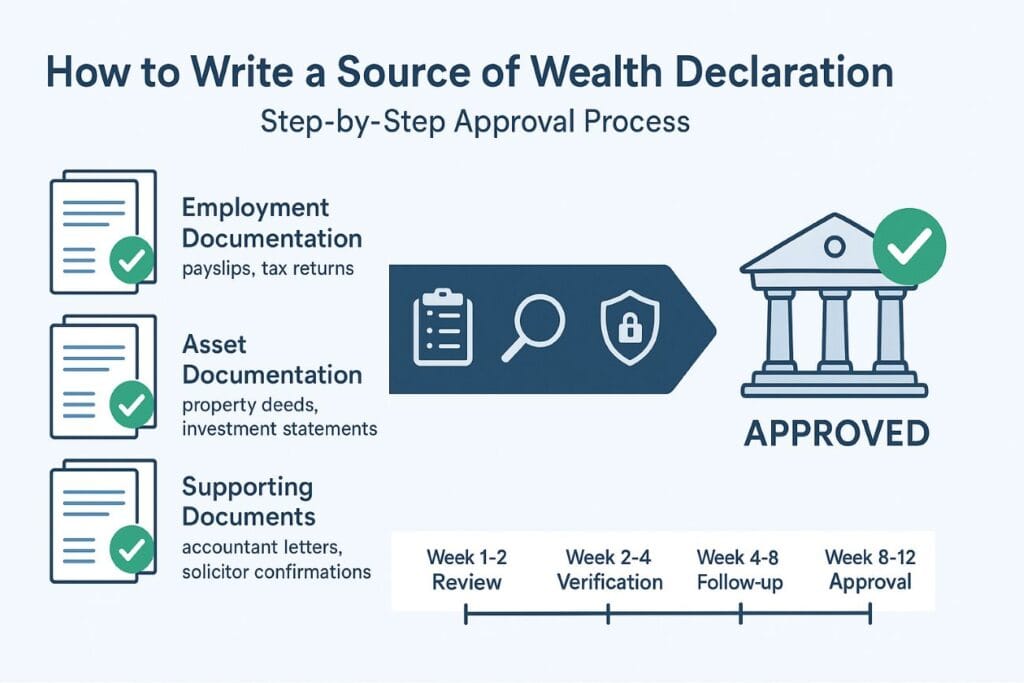
In practice, a strong source-of-funds file includes: employment contracts or company financials covering the relevant period, tax returns that align numerically with declared amounts, bank statements showing actual fund movement, and — for property sales — notarized sale agreements with corresponding transfer records.
Crypto-sourced wealth deserves particular attention because banks have gotten much more specific about what they need. Exchange transaction histories are the baseline. But you’ll also need wallet addresses with blockchain verification, fiat conversion records showing on-ramp and off-ramp dates, and ideally a forensic blockchain analysis from a recognized provider like Chainalysis or Elliptic. Several Swiss and Singapore banks now have dedicated crypto compliance teams. Their standards are rigorous, but they’re workable if you prepare correctly.
For the full format and language that compliance officers expect, the guide on writing a source of wealth declaration that banks approve is worth reading before you build your file.
What to do: Build the documentary chain before you apply — not after. Gap analysis first: look at your money trail from origin to current account and identify every step that lacks a supporting document. Each gap is a question a compliance officer will ask. Answer it proactively, in writing, before they get the chance.
3. Complex or Opaque Corporate Ownership Without a Clear UBO
Multi-layered structures aren’t inherently suspicious — plenty of legitimate businesses use holding companies, trusts, and subsidiaries for valid operational reasons. The issue is when the Ultimate Beneficial Owner (UBO) isn’t immediately identifiable, or when the structure looks like it exists to obscure rather than operate.
The EU’s new AML Regulation (effective July 2027 but already shaping internal bank policies) tightened beneficial ownership rules substantially. The 25% threshold now triggers at the threshold itself, not above it. Indirect ownership must be calculated by multiplying percentages through each layer of the chain. For higher-risk sectors, that threshold can drop to 15%. This matters practically: Company A owns 30% of Company B, which owns 40% of Company C. The UBO of Company A has a calculated indirect stake of 12% in Company C. Under old rules that might slip through. Under the new framework, that chain requires full disclosure and triggers enhanced scrutiny.
What to do: Prepare a visual organigram showing every entity in the chain with exact percentages at each level. Include notarized incorporation documents, shareholder registries, and a plain-English explanation of why the structure exists. If you can’t explain the purpose of your structure in two clear paragraphs, a compliance officer won’t attempt to reconstruct it for you.
Bar chart showing AML fines trend: 2020 approximately $2.1B, 2021 $2.7B, 2022 $3.5B, 2023 $6.6B, 2024 $4.6B, 2025 $3.8B global but EMEA fines up 767%.
Four Flags That Create a Long Delay — Then Often a Denial
These don’t necessarily kill an application at Stage 2. They surface during the manual review at Stages 3 and 4, and they create a bottleneck that most applicants don’t survive — either because follow-up requests go unanswered, or because the underlying issue turns out to be unfixable under scrutiny.
4. Inconsistent or Contradictory Information Across Documents
Banks algorithmically cross-reference every data point you submit: names across passports and corporate filings, addresses on utility bills versus application forms, income figures on tax returns versus stated amounts, dates that should match chronologically. Even minor discrepancies — a middle name present on one document and absent on another, a slight address variation — can trigger a review hold that stalls everything.
For applicants with multiple residences, dual nationalities, or name transliterations from non-Latin alphabets, this is a real operational challenge that requires proactive management. The solution isn’t simplifying your situation — it’s documenting the complexity upfront. Include a short cover letter that addresses any foreseeable discrepancy: “My passport lists my name as Aleksandr; my Swiss utility bill uses Alexander. These are transliterations of the same name.” That sentence takes ten seconds to write and eliminates a two-week review hold.
Tools that banks routinely use — World-Check (LSEG), Dow Jones Risk & Compliance, LexisNexis Risk Solutions — aggregate data from sanctions lists, PEP databases, adverse media, and regulatory filings across 200+ jurisdictions. Discrepancies a human might forgive get flagged automatically by these systems.
5. Vague or Missing Business Rationale
“International diversification” isn’t a business rationale. “Better banking” isn’t either. The compliance team needs to understand specifically why this account, at this institution, in this jurisdiction — and the answer has to connect to verifiable, documented activity.
Strong rationales: paying suppliers or receiving client payments in the bank’s local currency, managing rental income from property you own locally, supporting a subsidiary with a physical presence, or accessing specific wealth management services available only through that institution. These are concrete. They give a compliance officer a framework for monitoring the account — which is what AML rules actually require.
Weak rationales that commonly appear in rejected applications: wanting a “backup” account, vague references to “future business opportunities,” or stating you want access to “better banking.” None of these provides a monitoring framework. Under current AML rules, that makes approval functionally impossible regardless of everything else in your file.
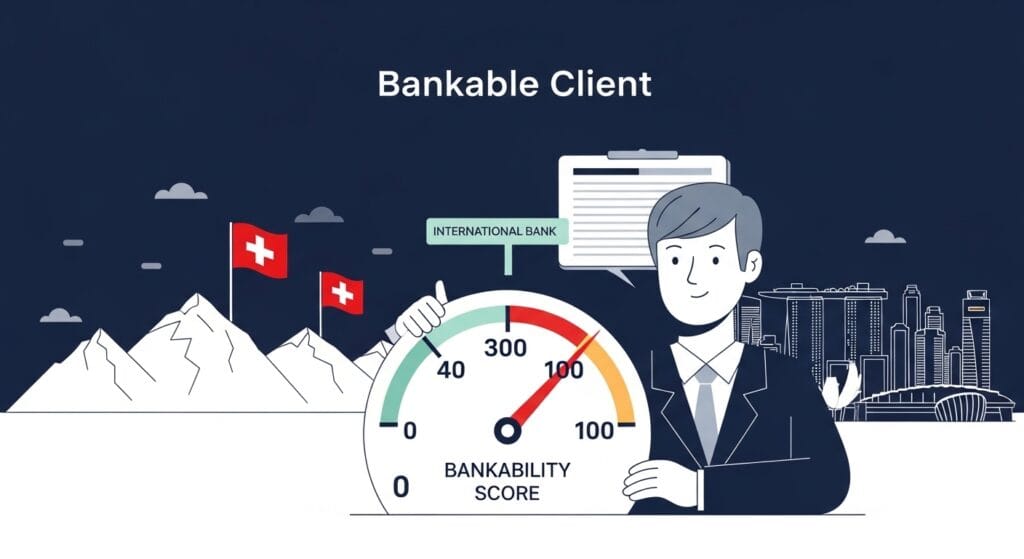
Applicants targeting Swiss or Singapore banking may find it useful to understand how banks score profiles using a bankability framework — business rationale is a weighted component, and a vague rationale drags down your entire score.
6. Suspicious Transaction Patterns in Your Existing Account History
Even when applying for a new account, banks request statements from your current banking relationships. They’re looking at how you’ve used accounts elsewhere. Certain patterns reliably trigger suspicion regardless of legitimate intent.
What flags reviewers: large deposits followed by rapid full withdrawals (the classic layering pattern), round-dollar amounts in repeated sequences, frequent personal-to-corporate transfers without corresponding invoices, heavy cash deposit activity disproportionate to your stated business type, and crypto-to-fiat conversions at irregular intervals without a documented strategy.
The insight here is that your transaction history tells a story. If that story contradicts the narrative in your application, banks won’t ask for clarification — they’ll reject. Before you apply anywhere, review your own statements with fresh eyes. Pretend you’re a compliance officer who has never met you. If something looks unusual, prepare a written explanation before anyone asks for one.
7. Non-Cooperation During the Due Diligence Process
Modern bank onboarding often requires video verification calls, document follow-ups, and in some cases in-person meetings. Missing a scheduled compliance call, taking three weeks to respond to a document request, or providing vague answers during interviews signals avoidance — which is precisely what AML training teaches compliance teams to spot.
One pattern worth knowing: compliance teams specifically watch for applicants who provide comprehensive initial documentation but become evasive when follow-up questions dig into specific transactions or business relationships. That asymmetry — polished upfront, evasive under pressure — suggests the initial package was prepared to look good rather than to be accurate.
The practical advice sounds simple but gets ignored constantly. Treat the compliance interview like a professional meeting. Have documents organized and accessible. Respond to information requests within 48 hours. If you genuinely need more time to obtain something, say so explicitly and give a realistic date. Banks tolerate “I need two weeks to get that apostilled” far better than silence.
Three Flags You Can Eliminate Before You Submit
These are the flags that frustrate people most, because they’re avoidable with a bit of preparation. None of them reflect badly on your character. They’re procedural — and procedure is fixable.
8. Negative Banking History in Screening Databases
Unpaid overdrafts, involuntary account closures, bounced payments, and Suspicious Activity Reports (SARs) filed by previous banks all appear in screening databases. In the U.S., ChexSystems and Early Warning Services hold these records. Internationally, banks share information through correspondent networks and commercial due diligence databases. Records typically persist for five to seven years.
What catches applicants off guard: even a minor issue from years ago can surface. A single unpaid overdraft from a closed account might seem trivial — but to an automated screening tool, it’s a flag requiring human review. Human reviewers prioritize the cleanest files first.
Request your ChexSystems report before applying (free once every 12 months under federal law in the U.S.). Check your credit file in your relevant jurisdiction. Contact any institution where you had a problematic exit. Resolve outstanding balances and get written confirmation that the issue is settled. Include that confirmation in your application package. This step costs nothing and eliminates a category of flag entirely.
9. PEP Status Without Proactive Disclosure
Being a Politically Exposed Person doesn’t disqualify you from banking. Failing to disclose it does. Banks screen every applicant against PEP databases covering current and former government officials, executives of state-owned enterprises, military leadership, and their close family members and associates.
If the bank’s screening tool identifies you as a PEP before you’ve disclosed it, the optics are terrible — it looks like concealment, which transforms a manageable compliance process into an immediate rejection. Timing matters: say it first.
PEP disclosure best practice: declare your status clearly in your application cover letter. Include an independent wealth attestation from a recognized auditor or law firm. Provide a clear separation between personal assets and any assets connected to public office. Anticipate ongoing enhanced monitoring — this isn’t punitive, it’s regulatory, and it applies to every PEP across every bank.
The guide on opening a bank account as a PEP covers jurisdiction-by-jurisdiction approaches, including which banking centers are more accommodating of PEP profiles and what documentation each expects.
10. Profile-Deposit Mismatch
This one works in both directions. Applying to a private bank with a $250,000 minimum while planning to transfer $10,000 wastes everyone’s time and gets you quickly rejected. But depositing $500,000 into a basic retail account at a community bank triggers its own AML alarm — the account profile doesn’t fit the deposit size, which flags the transaction as potentially suspicious under monitoring rules.
Match your deposit to the institution’s tier. Research minimum requirements before applying. If you fall below the threshold, either save until you meet it or apply to an institution better suited to your current profile. If your deposit significantly exceeds the institution’s typical client — consider the private banking division or a different institution entirely.
Understanding the minimum deposit requirements across Swiss banks or how high-risk industries navigate bank selection helps you identify the right institutional match before you begin the application process.
Why 2025–2026 Changed the Equation
Rejection rates at international banks haven’t risen because compliance teams suddenly became hostile. They’ve risen because the regulatory cost of onboarding the wrong client reached existential levels — and the new EU framework makes that pressure permanent rather than cyclical.
Three developments are reshaping bank behavior right now. First, AMLA — the EU’s Anti-Money Laundering Authority — began operations in July 2025 and held its first public hearing in March 2026. By 2028, it will directly supervise approximately 40 of the highest-risk cross-border financial institutions in the EU. Even before that supervision begins, its existence has changed internal compliance culture. Banks operating in EU jurisdictions know that a centralized authority — with the power to impose fines up to 10% of annual turnover or €10 million, whichever is higher — is watching and preparing.
Second, the EU AML Regulation single rulebook takes direct effect across all member states in July 2027. No national transposition required. Cash transaction reporting drops to €10,000. Customer identification kicks in at €3,000. Beneficial ownership analysis must use the multiplication method through ownership chains, not just top-level percentages. Banks are adapting their internal criteria now, years ahead of the deadline, because retrofitting compliance to a live client book is far harder than applying stricter standards at the onboarding stage.
Third, AI-driven transaction monitoring has become standard at tier-1 and tier-2 banks. These systems don’t just check static watchlists. They analyze behavioral patterns, flag anomalies against peer groups, and generate risk scores that compliance officers must formally address before approving an account. EY research found that 80% of financial institutions surveyed anticipate increased penalties following AMLA’s establishment — and that expectation has already translated into tighter onboarding thresholds across major banking centers.
The Complete Red Flag Risk Matrix
Every flag operates differently. Some hit in the first 30 seconds of automated processing. Others surface during a three-week manual review. Knowing which is which tells you where to focus your preparation energy.
| Red Flag | Severity | Detection Stage | Preventive Action |
|---|---|---|---|
| Weak source of funds | Critical | Manual (Stage 3) | Build full documentary chain before applying |
| Opaque ownership / unclear UBO | Critical | Manual (Stage 3–4) | Organigram + notarized UBO docs + plain-language explanation |
| Sanctioned nationality | Critical | Automated (Stage 2) | Consult specialist — limited options, jurisdiction-dependent |
| Inconsistent information | High | Automated + manual (Stage 1–3) | Cross-check all docs; address discrepancies in cover letter |
| Vague business rationale | High | Manual (Stage 4) | Provide contracts, invoices, property docs — concrete evidence |
| Suspicious transaction patterns | High | Manual (Stage 3) | Pre-review own statements; prepare written explanations for anomalies |
| Non-cooperation during EDD | High | Manual (Stage 3–5) | 48-hour response target; treat compliance interviews as professional meetings |
| Negative banking history | High | Automated (Stage 1–2) | Check ChexSystems/credit files; resolve issues; include written proof of resolution |
| Undisclosed PEP status | Medium–Critical | Automated (Stage 2) | Disclose in cover letter; include asset separation docs and independent attestation |
| Profile-deposit mismatch | Medium | Automated (Stage 1) | Match deposit to institution tier — research minimums before applying |
The Pre-Application Checklist: 8 Things to Do Before You Submit Anything
Compliance is preparation, not reaction. Applicants who treat documentation as an afterthought — “I’ll gather that if they ask” — are playing at a disadvantage that’s entirely unnecessary. Run through this checklist before submitting to any bank. Every item here corresponds directly to one of the 10 red flags above.
| # | Action | What It Prevents |
|---|---|---|
| ✓ | Build a complete source-of-funds documentary chain | Prevents the #1 reason for denial before it arises |
| ✓ | Cross-check all documents for name, address, date consistency | Eliminates automated screening flags in Stage 1–2 |
| ✓ | Prepare a visual UBO organigram (if any corporate structure applies) | Satisfies beneficial ownership requirements upfront |
| ✓ | Write a specific, verifiable business rationale — not a talking point | Gives compliance a monitoring framework (legally required) |
| ✓ | Review your own bank statements for unusual patterns | Lets you explain anomalies before they become questions |
| ✓ | Disclose PEP status or sanctioned-country connections in your cover letter | Turns concealment risk into a managed compliance process |
| ✓ | Check ChexSystems/credit reports and resolve outstanding issues | Negative history surfaces in automated screening every time |
| ✓ | Match your deposit amount to the target institution’s tier | Prevents profile-mismatch flags at initial automated screening |
When to Stop Doing This Alone
Some situations genuinely warrant expert guidance, and recognizing that early saves time and money. If you’ve been rejected at two different institutions with similar documentation, if your wealth involves crypto assets exceeding $500,000, if your corporate structure spans three or more jurisdictions, or if you hold PEP status — working with a specialized banking introduction advisor typically pays for itself through a faster outcome.
What a good advisor actually does isn’t magic. They pre-screen your documentation against the specific bank’s compliance criteria, identify fixable gaps before submission, and manage the communication between you and the compliance team. That intermediary layer often makes the difference between a hesitant “maybe” and a decisive approval — particularly for complex international profiles where the compliance relationship matters as much as the documentation itself.
If you’re navigating a complex profile, the team at Easy Global Banking can help you identify which jurisdictions and institutions best match your situation — before you start the application process and begin accumulating rejections.
Frequently Asked Questions About Bank Application Denials
Can I reapply to the same bank after being rejected?
Yes — but timing and preparation are everything. Most banks don’t maintain a formal blacklist period, though internal notes from your previous application remain visible to future reviewers. Wait until you’ve materially addressed the specific reason for rejection: gathered better documentation, resolved a negative banking record, or restructured your corporate ownership. Reapplying with an identical file to one already rejected almost guarantees a second denial.
Will the bank tell me why my application was denied?
Usually not — at least not with specificity. Banks in most jurisdictions aren’t required to disclose the exact reason for rejection, and many deliberately avoid specifics to prevent applicants from reverse-engineering their compliance criteria. You may receive a generic notice referencing “compliance requirements” or “risk assessment.” Working with a banking advisor who has an established relationship with the institution can sometimes surface more candid feedback through informal channels — which is one of the practical advantages of using an intermediary.
Does being rejected at one bank affect my application at another?
It depends on the reason. If the rejection triggered a Suspicious Activity Report, that information may be visible to other institutions through shared databases. For routine rejections based on missing documentation or profile mismatch, other banks typically won’t know unless you disclose it or it appears in a screening database. Applying to multiple banks simultaneously can itself raise questions if those banks share information through correspondent banking networks — so sequential applications with preparation time between them are generally the better approach.
Are digital-only banks easier to get approved at than traditional banks?
For basic consumer accounts, often yes — digital banks tend to have faster onboarding and lower minimums. For international clients, HNWIs, or corporate accounts, digital banks can actually be more restrictive: their automated systems leave less room for nuance or explanation. A traditional private bank with a relationship manager who understands complex profiles can sometimes accommodate situations that would trigger automatic rejection at a fintech. In the UK, roughly 20–30% of first-time business applications at traditional banks get rejected; digital challengers typically show lower rates for straightforward profiles but often higher rejection rates for complex ones.
What is AMLA and how does it affect bank applications in 2026?
AMLA is the EU’s new Anti-Money Laundering Authority, headquartered in Frankfurt. It became operational in July 2025 and held its first public hearing in March 2026. It doesn’t directly affect individual bank applications today — but its presence has already changed internal compliance culture across EU-based banks. The reason: starting in 2028, AMLA will directly supervise approximately 40 high-risk financial institutions. Banks that want to avoid being selected for that supervision are proactively tightening their onboarding criteria. For applicants, the practical impact in 2026 is stricter documentation requirements and longer review timelines at EU-based institutions, even for profiles that would have sailed through a few years ago.
How long should I wait before reapplying after a denial?
There’s no universal waiting period — the right timeline is however long it takes to fix the specific issue that caused the rejection. Missing documentation: potentially weeks, once you’ve built the complete file. Negative banking history or an unresolved compliance matter: months, depending on the complexity. Sanctioned nationality issues: tied to when sanctions policies change, which is unpredictable. The rule worth internalizing is: don’t reapply until you can demonstrate a material change in your application. Reapplying with the same file signals that you either don’t understand why you were rejected, or you’re hoping the outcome will be different — neither reading helps your case.
The Bottom Line
Banks want to approve you. Every rejection costs them time and a potential revenue relationship. When your application fails, something specific in your file created a compliance obstacle that the bank couldn’t — or wasn’t willing to — navigate around.
The 10 flags above account for the overwhelming majority of international banking denials today. Most of them are preventable. Strong source-of-funds documentation, proactive disclosure, consistent records, a clear business rationale, and a deposit matched to the right institution — these aren’t bureaucratic obstacles. They’re the language that compliance teams use to say yes.
Build your file as if the compliance officer is looking for a reason to approve you. Because in most cases, they are.
References
- Fenergo — Global Financial Regulatory Penalties Report 2025 (opens in new tab)
- AMLA — About the Anti-Money Laundering Authority (official EU site) (opens in new tab)
- Council of the EU — AML Package Adoption, May 2024 (opens in new tab)
- FATF — High-Risk and Other Monitored Jurisdictions (Black & Grey Lists) (opens in new tab)
- CFPB — Why Was I Denied a Checking Account? (opens in new tab)