
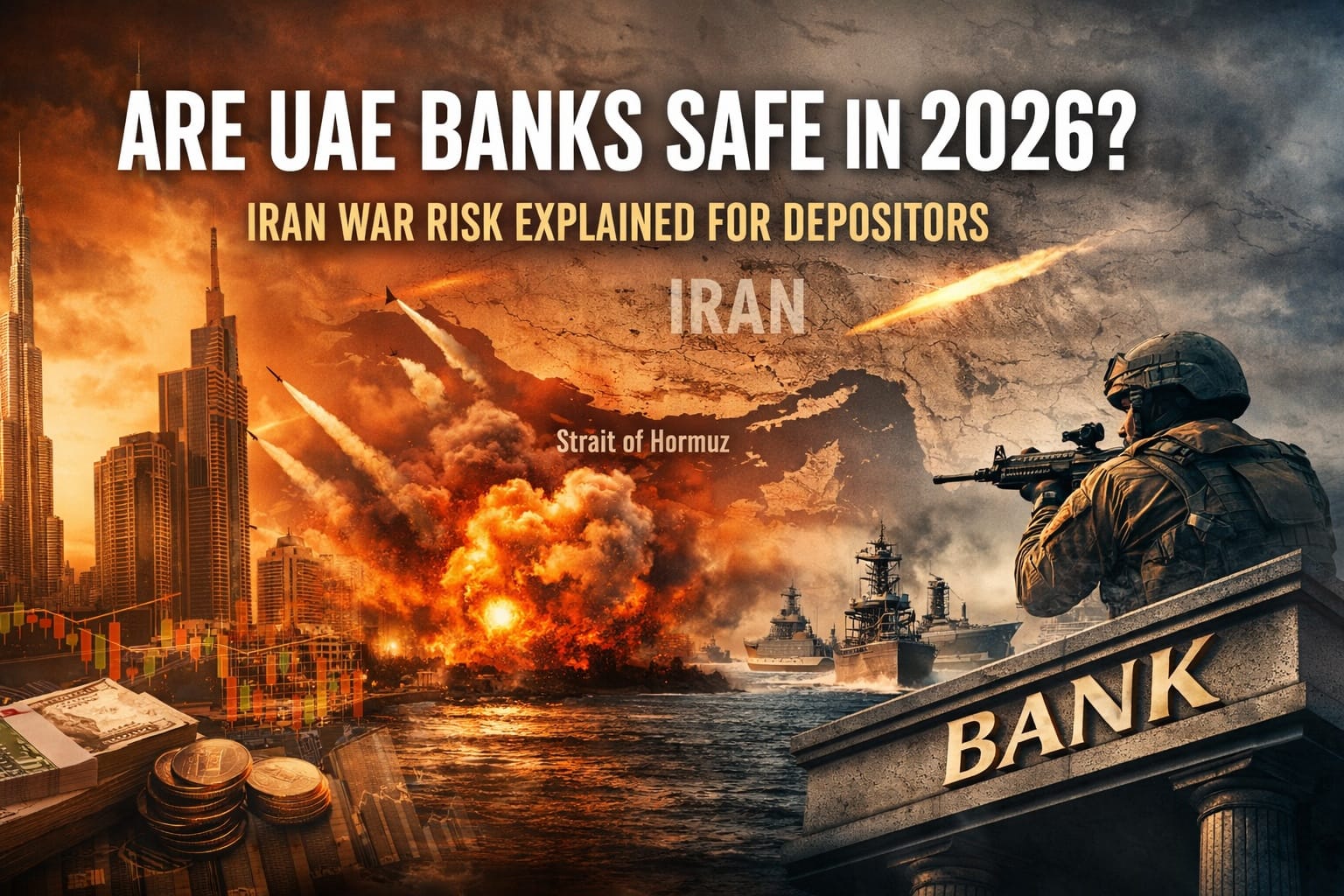
Implications for Depositors, Capital Flows, and Financial Stability
By Asel Mamytova, MBA — Swiss Banking & International Finance Expert | EasyGlobalBanking.com
Executive Summary
UAE banks entered the 2026 Iran war from a position of exceptional financial strength, and a systemic banking collapse remains unlikely in the near term. Yet the conflict is not a conventional economic shock — it is a geoeconomic rupture operating through five simultaneous transmission channels. The critical question for depositors, corporates, and policymakers is not whether the system survives the opening act, but whether its structural resilience holds under sustained pressure over 12 to 24 months.
Three conclusions define this analysis:
- The UAE banking sector’s capital and liquidity buffers are among the strongest in the world, providing substantial shock-absorption capacity
- The Strait of Hormuz disruption has triggered the largest oil supply shock in recorded history, introducing macro-financial risks that capital ratios alone cannot neutralize
- The central bank’s March 2026 resilience package — the largest since COVID-19 — confirms that authorities are treating this not as temporary volatility, but as a structural stress event requiring pre-emptive intervention
The Battlefield and the Balance Sheet
To understand why the Iran war matters for banking, one must start with geography. The Strait of Hormuz — a 33-kilometre-wide corridor between Iran and Oman — carries approximately 20% of the world’s oil supply and a significant share of global LNG volumes. By early March 2026, Iran’s closure of the Strait had disrupted oil production across the Gulf by a reported 6.7 million barrels per day, rising to at least 10 million barrels by mid-March — the largest supply disruption in the history of the global oil market. Brent crude surged from roughly $70 to over $110 per barrel within days of the conflict’s escalation.
For the UAE, this creates a paradox. Higher oil prices benefit sovereign revenues, yet disruptions to maritime trade, aviation, tourism, and logistics — the arteries of Dubai’s non-oil economy — represent direct structural damage. A prolonged Hormuz closure, analysts warn, would inevitably tip the global economy into recession. For a country whose economic model is built on being the world’s commercial crossroads, that is an existential risk to growth, not merely a financial footnote.
Pre-War Fundamentals: An Unusually Solid Foundation
Any credible assessment must begin at the baseline. UAE banks entered 2026 having spent years reinforcing capital buffers far above regulatory minima.
| Indicator | UAE Banking Sector (End-2024 / Early 2026) | Regulatory Minimum |
|---|---|---|
| Capital Adequacy Ratio (CAR) | 17.0–17.8% | ~10.5–13% |
| CET1 Ratio | 14.4–14.7% | 7.0% |
| Tier 1 Capital | 15.9% | 8.5% |
| Liquidity Coverage Ratio (LCR) | 146.6%+ (avg. GCC: 183% end-2024) | 100% |
| NPL Ratio (Sept 2025) | 3.2% (down from 6.8% in 2022) | — |
| Total Banking Assets | AED 5.42 trillion (+17% YoY) | — |
UAE Banking Capital Strength vs Regulatory Minimum
Insight: Demonstrates substantial capital buffer strength above requirements.
These are not cosmetic metrics. The NPL ratio had fallen 44% over three years by mid-2025, reaching a multi-year low of 3.2%. Fitch Ratings had confirmed Basel III full compliance, noting that “GCC banks are well positioned to meet short-term funding needs”. The starting point is therefore genuine resilience — not a system straining to maintain appearances.
The Strait as a Financial Variable
What makes the 2026 conflict analytically distinct from previous Gulf tension episodes is the Strait’s actual closure, rather than its threatened disruption. Approximately 75% of Hormuz oil flows to China, India, Japan, and South Korea — meaning the economic reverberations extend far beyond the Gulf. Saudi Arabia’s largest refinery and Qatar’s export facilities have already suffered drone strikes.
For UAE banks, the financial transmission does not require a bomb to fall on a data centre. The economic channels are subtler and more corrosive:
- Aviation and logistics revenues collapsed immediately as airspace closures took effect
- Real estate bonds have become the worst-performing emerging market debt category in March 2026, with Dubai and Abu Dhabi developers seeing steep losses as property demand stalls
- Tourism flows have been halved under moderate disruption scenarios, compressing the consumer credit cycle
- Sovereign wealth fund deployment from UAE, Saudi Arabia, and Qatar — collectively managing approximately $4.35 trillion in assets — is expected to slow materially as governments redirect fiscal resources
S&P Global estimated that Gulf banks could face domestic deposit outflows of $307 billion if the conflict deepens, though no evidence of major outflows had materialized as of mid-March 2026.
Five Transmission Channels Into the Banking System
Geopolitical shocks enter financial systems through identifiable pathways. In the UAE’s case, five channels operate simultaneously.
1. Macroeconomic Contraction via Trade. A sustained Hormuz disruption reduces non-oil GDP growth through lower trade volumes, elevated freight costs, and compressed logistics revenues. Non-oil GDP — which had been driving the UAE’s economic diversification — is directly in the line of fire.
2. Credit Risk and Asset Quality Deterioration. Economic slowdown translates into borrower stress. The loan book’s most vulnerable segments are trade finance (9.5% of total credit, AED 190.9 billion), transport and logistics (5.4%, AED 109.6 billion), and real estate (11.3%, AED 226.4 billion). As corporate earnings fall, NPL ratios — currently at their lowest in years — will reverse course.
3. Liquidity and Deposit Flow Volatility. Domestic deposits dominate UAE funding structures, providing inherent stability. However, non-resident deposits — approximately 9% of total — are acutely sensitive to geopolitical sentiment. In a deepening crisis, these flows can reverse rapidly, tightening liquidity at precisely the wrong moment.
4. Operational and Infrastructure Risk. Unlike financial crises born within the system, the Iran war introduces physical disruption risks: missile activity, airspace closures, cyberattacks on payment infrastructure. These risks threaten not solvency, but functionality — access to funds, payment processing, and cross-border transfers.
5. Sanctions and Regulatory Fragmentation. As enforcement of Iran-related sanctions intensifies, UAE banks must navigate increased compliance complexity, potential transaction restrictions, and risks of secondary sanctions designation for institutions with residual Iran-linked exposures.
The Sectoral Credit Map: Where Stress Concentrates
Understanding which sectors carry the most credit risk requires examining the loan book in detail. The UAE banking system had AED 2,011.9 billion in total resident credit as of Q3 2025.
*Percentage of personal loan sub-categories; overlaps exist with corporate real estate
The critical vulnerability lies in the intersection of real estate and transport. Real estate bonds are already under severe stress, and the departure of expatriates — who represent 88% of the UAE population — would exert sustained downward pressure on both property values and consumer credit. Fitch Ratings had forecast real estate price corrections of up to 15% even before the war; the conflict significantly amplifies that risk.
Scenario Analysis: Three Paths Over 24 Months
A probabilistic framework is more analytically honest than a single forecast.
Scenario A — Contained Conflict (6–9 months)
Hostilities de-escalate, Hormuz reopens within two months, oil markets stabilize. UAE GDP growth slows by 1–2 percentage points. NPL ratios inch from 3.2% toward 5–6%. Capital adequacy ratios decline by approximately 0.5–1 percentage point, remaining comfortably above minimums. Banking system stability preserved; depositor risk remains low.
Scenario B — Prolonged Regional Instability (12+ months)
Intermittent Hormuz disruptions persist; oil prices remain volatile; trade volumes fall ~25%; tourism halved. NPL ratios rise toward 7–8% (consistent with S&P stress scenario). Real estate and logistics sectors see default rates of 10–15%. Capital adequacy ratios fall by 2–3 percentage points, testing buffer adequacy but not solvency thresholds. Banks remain solvent; profitability declines; central bank support actively deployed.
Scenario C — Severe Escalation (24+ months)
Direct attacks on Gulf infrastructure, full Hormuz blockade, sanctions-driven financial fragmentation, global recession. NPL ratios could reach 12–15%; losses equivalent to 8–10% of the loan book across the system. Capital adequacy ratios in vulnerable banks could fall toward or below the 13% regulatory threshold. The risk shifts from solvency to functionality. Emergency state intervention likely; depositors face access disruptions rather than permanent losses.
UAE Banking Stress Scenarios, 2026–2028
Comparison of core variables translating geopolitical shock into bank resilience.
Analyst Note: Note the “Risk Ladder” effect—as GDP shock deepens, the NPL ratio rises almost linearly, while CAR (Capital Adequacy Ratio) remains above the 13% regulatory minimum in Scenario A and B, only breaching critical levels in the Severe Escalation scenario.
The Policy Arsenal: What the Central Bank Has Already Done
The UAE Central Bank’s response has been swift and substantial. On March 17, 2026, it unveiled its most significant policy intervention since the COVID-19 pandemic:
- Liquidity access: Banks can draw on up to 30% of reserve requirements; new term liquidity facilities in both AED and USD
- Capital buffer relief: Temporary release of countercyclical and conservation buffers, potentially freeing up to 3 percentage points of additional capital
- Total liquidity stock: The central bank confirmed that UAE banks’ combined liquidity at the regulator, plus eligible assets, has reached close to $250 billion, with reserve balances exceeding $109 billion
- Loan classification flexibility: Deferral of certain reclassifications for conflict-affected clients, softening immediate provisioning requirements
Bank stocks responded positively. Emirates NBD and Abu Dhabi Islamic Bank each gained over 6% the morning after the package was announced, and Abu Dhabi Commercial Bank rose over 5%. This is not the behavior of a system in freefall — it is the response of a market that recognizes meaningful institutional backstopping.
The Deposit Guarantee Scheme provides retail depositor protection up to AED 100,000 per depositor per bank, aligned with international standards. More consequentially, major UAE banks carry partial state ownership, and Moody’s and S&P have both cited “high support” probability from sovereign authorities in a severe stress scenario.
Historical Precedent: Why the System Has Absorbed Shocks Before
The UAE banking sector has navigated major crises before — and the precedents are instructive. During the 2008–09 global financial crisis, authorities intervened with direct capital injections to prevent disorderly failures. During COVID-19, a comparable resilience package was deployed, and banks maintained service continuity throughout. The NPL ratio, which peaked at 7.6% in 2021 in the pandemic’s wake, was subsequently reduced to 3.2% by September 2025 — demonstrating the system’s capacity not merely to absorb shocks, but to recover from them.
The current war is a larger external shock than COVID-19 in its geopolitical dimensions. But it finds the banking system in materially better condition: lower NPLs, higher capital ratios, and more comprehensive regulatory tools than existed in 2020.
What Depositors and Corporates Should Do Now
The correct response to the current environment is neither panic nor passivity. It is structured risk management based on a clear-eyed assessment of what is at stake.
For depositors:
- Prioritise systemically important banks (D-SIBs) — Emirates NBD, First Abu Dhabi Bank, Abu Dhabi Commercial Bank — which carry implicit sovereign backing and hold the largest capital buffers
- Stay within the AED 100,000 deposit guarantee threshold per institution where possible, to ensure full protection under the national scheme
- Diversify across jurisdictions — maintaining accounts in Switzerland, Singapore, or other stable financial centres provides meaningful geopolitical diversification for wealth above the guarantee threshold. Switzerland and Singapore remain the strongest alternatives
- Distinguish disruption from default — even in adverse scenarios, the probability of permanent depositor losses is low. The real risk is temporary access constraints under Scenario C conditions
For corporates:
- Map revenue concentration by geography and sector; hedge or redirect supply chains away from Hormuz-dependent routes where feasible
- Arrange contingency credit lines now, while appetite exists — liquidity market conditions will tighten if the conflict extends into Scenario B territory
- Use political risk insurance and commodity hedges to manage input cost volatility driven by oil price swings
- Engage lenders proactively on trade finance and project loan refinancing needs, particularly for Hormuz-linked operations
Conclusion: Resilience Is Not Immunity
The UAE banking system in 2026 is genuinely strong. Capital adequacy at 17%, NPL ratios at historic lows, liquidity coverage above 146%, and a central bank with both the tools and the political will to act — these are not paper credentials. They represent real shock-absorption capacity built over years of post-2008 regulatory discipline.
But resilience is not immunity. The Strait of Hormuz closure has triggered the largest oil supply shock in recorded market history. Real estate bonds are already the worst-performing asset class in emerging markets. Gulf sovereign wealth deployment is slowing as governments redirect fiscal resources. These are not hypothetical risks — they are observable data points from the first three weeks of the conflict.
The analytical framework that matters is not “safe or unsafe” — it is how resilience evolves under sustained pressure. Under Scenario A, the system emerges largely intact. Under Scenario B, it endures. Under Scenario C, it survives through extraordinary intervention rather than organic strength. In all three cases, a well-structured response — diversification, liquidity planning, jurisdiction management — is more valuable than a binary decision to stay or leave.
In periods of geopolitical stress, financial outcomes are determined less by reaction and more by preparation. The depositors and corporates who understand this distinction are the ones best positioned to preserve capital across whatever scenario materializes.
This analysis is for informational purposes only and does not constitute financial or investment advice. For a personalised consultation on international banking strategy, visit EasyGlobalBanking.com or contact us directly.
Core sources
- Reuters — UAE’s financial sector is resilient, c.bank says after Iranian air attacks
- Reuters — UAE central bank launches resilience package amid Iran war
- CBUAE — Financial Stability Report 2024 (PDF)
- CBUAE media page — Issues 2024 Financial Stability Report
Policy response
- Deccan Herald — UAE central bank launches resilience package amid Iran crisis
- Aawsat — UAE Bank Stocks Jump after Central Bank Launches Resilience Package
- Radio Shoma — UAE Central Bank approves resilience package to support banking sector
- Gulf News — CBUAE Board reviews strength, resilience of UAE’s financial system
Market and conflict impact
- Reuters — Some wealthy Asians look to move Dubai assets closer to home on Iran war fears
- Reuters — Most Gulf bourses end higher; UAE shares extend losses
- Arabian Business — UAE Central Bank unveils resilience package as banking sector backed by $1.47tn