Ratings matter most when you are choosing between jurisdictions rather than between banks. That comparison is in our offshore and non-resident banking guide.
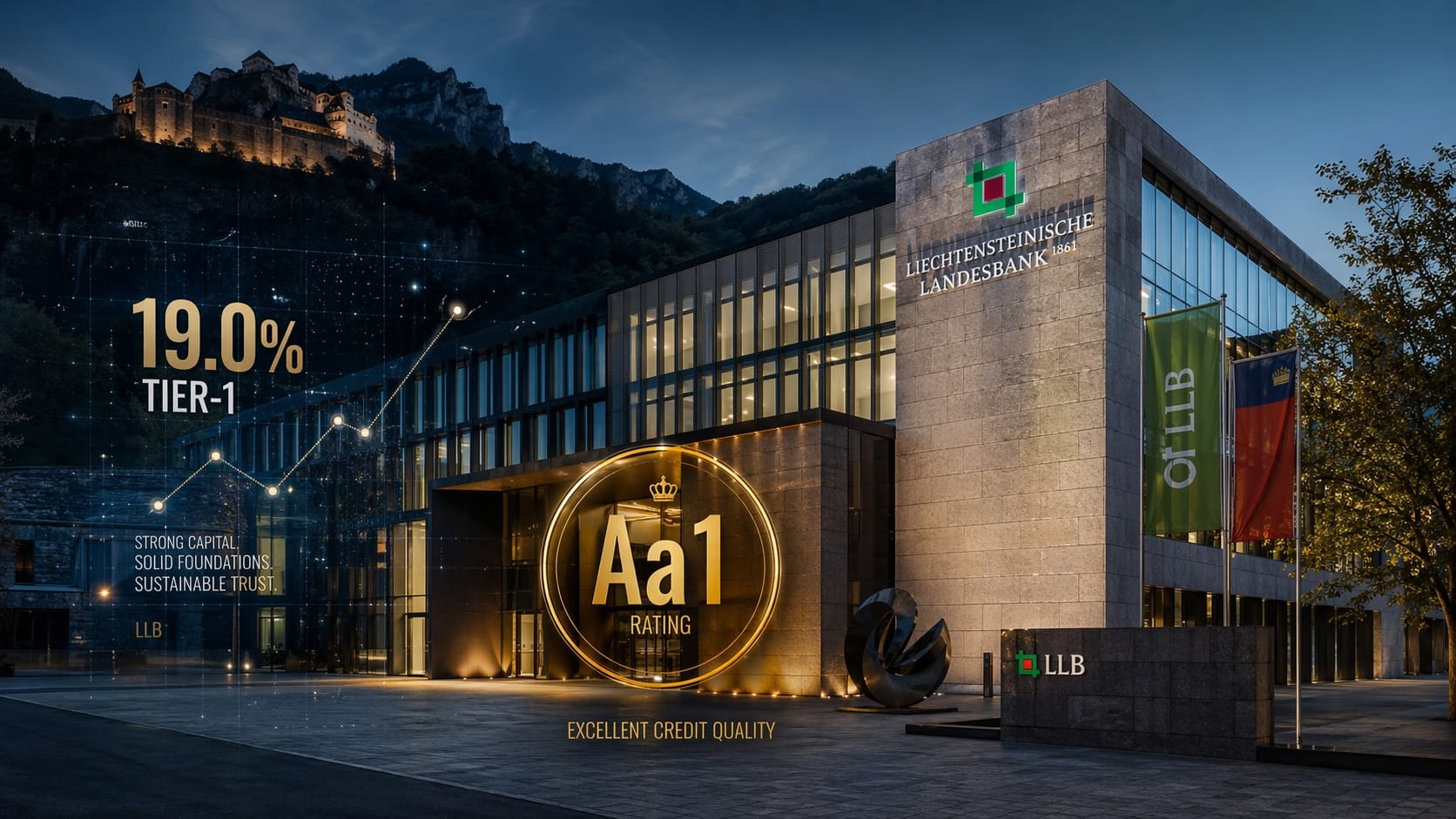
The Moody’s LLB Rating Upgrade to Aa1 marks a tectonic shift in European private banking, effectively crowning the Liechtensteinische Landesbank as the safest deposit harbor in the DACH region. Amidst a wave of EU regulatory reforms, LLB’s 19.0% Tier-1 ratio now provides a mathematical level of security that outclasses major peers in Zurich and Vaduz alike.
The Vaduz Fortress: Why One Notch Changes Everything
In the quiet, alpine corridors of Vaduz, news usually travels at the speed of a falling snowflake. However, the announcement this Wednesday, April 22, 2026, hit like an avalanche. Moody’s Ratings elevated the long-term deposit rating of the Liechtensteinische Landesbank (LLB) from Aa2 to Aa1. On the surface, it’s just one notch. In reality? It’s the difference between being a leader and being an outlier. This move isn’t just about LLB; it’s a statement on the entire 2026 financial ecosystem. We are entering an era where capital “safety” is the only currency that matters. And right now, LLB is minted in 24-karat gold.
The upgrade is a direct response to the EU’s “Crisis Management and Deposit Insurance” (CMDI) package. Let’s be honest: for years, large-cap depositors lived in a gray zone. If a bank failed, their capital was at the mercy of complex resolution laws. But the March 2026 reforms changed the game. By granting “Full Depositor Preference,” the EU essentially built a moat around the customer’s money. This policy shift is particularly striking when analyzed through a strategic comparison of Liechtenstein vs. Swiss banking, where regulatory agility has become a core differentiator for the Principality. Moody’s simply did the math. With deposits now sitting at the very top of the hierarchy, LLB’s risk of loss has effectively vanished.
Here is the thing. LLB is not just a bank; it’s a national project. With the Principality of Liechtenstein holding a 56.3% majority stake, the institution enjoys a “State-Backed” premium that private competitors simply cannot manufacture. While the 2026 rules favor “bail-in” over “bail-out,” the sheer optics of a debt-free, Aaa-rated sovereign backing the bank provides a psychological floor. In my experience, institutional treasurers don’t just look at balance sheets; they look at the phone number of the largest shareholder. Understanding these advanced bank bail-in protection strategies is now essential for HNWIs who realize that structural safety is the new primary yield. That is the Vaduz fortress in action.
The Safety Premium by the Numbers
Comparing the Titans: LLB vs. LGT, VP Bank, and Bendura
To truly grasp the significance of the Moody’s LLB Rating Upgrade, we have to look at the neighborhood. Liechtenstein is a hyper-concentrated hub of financial excellence. But even here, not all vaults are created equal. Take LGT Bank, for example. Owned by the Princely House, LGT is the world’s largest family-owned private banking group. It is an absolute powerhouse in asset management. However, LGT typically operates with a different risk appetite, focusing heavily on international wealth expansion. While their ratings are stellar, LLB’s new Aa1 deposit rating gives it a subtle edge for those seeking pure, unadulterated liquidity protection, a fact supported by the latest Liechtenstein banking sector 2025 performance analysis.
Then there is VP Bank. Listed on the SIX Swiss Exchange, VP Bank is the quintessential intermediary’s bank. They are agile and deeply rooted in the trust business. But size and ownership matter in the Moody’s playbook. VP Bank’s capital ratios, while healthy, generally hover a few percentage points below LLB’s 19.0% mark. In a crisis, the “Full Preference” rule helps everyone, but it benefits the bank with the largest internal buffer the most. Consequently, we are seeing a “Flight to Quality” within Vaduz itself. Investors aren’t leaving Liechtenstein; they are simply moving across the street to the bank with the state-majority backing.
The comparison becomes even more stark when looking at boutique players like Bendura Bank or Bank Frick. Bendura has carved out a massive niche in the Eastern European and Asian markets. Bank Frick, on the other hand, is the pioneer of blockchain banking. These are brilliant, specialized institutions. But their risk profiles are entirely different. For a corporate treasurer looking to park CHF 500 million, the innovative allure of a boutique bank cannot compete with the “Boring-is-Beautiful” security of LLB. This security is further bolstered by recent LLB Group financial milestones that have solidified its balance sheet well before the rating agencies caught up.
| Bank | Moody’s Deposit Rating | Tier-1 Ratio | Primary Focus |
|---|---|---|---|
| LLB (Liechtensteinische Landesbank) | Aa1 | 19.0% | Universal / State-Majority |
| LGT Bank | Aa2 | 17.4% | Private Banking / Family Owned |
| VP Bank | A1 | 15.8% | Intermediaries / Listed |
| Bank Frick | Specialized | 14.2% | Blockchain / Fintech |
| Bendura Bank | Boutique | 16.5% | HNW International |
The 19.0% Shield: Why Capital Is the New Gold
In my experience, the term “capital ratio” is often used to put people to sleep. But in 2026, it is the most exciting number in finance. LLB’s 19.0% Tier-1 ratio is a statement of defiance. While the European Central Bank and other regulators have pushed for higher buffers, many large European banks struggle to maintain even 15%. LLB is essentially sitting on a pile of high-quality cash that represents nearly a fifth of its entire risk-weighted asset base. This isn’t just about compliance; it’s about optionality. In a market crash, a 19% ratio means you aren’t selling assets to survive—you’re buying them to grow.
This capital strength allows LLB to navigate the “Full Depositor Preference” rule with ease. You see, the rule only works if there is something below the deposits to absorb the loss. With a massive Tier-1 buffer and a significant layer of subordinated debt, LLB has built a multi-layered shield. Bondholders know their place, and depositors know their priority. Furthermore, the bank’s business volume reached CHF 125.9 billion by the end of 2025. This volume provides the earnings power to keep that capital buffer topped up without squeezing the life out of their lending rates. It’s the definition of a well-oiled machine.
Furthermore, we must look at the quality of that capital. This isn’t “accounting magic.” It’s hard equity. As the 2026 CMDI package mandates stricter definitions of what counts as “loss-absorbing,” many banks are finding their ratios shrinking. LLB, conversely, has remained stable because their capital was high-quality from the start. Transitioning to these new rules was seamless for Vaduz. Meanwhile, in larger financial centers like Frankfurt or Milan, the struggle to meet these new “Resolution” standards is causing significant market friction. For the global elite, the choice is clear: do you want a bank that is struggling to be safe, or one that was born safe? As we move toward the top banking jurisdictions in 2025, it will be crucial for financial institutions to not only adapt to evolving regulations but also to demonstrate resilience in their operations. This shift will likely lead to a re-evaluation of banking practices, prioritizing transparency and quality over mere compliance. Institutions that fail to embrace these changes may find themselves at a significant disadvantage in the competitive landscape.
Institutional Flight: The Real-World Impact of Aa1
Let’s talk about the “Flight to Quality.” Since the news broke, institutional inflows into Liechtenstein have accelerated. Large corporations and pension funds have strict “Investment Policy Statements” (IPS). Many of these documents forbid holding cash in any institution rated below Aa2. By moving to Aa1, LLB has just unlocked a massive pool of global capital that was previously restricted. This is why the Moody’s LLB Rating Upgrade is a commercial masterstroke. It’s not just a trophy for the wall; it’s an invitation to the world’s largest wallets to move their liquidity to Vaduz.
Moreover, the upgrade has a halo effect on the bank’s subsidiary, Bank Linth in Switzerland. As part of the LLB Group, Bank Linth benefits from the parent company’s massive capital pool. For Swiss clients who are still reeling from the banking sector volatility of 2023, the stability of a Liechtenstein-owned partner is increasingly attractive. It offers the familiarity of the Swiss market with the upgraded “Aa1 Safety” of the Liechtenstein sovereign. Consequently, LLB is no longer just a “local” player; they are becoming the dominant defensive play in the entire Swiss-Franc zone. The “Vaduz-Zurich Axis” has never been more tilted in favor of Vaduz.
In addition, we are seeing a shift in the family office space. Multi-family offices, which previously split assets between five or six “Tier-1” banks, are now consolidating. Why deal with five different sets of reporting and five different risk profiles when one institution offers a higher rating than all of them combined? The simplicity of safety is a powerful draw. LLB’s CEO, Christoph Reich, noted that this upgrade “confirms our focus on financial stability.” That is an understatement. It has vindicated their entire business model. In 2026, being “boring and safe” is the ultimate competitive advantage, particularly when validated by the current ranking of the world’s safest financial jurisdictions in 2026.
Strategic Outlook: The Road to Aaa?
Is the journey over? Hardly. While Aa1 is an extraordinary achievement, the “Triple-A” tier remains the holy grail. For LLB to reach that level, they would likely need to maintain their current 19.0% ratio while further reducing their international credit exposure. Given that the bank is currently expanding its digital footprint in Germany and the UAE, a move to Aaa might be hindered by the inherent risks of geographic expansion. However, the current rating already provides 99% of the benefits of a Triple-A status. For all practical purposes, the market treats an Aa1-rated state-backed bank as “Risk-Free.”
Looking ahead to the Q3 2026 report, we expect to see a surge in “Net New Money.” The rating upgrade acts as a global advertisement. Furthermore, the bank is likely to use its high rating to issue new debt at incredibly favorable rates, further lowering its cost of capital. This will allow for more aggressive investment in their digital “ACT-26” platform. The goal is to provide a user experience that matches their credit rating. If they can marry “World-Class Safety” with “World-Class UX,” the competitive gap between LLB and its Liechtenstein peers will only widen. The Vaduz Fortress is being upgraded with high-tech sensors and digital gates.
In conclusion, the Moody’s LLB Rating Upgrade is more than a news item; it is a turning point. It marks the moment when the Liechtensteinische Landesbank proved that conservative management and state-backing are the ultimate winners in a volatile world. For the depositor, it offers an unprecedented level of peace of mind. For the competitor, it offers a daunting benchmark to chase. As we move into the second half of 2026, the message from Vaduz is loud and clear: if you value your capital, there is only one place it truly belongs. Welcome to the new era of safe-haven banking.
Executive Briefing: Frequently Asked Questions
Editorial Note: This feature is for informational purposes and reflects market data as of April 2026. Credit ratings are opinions of the agencies and not guarantees of solvency. Readers are encouraged to perform their own due diligence before committing large-scale capital.
Data Sources & Further Reading
Related reading:
- Beyond the Obvious: The Best Offshore Corporate Banking Jurisdictions in 2026
- Liechtenstein Private Banking for Non-Residents: The Overlooked Alternative to Switzerland (2026 Guide)
- More Than a Deposit: A Human Approach to Monaco’s Toughest Compliance Hurdles